
Ресурсы
Изучайте широкий спектр ценных ресурсов ВГГ, чтобы углубить своё понимание и повысить эффективность исследований, просветительской деятельности, преподавания и обучения.
Найдено: 3,530
 Prévenir l’antisémitisme par l’éducation: Lignes directrices à l’intention des décideurs politiques Год публикации: 2018 Организация-автор: OSCE. Office for Democratic Institutions and Human Rights (ODIHR) Cette nouvelle publication UNESCO/OSCE relève le défi de l’antisémitisme contemporain à un moment où la question devient de plus en plus cruciale dans le monde entier. Elle propose des moyens concrets pour combattre l’antisémitisme, lutter contre les préjugés et promouvoir la tolérance par l’éducation, sur la base de programmes fondés sur les droits humains, l’éducation à la citoyenneté mondiale, l’inclusion et l’égalité des sexes. Elle fournit également aux décideurs politiques des outils et des recommandations pour garantir que les systèmes éducatifs renforcent la résilience des jeunes aux idées et idéologies antisémites, à l’extrémisme violent et à toutes les formes d’intolérance et de discrimination, par l’acquisition d’une pensée critique et le respect des autres. Addressing Anti-semitism through Education: Guidelines for Policymakers Год публикации: 2018 Организация-автор: OSCE. Office for Democratic Institutions and Human Rights (ODIHR) A new UNESCO and OSCE co-publication takes up the challenge of educating learners to resist contemporary anti-Semitism at a time when the issue is becoming ever more crucial around the world. It suggests concrete ways to address anti-Semitism, counter prejudice and promote tolerance through education, by designing programmes based on a human rights framework, global citizenship education, inclusiveness and gender equality.It also provides policymakers with tools and guidance to ensure that education systems build the resilience of young people to anti-Semitic ideas and ideologies, violent extremism and all forms of intolerance and discrimination, through critical thinking and respect for others.
  The necessity of darkness. The pedagogic imperative to teach about the death camps How much knowledge about the Holocaust is too much for students? How early is too early to begin to teach about the event? How do we find the correct balance between teaching about the atrocities and teaching about Jewish agency? The Azrieli Graduate School of Jewish Education and Administration debate these and other pedagogical questions in these pages. (By the publisher)
  The duty to remember: Holocaust remembrance and education in contemporary France Though the decades following the liberation of France in 1944 were characterized by myths and repressions, since the 1970s historians, filmmakers, educators, the general public, and government officials have made considerable efforts to reconcile the dark aspects of France's history and to integrate them into French memory and national history. As Vichy's involvement in the perpetration of the Holocaust moved from the periphery into the mainstream of French consciousness, so did Holocaust remembrance and education. Though for several decades these initiatives appear to have provided a symbolic protection against anti-Semitic acts, the 21st century has been marked by a resurgence of anti-Semitic incidents in France. This paper explores the evolution of France's memory of Vichy's anti-Semitism, the measures taken to incorporate Holocaust remembrance and education into national memory and history, and the reasons why these measures no longer appear to have the same effect in contemporary France. (By the author) Complicating Issues in Holocaust Education Confronting the Holocaust in a classroom setting involves a complex undertaking that demands careful planning as educators develop and present curricula on the subject to their students. This article explores another problematic factor involved in teaching the Shoah, that is, several issues that exist outside the content/pedagogical framework but that nonetheless may exert a major influence on the teaching of the subject. These issues affect the environment that surrounds Holocaust education and, therefore, can have a considerable impact on the teaching of the subject. (By the author)
  Child Rights Education Toolkit: Rooting Child Rights in Early Childhood Education, Primary and Secondary Schools Год публикации: 2014 Организация-автор: United Nations Children's Fund (UNICEF) This toolkit, developed by UNICEF, defines what is meant by child rights education and the child rights approach. It explains the relevance of child rights education to UNICEF’s mission and the ways in which education can take place in a range of contexts--including with professionals, caregivers, the corporate sector, the media, and children’s groups. The audience of this toolkit is therefore intended to be UNICEF National Committees, UNICEF country offices, UN agencies working on child rights education (CRE), governments, and other civil society organisations, NGOs, and academic institutions.Although this Toolkit focuses on child rights education in the formal learning environment (early childhood education settings, primary and secondary schools), it is hoped that it will also be useful for those working to promote child rights education through other channels, such as in the media, with children’s organizations and through children’s involvement in advocacy.For more information check the UNICEF webpage.
  Strategies in Facing Antisemitism : An educational resource guide This resource guide from Yad Vashem and the Simon Wisenthal Center is divided into two parts. First, it assesses antisemitism today. Then it proposes a few articles on ways to sensitize the public to antisemitism : how to broach the topic in the classroom, how to deal with antisemitism on internet... Stratégies pour faire face à l'Antisémitisme: Un guide de ressources éducatives Ce guide de ressources de Yad Vashem et le Centre Simon Wiesenthal est divisé en deux parties. Premièrement, il évalue l'antisémitisme aujourd'hui. Ensuite, il propose quelques articles sur les moyens de sensibiliser le public à l'antisémitisme: comment aborder le sujet en classe, comment faire face à l'antisémitisme sur internet ... Mémoire et Histoire de la Shoah à l'école Cette publication est organisé selon trois thèmes: «L'histoire de l'Holocauste», la «citoyenneté» et «arts et de la transmission". Il est un guide précieux pour les enseignants de l'enseignement primaire, où ils peuvent trouver des suggestions et des matériaux atelier pour une première approche du sujet de l'Holocauste.
 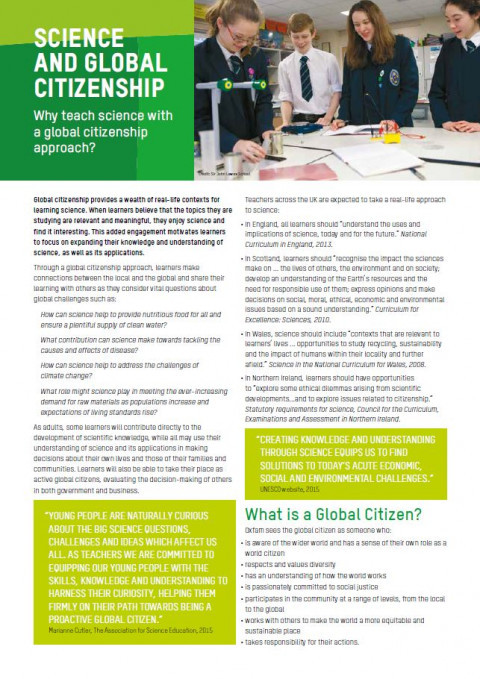 Science and Global Citizenship Организация-автор: Oxfam GB Nurturing global scientists is key to the creation of a clean and fairer world for the future. A global citizenship approach enables learners to appreciate the relevance of science and investigate how it can be used to answer vital questions to global challenges.This guide includes practical advice for embedding global citizenship in topic areas like health and disease, water and climate change. It also has handy links to teaching resources which can be used in your lessons.