
Ресурсы
Изучайте широкий спектр ценных ресурсов ВГГ, чтобы углубить своё понимание и повысить эффективность исследований, просветительской деятельности, преподавания и обучения.
Найдено: 3,500
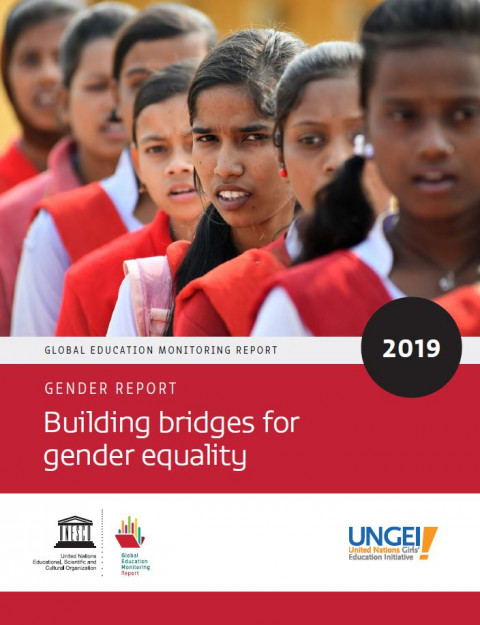 التقرير العالمي لرصد التعليم 2019: التقرير عن المسائل الجنسانية; بناء الجسور لتحقيقالمساواة بين الجنسين Год публикации: 2019 Организация-автор: Global Education Monitoring Report Team يمثل تحقيق المساواة بين الجنسين من حيث الالتحاق بالمدرسة والمشاركة في عمليات التعليم والتعلم والاستفادة من الفرص الاقتصادية والاجتماعية التي يمكن أن يتيحها التعليم طموحات أساسية مترابطة لهدفين من أهداف التنمية المستدامة المحددة في خطة التنمية المستدامة لعام 2030 ، هما: هدف التنمية المستدامة 4 الخاص بالتعليم وهدف التنمية المستدامة 5 الخاص بالمساواة بين الجنسين. وهذان الهدفان ضروريان أيضاً لتحقيق برنامج "التعليم حتى عام 2030 إطار العمل لتحقيق الهدف الرابع من أهداف التنمية المستدامة" الذي يدعو البلدان إلى اعتماد استراتيجيات لا تتطرق فقط إلى انتفاع الجميع بالتعليم بل تتناول أيضاً قضايا جوهرية تتعلق بالمساواة بين الجنسين منها: "دعم السياسات والخطط وبيئات التعلّم المراعية لقضايا الجنسين، وبتعميم مراعاة قضايا الجنسين في إعداد المعلمين وفي المناهج الدراسية، وبالقضاء على التمييز والعنف القائمين على نوع الجنس في المدارس".ويستند التقرير عن المسائل الجنسانية لعام 2019 إلى إطار رصد اعتُمد أول مرة في التقرير العالمي لرصد التعليم لعام 2016 . وهذا الإطار، فضلاً عن تركيزه على التكافؤ بين الجنسين في المشاركة في التعليم والتحصيل الدراسي والنتائج الدراسية، يدرس الظروف الاقتصادية والاجتماعية العامة )المعايير الجنسانية والمؤسسات( وسمات نظام التعليم الرئيسية )القوانين والسياسات وممارسات التعليم والتعلم وبيئات التعلم والموارد(. ويبحث الإطار أيضاً العلاقة القائمة بين التعليم ومجموعة مختارة من النتائج الاقتصادية والاجتماعية. فالتحرك باتجاه تحقيق التكافؤ بين الجنسين على مستوى التحصيل الدراسي، على سبيل المثال، يؤدي إلى ارتفاع معدلات مشاركة المرأة في القوة العاملة، غير أن مشاركتها هذه، إذا كانت منخفضة المستوى، تعزز المعايير السائدة وتحول دون زيادة فرص التعليم التي يمكن أن تتاح لها.
 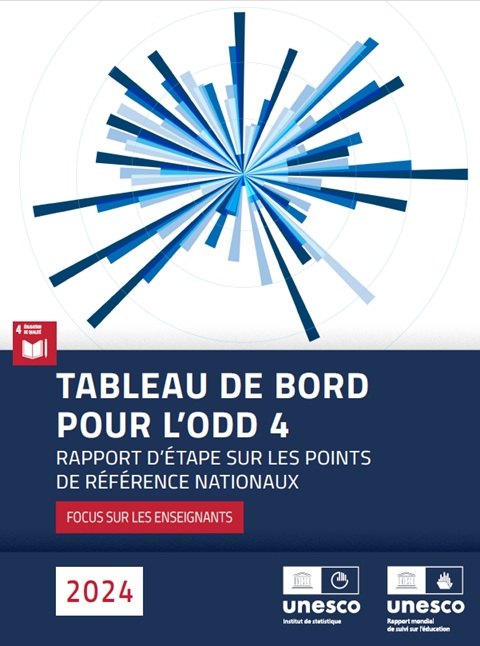 Tableau de bord pour l’ODD 4, rapport d’étape sur les points de référence nationaux: focus sur les enseignants Год публикации: 2024 Организация-автор: Global Education Monitoring Report Team | UNESCO Institute for Statistics (UIS) Il s'agit de la deuxième évaluation des progrès des pays vers les points de référence, ou objectifs nationaux, que les pays ont fixés pour huit indicateurs de l'ODD 4 afin de marquer leur contribution aux objectifs mondiaux. L’évaluation couvre la période depuis 2015 et examine la probabilité que chaque pays atteigne son point de référence pour 2025 ou – lorsqu’un tel objectif n’a pas été fixé – la valeur qu’il aurait atteinte s’il avait progressé au rythme historique (2000–15) des 25 % des pays qui s’améliorent le plus rapidement.Le tableau de bord de l’ODD 4 2024 révèle que les progrès vers les objectifs nationaux sont en retard pour la plupart des indicateurs. Dans deux cas – l’écart entre les genres au détriment des garçons dans l’achèvement du deuxième cycle du secondaire et les dépenses publiques d’éducation en proportion des dépenses publiques totales – les pays reculent même.En revanche, les progrès sont plus rapides pour le huitième indicateur de référence, la connectivité Internet dans les écoles, qui a été ajouté suite à la priorité accordée à la transformation numérique lors du Sommet sur la transformation de l’éducation en 2022. Un tiers des pays ont fixé des objectifs nationaux en 2023 et les progrès sur l’indicateur sont examinés pour la première fois dans cette édition.Les progrès sont également relativement rapides en ce qui concerne le pourcentage d'enseignants possédant les qualifications minimales requises, qui est également l'indicateur central de cette édition. De nouvelles données sont présentées sur les politiques nationales concernant les niveaux de qualification minimaux requis pour accéder à la profession enseignante, les politiques de développement professionnel continu obligatoire et les politiques de formation des enseignants sur la tec
 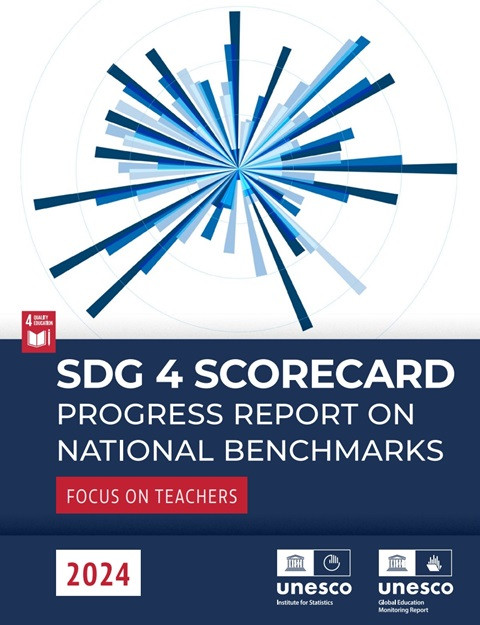 SDG 4 Scorecard: Progress Report on National Benchmarks; Focus on Teachers Год публикации: 2024 Организация-автор: Global Education Monitoring Report Team | UNESCO Institute for Statistics (UIS) This is the second assessment of country progress towards the benchmarks, or national targets, that countries have set for eight SDG 4 indicators to mark their contribution to the global targets. The assessment covers the period since 2015 and reviews the probability that each country will achieve its 2025 benchmark or – where such a benchmark was not set – the value they would have achieved if they had progressed at the historic (2000–15) rate of the fastest improving 25% of countries.The 2024 SDG 4 Scorecard finds that progress towards national targets is off track for most indicators. In two cases – the gender gap at the expense of boys in upper secondary education completion and public education expenditure as share of total public expenditure – countries are even moving backwards.In contrast, progress is faster in the eighth benchmark indicator, school internet connectivity, which was added following the priority given to digital transformation at the Transforming Education Summit in 2022. One third of countries set national targets in 2023 and progress on the indicator is being reviewed for the first time in this edition.Progress is also relatively fast in the percentage of teachers with minimum required qualifications, which is also the focus indicator of this edition. New evidence is presented on national policies for minimum required qualification levels to enter the teaching profession, compulsory continuous professional development policies, and teacher training policies on technology in education.
 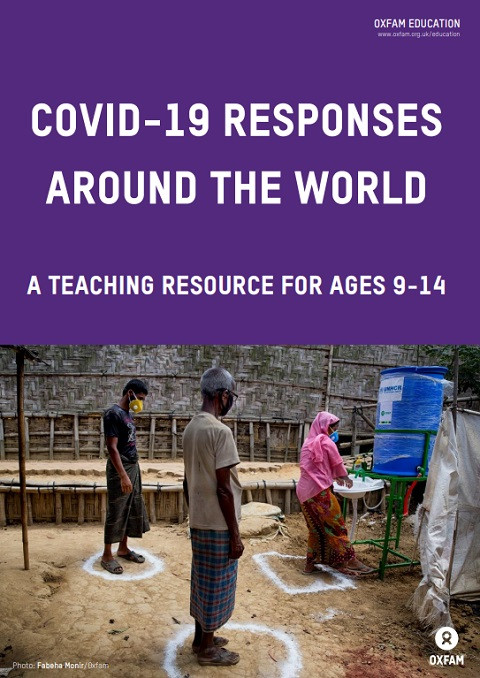 COVID-19 Responses Around the World: A Teaching Resource for Ages 9-14 Год публикации: 2021 Организация-автор: Oxfam GB This resource helps learners to discuss their thoughts and feelings about the pandemic with others. Learners will also find out about ways to stop the current ‘infodemic’ – the rapid spread of misinformation and disinformation about COVID-19.This material will help learners to:discuss their thoughts and feelings about COVID-19.investigate some of the incredible ways in which people have been responding to this crisis.understand the difference between information, disinformation and misinformation.consider their own responses to the pandemic and possible actions that they might take to manage their own wellbeing and support others.
 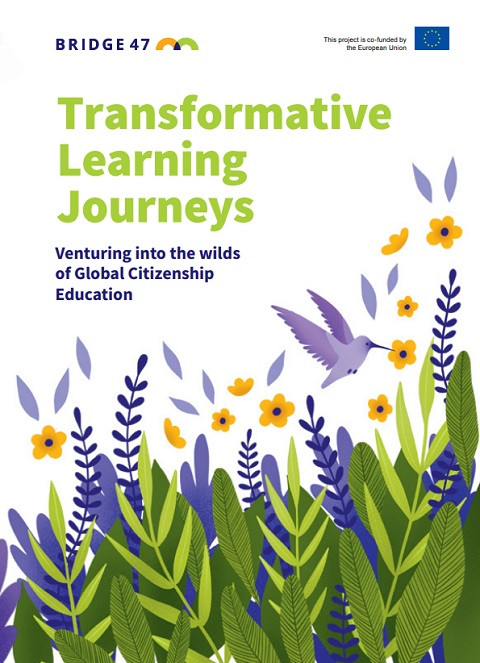 Transformative Learning Journeys: Venturing Into the Wilds of Global Citizenship Education Год публикации: 2021 Организация-автор: Bridge 47 With the intensive courses of the Transformative Learning Journey, Bridge 47 created experimental learning spaces for communities of practitioners, researchers and activists of transformative education from around the world.The courses endeavored to challenge common concepts of Global Citizenship Education, to explore questions like those below and to experiment with different, holistic and potentially more transformative, practices of learning and co-creating.What are the (cultural) root causes of the global multi-crisis?How to decolonize and transform a modern system that is broken beyond fixing?What do we have to learn, unlearn or let go of- individually and collectively - in order to allow, embrace and foster real change? What characterizes transformative learning, and how can education create holistic spaces to trigger, support and accompany such learning processes? How transformative is our own organizational and educational practice?Do we have to re-imagine education and activism and become more radical? Are we asking the right questions?Based on the positive resonance, Bridge 47 wants to share some of the learnings through this publication. The book gives insights into the design, content and methodology of the course. Featuring diverse contributions from participants, it is a mosaic of perspectives and experiences of transformation, decolonization and learning. It also comprises some tools and invitations for reflection. It is not a cohesive prescription of how to facilitate transformative learning – as there is none - but an invitation to relate to and play."This book is dedicated to all the curious people out there who are passionate about education in caring for our world and each other - the dreamers, the healers, the lovers, the teachers for a different future to emerge. It goes to the fighters who are desperate and overwhelmed in face of complex challenges and are worn out by their struggle for justice and change – to find inspiration, energy and courage to treat ourselves gently, to let go and to make space for new things to emerge."
 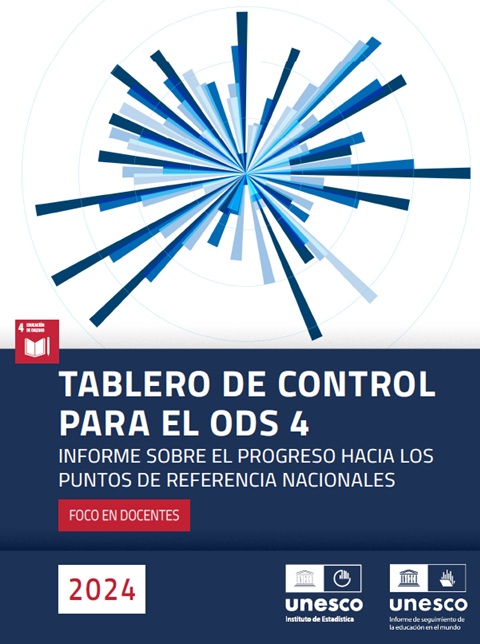 Tablero de control para el ODS 4: informe sobre el progreso hacia los puntos de referencia nacionales; foco en docentes Год публикации: 2024 Организация-автор: Global Education Monitoring Report Team | UNESCO Institute for Statistics (UIS) Esta es la segunda evaluación del progreso de los países hacia los puntos de referencia, o metas nacionales, que los países han establecido para ocho indicadores del ODS 4 para marcar su contribución a las metas globales. La evaluación cubre el período desde 2015 y revisa la probabilidad de que cada país alcance su punto de referencia para 2025 o, cuando no se haya establecido dicho punto de referencia, el valor que habría alcanzado si hubiera progresado al ritmo histórico (2000–15) del 25 % de los países que mejoran más rápidamente.El Tablero de Control para el ODS 4 de 2024 revela que el progreso hacia las metas nacionales está desviado en la mayoría de los indicadores. En dos casos – la brecha de género a expensas de los niños que terminan la educación secundaria alta y el gasto público en educación como proporción del gasto público total – los países incluso están retrocediendo.Por el contrario, el progreso es más rápido en el octavo indicador de referencia, la conectividad a Internet en las escuelas, que se añadió tras la prioridad otorgada a la transformación digital en la Cumbre sobre la Transformación de la Educación en 2022. Un tercio de los países estableció objetivos nacionales en 2023 y el progreso en el indicador está siendo revisado por primera vez en esta edición.El progreso también es relativamente rápido en el porcentaje de docentes con las calificaciones mínimas requeridas, que también es el indicador central de esta edición. Se presenta nueva evidencia sobre políticas nacionales en cuanto a los niveles mínimos de calificación requeridos para ingresar a la profesión docente, políticas de desarrollo profesional continuo obligatorio y políticas de formación docente sobre tecnología en educación.
 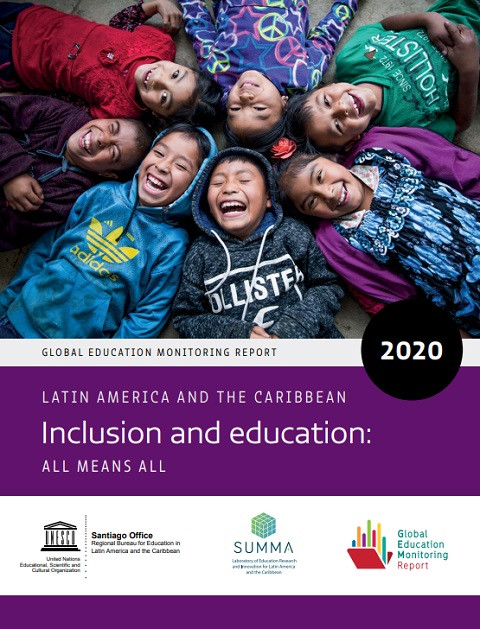 Latin America and the Caribbean 2020: Inclusion and Education; All Means All (Global Education Monitoring Report) Год публикации: 2020 Организация-автор: Global Education Monitoring Report Team | UNESCO | Laboratory of Education Research and Innovation for Latin America and the Caribbean (SUMMA) Latin America and the Caribbean has the largest and most challenging socio-economic inequalities in the world, which have shaped its education systems over the decades. This report looks at everyone both in and excluded from education in the region, pinpointing barriers facing learners, especially when multiple disadvantages intersect. The report also explores challenges in education posed by COVID-19 and the need for urgent action to prevent an exacerbation of inequalities. Produced by the Global Education Monitoring (GEM) Report team, in partnership with the UNESCO Regional Bureau for Education in Latin America and the Caribbean (OREALC) and the Laboratory of Education Research and Innovation for Latin America and the Caribbean (SUMMA), the report assesses key solutions for greater inclusion through several case studies from the region. It provides in-depth analysis on challenges to inclusion in education arising from migration and displacement in Colombia and Costa Rica; remoteness in Brazil and Suriname; disability in Cuba and Nicaragua; gender in Peru and Jamaica; sexual orientation, gender identity and expression in Chile and Mexico; poverty in the Dominican Republic and Honduras; ethnicity in Bolivia and Ecuador; and incarceration in El Salvador and Uruguay. Building on the 2020 Global Education Monitoring Report, this regional edition concludes that strong laws and policies in Latin America and the Caribbean demonstrate a commitment to inclusion, but that the daily realities faced by learners suggest implementation is lagging. Recommendations are aimed at promoting more inclusive education systems to benefit all children and youth, no matter their background, identity or ability. The recommendations provide a systematic framework for identifying and dismantling barriers for vulnerable populations, according to the principle that ‘every learner matters and matters equally’. América Latina y el Caribe 2020: Inclusión y educación; Todos y todas sin excepción (Informe de seguimiento de la educación en el mundo) Год публикации: 2020 Организация-автор: Global Education Monitoring Report Team | UNESCO | Laboratory of Education Research and Innovation for Latin America and the Caribbean (SUMMA) América Latina y el Caribe es la región con las mayores y más tenaces desigualdades socioeconómicas del mundo. Durante decenios estas desigualdades se han reflejado en sus sistemas educativos. El presente informe examina a quiénes incluyen y a quiénes excluyen estos sistemas y llama la atención sobre las barreras que enfrentan los educandos, especialmente cuando están expuestos a múltiples desventajas. El informe también explora los nuevos retos educativos que plantea la pandemia de la Covid-19 y la necesidad de actuar sin dilación para evitar que se agraven las desigualdades. El informe, elaborado por el equipo del Informe de Seguimiento de la Educación en el Mundo (Informe GEM), en colaboración con la Oficina Regional de Educación para América Latina y el Caribe (OREALC/ UNESCO Santiago) y el Laboratorio de Investigación e Innovación en Educación para América Latina y el Caribe -SUMMA, evalúa algunas de las principales iniciativas emprendidas para mejorar la inclusión, basándose en varios estudios de casos de la región. Analiza en profundidad algunos ejemplos de los grandes desafíos que amenazan la inclusión en la educación: migración y desplazamiento en Colombia y Costa Rica; aislamiento rural en el Brasil y Suriname; discapacidad en Cuba y Nicaragua; discriminación de género en el Perú y Jamaica; orientación sexual e identidad y expresión de género en Chile y México; pobreza en la República Dominicana y Honduras; etnicidad en Bolivia y el Ecuador; y jóvenes en situación de privación de libertad en El Salvador y el Uruguay. Esta edición regional del Informe de Seguimiento de la Educación en el Mundo 2020 concluye que, si bien las leyes y políticas de América Latina y el Caribe demuestran la firme determinación de promover la inclusión, la realidad cotidiana de los alumnos y las alumnas sugiere que la aplicación práctica lleva retraso. Se formulan recomendaciones con el objeto de promover sistemas de educación más inclusivos en beneficio de todos los niños, niñas y jóvenes, sin distinción de origen, identidad o capacidad. Las recomendaciones brindan un marco sistemático que permite identificar y eliminar barreras para las poblaciones marginadas, conforme al principio de que “cada alumno es importante y todos los alumnos importan por igual”.
 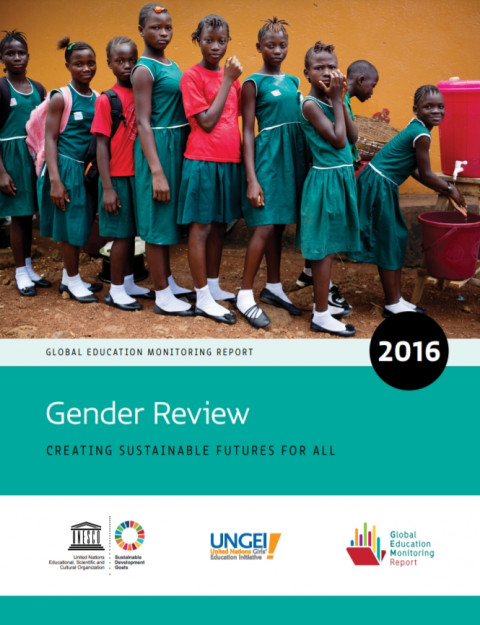 Creating sustainable futures for all; Global education monitoring report, 2016; gender review Год публикации: 2016 Автор: Sachs, Jeffrey D Организация-автор: Global Education Monitoring Report Team Education and gender equality are central concerns in the new sustainable development agenda. The Education 2030 Framework for Action, agreed by the global education community in November 2015 to accompany the SDG agenda, recognizes that gender equality is inextricably linked to the right to education for all, and that achieving gender equality requires an approach that ‘ensures that girls and boys, women and men not only gain access to and complete education cycles, but are empowered equally in and through education’ (UNESCO, 2016a, p. 8). Women, girls, boys and men all need to be given opportunities for active participation in society, for their voices to be heard and their needs met (UN Women, 2016a). To facilitate and achieve this, better evidence-based knowledge and understanding of gender issues in and through education are needed. The Gender Review of the 2016 Global Education Monitoring Report (GEM Report) recognizes and largely focuses on the challenges facing girls and women because of the disproportionate overall disadvantage they continue to experience in and beyond education. But it also understands that gender disadvantage can be experienced by boys and men, and that gender equality involves males, relationships and power. Gender inequality affects us all. Achieving gender equality must involve us all. Résumé sur l'égalité des genres: créer des avenirs durables pour tous; Rapport mondial de suivi sur l'éducation, 2016 Год публикации: 2016 Автор: Sachs, Jeffrey D Организация-автор: Global Education Monitoring Report Team L’éducation et l’égalité des genres sont des préoccupations essentielles dans le nouveau programme de développement durable. Le Cadre d’action Éducation 2030, approuvé par la communauté mondiale de l’éducation en novembre 2015 en complément du Programme 2030, reconnaît que l’égalité des genres est indissociable du droit à l’éducation pour tous, et que, pour qu’elle devienne une réalité, il faut adopter une démarche « qui garantisse que les filles et les garçons, les femmes et les hommes non seulement ont le même accès aux différents cycles d’enseignement, jusqu’à leur terme, mais aussi qu’ils ont les mêmes possibilités de s’épanouir dans l’éducation et grâce à l’éducation » (UNESCO, 2016a, p. 8). Femmes, filles, hommes et garçons ont tous besoin que des possibilités leur soient données de participer activement à la vie sociale et de faire entendre leur voix et qu’il soit répondu à leurs besoins (ONU Femmes, 2016a). Faciliter et permettre la réalisation de cet objectif exige une connaissance et une compréhension mieux étayées par des données factuelles de la manière dont l’égalité des genres peut être assurée dans l’éducation et par l’éducation. Le Résumé sur l’égalité des genres de l’édition 2016 du Rapport mondial de suivi sur l’éducation (Rapport GEM) reconnaît les difficultés rencontrées par les filles et les femmes du fait du désavantage global disproportionné auquel elles continuent de se heurter dans leurs études et au-delà, et est grande partie centré sur ces difficultés. Mais il admet aussi que les garçons et les hommes peuvent eux aussi être désavantagés du fait de leur sexe et que l’égalité des genres les concerne et est affaire de relations et d’exercice du pouvoir. L’inégalité entre les genres nous touche tous. Instaurer l’égalité entre les genres est notre responsabilité à tous.