
Ресурсы
Изучайте широкий спектр ценных ресурсов ВГГ, чтобы углубить своё понимание и повысить эффективность исследований, просветительской деятельности, преподавания и обучения.
Найдено: 3,500
 2020 세계시민윤리 콘텐츠: 세계시민으로 성장하는 학습 꾸러미 Год публикации: 2021 Автор: 배성호 | 임재민 | 최유정 | 정미선 | 승현아 | 홍윤빈 | 강방식 | 윤상철 | 박범철 Организация-автор: 서울특별시교육청 세계시민으로 성장하는 학습 꾸러미(2020 세계시민윤리 콘텐츠)는 초등학교, 중학교, 고등학교의 학교급 대상으로 각각 구성되어 있으며 각각 나에서 우리, 그리고 사회 및 세계로 학생들이 바라보는 영역을 확장할 수 있도록 하였으며 학생 중심의 수업에서 교사와 학생 모두가 관심을 가질 만한 내용으로 구성되었다. 학습 주제와 관련된 교과목에서 직접 수업을 운영할 수도 있지만 창체나 자유학년제 프로그램 혹은 학년말의 전환기 프로그램에서도 사용할 수 있고 관련 동아리 수업에서도 활용이 가능하도록 하였다.
 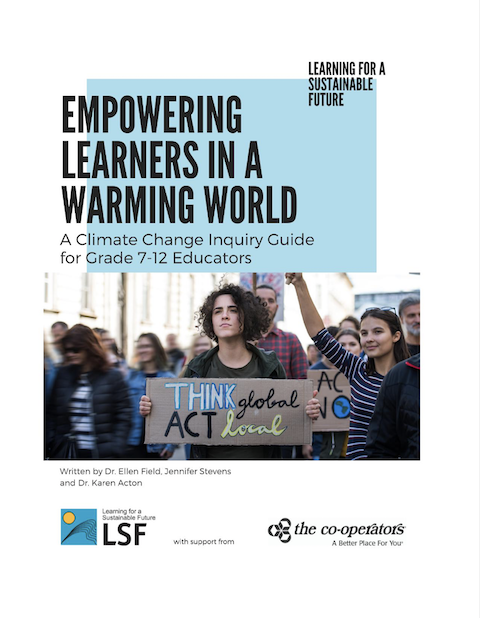 Équiper nos apprenants à un monde en réchauffement : Guide d’apprentissage par l’enquête sur le changement climatique pour les éducateurs du secondaire Год публикации: 2020 Автор: Ellen Field | Jennifer Stevens | Karen Acton Организация-автор: Learning for a Sustainable Future (LSF) Ce guide suit les principes directeurs de apprentissage par l’enquête. Il a pour but de proposer des occasions de favoriser l’évolution de la compréhension des élèves à l’égard du climat et du changement climatique, d’évaluer les risques et les occasions d’y remédier, de s’adapter au climat changeant, d’analyser les dimensions éthiques et de respecter les émotions qui découlent nécessairement du processus lié à la compréhension de la complexité et de l’urgence du problèmeLes stratégies d’enseignement transformatrices, telles que d’apprentissage par l’enquête , sont mieux adaptées à l’enseignement de problèmes complexes, comme le changement climatique. Ces stratégies utilisent souvent, comme point de départ, les connaissances et les expériences que les élèves détiennent déjà. Les éducateurs, qui eux-mêmes sont aux prises avec les enjeux liés au changement climatique, jouent le rôle de facilitateur pour guider les apprenants et aider la classe à collaborer pour apprendre, penser de façon critique et passer à l’actionEnfin et surtout, ce guide vise à mobiliser les élèves pour qu’ils contribuent aux solutions à école, dans la communauté et à la maison. Ce guide propose aux éducateurs des stratégies didactiques permettant aux élèves d’exprimer leurs perspectives et leur voix, des recherches et données scientifiques courantes sur le changement climatique, des ressources et activités, ainsi que des solutions pour agir.
  Policy Brief: Talking Across Generations on Education; #TAGe Bujumbura: Youth, Social and Emotional Education and the Prevention of Violent Extremism Год публикации: 2020 Организация-автор: Mahatma Gandhi Institute of Education for Peace and Sustainable Development (MGIEP) With the aim to mainstream the voices of Burundi youth and include them in the policymaking process in the areas of education for peace, sustainable development and global citizenship, UNESCO MGIEP, YELI-Burundi (Youth Empowerment and Leadership Initiative Burundi) and the Government of Burundi organised a series of high-level #TAGeBujumbura dialogues. These were an integral part of the Annual Prevention of Violent Extremism (PVE) Youth Blast, which was organised by YELI-Burundi on September 16-17, 2019 in Bujumbura, Burundi. H.E Everlyne Butoyi, Minister of Youth, IT and Posts, inaugurated the event. The theme of the main TAGe plenary was The Place of the Youth and Social and Emotional Learning for the Prevention of Violent Extremism – within the broader context of United Nations Security Council Resolution 2250.This unique UNESCO MGIEP TAGe modality for actionable dialogue comprised the following components – month-long online discussions, live TAGe and actionable outputs. The preceding online discussion had over 1,000 participants, and witnessed rich discussion threads being compressed into insightful, actionable ideas. Subsequently, based on the online engagement and the on-ground work done, six representatives were chosen from these participants to represent the collective voices of the youth. They were joined by three distinguished senior decision-makers (from the Government of Burundi and civil society) in a live TAGe exchange, where they delved into issues and unearthed creative solutions in front of an audience of over 200.
 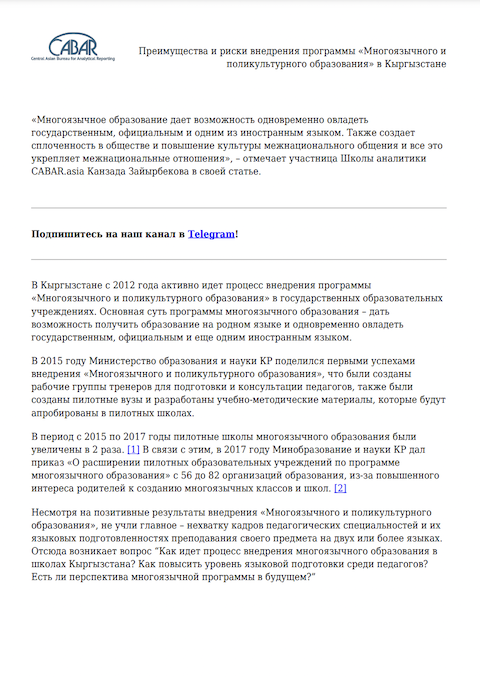 Advantages and Risks of Introducing the “Multilingual and Multicultural Education” Program in Kyrgyzstan Год публикации: 2019 Автор: Kanzada Zayirbekova Организация-автор: Central Asian Bureau for Analytical Reporting (CABAR) | Institute for War and Peace Reporting (IWPR) «Multilingual education makes it possible to simultaneously master the state and official languages, along with one of the foreign ones. It also creates social cohesion, enhances the culture of interethnic communication, and all this in total strengthens interethnic relations,» notes Kanzada Zayirbekova, a participant of the CABAR.asia School of Analytics, in her article. Преимущества и риски внедрения программы «Многоязычного и поликультурного образования» в Кыргызстане Год публикации: 2019 Автор: Kanzada Zayirbekova Организация-автор: Central Asian Bureau for Analytical Reporting (CABAR) | Institute for War and Peace Reporting (IWPR) «Многоязычное образование дает возможность одновременно овладеть государственным, официальным и одним из иностранным языком. Также создает сплоченность в обществе и повышение культуры межнационального общения и все это укрепляет межнациональные отношения», – отмечает участница Школы аналитики CABAR.asia Канзада Зайырбекова в своей статье.
  Éducation aux médias et à l’information (Édition 2021-2022) Год публикации: 2021 Организация-автор: Centre pour l’éducation aux médias et à l’information (CLEMI) | Réseau Canopé Cette édition 2021-2022 s'est enrichie de nouvelles fiches pédagogiques, pour le 1er comme pour le 2nd degré. Vous y trouverez notamment :Les informations pratiques (socle commun, textes réglementaires...) et les dispositifs du CLEMI (Semaine de la presse et des médias dans l'école, Concours Médiatiks, #ZéroCliché, Classe investigation...), afin de présenter les enjeux de l'Éducation aux médias et à l'information et les moyens proposés par le CLEMI pour la mettre en œuvre.Le focus Déclic' Critique, qui présente des exemples d'ateliers proposés en classe par le CLEMI et explique comment utiliser ces séquences pour développer l'esprit critique des élèves.Une partie est consacrée aux médias scolaires, à la fois pour encourager cette pratique mais aussi mieux la valoriser.Dans la partie 1er degré, vous trouverez deux nouvelles fiches pédagogiques organisées en séquence sur le dessin de presse et la liberté d'expression. Et toujours les ressources nécessaires pour découvrir la presse, vérifier les images sur internet ou encore analyser un journal télévisé.La partie 2nd degré va s'intéresser elle aussi à la liberté d'expression et son expérimentation en classe, ainsi qu'à la question du complotisme, mais aussi à l'évaluation des discours scientifiques sur YouTube, aux biais cognitifs, ou encore la représentation des datas en photo et vidéo.
 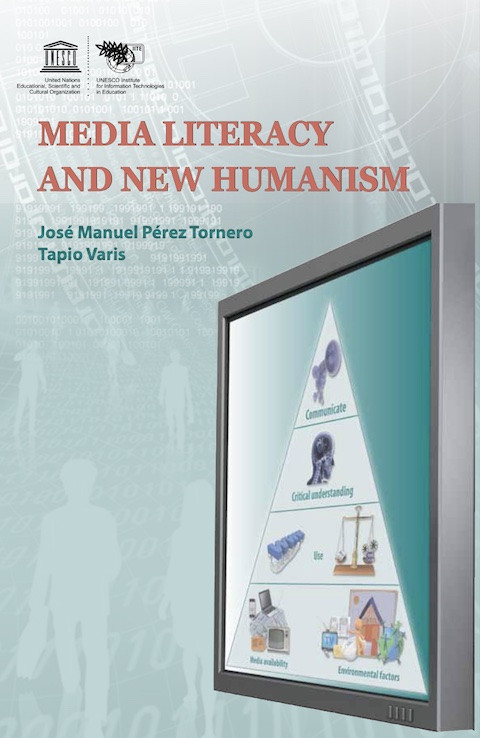 Media Literacy and New Humanism Год публикации: 2010 Автор: José Manuel Pérez Tornero | Tapio Varis Организация-автор: UNESCO Institute for Information Technologies in Education (IITE) The authors consider the opportunities that media literacy opens in the world of global education and communication in the context of new humanism.Being applied to education, the concept of new humanism, a new UNESCO credo, suggests the creation of a more inclusive society in which all humans have a chance to access knowledge and quality education and every word being heard in the universal dialogue. In the authors’ opinion, the new humanism in the global society must prioritize a new sense of respect for multiplicity and cultural diversity and must support media development with the goal of consolidating the new culture of peace.The book is aimed at educators, researchers, policy-makers, the media and civil society.
  AI in Education: Change at the Speed of Learning Год публикации: 2020 Автор: Steven Duggan Организация-автор: UNESCO Institute for Information Technologies in Education (IITE) The policy brief “AI in Education: Change at the Speed of Learning” published by the UNESCO Institute for Information Technologies in Education (UNESCO IITE) opens a new series of publications “Digital Transformation of Education”. The new publication describes the advancements in technology, including data, analytics and personalized learning, Artificial Intelligence (AI), cloud computing and machine learning, and explores the promises of AI for students, teachers, school leaders, parents and education administrators. The publication also highlights the ethical aspects of AI implementation and challenges that it might bring. Искусственный интеллект в образовании: Изменение темпов обучения Год публикации: 2020 Автор: Steven Duggan Организация-автор: UNESCO Institute for Information Technologies in Education (IITE) Аналитическая записка «Искусственный интеллект в образовании: Изменение темпов обучения», опубликованная Институтом ЮНЕСКО по информационным технологиям в образовании (ИИТО ЮНЕСКО), открывает издание новой серии публикаций «Цифровая трансформация образования». В новой публикации представлены достижения в области технологий, включая данные, аналитику и персонализированное обучение, искусственный интеллект (ИИ), облачные вычисления и машинное обучение, а также рассматриваются многообещающие возможности ИИ для учащихся, педагогов, родителей, руководителей учебных заведений и администраторов системы образования. В публикации также обозначены этические аспекты и вызовы, связанные с применением ИИ. Empowering Learners in a Warming World: A Climate Change Inquiry Guide for Secondary Educators Год публикации: 2020 Автор: Ellen Field | Jennifer Stevens | Karen Acton Организация-автор: Learning for a Sustainable Future (LSF) The purpose of this guide is to present opportunities to evolve students’ understanding of the climate and climate change, assess the risks and opportunities to mitigate and adapt to the changing climate, unpack ethical dimensions, and honour emotions that are part of the process of coming to understand the complexity and urgency of the issue.Transformative teaching strategies used throughout this guide are important to tackling complex problems like climate change. These strategies often begin with the understanding and experiences that students bring with them. Educators, who themselves are grappling with climate change issues, take the role of facilitators and co-learners as the class works together to learn, critically reflect, and take action.Most importantly, this guide aims to engage students in contributing to solutions in their schools, communities and homes. It aims to connect educators to instructional strategies that allow for students’ perspectives and voice, currently available climate change science and research, teacher resources and activities, datasets, and action solutions.