
Ресурсы
Изучайте широкий спектр ценных ресурсов ВГГ, чтобы углубить своё понимание и повысить эффективность исследований, просветительской деятельности, преподавания и обучения.
Найдено: 2,768
 2019 유네스코 ESD 정책 포럼: 2030년을 위한 지속가능발전교육(ESD), 한국은 어떻게 준비할 것인가 Год публикации: 2019 Организация-автор: 대한민국 교육부 | 유네스코한국위원회 2019년 11월에 유네스코한국위원회(ESD한국위원회)에서 주최한 '2019 유네스코 지속가능발전교육 정책 포럼'의 자료집으로 행사개요와 토론자료, 지속가능발전교육에 대한 부록을 수록하고 있다.2030년을 위한 지속가능발전교육(ESD), 한국은 어떻게 준비할 것인가를 주제로 ESD for 2030 체계 수립 및 이행 준비에 대한 국제사회 최신 동향 공유, 국가 이니셔티브 구축 관련 한국 차원의 정책적 준비 및 운영 체계 수립 방안 논의, GAP 참여기관 등 국내 ESD 이행 핵심 주체별 활동 내용 공유 및 제언 등이 주요 내용이다.
  Exploring the Circular Economy: Seeing The Bigger Picture - Lesson 2 Организация-автор: United Nations Children's Fund (UNICEF) World’s Largest Lesson is a collaborative education project to support the announcement of the United Nations Global Goals for Sustainable Development. Learning outcomes of the project: • to compare living systems with man-made systems • to critique our materials economy • to begin to investigate an alternative model: the circular economy
  Understanding the Challenge of Finite Resources: Seeing The Bigger Picture - Lesson 3 Организация-автор: United Nations Children's Fund (UNICEF) World’s Largest Lesson is a collaborative education project to support the announcement of the United Nations Global Goals for Sustainable Development. Learning outcomes of the project: • To understand and the urgent challenge that finite resources pose to our current economic system • To explore economic history since the industrial revolution through personal narrative • To critically evaluate our current consumption and production systems and explore better ways of dealing with resources.
  Designing for a Circular Economy: Seeing The Bigger Picture - Lesson 4 Организация-автор: United Nations Children's Fund (UNICEF) World’s Largest Lesson is a collaborative education project to support the announcement of the United Nations Global Goals for Sustainable Development. Learning outcomes of the project: • To learn about companies that have adopted the circular economy framework • To design a product or service based on the circular economy
  Including Transformative Education in Pre-service Teacher Training: A Guide for Universities and Teacher Training Institutions in the Arab Region Год публикации: 2024 Автор: Khalaf Al Abri | Marco Pasqualini Организация-автор: UNESCO Beirut Transformative Education (TE), which includes concepts such as Global Citizenship Education (GCED) and Education for Sustainable Development (ESD), is an essential approach to provide learners with the tools to act for more just, peaceful and sustainable societies. Between 2021 and 2023, the experts of the UNESCO Arab Transformative Education Network identified the creation of a course on Transformative Education for teachers’ pre-service training as a key step to (i) provide teachers with the needed skills to promote Transformative Education as part of the national curriculum as well as though their daily teaching practices, and (ii) to support the reform of pedagogies more broadly, by making them more interactive and focused on critical thinking, and thus positively contributing to improving learners’ overall learning outcomes. This guidance document is addressed to all entities in charge of pre-service teacher training (e.g. departments of education within higher education institutions and teacher training institutions) in the Arab region interested in including Transformative Education as part of their programmes. The guidance document particularly supports faculty deans and academia in defining the scope and the key parameters to consider while developing a course on Transformative Education, including defining course objectives, format, content, and pedagogy, as well as choosing the right facilitator(s) to deliver the course. The document also provides useful references to other guides and tools which can further support the reflections around Transformative Education and how it can be concretely applied and promoted at the higher education level.
 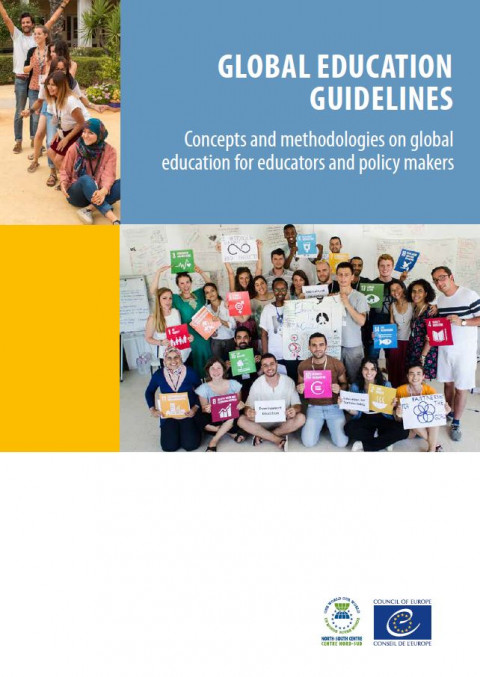 Global Education Guidelines 2019: Concepts and Methodologies on Global Education for Educators and Policy Makers Год публикации: 2019 Организация-автор: North-South Centre of the Council of Europe | Council of Europe The Global Education Guidelines are an initiative of the Global Education Programme of the North South Centre of the Council of Europe, and answer a need expressed by the North-South Centre’s (NSC) network of global education practitioners – the Global Education network - to have a common tool, built on experience gained by the network and other partners, to support educators to comprehend and successfully design, implement and carry out global education initiatives and learning activities. This updated edition of the Guidelines includes novelties and responds to the challenge of being a user-friendly handbook, by (i) introducing the concept of competence-based learning, with the Council of Europe Reference Framework of Competences for Democratic Culture and the OECD concept of global competences, and explains in detail and with practical examples and user friendly tools how global education can make use of competence-based learning to empower learners; (ii) has broadened the content of the chapter on methodology and methods, with step by step guides for the daily work of practitioners, educators and facilitators, and further exemplifying the competence-based learning concept; and (iii) by including a new chapter on media literacy to support practitioners and learners to navigate today’s communication and digital challenges. Guide Pratique sur l’Éducation à la Citoyenneté Mondiale 2019: Concepts et méthodologies en matière d’éducation à la citoyenneté mondiale à l’usage d’éducateurs et de responsables politiques Год публикации: 2019 Организация-автор: North-South Centre of the Council of Europe | Conseil de l'Europe Ce guide pratique sur l’éducation à la citoyenneté mondiale répond à un besoin exprimé par les praticiens du réseau de la Semaine de l’éducation à la citoyenneté mondiale du Centre Nord-Sud du Conseil de l’Europe (CNS), lesquels ont manifesté leur désir de disposer d’un instrument commun, façonné à la lumière de l’expérience acquise par le réseau et d’autres partenaires, susceptibles d’aider les éducateurs à concevoir et à mener à bien des initiatives en matière d’ECM. La présente édition mise à jour du Guide inclut des nouveautés et répond aux défis inhérents à la rédaction d’un manuel facile à utiliser en : (i) introduisant le concept d’apprentissage fondé sur les compétences, conformément au Cadre de référence des compétences pour une culture démocratique du Conseil de l’Europe et au concept de compétence globale de l’OCDE, et en recourant à des exemples pratiques détaillés et à des outils conviviaux pour expliquer comment l’éducation à la citoyenneté mondiale peut utiliser l’apprentissage fondé sur les compétences pour autonomiser les apprenants; (ii) élargissant le contenu du chapitre sur la méthodologie et les méthodes par le biais d’un guide étape par étape conçu pour aider les praticiens, les éducateurs et les facilitateurs dans leur travail quotidien et d’une meilleure illustration des avantages inhérents au concept d’apprentissage fondé sur les compétences; et (iii) en incluant un nouveau chapitre sur l’éducation aux médias pour aider les praticiens et les apprenants à relever les défis actuels associés à la communication et au numérique.
  UNESCO Framework for Culture and Arts Education: Implementation Guidance Год публикации: 2025 Организация-автор: UNESCO Culture and the arts are integral to inclusive, equitable and quality education. They nurture creativity, critical thinking, and respect for cultural diversity, empowering learners to engage meaningfully with the world and to build more just, sustainable and peaceful societies. Yet, countries have not systematically incorporated culture and arts education across all levels of education. This Implementation guidance for the UNESCO Framework for Culture and Arts Education is a collective invitation to reimagine education by placing culture and the arts at its heart and advancing a transformative vision of education for all.Through a holistic approach, the Guidance supports the integration of culture and the arts across formal, non-formal and informal education, throughout life. It offers practical orientations to help Member States fulfil the commitment enshrined in the UNESCO Framework for Culture and Arts Education, adopted by Ministers of Culture and Education in 2024. With a global perspective, this Guidance will equip policy-makers, educators and cultural actors in developing inclusive, context-relevant policies, curricula and learning environments.The Guidance is a milestone on a shared journey, inviting countries to harness their cultural strengths, respond to emerging challenges, and work together towards a more inclusive education for all. Pautas para una Educación Global: Manual para que las y los educadores entiendan e implementen una educación global Год публикации: 2019 Организация-автор: North-South Centre of the Council of Europe | Council of Europe Esta guía práctica para la educación para la ciudadanía mundial responde a una necesidad expresada por los profesionales de la red de la Semana de Educación para la Ciudadanía Mundial del Centro Norte-Sur (CNS) del Consejo de Europa, quienes expresaron su deseo de tener un instrumento común, configurado a la luz de la experiencia adquirida por la red y otros socios, que pueden ayudar a los educadores a diseñar y llevar a cabo iniciativas en GCED. Esta guía práctica para la educación para la ciudadanía mundial responde a una necesidad expresada por los profesionales de la red de la Semana de Educación para la Ciudadanía Mundial del Centro Norte-Sur (CNS) del Consejo de Europa, quienes expresaron su deseo de tener un instrumento común, configurado a la luz de la experiencia adquirida por la red y otros socios, que pueden ayudar a los educadores a diseñar y llevar a cabo iniciativas en GCED.
  Digital Citizenship Education Project (DCE): 10 Domains Год публикации: 2018 Организация-автор: Council of Europe The aim of the DCE project launched by the Council of Europe’s Education Policy Division is to empower children to participate actively in digital society. This involves providing them with an education that develops a sense of critical analysis and the effective use of digital technologies while fostering a notion of citizenship based on respect for human rights and democratic culture.