
Ресурсы
Изучайте широкий спектр ценных ресурсов ВГГ, чтобы углубить своё понимание и повысить эффективность исследований, просветительской деятельности, преподавания и обучения.
Найдено: 2,829
 Sud-Africain Holocauste et Fondation du Génocide Une initiative unique sur le continent africain, la Fondation sur le génocide sud-africaine de l'Holocauste et est dédié à la création d'une société plus humaine et juste dans laquelle les droits de l'homme et la diversité sont respectés et valorisés. Centres couverts par la Fondation servent de monuments aux six millions de Juifs qui ont été tués dans l'Holocauste et toutes les victimes du nazisme, enseignent sur les conséquences des préjugés, le racisme et la discrimination, et de promouvoir une compréhension des dangers de l'indifférence, l'apathie et le silence.
  Metadata for the Global and Thematic Indicators for the Follow-up and Review of SDG 4 and Education 2030 Год публикации: 2017 Организация-автор: UNESCO Institute for Statistics (UIS) This document contains standardised metadata for each of the proposed global and thematic indicators for monitoring Sustainable Development Goal 4 (SDG 4) and the Education 2030 Agenda.The metadata included in this document have been developed by the UIS and are based on the set of thematic indicators approved by the Technical Cooperation Group on SDG 4–Education 2030 Indicators, a group set up in 2016 to provide the technical platform to support the implementation of the thematic indicator framework for the follow-up and review of SDG 4 and the Education 2030 Agenda. Метаданные глобальных и тематических показателей для сопровождения и обзора "ЦУР 4" и программы «Образование-2030" Год публикации: 2017 Организация-автор: UNESCO Institute for Statistics (UIS) Этот документ содержит стандартизованные метаданные для каждого из предлагаемых глобальных и тематических показателей для мониторинга Цели 4 устойчивого развития (SDG 4) и Повестки дня "Образование-2030".Метаданные, включенные в этот документ, были разработаны Институтом статистики ЮНЕСКО и основаны на наборе тематических показателей, одобренных Группой технического сотрудничества по индикаторам ЦУР 4 - "Образование-2030", созданной в 2016 году для предоставления технической платформы по поддержке реализации структуры тематических показателей для последующей деятельности и обзора ЦУР 4 и Повестки дня "Образование-2030".
 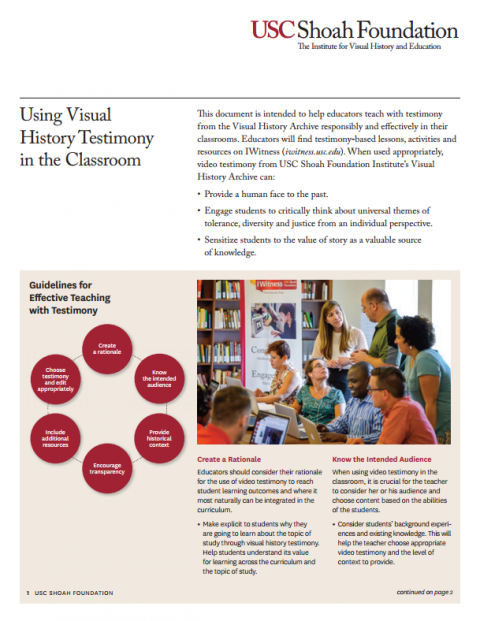 Using Visual History Testimony in the Classroom This short document published by the USC Shoah Foundation gives teachers basic key elements to integrate visual testimonies in class. The 4-page document provides constructive principles of learning applicable to all kind of digital approaches. Utilisation de l'Historique Témoignage Visuel dans la salle de classe Ce court document publié par la Fondation USC Shoah donne aux enseignants des éléments clés de base pour intégrer les témoignages visuels en classe. Le document de 4 pages fournit des principes constructifs de l'apprentissage applicable à tous les types d'approches numériques. South African Holocaust & Genocide foundation A unique initiative on the African continent, the South African Holocaust and Genocide Foundation is dedicated to creating a more caring and just society in which human rights and diversity are respected and valued. Centres covered by the Foundation serve as memorials to the six million Jews who were killed in the Holocaust and all victims of Nazism, teach about the consequences of prejudice, racism and discrimination, and promote an understanding of the dangers of indifference, apathy and silence. Website of Memorial and Museum of Auschwitz-Birkenau The Auschwitz-Birkenau German Nazi Concentration and Extermination Camp was added to the UNESCO World Heritage List in 1979. The website of the Auschwitz-Birkenau State Museum gives access to historical information and documentation about the camp and provides educators and students with various educational resources. Site du Mémorial et Musée d'Auschwitz-Birkenau La concentration d'Auschwitz-Birkenau allemand nazi et Extermination Camp a été ajouté à la Liste du patrimoine mondial de l'UNESCO en 1979. Le site du Musée d'Etat d'Auschwitz-Birkenau donne accès à l'information et à la documentation historique sur le camp et fournit aux éducateurs et aux élèves diverses ressources éducatives.
  Understanding Policy Instrument Choice Concerning Citizenship in Education and Youth Policies: A Typology of Public Tools Год публикации: 2018 Автор: Valérie Becquet Организация-автор: Lien social et Politiques Whether at European or at national level, issues relating to the citizenship of young people are present in public debates and give to the implementation of specific tools. The past and the recurrence of setting up this issue on the agenda invites to reflect on the dynamics of public action. This article presents a typology of the tools gradually developed in two public sectors that concern young people: education and youth. Based on a policy instrument choice approach, it highlights that the choices made by public decision-makers to deal with citizenship issues lead to a multiplication and a diversification of the tools. This proliferation introduces suppose to reflect on the legibility of public action: if those mechanisms can be seen as complementary and as an opportunity for young people, they can also enter into tension. In a context of generational renewal of the electorate, it also calls for reflection on the consequences for young people’s practices and on the building of the perception of citizenship. Comprendre l’instrumentation des questions de citoyenneté dans les politiques d’éducation et de jeunesse : une typologie des dispositifs d’action publique Год публикации: 2018 Автор: Valérie Becquet Организация-автор: Lien social et Politiques Que ce soit au niveau européen qu’au niveau national, les enjeux relatifs à la citoyenneté des jeunes sont présents dans les débats publics et donnent lieu à la mise en place de dispositifs spécifiques. L’ancienneté et la récurrence de la mise à l’agenda de cette question invitent à réfléchir sur les dynamiques de l’action publique. Cet article propose une typologie des dispositifs progressivement développés dans deux secteurs publics qui interviennent auprès des jeunes : l’éducation et la jeunesse. En mobilisant une approche par les instruments d’action publique, il met en évidence que les choix opérés par les décideurs publics pour traiter des questions de citoyenneté conduisent à une multiplication et à une diversification des dispositifs. Cette prolifération interroge la lisibilité de l’action publique : si les dispositifs peuvent apparaître complémentaires et constituer une opportunité pour les jeunes, ils peuvent aussi entrer en tension. Dans un contexte de renouvellement générationnel du corps électoral, elle invite également à réfléchir sur les conséquences sur les pratiques des jeunes et sur la construction de leur représentation de la citoyenneté.