
Ресурсы
Изучайте широкий спектр ценных ресурсов ВГГ, чтобы углубить своё понимание и повысить эффективность исследований, просветительской деятельности, преподавания и обучения.
Найдено: 2,813
 Asia-Pacific Living Heritage Lesson Plan 2023 Год публикации: 2023 Организация-автор: APCEIU | UNESCO Bangkok | International Information and Networking Centre for Intangible Cultural Heritage in the Asia-Pacific Region (ICHCAP) In partnership with UNESCO Bangkok and ICHCAP (International Information and Networking Centre for Intangible Cultural Heritage in the Asia-Pacific Region), APCEIU (Asia-Pacific Centre of Education for International Understanding) carried out “Bringing Living Heritage to the Classroom in the Asia-Pacific” since 2020. As a part of this multi-year project, the UNESCO Asia-Pacific Living Heritage Lesson Plan Contest 2023, co-organized by UNESCO Bangkok, APCEIU, and ICHCAP was launched and 18 lesson plans from 10 countries – Bhutan, China, India, Indonesia, the Republic of Korea, Malaysia, Nepal, The Philippines, Singapore, and Viet Nam - were selected as follows. - Saykha Offering (Subject: English), Tsirangtoe Central School, Bhutan- Setting Up a Herbarium, Learning about Medicinal Herbs and their Cultural and Traditional Uses in the Community (Subject: Science/Grades 7–9), Zilukha Middle Secondary School, Bhutan- Shamanistic Worship and Propitiation to the Spirits (Subject: Bhutan History and Civics and Citizenship Education/Grade 8), Bajothang Higher Secondary School, Bhutan- Beauty of Intangible Cultural Heritage (Subject: Foundations of College Art Education/ Freshman Year), Anhui Medical University, China- The Folk Custom of Building the Peace Kiln for the Mid-Autumn Festival in Jingdezhen (Subject: Mathematics/Grade 7), Jingdezhen No.13 Secondary School, China - When Xiabu Meets Batik (Subject: Art/Grade 5–6), ChongQing Shuren Primary School, China- Agricultural Practices (Subject: Biology/Grade 8), Paramita Heritage School, India- Living Heritage – Quilting in the Kalbelia Community of Rajasthan (Subject: Social Science/Grade 9), St. Stephen's Senior Secondary School, India- My City: Varanasi (Subject: Environmental Studies/Grade 2), Sunbeam School Lahartara, India - Bringing Back the Javanese Saka Calendar through Ethnomathematics (Subject: Mathematics/Grade 7–12), Binus School Bekasi, Indonesia- Song, Play, and Dance (Subject: Interdisciplinary for Indonesian Language, Balinese Culture, Music and Physical Education/Grade 3), Green School Bali, Indonesia- Teaching Sound Wave with Sundanese Traditional Instruments (Subject: Physics/Grade 8), Binus School Bekasi, Indonesia- Wau – The Malays Traditional Kite: Introduction, Wau Bulan Appreciation, Wau Making and Flying Workshop and Wau Corner (Subject: Traditional Games/Grades 4–5), SMU (A) Tarbiah Islamiah (SABK), Malaysia- Himalayan Aromatic Incense-Making and Meditation Workshop (Subject: Economics and Social Studies/ Grades 8–9, 11–12), Pragati Pathshala, Nepal- Influence of Biodiversity on the Stability of Ecosystems (Subject: Science/Grade 10), Philippine Normal University Mindanao, The Philippines- Understanding the Nature of Religion: From the Perspective of the Tripeople (Christians, Muslims, & Lumads) of Kidapawan City, North Cotabato (Subject: Humanities and Social Sciences/Grade 12), Kidapawan City National High School, The Philippines- Bongsan Talchum that Helps the Community Become More Sustainable (Subject: Korean Language and Literature, Social Studies, P.E., Arts/Grade 6), Kimje Buk Elementary School, Republic of Korea- Exploring Community Gardens – How and why are they so precious to humans? (Subject: Geography/Grade 9), Admiralty Secondary School, Singapore 무형유산을 통해 키우는 세계시민성: 2023 아태지역 무형유산 교수학습계획안 Год публикации: 2023 Организация-автор: 유네스코 아시아태평양 국제이해교육원 | UNESCO Bangkok | 유네스코아태무형유산센터 유네스코 아태교육원은 2020년부터 유네스코 방콕사무소와 유네스코아태무형유산센터(ICHCAP)와 협력하여 「아시아태평양 교실에서 만나는 무형유산 사업」을 수행하였다. 이 사업의 일환으로, <2023 아태지역 무형유산 교수학습계획안 공모전 >을 개최하였으며, 총 10개국(네팔, 말레이시아, 베트남, 부탄, 싱가포르, 인도, 인도네시아, 중국, 필리핀, 한국)의 18개 교수학습계획안을 모범사례로 최종 선정하였다. 다음은 수상작 목록이다. - Saykha Offering (Subject: English), Tsirangtoe Central School, Bhutan- Setting Up a Herbarium, Learning about Medicinal Herbs and their Cultural and Traditional Uses in the Community (Subject: Science/Grades 7–9), Zilukha Middle Secondary School, Bhutan- Shamanistic Worship and Propitiation to the Spirits (Subject: Bhutan History and Civics and Citizenship Education/Grade 8), Bajothang Higher Secondary School, Bhutan- Beauty of Intangible Cultural Heritage (Subject: Foundations of College Art Education/ Freshman Year), Anhui Medical University, China- The Folk Custom of Building the Peace Kiln for the Mid-Autumn Festival in Jingdezhen (Subject: Mathematics/Grade 7), Jingdezhen No.13 Secondary School, China - When Xiabu Meets Batik (Subject: Art/Grade 5–6), ChongQing Shuren Primary School, China- Agricultural Practices (Subject: Biology/Grade 8), Paramita Heritage School, India- Living Heritage – Quilting in the Kalbelia Community of Rajasthan (Subject: Social Science/Grade 9), St. Stephen's Senior Secondary School, India- My City: Varanasi (Subject: Environmental Studies/Grade 2), Sunbeam School Lahartara, India - Bringing Back the Javanese Saka Calendar through Ethnomathematics (Subject: Mathematics/Grade 7–12), Binus School Bekasi, Indonesia- Song, Play, and Dance (Subject: Interdisciplinary for Indonesian Language, Balinese Culture, Music and Physical Education/Grade 3), Green School Bali, Indonesia- Teaching Sound Wave with Sundanese Traditional Instruments (Subject: Physics/Grade 8), Binus School Bekasi, Indonesia- Wau – The Malays Traditional Kite: Introduction, Wau Bulan Appreciation, Wau Making and Flying Workshop and Wau Corner (Subject: Traditional Games/Grades 4–5), SMU (A) Tarbiah Islamiah (SABK), Malaysia- Himalayan Aromatic Incense-Making and Meditation Workshop (Subject: Economics and Social Studies/ Grades 8–9, 11–12), Pragati Pathshala, Nepal- Influence of Biodiversity on the Stability of Ecosystems (Subject: Science/Grade 10), Philippine Normal University Mindanao, The Philippines- Understanding the Nature of Religion: From the Perspective of the Tripeople (Christians, Muslims, & Lumads) of Kidapawan City, North Cotabato (Subject: Humanities and Social Sciences/Grade 12), Kidapawan City National High School, The Philippines- Bongsan Talchum that Helps the Community Become More Sustainable (Subject: Korean Language and Literature, Social Studies, P.E., Arts/Grade 6), Kimje Buk Elementary School, Republic of Korea- Exploring Community Gardens – How and why are they so precious to humans? (Subject: Geography/Grade 9), Admiralty Secondary School, Singapore
  Rethinking Global Citizenship Education: From Asia-Pacific Perspectives Год публикации: 2024 Автор: Sicong Chen | Suzanne S. Choo | Thippapan Chuosavasdi | Aigul Kulnazarova | Mousumi Mukherjee | Tania Saeed | Tanya Wendt Samu | Kyujoo Seol | Jun Teng Организация-автор: APCEIU Rethinking Global Citizenship Education from Asia-Pacific Perspectives aims to rethink and reinterpret global citizenship and GCED in light of the cultural and historical contexts and political and economic conditions of the Asia-Pacific region. The edited volume offers an in-depth exploration of global citizenship and GCED through the contributions of nine scholars who examine the subject from a range of cultural, historical, and theoretical perspectives. Each chapter brings to light the complexities involved in fostering global citizenship in an era defined by both growing interconnectedness and intensifying political, social, and economic divides.This book is structured into three parts. The first part examines how various philosophical traditions from the Asia-Pacific region, such as Confucian cosmopolitanism, Tagore’s mindset, Pacific indigenous wisdom, and the Tianxia system, can inform and enrich the concept of GCED. The second part delves into the foundational ideas of global citizenship embedded within Asian religious and spiritual traditions, including Buddhist and Sufi perspectives. The third part provides case studies from Central and East Asia, highlighting the practical application of GCED in local contexts such as Kazakhstan, China, Japan, and South Korea. Together, these chapters offer a comprehensive analysis of the evolving challenges, opportunities, and innovations within GCED from Asia-Pacific viewpoints, emphasising the need for education systems to adapt and respond to the multifaceted nature of global citizenship.
 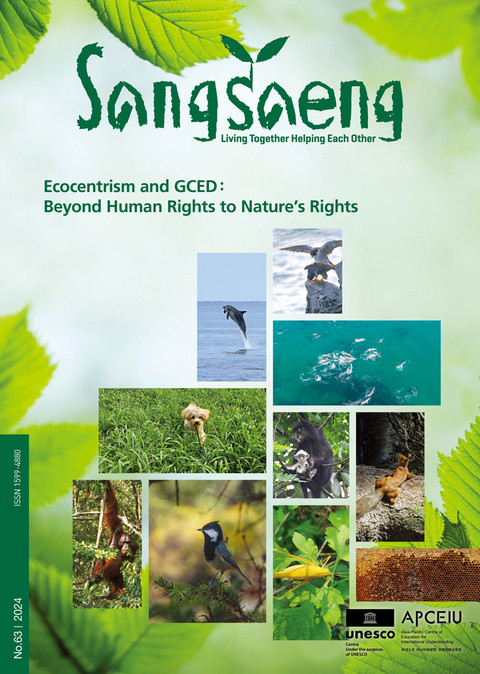 Ecocentrism and GCED : Beyond Human Rights to Nature’s Rights (SangSaeng; No.63, 2024) Год публикации: 2024 Организация-автор: APCEIU In the context of Sustainable Development Goal (SDG) 4, global citizenship and sustainability are spotlighted through SDG Target 4.7, which underscores the importance of harmonising cultural and biological diversity.To address the urgent need for harmony between humanity and the nature, ecocentrism needs to be explored as a guiding principle for fostering ethical and sustainable coexistence.In this light, Issue 63 of SangSaeng delves into Ecocentrism—a perspective advocating for the ethical treatment of all beings and recognising their intrinsic value—alongside Global Citizenship Education (GCED). Contents 03 Editor's Note 04 Special Column- Creating Respectful, Valued Society — Strengthening Global Citizenship Education (GCED) to Combat Hate, Racism, and Discrimination Worldwide / Peter K. Ngure 08 FOCUS Ecocentrism and GCED: Beyond Human Rights to Nature’s Rights- Getting Over Ourselves — Ecocentrism: The Importance of Earth Jurisprudence, Compassionate Conservation, and Personal Rewilding / Marc Bekoff- Combating Decline of Nature’s Diversity — Global Citizenship Education for Geodiversity, Biodiversity Conservation / Eunhee Lee- Ecocentrism and Global Citizenship Education — Fostering Coexistence with Critically Endangered Primates through Citizen Science / Andie Ang- Dolphins Dream of Peace: Beyond Human Rights to Nature’s Rights / Interview with Seungmok Oh 23 Special Report- Small Actions, Global Ripples — How GCED is Revitalizing Peace / Micha Aime 26 Best Practices- What’s Good for the Community — GCED in Action Fosters Culture of Bulungi Bwansi in Uganda / Barbara Nakijoba- Sharing Emotional Sensibility in Education — Practicing Arts Opens up the Spirit of Global Citizenship / Seoyoung Bae - Teaching GCED through Liberation History — Working to Eradicate Entrenched Racism, Intolerance, Xenophobia / Charles Chikunda 36 GCED YOUTH NETWORK- How Youth Leaders Redefine Advocacy, Leading Global Change to Shape our Future — Deep Dive into South Asian Youth Declaration on GCED, Facilitation Techniques for Empowered Youth / Noora Elkenawi 39 Peace in My Memory- Pathway to Inner Peace — Journey is Interconnected with Relationships and Environment / Itseng Kwelagobe 42 Story Time- From Drops to Waves — Power of Poetry-telling in Times of Crisis / Kalpani Dambagolla & Alessia Marzano 45 Understanding the Asia Pacific Region- Central Asian Heart of Culture — Legacy of Horsemanship from Tradition to Modernity / Gulzhan Kabysheva 48 Letter- Raising a Global Citizen / Nelly Aluanga Omino 50 APCEIU in Action
  세계시민교육 협력센터 구축을 위한 타당성 연구: 동아프리카를 중심으로 Год публикации: 2024 Автор: 박환보 | 임진호 Организация-автор: 유네스코 아시아태평양 국제이해교육원 본 연구는 유네스코 아태교육원의 '세계시민교육 협력센터 구축 사업'의 동아프리카 지역 내 추진을 위해 동아프리카 지역 3개국의 교육제도 및 세계시민교육 현황과 세계시민교육 협력센터 설립 타당성을 분석한 연구이다.유네스코 아태교육원은 세계시민교육 확산의 일환으로 2021년 태국과 말레이시아를 시작으로, 2022년 필리핀, 캄보디아, 2023년 인도네시아, 라오스, 2024년 네팔, 방글라데시 등 총 8개국에 세계시민교육 협력센터를 설립·운영하며 현지 교사 및 교사교육가의 세계시민교육 역량 강화를 지원해오고 있다. 세계시민교육 협력센터 사업은 처음에는 아세안 국가를 대상으로 시작하였지만, 점차 그 대상을 서남아시아 지역으로 확장시켰고, 향후 아프리카 지역까지 확대해 나갈 계획에 있다. 이러한 배경에서 영어 언어권에 위치하고 유네스코와의 협력 사업 참여 경험이 풍부한 동아프리카 3개국 케냐, 우간다, 탄자니아를 대상으로 세계시민교육 협력센터 설립의 타당성을 검토하였다.
  ACER-APCEIU Global Citizenship Education Monitoring Toolkit: For Teachers, Schools and System Leaders Год публикации: 2024 Автор: Rachel Parker | Amy Berry | Payal Goundar | Karena Menzie-Ballantyne Организация-автор: Australian Council for Educational Research (ACER) | APCEIU The APCEIU-ACER GCED Monitoring Toolkit was developed and informed by research conducted from 2022-2024 in collaboration with partners in Australia, Lao PDR, Philippines, and South Korea. The toolkit aims to assist education stakeholders to embed GCED within policy and practice in alignment with local, regional, and international frameworks. Target users of this toolkit include policy makers, education department and ministry personnel, leaders, and educators at all levels in both formal and non-formal education sectors.The toolkit explores effective GCED including how to conceptualise and define, plan, enact and monitor implementation, and how to measure success. By guiding educators and leaders to align their enactment and monitoring efforts to international guidance, research, theory and practice, this toolkit supports a robust and evidence-informed process for enacting GCED in ways that nurture learners as proactive and empowered global citizens.Phase I Report (Link): https://www.unescoapceiu.org/post/4995Phase II Report (Link): https://www.unescoapceiu.org/post/5184
  7th Global Capacity-Building Workshop on GCED: Mentorship Programme Activity Report Год публикации: 2023 Организация-автор: APCEIU This report summarizes 15 GCED projects implemented by the selected mentees/grantees of APCElU's 7th Global Capacity-Building Workshop on GCED in 2022. 15 GCED initiatives, including teacher training workshops, curriculum development, school-based activities, and community development projects, have been taken by educators, teachers, and practitioners in Asia, Europe, Africa, Latin America, and the Caribbean. The mentees/grantees first participated in the 7th Global Capacity-Building Workshop on GCED in September 2022. After the completion of the Workshop, graduates submit the GCED proposals to be selected as the grantees/mentees. The selected 15 mentees/grantees are matched with expert mentors to be guided for their project development and implementation. This report describes the summary of 15 projects held in different corners of the world, along with its outputs.
  7th Meeting of UNESCO Category 2 Centres in Education: Meeting Report Год публикации: 2023 Организация-автор: APCEIU This meeting report provides the summary of the 7th Meeting of UNESCO Category 2 Centres in Education held on 7 November 2023 in Paris, France. It offers an overview of the presentations delivered by Category 2 Centres in Education, outlining their programmes and activities for the upcoming years, specifically for 2024.
  2023 Youth Leaders' Mentorship & Local GCED Project: Activity Report Год публикации: 2023 Организация-автор: APCEIU This report summarizes 10 GCED projects implemented in different parts of the world by the alumni of APCEIU’s Youth Leadership Workshop on GCED in 2023. Ranging from community advocacy for global citizenship to youth-led campaign projects, 10 GCED initiatives have been taken by 10 young leaders in their own communities in Asia, Europe, Africa, Latin America, and the Caribbean. APCEIU offers GCED training programmes targeting youth leaders around the globe to encourage them to achieve the SDGs through global citizenship and GCED. Since 2015, the Youth Leadership Workshop on GCED has been held every year in the Republic of Korea, inviting 50 young global leaders to take part in an intensive training programme where they share their actions, deepen their knowledge on global/local issues, enhance their motivation to take actions for a change, and establish the young leaders’ network on GCED. Since 2021, it has been shifted to a comprehensive training programme composed of online training workshops, mentorship, and local project implementation.
  5th Annual Meeting of the GCED Actors' Platform: Meeting Report Год публикации: 2023 Организация-автор: APCEIU This meeting report provides the summary of the 5th Annual Meeting of the GCED Actors' Platform held on 20 October 2023. The report outlined the presentations from UNESCO, regional coordinators from 4 Regional GCED Networks (Arab States, Asia-Pacific, Latin America and the Caribbean and Sub-Saharan Africa), including their achievements in advancing GCED in their respective regions over the past year and discussion on potential ways to strengthen GCED implementation on both regional and global levels.