
Ресурсы
Изучайте широкий спектр ценных ресурсов ВГГ, чтобы углубить своё понимание и повысить эффективность исследований, просветительской деятельности, преподавания и обучения.
Найдено: 2,813
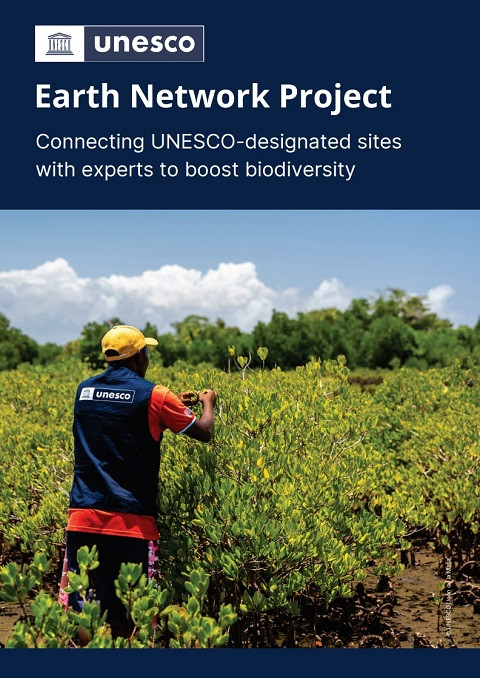 Earth Network Project: Connecting UNESCO-Designated Sites With Experts to Boost Biodiversity Год публикации: 2024 Организация-автор: UNESCO The Earth Network project was launched in 2021 with the support of the Government of Italy. It brings together over 380 experts from more than 60 countries, encompassing diverse biodiversity-related fields that include land restoration, environmental management and environmental law. The specialists volunteer to put their unique skillsets and knowledge at the disposal of sites designated by UNESCO which request their assistance. The Earth Network covers all scientific domains and proudly combines different forms of knowledge: scientific, practitioner, local and indigenous. On the ground, these experts provide technical advice, collect data, build partnerships, and provide training tailored to the specific needs and priorities of each UNESCO-designated site.
  Transforming Education Towards SDG4: Report of a Global Survey on Country Actions to Transform Education; Highlights Год публикации: 2024 Организация-автор: UNESCO In 2022, the United Nations Transforming Education Summit responded decisively to mobilize action, ambition and solidarity as well as to elevate education to the top of the political agenda. This powerful mobilization led to 143 countries presenting national statements of commitment, demonstrating their political resolve to reimagine and transform their education systems. On the Summit’s fi rst anniversary, UNESCO invited its Member States to participate in the Survey on Country Actions to Transform Education and report on how they have translated their commitments into actions. This document presents highlights from the Transforming Education Towards SDG 4: Report of a global survey on country actions to transform education. It showcases transformative actions that countries have undertaken to accelerate progress towards SDG 4. The report emphasizes that education must adopt a holistic, lifelong and comprehensive approach that addresses the development and well-being of individual learners and society. Transforming education requires placing inclusion, equity and gender equality at the core of policies and interventions. It also requires more and better education fi nancing, and investments in the teaching profession.
 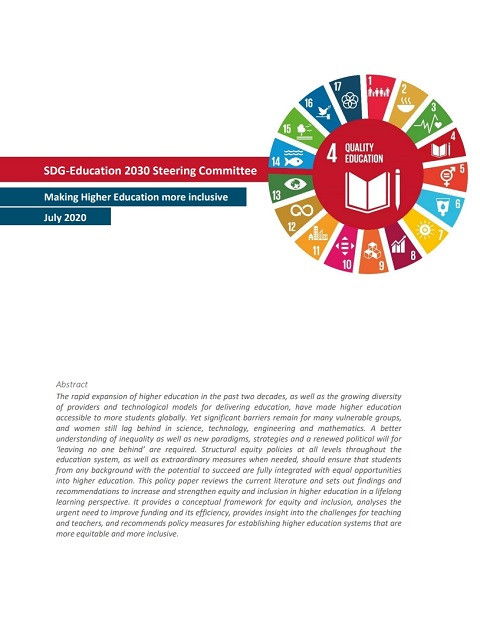 SDG-Education 2030 Steering Committee: Making Higher Education More Inclusive, July 2020 Год публикации: 2020 Организация-автор: UNESCO The rapid expansion of higher education in the past two decades, as well as the growing diversity of providers and technological models for delivering education, have made higher education accessible to more students globally. Yet significant barriers remain for many vulnerable groups, and women still lag behind in science, technology, engineering and mathematics. A better understanding of inequality as well as new paradigms, strategies and a renewed political will for ‘leaving no one behind’ are required. Structural equity policies at all levels throughout the education system, as well as extraordinary measures when needed, should ensure that students from any background with the potential to succeed are fully integrated with equal opportunities into higher education. This policy paper reviews the current literature and sets out findings and recommendations to increase and strengthen equity and inclusion in higher education in a lifelong learning perspective. It provides a conceptual framework for equity and inclusion, analyses the urgent need to improve funding and its efficiency, provides insight into the challenges for teaching and teachers, and recommends policy measures for establishing higher education systems that are more equitable and more inclusive.
  Chile: Artificial Intelligence Readiness Assessment Report Год публикации: 2023 Организация-автор: UNESCO The Readiness Assessment Methodology (RAM) is a diagnostic tool intended to assist Member States in upholding their commitment to the Recommendation by helping them understand how prepared they are to implement AI ethically and responsibly for all their citizens. The RAM questionnaire forms the basis for the first section of this readiness assessment report, providing a comprehensive but detailed overview of laws, institutions, and the cultural, social, and human capital landscape shaping AI. This is then complemented in the second section by a summary of concerns and priorities raised during a national multistakeholder consultation that was conducted in 2023. Finally, the third section presents a roadmap and recommendations for building capacities across national institutions, laws and policies, and human capital, to achieve a responsible AI ecosystem aligned with the UNESCO Recommendation. As the very first country to complete the RAM and the country report, Chile is blazing the trail not only for Latin America but the world. We applaud the initiative the Chilean government has taken to update its AI strategy putting ethics and governance front and centre, and thank them for inviting UNESCO to assist in this endeavour. The report presented here reveals a complex and rapidly-changing landscape. In the legal and regulatory dimension, the 2021 National Artificial Intelligence Policy (NAIP) represents a substantive and wide-ranging commitment to developing AI. One of the key recommendations of this report is to fully integrate the UNESCO Recommendation into the NAIP’s axis of Ethics, Regulation, and Socioeconomic Impacts. Notably, the RAM reveals the pressing need to update legislation around data protection and cybersecurity to meet the challenges of AI. It also highlights several areas the Chilean government is actively working to develop. [...] Overall, this report presents a fundamentally optimistic vision that we at UNESCO share: that ethical governance and responsible regulation of AI is entirely consistent with innovation and economic growth, and is essential for ensuring a technological ecosystem that benefits the public good. In drawing a clear line from the RAM data through to the multistakeholder consultations and the recommendations, Chile has a clear roadmap for how to get there. (This text has been extracted from the Foreword of the publication)
 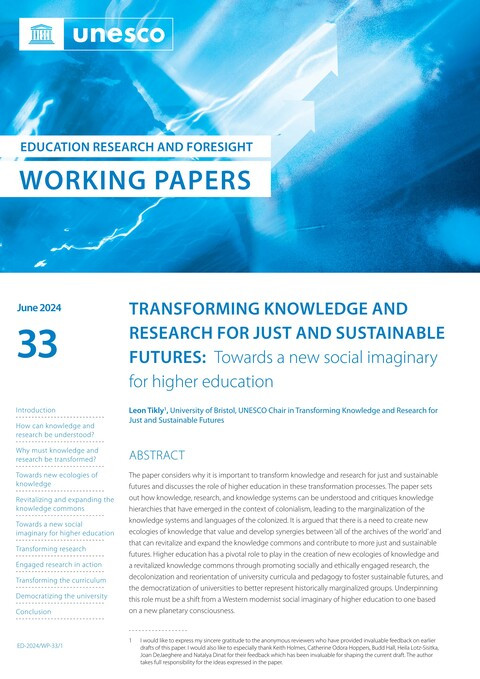 Transforming Knowledge and Research for Just and Sustainable Futures: Towards a New Social Imaginary for Higher Education (Education, Research and Foresight: Working Papers; No.33, 2024) Год публикации: 2024 Автор: Leon Tikly Организация-автор: UNESCO The paper considers why it is important to transform knowledge and research for just and sustainable futures and discusses the role of higher education in these transformation processes. The paper sets out how knowledge, research, and knowledge systems can be understood and critiques knowledge hierarchies that have emerged in the context of colonialism, leading to the marginalization of the knowledge systems and languages of the colonized. It is argued that there is a need to create new ecologies of knowledge that value and develop synergies between ‘all of the archives of the world’ and that can revitalize and expand the knowledge commons and contribute to more just and sustainable futures. Higher education has a pivotal role to play in the creation of new ecologies of knowledge and a revitalized knowledge commons through promoting socially and ethically engaged research, the decolonization and reorientation of university curricula and pedagogy to foster sustainable futures, and the democratization of universities to better represent historically marginalized groups. Underpinning this role must be a shift from a Western modernist social imaginary of higher education to one based on a new planetary consciousness.
 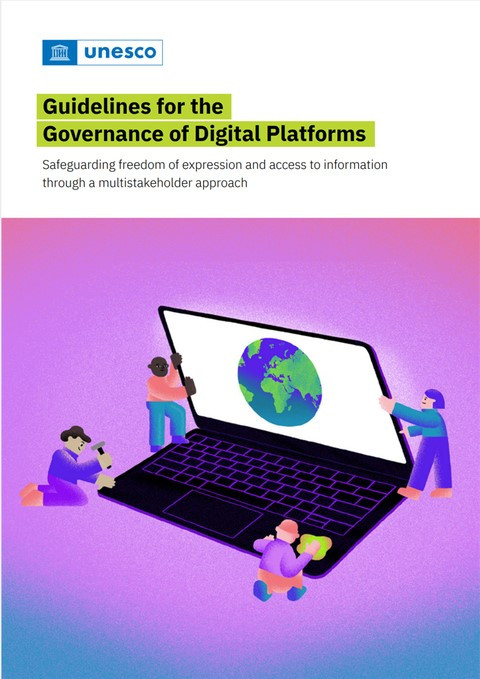 Guidelines for the governance of digital platforms: safeguarding freedom of expression and access to information through a multi-stakeholder approach Год публикации: 2023 Организация-автор: UNESCO Guidelines for an Internet for TrustSafeguarding freedom of expression and the right to information while dealing with dis- and misinformation, hate speech, and conspiracy theories requires a multistakeholder approach. This is the reason why UNESCO, the leading UN agency for the promotion and protection of freedom of expression and to information, is launching Guidelines for the Governance of Digital Platforms. The Guidelines outline a set of duties, responsibilities and roles for States, digital platforms, intergovernmental organizations, civil society, media, academia, the technical community and other stakeholders to enable the environment where freedom of expression and information are in the core of digital platforms governance processes. The Guidelines were produced through a multi-stakeholder consultation that gathered more than 10,000 comments from 134 countries. These global-scale consultations fostered inclusive participation, ensuring a diversity of voices to be heard, including those from groups in situation of marginalization and vulnerability. Cultivating an Internet of Trust is a shared responsibility among all stakeholders. It calls upon us all to sustain an enabling environment for freedom of expression and the right to information.
  Countering Online Hate Speech Год публикации: 2015 Автор: Iginio Gagliardone | Danit Gal | Thiago Alves | Gabriela Martinez Организация-автор: UNESCO The present report provides a global overview of the dynamics characterizing hate speech online and some of the measures that have been adopted to counteract and mitigate it, highlighting good practices that have emerged at the local and global levels. While the study offers a comprehensive analysis of the international, regional and national normative frameworks developed to address hate speech online, and their repercussions for freedom of expression, it places particular emphasis on social and non-regulatory mechanisms that can help to counter the production, dissemination and impact of hateful messages online. Combattre les discours de haine sur internet Год публикации: 2015 Автор: Iginio Gagliardone | Danit Gal | Thiago Alves | Gabriela Martinez Организация-автор: Organisation des Nations Unies pour l'éducation, la science et la culture (UNESCO) Le présent rapport offre un panorama mondial des dynamiques caractéristiques des discours de haine en ligne et des mesures prises pour les combattre et les contenir, en mettant en évidence les bonnes pratiques qui ont émergé au niveau local comme au niveau international. Si l’étude fournit une analyse exhaustive des cadres normatifs internationaux, régionaux et nationaux mis en place pour lutter contre les discours de haine en ligne et de leurs répercussions sur la liberté d’expression, elle met particulièrement l’accent sur les mécanismes sociaux et non réglementaires qui peuvent contribuer à lutter contre la production, la diffusion et l’impact des messages de haine en ligne.
 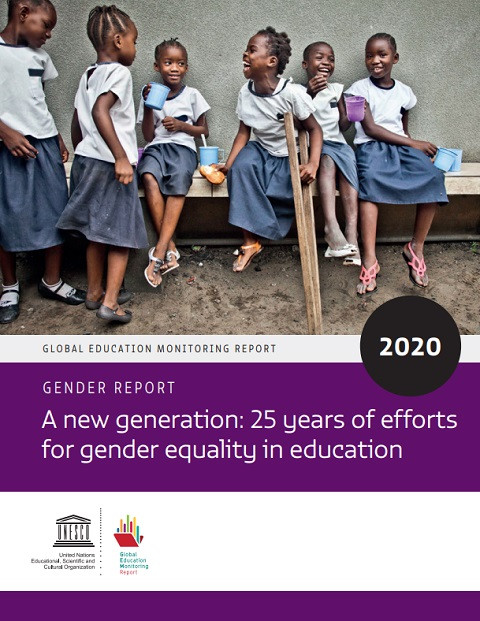 Gender Report 2020: A New Generation; 25 Years of Efforts for Gender Equality in Education (Global Education Monitoring Report) Год публикации: 2020 Организация-автор: UNESCO | Global Education Monitoring Report Team Building on the 2020 Global Education Monitoring Report, this report investigates how inclusion in education can advance gender equality in and through education, which is critical to make progress towards gender equality in society. The goal of gender equality is, of course, not new. It was enshrined in the 1979 Convention on the Elimination of All Forms of Discrimination Against Women and was at the core of the 1995 Beijing Declaration and Platform for Action, whose 25th anniversary is marked in 2020.
  Youth and Violent Extremism on Social Media: Mapping the Research Год публикации: 2017 Автор: Séraphin Alava | Divina Frau-Meigs | Ghayda Hassan Организация-автор: UNESCO | Information for All Programme (IFAP) Does social media lead vulnerable individuals to resort to violence? Many people believe it does. And they respond with online censorship, surveillance and counter-speech. But what do we really know about the Internet as a cause, and what do we know about the impact of these reactions? All over the world, governments and Internet companies are making decisions on the basis of assumptions about the causes and remedies to violent attacks.The challenge is to have analysis and responses firmly grounded. The need is for a policy that is constructed on the basis of facts and evidence, and not founded on hunches – or driven by panic and fearmongering.It is in this context that UNESCO has commissioned the study titled Youth and Violent Extremism on Social Media – Mapping the Research. This work provides a global mapping of research (mainly during 2012-16) about the assumed roles played by social media in violent radicalization processes, especially when they affect youth and women. The research responds to the belief that the Internet at large is an active vector for violent radicalization that facilitates the proliferation of violent extremist ideologies.Indeed, much research shows that protagonists are indeed heavily spread throughout the Internet. There is a growing body of knowledge about how terrorists use cyberspace. Less clear, however, is the impact of this use, and even more opaque is the extent to which counter measures are helping to promote peaceful alternatives. While Internet may play a facilitating role, it is not established that there is a causative link between it and radicalization towards extremism, violent radicalization, or the commission of actual acts of extremist violence.