
Ресурсы
Изучайте широкий спектр ценных ресурсов ВГГ, чтобы углубить своё понимание и повысить эффективность исследований, просветительской деятельности, преподавания и обучения.
Найдено: 1,983
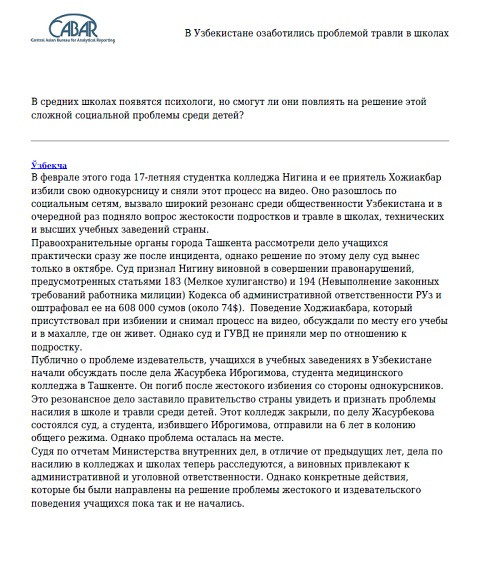 В Узбекистане озаботились проблемой травли в школах Год публикации: 2018 Автор: Дарина Солод Организация-автор: Central Asian Bureau for Analytical Reporting (CABAR) В средних школах в Узбекистане появятся психологи. Автор задается вопросом, смогут ли они повлиять на решение этой сложной социальной проблемы среди детей.
 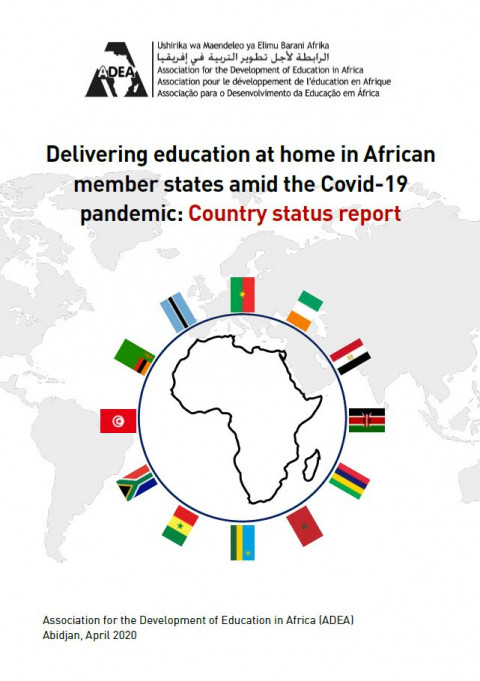 Delivering Education at Home in African Member States Amid the Covid-19 Pandemic: Country Status Report Год публикации: 2020 Организация-автор: Association for the Development of Education in Africa (ADEA) Since its emergence in late 2019, the coronavirus disease 2019 (COVID-19) has evolved into a pandemic, heavily affecting the lives of billions of people across the world with an anticipated huge impact on the global economy and Africa in particular. Education is one of the sectors heavily affected, with the closure of learning institutions in many African countries likely to negatively affect the education quality.In order to obtain a clearer view of the status of learning during this period, and to better support countries in the immediate, short and long term, ADEA engaged some of the most affected African countries in March 2020 to map the national situation in the education sector. The foregoing is a synopsis of the feedback from Burkina Faso, Côte d’Ivoire, Egypt, Ghana, Kenya, Mauritius, Morocco, Rwanda, Senegal, South Africa, Tunisia, and Zambia in terms of national strategies, platforms and tools or applications, gaps and challenges, partner engagement, good practices and lessons learnt with some recommendations.
  Lifelong Education: Continuous Education for Sustainable Development; The Collection of the 15th International Conference Год публикации: 2017 Организация-автор: National Academy for Education (NAE) This edition of the proceedings of international cooperation presents the reports of the participants of the first stage of the 15th (anniversary) international conference “Education Throughout Life: Continuing Education for Sustainable Development”, which was held in Astana, Republic of Kazakhstan. The conference participants focused on the issues of training competent specialists, models, methods, technologies and organizational forms of continuing education used in pedagogical practice. The authors paid special attention to new pedagogical and organizational strategies for continuing education of adults, people with disabilities and the "third age", as well as spiritual, moral, ethical and democratic values in the context of upbringing in continuing education. Образование через всю жизнь: непрерывное образование в интересах устойчивого развития; Сборник материалов 15-й международной конференции Год публикации: 2017 Организация-автор: National Academy for Education (NAE) В настоящем выпуске трудов международного сотрудничества представлены доклады участников первого этапа 15-й (юбилейной) международной конференции «Образование через всю жизнь: Непрерывное образование в интересах устойчивого развития», которая проходила в Астане, Республика Казахстан. В центре внимания участников конференции были вопросы подготовки компетентных специалистов, применяемые в педагогической практике модели, методики, технологии и организационные формы непрерывного образования. Особое внимание авторы уделили новым педагогическим и организационным стратегиям непрерывного образования взрослых, людей с ограниченными возможностями и «третьего возраста», а также вопросам духовно-нравственных, этических и демократических ценностей в контексте воспитания в непрерывном образовании.
 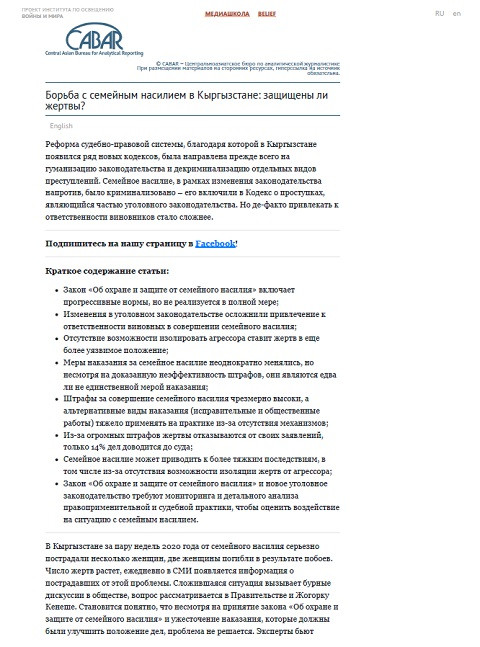 Combating Domestic Violence in Kyrgyzstan: Are Victims Protected? Год публикации: 2020 Автор: Анна Зубенко Организация-автор: Central Asian Bureau for Analytical Reporting (CABAR) The reform of the judicial system, thanks to which a number of new codes appeared in Kyrgyzstan, was aimed primarily at the humanization of legislation and the decriminalization of certain types of crimes. Domestic violence, in the framework of changing the legislation, on the contrary, was criminalized - it was included in the Code of Misconduct, which is part of the criminal law. But the de facto prosecution of perpetrators has become more difficult.
 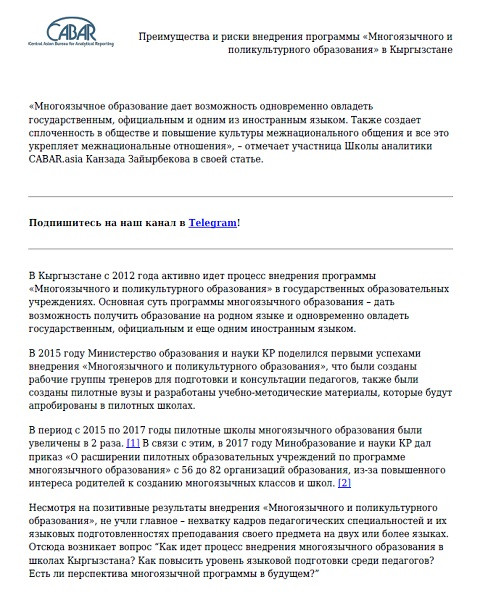 Advantages and Risks of Introducing the “Multilingual and Multicultural Education” Program in Kyrgyzstan Год публикации: 2019 Автор: Kanzada Zayirbekova Организация-автор: Central Asian Bureau for Analytical Reporting (CABAR) According to the author, multilingual education makes it possible to simultaneously master the state, official and one of the foreign languages, and also creates cohesion in society and enhances the culture of interethnic communication, and all this strengthens interethnic relations.
 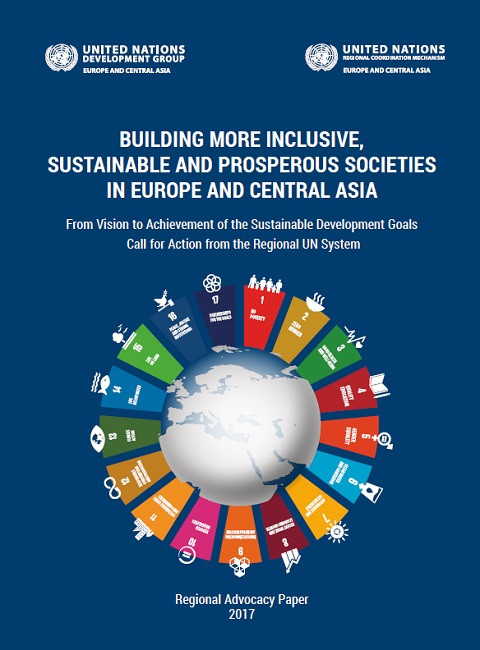 Building More Inclusive, Sustainable and Prosperious Societies in Europe and Central Asia: From Vision to Achievement of the Sustainable Development Goals Call for Action from the Regional UN System (Regional Advocacy Paper 2017) Год публикации: 2017 Организация-автор: United Nations Development Group (UNDG) This regional advocacy paper provides key policy recommendations that can help countries of Europe and Central to overcome the existing development bottlenecks and boost the implementation of the 2030 Agenda, leaving no one behind. На пути к устойчивости и всеобщему процветанию в Европе и Центральной Азии: Переход от видения к реализации Целей в области у стойчивого развития Призыв к действию от региональной системы ООН (Региональный консультационный документ 2017) Год публикации: 2017 Организация-автор: United Nations Development Group (UNDG) Этот региональный консультационный документ содержит ключевые политические рекомендации, которые могут помочь странам Европы и Центральной Азии преодолеть существующие узкие места в области развития и ускорить реализацию Повестки дня на период до 2030 года, не оставив никого позади.
  المجتمع المدني وسؤال المواطنة: فرص التفعيل وحدود التأثير Год публикации: 2017 Автор: Assia Belkhir Организация-автор: Larbi Ben M'Hidi أدت التغيرات السريعة والمتلاحقة التي عرفتها المجتمعات المعاصرة، إلى إعادة النظر في منظومة المفاىي المرتبطة بالدولة والمجتمع، وفي طبيعة العلاقة بينيما، وفيما يربط الأفراد بمجتمعاتهم ودولهم، وأصبحت قوة الدولة لا تقاس فقط بقدراتها العسكرية، ولكن أساسا بقدرتها على تنفيذ السياسات العامة التي توفر الخدمات الاساسية للمواطنين، وقدرتها على توزيع الأدوار مع المجتمع المدني بما يزيد المشاركة ويحقق المواطنة السياسية والاجتماعية، التي يعاد التساؤل بشأنهاهي الأخرى مع بروز فكرة المواطنة العالمية. Civil Society and the Question of Citizenship : Opportunities for Activation and Limits of Influence Год публикации: 2017 Автор: Assia Belkhir Организация-автор: Larbi Ben M'Hidi The rapid and progressive changes that contemporary societies have undergone, have led to a reconsideration of the system of concepts associated to the state and the society, the nature of their relationship, and the connection of individuals to their societies and states. The power of the state is not only measured by its Military capabilities but mainly by its ability to implement public policies that provide essential services to the citizens, and its capacity to distribute roles within civil society, there by increasing participation and achieving the requirements of political and social citizenship, which is questioned as well, with the emergence of the idea of a global citizenship.