
Ресурсы
Изучайте широкий спектр ценных ресурсов ВГГ, чтобы углубить своё понимание и повысить эффективность исследований, просветительской деятельности, преподавания и обучения.
Найдено: 1,983
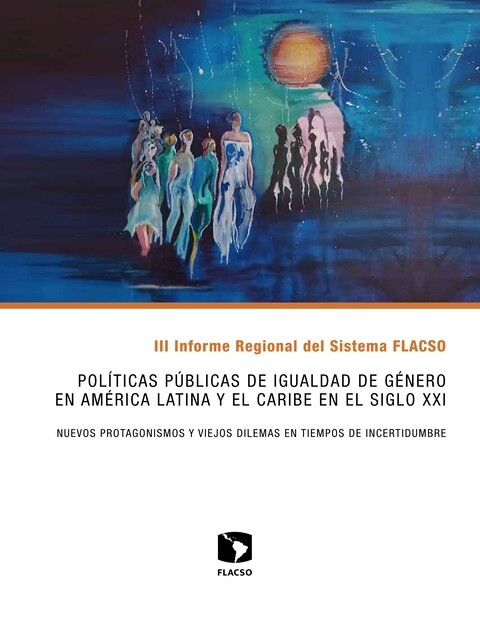 Public Policies on Gender Equality in Latin America and the Caribbean in the 21st Century: New Protagonisms and Old Dilemmas in Times of Uncertainty Год публикации: 2023 Автор: Cinthya Fernández Lépiz | Esteban Zolezzi Организация-автор: Latin American Council of Social Sciences (CLACSO) The III Report of FLACSO on Gender Issues is the result of a collaborative process among the Academic Units of FLACSO. Its chapters aim to identify the main challenges in each country regarding gender equality in the early 21st century and engage them in a dialogue with contributions from the academic community of FLACSO. They seek to provide a general characterization of each country, analyze the main challenges in terms of gender equality, as well as the critical contributions and limitations raised by gender and feminist studies in conjunction with the contributions made by FLACSO. Políticas públicas de igualdad de género en América Latina y el caribe en el siglo XXI: Nuevos protagonismos y viejos dilemas en tiempos de incertidumbre. Год публикации: 2023 Автор: Cinthya Fernández Lépiz | Esteban Zolezzi Организация-автор: Latin American Council of Social Sciences (CLACSO) El III Informe Regional de la FLACSO sobre el tema de Género es el resultado de un proceso colaborativo entre las Unidades Académicas de la FLACSO. Sus capítulos se proponen identificar cuáles son las principales problemáticas en cada país en materia de igualdad en el comienzo del siglo XXI y ponerlas en diálogo con los aportes que se vienen realizando desde la comunidad académica de FLACSO. Procuran dar cuenta de una caracterización general de cada uno de los países, el análisis de las principales problemáticas que se presentan en materia de igualdad de género, así como los aportes críticos y limitaciones que se plantean desde los estudios de género y feministas con los aportes realizados desde la FLACSO.
  Discrimination, Mobbing and Equality Организация-автор: Amnesty International. Swiss Section These 7 education sheets(Stereotypes and Discrimination, Occupational Inequalities, Discrimination in Job Searching, Let’s Talk about Mobbing!, Conflict or Mobbing?, Declaration against Mobbing at School, Freedom from Discrimination) cover the themes of discrimination, equality and mobbing(conflictual relations in the workplace, both between colleagues and between superiors and subordinates), in relation to article 2 of the Universal Declaration of Human Rights. Discrimination, mobbing et égalité Организация-автор: Amnesty International. Swiss Section Ces 7 fiches pédagogiques(Stéréotypes et discrimination, Inégalités professionnelles, Discrimination dans la recherche d'emploi, Parlons mobbing!, Conflit ou mobbing? Déclaration contre le mobbing à l'école, Freedom from discrimination) portent sur les thématiques de la discrimination, de l'égalité et du mobbing (relation conflictuelle sur le lieu de travail, aussi bien entre collègues qu'entre supérieurs et subordonnés), en lien avec l'article 2 de la Déclaration universelle des droits de l’homme.
 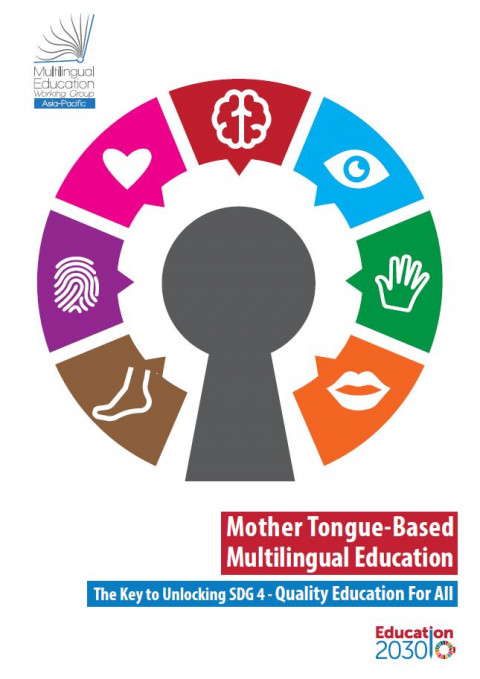 Mother Tongue-Based Multilingual Education: The Key to Unlocking SDG 4 - Quality Education for All Год публикации: 2017 Автор: Matt Wisbey Организация-автор: UNESCO Bangkok This brochure, designed as a bright and bold resource to be used with policy makers and other key stakeholders, explores the reasons why mother tongue-based multilingual education (MTB-MLE) is the key to quality lifelong learning opportunities for all. Linking the key elements of MTB-MLE with SDG4’s targets, it outlines the benefits for both individual learners and society as a whole. Полиязычное образование на основе родного языка. Ключ к реализации ЦУР 4 - качественное образование для всех Год публикации: 2017 Автор: Matt Wisbey Организация-автор: UNESCO Bangkok Полиязычное образование на основе родного языка - это образование, начинающееся на языке, которым ученик владеет свободно и затем постепенно вводит другие языки.Справедливое качественное образование и непрерывное обучение для всех возможно только тогда, когда образование учитывает и отражает полиязычный характер общества. Дети, молодежь и взрослые нуждаются в образовательных возможностях, основанных на их образе жизни и потребностях, на родном языке и посредством него.Поскольку ЦУР 4 является основополагающей для других целей устойчивого развития, без полиязычного образования на основе родного языка остальные 16 целей так и останутся недостижимыми.Информация в этой брошюре частично основана на презентациях и дискуссиях с 5-й Международной конференции по языку и образованию: устойчивое развитие посредством многоязычного образования, которая состоялась в Бангкоке, Таиланд, в октябре 2016 года.Для получения дополнительной информации о конференции или просмотра оригинальных презентаций и ключевых сообщений, пожалуйста, посетите: http://www.lc.mahidol.ac.th/mleconf/2016/program.htm
  Readiness for Education for the Future: A Safe and Sustainable Return to Teaching and Learning Год публикации: 2021 Организация-автор: Regional Center for Quality and Excellence in Education (RCQE) Predicting the future of quality education is a complex process, but it is an inevitable necessity, and anticipation and preparation for every new and changing must be the goal of education in its present and future. Today, education in all countries of the world faces unprecedented challenges, most notably the Corona pandemic, Covid-19, in conjunction with previous challenges of acceleration in knowledge and technological development, as well as economic crises and conflicts in some countries, unfamiliar contexts that made this symposium review the issue of education and its safe return to it after Corona pandemic. جاهزية التعليم للمستقبل: العودة الآمنة والمستدامة للتعليم والتعلم Год публикации: 2021 Организация-автор: Regional Center for Quality and Excellence in Education (RCQE) التنبؤ بمستقبل جودة التعليم عملية معقدة إلا أنها ضرورة حتمية، والتحسب والاستعداد لكل مستجد ومتغير يجب أن يكون غاية التربية في حاضرها ومستقبلها. اليوم يواجه التعليم في جميع دول العالم تحديات غير مسبوقة أبرزها جائحة كورونا Covid-19 بتزامن مع تحديات سابقة من تسارع في التطور المعرفي والتكنولوجي، وكذلك أزمات اقتصادية وصراعات في بعض الدول، سياقات غير مألوفة جعلت من عملية تستعرض هذه الندوة قضية التعليم والعودة الامنة له بعد جائحة كورونا.
  SDG 4 Midterm Review: Monitoring Implementation of SDG 4 Target 4.1. ~ 4.c. in Rep. of Korea Год публикации: 2023 Автор: Hunwoo Joo | Mikyung Kim | Mugyeong Moon | Jeongwon Hwang | Kirak Ryu | Hyeseung Cho | Yunjeong Choi | Hyosook Shin | Kyungsook Kang | Minseon Park | Eunju Lee | Nayoung Kim | Hwanbo Park | Hannah Kim | Jonghun Kim Организация-автор: National Consultative Group on Education 2030 | Korean National Commission for UNESCO This report presents the compiled work from the National Consultative Group and Working Groups on Education 2030 of the Republic of Korea regarding the midterm review on the implementation of SDG 4.
 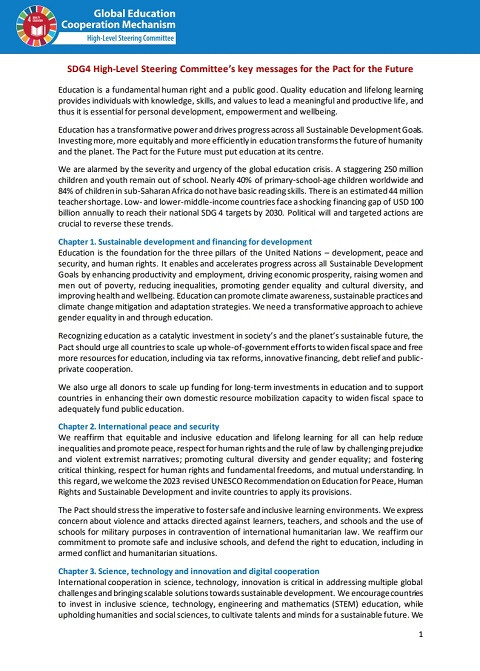 SDG4 High-Level Steering Committee’s Key Messages for the Pact for the Future Год публикации: 2024 Организация-автор: SDG4 High-Level Steering Committee Education is a fundamental human right and a public good. Quality education and lifelong learning provides individuals with knowledge, skills, and values to lead a meaningful and productive life, and thus it is essential for personal development, empowerment and wellbeing. Education has a transformative power and drives progress across all Sustainable Development Goals. Investing more, more equitably and more efficiently in education transforms the future of humanity and the planet. The Pact for the Future must put education at its center.