
Ресурсы
Изучайте широкий спектр ценных ресурсов ВГГ, чтобы углубить своё понимание и повысить эффективность исследований, просветительской деятельности, преподавания и обучения.
Найдено: 1,983
 Bringing Living Heritage to the Classroom in Asia-Pacific: A Resource Kit Год публикации: 2022 Организация-автор: UNESCO Bangkok | APCEIU | International Information and Networking Centre for Intangible Cultural Heritage in the Asia-Pacific Region (ICHCAP) Integrating living heritage in school teaching and learning can enhance education quality, enliven the experiences of students and teachers, and contribute to keeping this heritage alive for current and future generations. In addition, as the ongoing COVID-19 pandemic has also demonstrated, living heritage can play an important role in ensuring the well-being and resilience of communities. UNESCO encourages countries to safeguard living heritage through formal and non-formal education. From the end of 2019 to early 2022, UNESCO has been working with partners to implement a pilot project “Teaching and Learning with Living Heritage in Schools” in six countries in Asia and the Pacific - including Cambodia, Kazakhstan, Kyrgyzstan, Nepal, Republic of Korea and Thailand. Over 1900 students from 21 schools had the opportunity to participate in these innovative classes. Throughout the process, 86 teachers, with more than two thirds being women, have developed and tested 101 lesson plans and activities. This Resource Kit provides step-by-step guidance and key resources on why and how to integrate living heritage in lessons and extracurricular activities in schools. Whoever you are – policy-maker, school director, teacher, student, parent, heritage practitioner – you have a vital role to play in this process.
  The Teaching of the Holocaust in Latin America the Challenges for Educators and Legislators Год публикации: 2017 Автор: María Celeste Adamoli | Emmanuel Kahan, Pablo Luzuriaga | Ministerio de Educación Организация-автор: UNESCO Santiago This book provides an overview of opportunities that may arise from educating about the Holocaust in diverse cultural contexts and educational situations, with a special focus on Latin American countries. We can actually be away from the places where the genocide against the Jewish people was perpetrated, but Latin America is still taking charge of its own past of violence and crimes against humanity. With this publication, Latin American educators will have at their fingertips an updated account of the most outstanding topics that are discussed on pedagogy and policy making. You can also explore how, even today in Europe, education about the Holocaust shapes a culture of memory. On the other hand, you can see how in other places the memory of the Holocaust can be a starting point to relate to other difficult pasts. UNESCO is convinced that the prevention of genocide begins at school. In a world where mass violence is possible, this publication will show the importance of teaching young people about the Holocaust and about other genocides in history. It is a condition to prevent similar crimes from happening in the future. La Enseñanza del Holocausto en América Latina: los desafíos para los educadores y legisladores Год публикации: 2017 Автор: María Celeste Adamoli | Emmanuel Kahan, Pablo Luzuriaga | Ministerio de Educación Организация-автор: UNESCO Santiago Este libro proporciona un panorama de oportunidades que pueden surgir de educar sobre el Holocausto en diversos contextos culturales y situaciones educativas, con un foco especial en los países latinoamericanos. Podemos en realidad estar lejos de los lugares donde el genocidio contra el pueblo judío fue perpetrado, pero también América Latina está todavía haciéndose cargo de su propio pasado de violencia y crímenes contra la humanidad. Con esta publicación, los educadores latinoamericanos van a tener al alcance de la mano un recuento actualizado de los temas más destacados que se discuten sobre pedagogía y construcción de políticas. También podrán explorar cómo, todavía hoy en Europa, la educación sobre el Holocausto da forma a una cultura de la memoria. Por otra parte, pueden ver cómo en otros lugares la memoria del Holocausto puede ser un punto de partida para relacionarse con otros pasados difíciles. La UNESCO está convencida de que la prevención del genocidio comienza en la escuela. En un mundo en donde la violencia masiva es posible, esta publicación mostrará lo importante de enseñar a los jóvenes sobre el Holocausto y sobre otros genocidios en la historia. Es una condición para prevenir que crímenes similares sucedan en el futuro.
  Religion and Belief Issues in the Countries of Central Asia (Kyrgyzstan, Kazakhstan, Uzbekistan, Tajikistan) and Russia in the Media; April 2016 - April 2017 Год публикации: 2017 Автор: Evgeny Zavyalov Организация-автор: Open Position (Kyrgyzstan) This publication is a review of news on religion and belief issues that appeared in the media from April 2016 to April 2017, in Central Asia (Kyrgyzstan, Kazakhstan, Uzbekistan, Tajikistan) and Russia. The materials included in the publication were distributed monthly on a newsletter including members of religious communities and experts working on issues of religion and belief. Вопросы религии и убеждений в странах Центральной Азии (Кыргызстан, Казахстан, Узбекистан, Таджикистан) и России в материалах СМИ. Апрель 2016 г. - апрель 2017 г. Год публикации: 2017 Автор: Evgeny Zavyalov Организация-автор: Open Position (Kyrgyzstan) Настоящее издание представляет собой обзор новостей по вопросам религии и убеждений, вышедших в СМИ в период с апреля 2016 по апрель 2017 года, по странам Центральной Азии (Кыргызстан, Казахстан, Узбекистан, Таджикистан) и России. Вошедшие в публикацию материалы ежемесячно рассылались по рассылке, включающей членов религиозных общин и экспертов, занимающихся вопросами религии и убеждений.
  The Role of Education Towards Enhancing the Peaceful Coexistence Culture and Devoting the Citizenship Values of Postmodern Society Год публикации: 2019 Автор: Lilia Bensouilah Организация-автор: Research & Development of Human Resources Center REMAH This study aims to examine the role of education in creation the peaceful coexistence culture, promote opportunities for cosmopolitan openness to the other, preserve mutual respect and legitimize culture of difference, tolerance and pluralism of religions, beliefs and ideologies away from all manifestations of intolerance, hatred and destructive conflicts that violate human rights. دور التعليم في تعزيز ثقافة التعايش السلمي وتكريس قيم المواطنة في سياق مجتمع ما بعد الحداثة Год публикации: 2019 Автор: Lilia Bensouilah Организация-автор: Research & Development of Human Resources Center REMAH تركز الورقة على تحليل دور التعليم وبحث المجهودات العالمية والمساعي الدولية في سياق مجتمعي لما بعد الحداثة نحو تعزيز ثقافة التعايش السلمي وتكريس قيم المواطنة بما يتوافق مع المنظور الحقوقي الإنساني، وما ينبثق عنه من احترام وتقبل لتعددية واختلاف المذاهب والأديان والأيديول وجيات والثقافات بعيدا عن كل مظاهر التعصب الفكري المذهبي والعرقي والذي يمكن أن يهيأ بيئة محفزة لنشوب النزاعات المسلحة والصراعات المدمرة المنتهكة الكيان الحقوقي للبشرية قاطبة.
  Final Report: 18th Asia-Pacific Training Workshop on EIU Год публикации: 2018 Организация-автор: APCEIU This report is the summary of the 18th Asia-Pacific Workshop on EIU (APTW) held in the Republic of Korea from 20 to 28 July 2018. Designed as TOT (Training of Trainers), the Workshop has invited 31 teacher educators/trainers from the Asia-Pacific region, strengthening their capacities to carry out Global Citizenship Education in their respective institutions and countries.
 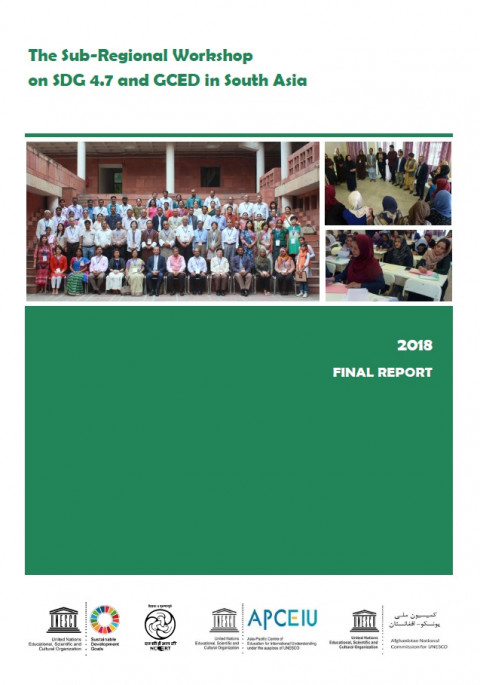 Final Report: 2018 Sub-regional Workshop on SDG 4.7 and GCED Год публикации: 2018 Организация-автор: APCEIU This report is the summary of the Sub-regional Workshop on SDG 4.7 and GCED in South Asia. Implemented by two occasions, the Workshop has offered the platform for the key educators from the South Asian region to discuss GCED in the regional context of achieving SDG 4.7. The report provides the overview of the two workshops held in India and Afghanistan in 2018.
  세계시민교육 학교 만들기 가이드 -전학교적 접근으로 실천하는 세계시민교육 Год публикации: 2018 Организация-автор: 유네스코 아시아태평양 국제이해교육원 '전학교적 접근으로 실천하는 세계시민교육'이라는 부제를 갖고 있는 본 도서는 학교 차원에서 세계시민교육을 실천할 때 참고할 수 있는 유용한 가이드를 제공한다. 세계시민교육은 지식뿐 아니라 가치관, 태도, 행동의 변화까지 아우르기 때문에 교실을 넘어 학교, 가정, 지역사회까지 그 실천 범위가 확장되었을 때 더욱 효과적이다. 본 도서는 세계시민교육의 범위를 확장시켜 전학교적으로 실천하기 위한 전략과 활동 계획 구축에 대한 가이드를 구체적으로 제공하고 있다. 또한, 현장의 목소리를 담아 세계시민교육을 실천하며 겪었던 어려움, 고민, 극복 방안, 참고 사례 등을 나누고자 하였다. 여는 글PART I. 함께 그려보는 세계시민교육 학교의 비전Step 1_세계시민교육 학교, 왜 필요한가요?Step 2_세계시민교육 학교, 누가 만들 수 있나요?Step 3_세계시민교육 학교, 어떻게 만들 수 있나요?Step 4_세계시민교육 학교, 무엇을 하면 되나요? PART II. 학교에 부는 변화의 바람Story 1_아이들을 위한 변화를 만드는 교사 Story 2_학교 변화의 디자이너, 교장Story 3_다시 생각하는 학교의 역할