
Ресурсы
Изучайте широкий спектр ценных ресурсов ВГГ, чтобы углубить своё понимание и повысить эффективность исследований, просветительской деятельности, преподавания и обучения.
Найдено: 1,983
 Achieving gender equality in and through education Год публикации: 2019 Организация-автор: GPE The purpose of this paper is to describe the current landscape in gender equality in education and spark discussion and debate around potential areas for Knowledge and Innovation Exchange (KIX) investment. The paper is part of a series of discussion papers, drafted to support the engagement and consultation of developing country partners and technical experts in the initial design of the GPE Knowledge and Innovation Exchange. Réaliser l’égalité entre les sexes, dans et par l’éducation Год публикации: 2019 Организация-автор: GPE Le présent document a pour objet de décrire la situation actuelle de l’égalité entre les sexes dans l’éducation et d’encourager l’examen des domaines dans lesquels le KIX pourrait investir. Il fait partie d’une série de documents de travail établis pour soutenir la consultation des pays en développement partenaires et des experts techniques, et les faire participer à la conception initiale du Mécanisme de partage de connaissances et d’innovations du PME. Les idées qu’il présente doivent servir de point de départ aux discussions et pourraient sensiblement évoluer au fil du processus de consultation.
  FramerSpace Организация-автор: Mahatma Gandhi Institute of Education for Peace and Sustainable Development (MGIEP) FramerSpace is an AI-powered digital platform where the curriculum’s content can be implemented in a multi-modal environment, data collected in an open and transparent manner and analysis done with ease and the highest data analytics capabilities in the pursuit of implementing personalised learning plans in a teacher driven setting. From the Content creator’s point of view, FramerSpace offers rich content creation abilities including embedding Audio, Rich Text, Video, Journaling, Games (developed using Unity/Phaser) to name a few. The platform framework design has been made extremely intuitive and powerful to help reduce the learning curve for creators significantly and make it look significantly different than any existing learning system out there. Creators are further armed with the real-time Emotion Analysis insights related to course reviews and related discussions and facilitated dialogues. These insights would help creators identify the emotion shift on pertinent topics and identify influencers by studying context-specific trends. FramerSpace has embedded analytics that helps creators always be mindful of what is working and what is not in terms of the learning outcomes of the respective courses. Predictive analytics within FramerSpace can potentially help creators take pro-active actions, especially in the case of at-risk learners who may be on the verge of dropping out. URL: https://framerspace.com/
 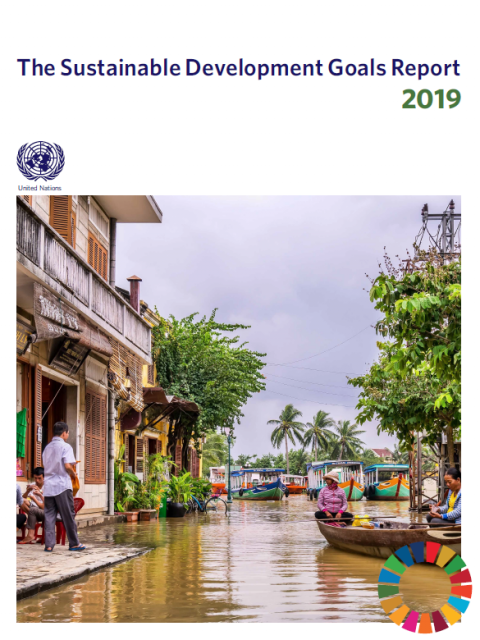 The Sustainable Development Goals Report 2019 Год публикации: 2019 Организация-автор: United Nations (UN) Four years after signing the 2030 Agenda for Sustainable Development, countries have taken action to integrate the Goals and targets into their national development plans and to align policies and institutions behind them. The Sustainable Development Goals Report 2019 uses the latest available data to track global progress on the SDGs and to take stock of how far we have come in realizing our commitments. The report shows that, while advances have been made in some areas, monumental challenges remain. The evidence and data spotlight areas that require urgent attention and more rapid progress to realize the 2030 Agenda’s far-reaching vision. Member States agree that these challenges and commitments are interrelated and call for integrated solutions. It is therefore imperative to take a holistic view of the 2030 Agenda and to identify the highest impact areas in order to target interventions. The most urgent area for action is climate change. If we do not cut record-high greenhouse gas emissions now, global warming is projected to reach 1.5°C in the coming decades. As we are already seeing, the compounded effects will be catastrophic and irreversible: increasing ocean acidification, coastal erosion, extreme weather conditions, the frequency and severity of natural disasters, continuing land degradation, loss of vital species and the collapse of ecosystems. These effects, which will render many parts of the globe uninhabitable, will affect the poor the most. They will put food production at risk, leading to widespread food shortages and hunger, and potentially displace up to 140 million people by 2050. The clock for taking decisive actions on climate change is ticking. The other defining issue of our time is increasing inequality among and within countries. Poverty, hunger and disease continue to be concentrated in the poorest and most vulnerable groups of people and countries. Over 90 per cent of maternal deaths occur in low- and middle-income countries. Three quarters of all stunted children live in Southern Asia and sub-Saharan Africa. People living in fragile States are twice as likely to lack basic sanitation, and about four times as likely to lack basic drinking water services as people in non-fragile situations. Youth are three times more likely to be unemployed than adults. Women and girls perform a disproportionate share of unpaid domestic work and lack autonomy in decision-making. Just as problems are interrelated, the solutions to poverty, inequality, climate change and other global challenges are also interlinked. Valuable opportunities exist to accelerate progress by examining interlinkages across Goals. For example, tackling climate change requires a shift to clean energy, reversing the trend in forest loss, and changing our production and consumption patterns. Promoting sustainable agriculture can help reduce both hunger and poverty, since close to 80 per cent of those who are extremely poor live in rural areas. Increasing access to safe drinking water, sanitation and hygiene can save millions of lives per year and improve school attendance. Improving proficiency in reading and mathematics of some 200 million children who are falling behind in sub-Saharan Africa will help them climb out of poverty and ultimately enable the region to better compete in the global marketplace. This report also highlights the importance of investing in data for the full implementation of the 2030 Agenda. Most countries do not regularly collect data for more than half of the global indicators. The lack of accurate and timely data on many marginalized groups and individuals makes them “invisible” and exacerbates their vulnerability. While considerable effort has been made to address these data gaps over the past four years, progress has been limited. Increased investment is urgently needed to ensure that adequate data are available to inform decision-making on all aspects of the 2030 Agenda. Towards that end, the Dubai Declaration, launched at the second World Data Forum in October 2018, outlines a demand-driven funding mechanism under Member States’ oversight that will respond quickly and efficiently to the priorities of national statistical systems.
 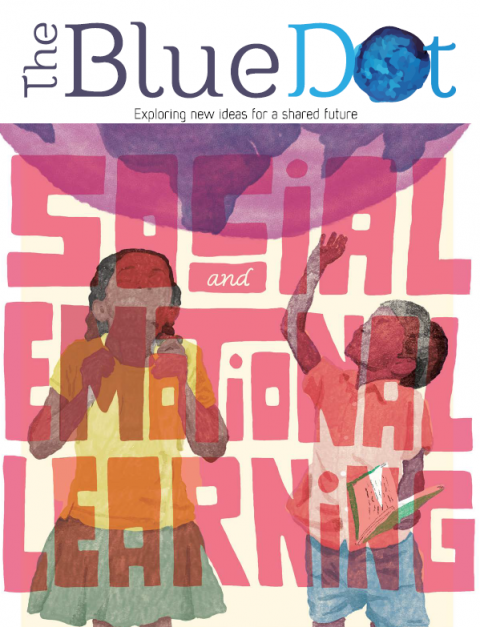 Social and emotional learning (The Blue Dot Issue 10, 2019) Год публикации: 2019 Организация-автор: Mahatma Gandhi Institute of Education for Peace and Sustainable Development (MGIEP) The tenth edition of The Blue DOT focuses on different aspects of social and emotional learning, including the neurosciences, teacher training, frameworks such as CASEL and SEE Learning and systemic SEL, amongst others. The issue includes a Foreword by Dr. Richard Davidson, William James and Vilas Professor of Psychology and Psychiatry at the University of Wisconsin–Madison and the Founder and Director of the Center for Healthy Minds, and our Cover Story that focuses on how SEL can help to achieve the United Nations Sustainable Development Goals (SDGs). Additionally, it features interviews and opinions from some of the world’s most prominent SEL experts on the importance of integrating SEL in our education systems. Amongst various experts, we hear from Kimberly Schonert-Reichl on her journey in SEL, Robert W. Roeser on “Educating the Head, the Heart and the Hand in the 21st Century” as well as Roger P. Weissberg and Joseph L. Mahoney on “What is Systemic Social and Emotional Learning and Why Does it Matter”? Further, a featured article with responses to a survey by teachers from 4 countries (Bhutan, India, South Africa and Sri Lanka), following the launch of the Institute’s SEL modules on Global Citizenship in a workshop conducted in New Delhi, India in April 2019 is presented. The modules have been rendered on MGIEP’s in house Artificial Intelligence (AI) driven digital platform now called FramerSpace (formerly CHI) and allow the student to have an interactive, instantaneous feedback and immersive experience while addressing contemporary issues such as migration, nationalism and violence.
  Right to Education Handbook Год публикации: 2019 Организация-автор: Right to Education Initiative (UK) The ultimate aim of this handbook is to facilitate the realization and universal enjoyment of the right to education. Its objective is not to present the right to education as an abstract, conceptual, or purely legal concept, but rather to be action-oriented. Where possible, practical guidance is given on how to implement and monitor the right to education along with recommendations to overcome persistent barriers. It seeks to do this by: Increasing awareness and knowledge of the right to education. This includes the normative content of the right to education, states’ legal obligations, the various sources of law regarding the right to education, what states must do to domestically implement the right to education, how to monitor the right to education, and how to increase accountability of the right to education. Providing a summary of current debates and issues regarding education and what human rights law says about them, including on forced migration, education in emergencies, the privatization of education, and the challenge of reaching the most marginalized. Providing an overview of the UN landscape and its mechanisms, including a clear understanding of the role of UNESCO and more generally the UN, as well as all relevant stakeholders in education, particularly civil society. UNESCO’s Strategy on standard-setting instruments in the field of education (2016-2021) encourages Member States of the Organization to use normative action in relation with the right to education as a strategic tool to implement and achieve SDG4. In line with this, this handbook – specifically foreseen by the Strategy– will also serve as a reference tool for the design and organization of training modules and workshops in the field of right to education. Finally, the handbook will also be an important reference for those working towards the achievement of SDG4, by offering guidance on how to leverage legal commitment to the right to education as a strategic way to achieve this goal.
 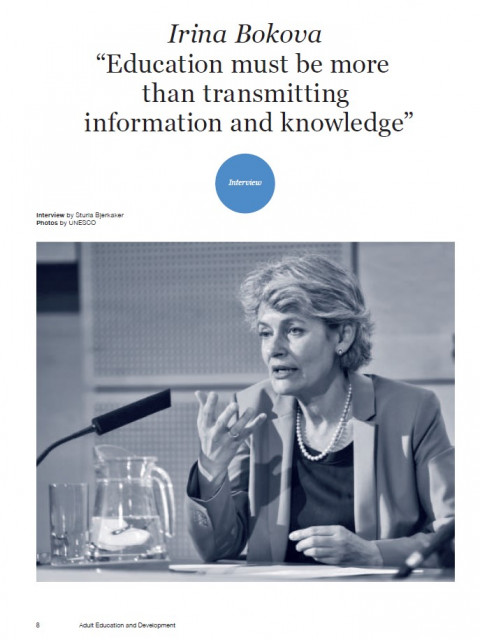 Education must be more than transmitting information and knowledge Год публикации: 2015 Автор: Sturla Bjerkaker Организация-автор: UNESCO. Director-General, 2009-2017 (Bokova, I.G.) Irina Bokova has been the Director-General of UNESCO since November 2009. She is the first woman to lead the organisation. Ms Bokova has served as Bulgaria’s Secretary of State for European Integration, Minister of Foreign Affairs, Ambassador to France and Monaco and Permanent Delegate to UNESCO, among other positions. She has been actively engaged in international efforts to advance quality education for all, gender equality, human rights, cultural dialogue and scientific cooperation. She also serves as Executive Secretary of the Steering Committee of the UN Secretary-General’s Global Education First Initiative.
  Intersections – Politiques et pratiques pour l’enseignement des religions et des visions non religieuses du monde en éducation interculturelle Год публикации: 2015 Автор: Robert Jackson Que peut apporter l’étude des religions et des visions non religieuses du monde à l’éducation interculturelle des élèves européens ? Dans une importante recommandation, la Recommandation CM/Rec(2008)12 relative à la dimension des religions et des convictions non religieuses dans l’éducation interculturelle, le Comité des Ministres du Conseil de l’Europe explique la nature et les objectifs de cet enseignement.Intersections va beaucoup plus loin, car il s’agit ici d’aider les décideurs, les établissements scolaires (enseignants et équipe de direction) et les formateurs d’enseignants à relever au mieux les défis que soulève la recommandation. En tenant dûment compte de l’avis de responsables pédagogiques, d’enseignants et de formateurs d’enseignants des États membres du Conseil de l’Europe, Intersections fournit des conseils pour, par exemple, comprendre la terminologie employée dans cette forme d’enseignement; développer des compétences d’enseignement et d’apprentissage, et adopter différentes approches pédagogiques; créer en classe un « espace sécurisant » propice au dialogue entre élèves; aider les élèves à analyser les représentations des religions dans les médias; parler à la fois des visions non religieuses du monde et des points de vue religieux ; aborder les questions de religions et de convictions sous l’angle des droits de l’homme ; et tisser des liens entre établissements scolaires (de différents types) et entre l’école et son environnement.Intersections n’est ni un programme à suivre ni un manifeste politique. L’ouvrage vise à donner aux décideurs, aux établissements scolaires et aux formateurs d’enseignants des États membres du Conseil de l’Europe, ainsi qu’à toutes les personnes intéressées, les outils nécessaires pour résoudre les problèmes d’interprétation de la recommandation et adapter son message aux besoins propres à chaque pays. Intersections est le fruit du travail d’un groupe international d’experts réunis sous les auspices du Conseil de l’Europe et du Centre européen Wergeland. Il a été rédigé au nom du groupe par le professeur Robert Jackson.
 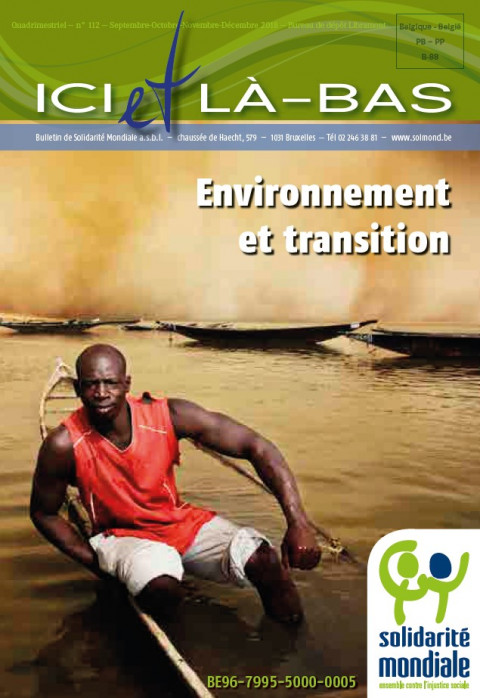 Environnement et transition (ici et là-bas) Год публикации: 2018 Организация-автор: Solidarité mondiale Les « Objectifs de Développement Durable » (ODD), adoptés en 2015 par les Nations unies, nous obligent à transformer notre monde. Nous devons prendre d’urgence des mesures pour lutter contre les changements climatiques et leurs répercussions. Si l’action humaine est à la base de ces changements climatiques, elle doit aussi être à la base des solutions. Cette prise de conscience est un fil rouge dans le travail de notre organisation. Les mouvements des travailleurs et travailleuses ont l’obligation d’intégrer le respect de l’environnement dans leurs stratégies, car la planète fixe les limites de tout développement durable ! J’espère que les actions concrètes de nos collègues en Afrique, Amérique latine et en Asie présentées dans notre revue, vous serviront de source de motivation et d’inspiration. Ces bonnes pratiques illustrent que le monde du travail est en train de bâtir, pas à pas, le chemin vers des économies à faibles émissions de carbone. Les personnes en situation pré- caire sont les plus touchées par les changements climatiques. Face à ce constat, nous défendons aussi que les politiques de protection sociale peuvent à la fois contribuer au renforcement des capacités individuelles pour s’adapter, et à l’atténuation des effets dévastateurs de ces changements.
 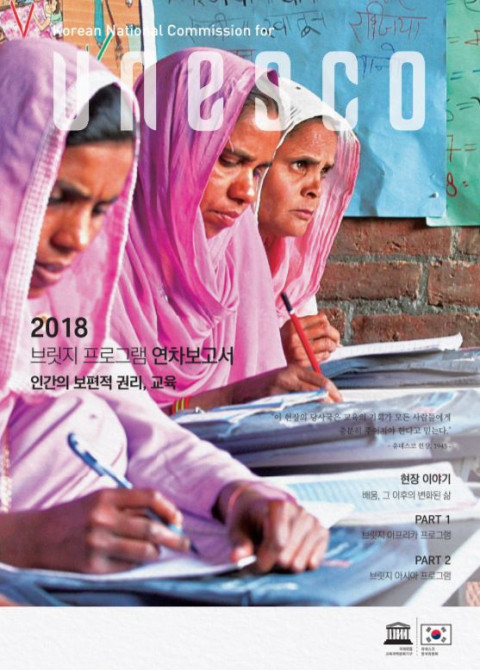 2018-2019 브릿지 프로그램 연차보고서 Год публикации: 2019 Организация-автор: 유네스코한국위원회 국제사회는 지속가능발전목표 4번(SDG4)를 통해 2030년까지 모든 이들에게 포용적이고 공평한 양질의 교육을 보장하고, 평생학습의 기회가 증진되도록 노력하자는 교육 기치를 내세웠다.특히 SDG4는 아동의 초등교육 강화에 중심을 둔 '새천년개발목표' 2번(MDG2)과 모든 연령대의 기초교육에 초점을 둔 '모두를위한교육'(EFA)의 미완의 목표를 포괄함은 물론, 기초교육 이후의 교육(중등, 고등) 및 훈련(직업,기술)을 평생학습 차원에서 촉진함으로써 교육의 보편성을 강조하고 있다. 유네스코한국위원회의 브릿지 사업은 이러한 국제사회의 노력에 동참하며, 교육의 보편적 기본권이 확산될 수 있도록 돕기 위해, 전 세계적으로 교육 소외자가 집중되어 있는 사하라 이남 아프리카 지역과 남아시아 지역의 모든 연련대 교육 소외자들을 대상으로 교육권 강화에 이바지하고 있다. 브릿지 사업은 나이, 성별, 종교 그리고 사회적 배경으로 인해 공교육으로부터 배제된 이들이 교육을 받음으로써 자존감을 회복하고 삶의 질을 향상시킬 수 있게 도우며, 이러한 개인의 성장만이 궁극적으로 지역사회의 변화와 발전으로 이어진다는 확신을 갖고 있다.이 보고서에서는 브릿지 아프리카 프로그램, 브릿지 아시아 프로그램과 국별 프로젝트 및 성과를 확인할 수 있다.