
Ресурсы
Изучайте широкий спектр ценных ресурсов ВГГ, чтобы углубить своё понимание и повысить эффективность исследований, просветительской деятельности, преподавания и обучения.
Найдено: 1,951
 Education for Social Peace Год публикации: 2018 Автор: Idris Sultan Saleh Организация-автор: Morocco. Ministry of Awqaf and Islamic Affairs The author reviews the concept of social peace and its importance for individuals and societies. Then he goes on to refer to Islamic religion and its framing of societies with social peace. The article concludes with a discussion of education in the light of social peace. التربية من أجل السلام الاجتماعي Год публикации: 2018 Автор: Idris Sultan Saleh Организация-автор: Morocco. Ministry of Awqaf and Islamic Affairs يستعرض الكاتب مفهوم السلام ألاجتماعي وأهميته للإفراد والمجتمعات. ومن ثم يستطرد في الاشارة للدين الاسلامي وتأطيره للمجتمعات بالسلام الاجتماعي. ويختم المقال بمناقشة التربية في ضوء السلام الاجتماعي.
  Asia-Pacific Education 2030: SDG 4 Midterm Review Год публикации: 2024 Организация-автор: UNESCO Institute for Statistics (UIS) | UNESCO Bangkok This publication marks the conclusion of the collaborative national midterm reviews of SDG 4 achievement in the Asia-Pacific. More importantly, it represents the beginning of the final sprint to the 2030 finish line. It also serves as a comprehensive analytical and policymaking tool for all stakeholders in the region to reflect and be better prepared for the second half of the journey. At the midway point of implementing the Education 2030 Agenda, we are observing both challenges and progress in achieving Sustainable Development Goal 4 (SDG 4) in the Asia-Pacific. The region, overall, has made advances in reaching the globally and regionally most important targets under SDG 4, yet it is still far from delivering the common commitment of the Education 2030 Agenda, to ‘ensure inclusive and equitable quality education and promote lifelong learning opportunities for all’. Eight years into implementation, the Asia-Pacific has shown progress, especially in improving access to lower levels of basic education, as well as expanding early childhood education (ECE). Across most subregions of Asia and the Pacific, over 95% of primary school students complete primary education within the expected timeframe, while more than 80% of children one year before the official primary entry age are enrolled in organized early childhood education. However, participation in education is only one part of the puzzle, and the quality of learning, evidenced by limited data for the Asia-Pacific region on learning outcomes, remains concerning. More than half of students in Eastern and South-Eastern Asia do not reach the minimum proficiency level in mathematics at the end of lower secondary education. Overall and from a regional perspective, with priorities having accelerated in ECE, primary education reaching universal participation, and higher education being consistently regarded as prestigious to accomplish, secondary education is currently the weakest link apart from the chronically undervalued technical vocational education and training path. Fulfilling our commitment to the Education 2030 Agenda and leaving no one behind is not an easy endeavour and we need everyone on board in this unprecedented, yet necessary feat. This publication is meant to facilitate taking stock of the current situation and accelerate focused advances on the most relevant education topics for the Asia-Pacific region.
  Education and Conflict: Complexity and Chaos Год публикации: 2003 Автор: Lynn Davies Based on the author's extensive research and experience of education in several areas afflicted by conflict, the book explores the relationship between schooling and social conflict and looks at conflict internal to schools. It posits a direct link between the ethos of a school and the attitudes of future citizens towards 'others'. It also looks at the nature and purpose of peace education and war education, and addresses the role of gender and masculinity. Education and Conflict: Complexity and Chaos Год публикации: 2003 Автор: Lynn Davies Basé sur une recherche approfondie de l'auteur et sur son expérience en terme d'éducation dans plusieurs zones affectées par des conflits, ce livre analyse la relation entre le fait d'aller à l'école et le conflit social, et s'attache aux conflits qui surviennent au sein des établissements scolaires. L’auteur postule un lien direct entre l'éthos adopté par une école donnée et le comportement de ses futures citoyens envers « les autres ». Il s'attache également à la nature et à l'objet de l'éducation pour la paix et de l'enseignement des conflits, et aborde la question du rôle joué par le genre et la masculinité.
  Schools and war: urgent agendas for comparative and international education Год публикации: 2005 Автор: Lynn Davies Организация-автор: Taylor & Francis This paper looks first at the contributions that education makes to conflict, through the reproduction of inequality and exclusion, through perpetuation of ethnic or religious divisions, through its acceptance of dominant aggressive masculinities, through selection, competition and fear, and through distorted curricular emphases on narrow cognitive areas of learning. However, the paper also outlines some ‘possibilities for hope’, such as resilient schools, the impact of peace education initiatives and the rise of global citizenship education. Schools and war: urgent agendas for comparative and international education Год публикации: 2005 Автор: Lynn Davies Организация-автор: Taylor & Francis Cet article examine en premier lieu les contributions de l'éducation aux conflits, à travers la reproduction de l'inégalité et de l’exclusion, la perpétuation des divisions ethniques ou religieuses, l’acceptation de la dominance de l’agressivité masculine ; à travers la sélection, la compétition et la peur, et à travers une déformation des programmes scolaires mettant l’accent sur des zones cognitives étroites de l'apprentissage. Toutefois, le document décrit également quelques « notes positives », telles que les écoles de la résilience, l'impact des initiatives de l'éducation à la paix et l’importance croissante donnée à l'éducation à la citoyenneté mondiale.
 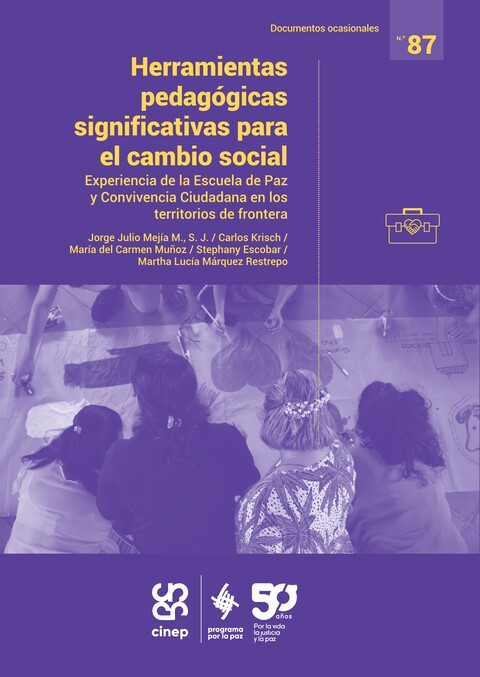 Significant Pedagogical Tools for Social Change Год публикации: 2023 Автор: Jorge Julio Mejía | Carlos Krisch | Sthepany Escobar | Martha Lucía | Márquez Restrepo | María Del Carmen Muñoz Организация-автор: Center for Research and Popular Education / Program for Peace (CINEP/PPP) This document includes significant pedagogical tools to promote processes of social change through training experiences for twelve years in territories on the Colombian-Venezuelan border. Through workshops and activities, participants have experienced transformations in attitudes and practices that have been useful for understanding the border as a shared space. Herramientas pedagógicas significativas para el cambio social Год публикации: 2023 Автор: Jorge Julio Mejía | Carlos Krisch | Sthepany Escobar | Martha Lucía | Márquez Restrepo | María Del Carmen Muñoz Организация-автор: Center for Research and Popular Education / Program for Peace (CINEP/PPP) En este documento se recogen las herramientas pedagógicas significativas para promover procesos de cambio social a través de experiencias formativas durante doce años en territorios de la frontera colombo-venezolana. Mediante talleres y actividades, los participantes han experimentado transformaciones en actitudes y prácticas que les han resultado útiles para comprender la frontera como un espacio compartido.
 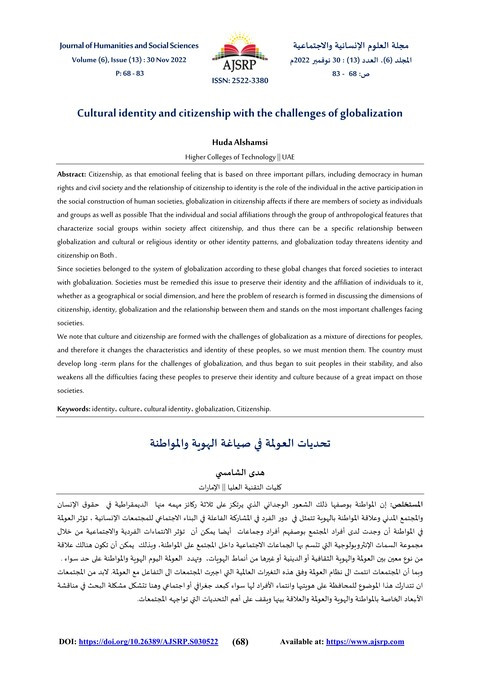 Cultural Identity and Citizenship With the Challenges of Globalization (Journal of Humanities and Social Sciences; Vol.6, No.13) Год публикации: 2022 Автор: Huda Alshamsi Организация-автор: Arab Institute of Science and Research Publishing (AISRP) Citizenship is the emotional feeling that is based on three important pillars, including democracy in human rights, civil society, and the relationship between citizenship and identity, is manifested in the active role of individuals in social construction within human societies. Globalization affects citizenship when it exists among individuals and groups in society. Individual and social affiliations, characterized by anthropological features within social groups, can also impact citizenship. Thus, there may be a specific relationship between globalization and cultural, religious, or other identity patterns. Today, globalization threatens both identity and citizenship. As societies adapt to the global system through these global changes that force interaction with globalization, it becomes essential for communities to address this issue to preserve their identity and individual belonging, whether geographically or socially. This forms the basis for researching the dimensions related to citizenship, identity, globalization, and their interrelationships, which pose significant challenges for societies.