
Ресурсы
Изучайте широкий спектр ценных ресурсов ВГГ, чтобы углубить своё понимание и повысить эффективность исследований, просветительской деятельности, преподавания и обучения.
Найдено: 1,983
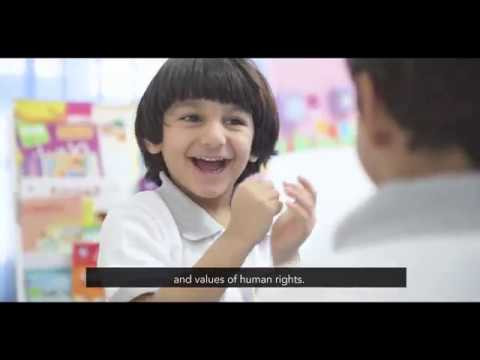 [Video] أكبر درس عالمي ٢٠١٨- أهداف التنمية المستدامة Год публикации: 2018 Организация-автор: Oman. Ministry of Education هذا الفيديو من انتاج وزارة التربية والتعليم بسلطنة عمان ، ويتحدث عن الأهداف التي ترنو لها وزارة التربية واتلعليم لتحقيق مفهوم التنمية المستدامة في الحقل البتربوي [Video] World's Biggest Lesson 2018 - Sustainable Development Goals Год публикации: 2018 Организация-автор: Oman. Ministry of Education This video is produced by the Ministry of Education in the Sultanate of Oman, and talks about the objectives of the Ministry of Education to achieve the concept of sustainable development in the field of education.
 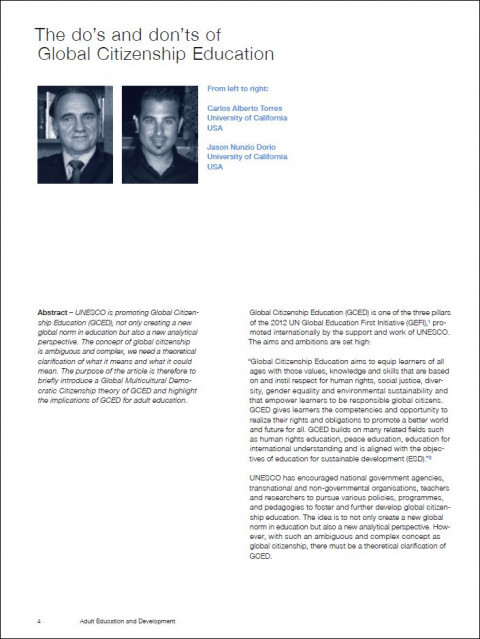 The Do's and Don’ts of Global Citizenship Education Год публикации: 2015 Автор: Carlos Alberto Torres | Jason Nunzio Dorio Организация-автор: Éducation des Adultes et Développement UNESCO is promoting Global Citizenship Education (GCED), not only creating a new global norm in education but also a new analytical perspective. The concept of global citizenship is ambiguous and complex, we need a theoretical clarification of what it means and what it could mean. The purpose of the article is therefore to briefly introduce a Global Multicultural Democratic Citizenship theory of GCED and highlight the implications of GCED for adult education. Qué hacer y qué evitar en la educación para la ciudadanía mundial Год публикации: 2015 Автор: Carlos Alberto Torres | Jason Nunzio Dorio Организация-автор: Éducation des Adultes et Développement La UNESCO está promoviendo la educación para la ciudadanía mundial (ECM), no solo creando una nueva normativa mundial sobre educación, sino introduciendo además una nueva perspectiva de análisis. Como el concepto de ciudadanía mundial es ambiguo y complejo, se requiere una aclaración teórica de lo que signifi ca y de lo que podría denotar. El objetivo de este artículo es, por tanto, exponer brevemente una teoría de ECM basada en una ciudadanía mundial democrática y multicultural, y subrayar las implicaciones de la ECM para la educación de adultos. Les choses à faire et à éviter dans le domaine de l’éducation à la citoyenneté mondiale Год публикации: 2015 Автор: Carlos Alberto Torres | Jason Nunzio Dorio Организация-автор: Éducation des Adultes et Développement L’UNESCO promeut l’éducation à la citoyenneté mondiale (ECM), en créant non seulement une nouvelle norme mondiale dans l’éducation, mais aussi un nouvel angle analytique. Le concept de la citoyenneté mondiale est ambigu et complexe. Aussi convient-il de mettre au point au plan théorique ce qu’il veut dire et ce qu’il pourrait vouloir dire. Par conséquent, cet article a pour objectif de présenter rapidement une théorie de l’ECM portant sur la citoyenneté mondiale multiculturelle et démocratique, et de mettre en lumière ce qu’implique l’ECM pour l’éducation des adultes.
 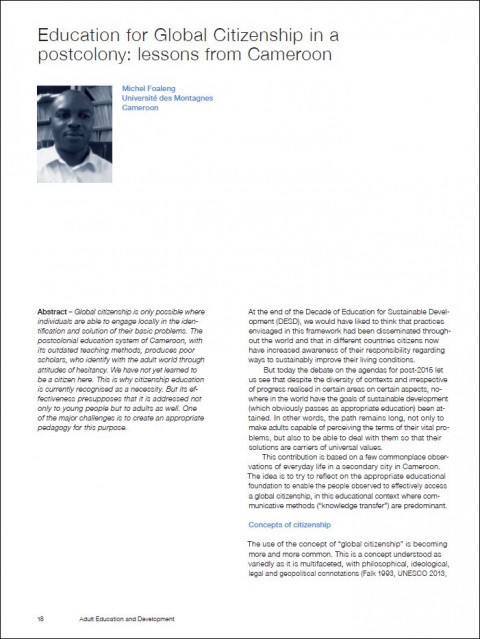 Education for Global Citizenship in a Postcolony: Lessons from Cameroon Год публикации: 2015 Автор: Michael Foaleng Организация-автор: Éducation des Adultes et Développement Global citizenship is only possible where individuals are able to engage locally in the identification and solution of their basic problems. The postcolonial education system of Cameroon, with its outdated teaching methods, produces poor scholars, who identify with the adult world through attitudes of hesitancy. We have not yet learned to be a citizen here. This is why citizenship education is currently recognised as a necessity. But its effectiveness presupposes that it is addressed not only to young people but to adults as well. One of the major challenges is to create an appropriate pedagogy for this purpose. Educación para la ciudadanía mundial en una nación postcolonial: lecciones de Camerún Год публикации: 2015 Автор: Michael Foaleng Организация-автор: Éducation des Adultes et Développement La ciudadanía mundial solo puede ejercerse allí donde las personas son capaces de participar a nivel local en la identifi cación y la solución de sus problemas básicos. El sistema postcolonial de educación de Camerún, cuyos métodos pedagógicos están obsoletos, forma estudiantes deficientes, que se identifi can con el mundo de los adultos mediante actitudes de vacilación. Aún no hemos aprendido a ser ciudadanos en este país. Por eso en la actualidad se reconoce la necesidad de impartir educación para la ciudadanía. Sin embargo, para que resulte efi caz es preciso que no solo esté orientada a los jóvenes, sino también a los adultos. Uno de los principales desafíos consiste en crear una pedagogía adecuada para alcanzar este objetivo. Éducation à la citoyenneté mondiale à l’ère postcoloniale : leçons du Cameroun Год публикации: 2015 Автор: Michael Foaleng Организация-автор: Éducation des Adultes et Développement Une citoyenneté mondiale n’est possible que là où localement les individus sont capables de s’engager dans l’identification et la résolution de leurs problèmes élémentaires. Le système éducatif du Cameroun postcolonial, avec ses méthodes pédagogiques désuètes, produit des déchets scolaires, qui se reconnaissent dans le monde des adultes par des attitudes attentistes. On n’a pas encore appris ici à être citoyen. C’est pourquoi l’éducation à la citoyenneté est actuellement reconnue comme une nécessité. Mais son efficacité présuppose qu’elle s’adresse non seulement aux jeunes, mais aussi adultes. L’un des défis majeurs reste alors d’imaginer une pédagogie appropriée à cet effet.
 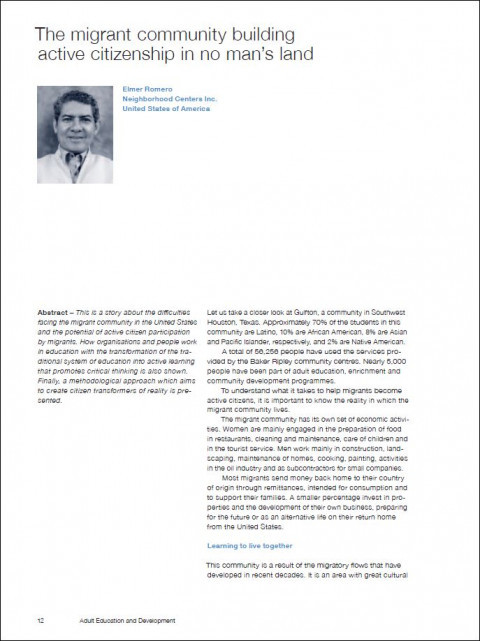 The Migrant Community Building Active Citizenship in No Man’s Land Год публикации: 2015 Автор: Elmer Romero Организация-автор: Éducation des Adultes et Développement This is a story about the difficulties facing the migrant community in the United States and the potential of active citizen participation by migrants. How organisations and people work in education with the transformation of the traditional system of education into active learning that promotes critical thinking is also shown. Finally, a methodological approach which aims to create citizen transformers of reality is presented. La comunidad migrante como constructora de la ciudadanía activa en tierra de nadie Год публикации: 2015 Автор: Elmer Romero Организация-автор: Éducation des Adultes et Développement Esta es una historia sobre las dificultades que afronta la comunidad migrante en Estados Unidos, y el potencial de participación ciudadana activa que poseen las y los migrantes. Asimismo, en esta nota se expone el papel de las entidades y personas que trabajan en el área educativa con respecto a la transformación del tradicional sistema de educación hacia un aprendizaje activo que propicie el pensamiento crítico. Por último, se da a conocer un abordaje metodológico que tiene como fin último formar a ciudadanos transformadores de la realidad.