
Ресурсы
Изучайте широкий спектр ценных ресурсов ВГГ, чтобы углубить своё понимание и повысить эффективность исследований, просветительской деятельности, преподавания и обучения.
Найдено: 948
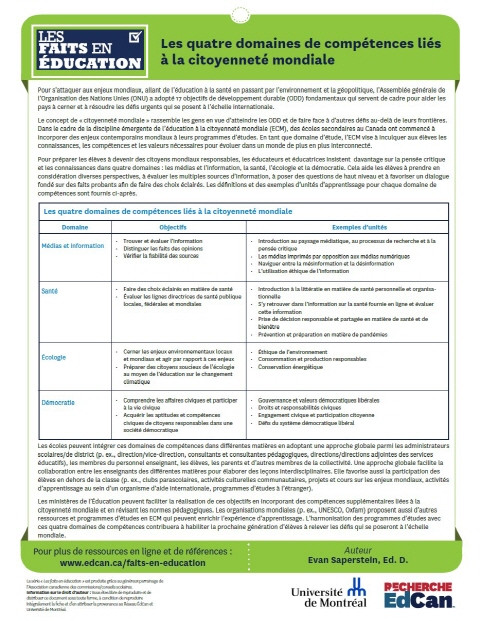 The Four Areas of Competence Linked to Global Citizenship Год публикации: 2023 Автор: Evan Saperstein Организация-автор: Université de Montréal | Association Canadienne d'Education Ce document présente les quatre domaines de compétences liées à la citoyenneté, et comment les intégrer à l'éducation des élèves. Pour préparer les élèves à devenir des citoyens mondiaux responsables, les éducateurs et éducatrices insistent davantage sur la pensée critique et les connaissances dans quatre domaines : les médias et l’information, la santé, l’écologie et la démocratie. This document presents the four areas of competency linked to citizenship, and how to integrate them into pupils' education. To prepare students to become responsible global citizens, educators are placing greater emphasis on critical thinking and knowledge in four areas: media and information, health, ecology and democracy. Les quatre domaines de compétences liés à la citoyenneté mondiale Год публикации: 2023 Автор: Evan Saperstein Организация-автор: Université de Montréal | Association Canadienne d'Education Ce document présente les quatre domaines de compétences liées à la citoyenneté, et comment les intégrer à l'éducation des élèves. Pour préparer les élèves à devenir des citoyens mondiaux responsables, les éducateurs et éducatrices insistent davantage sur la pensée critique et les connaissances dans quatre domaines : les médias et l’information, la santé, l’écologie et la démocratie. This document presents the four areas of competency linked to citizenship, and how to integrate them into pupils' education. To prepare students to become responsible global citizens, educators are placing greater emphasis on critical thinking and knowledge in four areas: media and information, health, ecology and democracy.
  2022 대한민국 SDG4 이행현황 보고서 Год публикации: 2023 Организация-автор: SDG4-교육2030협의체 | 유네스코한국위원회 SDG4-교육20230 협의체가 공동집필한 보고서로서, 2022년도 SDG4(교육분야 지속가능발전목표) 관련 국내외 동향을 소개하고 SDG4 세부목표별 국내 이행현황 및 과제를 분석하고 있다.
  3 minutes pour comprendre l’Europe Год публикации: 2021 Организация-автор: Toute l’Europe Vous n’êtes pas spécialiste des questions européennes ? Mais vous souhaitez en avoir une première approche sans vous confronter au jargon et discours trop technique ? Alors cette rubrique est pour vous ! Parce qu’il y a mille et une façons de parler de l’Union européenne, Toute l’Europe a choisi de vous présenter l’Europe “en toute simplicité” à travers des articles courts et faciles à lire. Une série d’épisodes de trois minutes, dans lesquels vous trouverez l’essentiel pour mieux comprendre l’Europe. You are not a specialist of European issues ? But you want to have a first approach without confronting yourself with too much technical language ? Then this section is for you ! Because there is a thousand and one ways to talk about the European Union, Toute l’Europe has chosen to present Europe "in all simplicity" through short and easy-to-read articles. A serie of three-minutes episodes in which you will find the essentials to better understand Europe.
  L'éducation aux médias, à l'information et à la citoyenneté numérique - rapport sur l'exercice 2022-2023 Год публикации: 2023 Организация-автор: Autorité de Régulation de la Communication audiovisuelle et numérique Pour la troisième année consécutive, l'Arcom présente un bilan rendant compte des actions entreprises par les médias audiovisuels en matière d'éducation aux médias, à l'information et à la citoyenneté numérique, et mettant en lumière des initiatives innovantes à l’échelle nationale ou européenne.For the third year in a row, Arcom is presenting a review reporting on actions undertaken by audivisual media, in the field of media education, information literacy, and digital citizenship, and highligthing innovative initiative on nationale and european scale.
  التربية على القيم دعامة أساسية في التنمية البشرية Год публикации: 2021 Автор: Souad MRIMI Организация-автор: Mohammed First University ركز الميثاق الوطني للتربية والتكوين بالمغرب على أهمية ترسيخ منظومة القيم من أجل بناء الإنسان باعتباره اللبنة الأساس في بناء المجتمع، كما يعد ترسيخ القيم والتربية عليها إحدى الدعامات المهمة في الرؤية الاستراتيجية لإصلاح منظومة التربية والتكوين، خصوصا بعد التقرير الأخير الذي أصدره المجلس الأعلى للتربية والتكوين والبحث العلمي بالمغرب، حول التربية على القيم في منظومة التربية والتكوين، والذي كشف عن اختلالات كثيرة في جانب القيم، يتجلى أهمها في "ضعف الانسجام في تعامل المدرسة مع قضايا القيم والتربية عليها. Value education is an essential pillar of human development Год публикации: 2021 Автор: Souad MRIMI Организация-автор: Mohammed First University The National Charter for Education and Training inMorocco had focused on the importance of consolidating the valuesystem to build the human being as one of the main element ofbuilding society, and the consolidation of values and value educationis one of the important pillars in the strategic vision to reform thesystem of education and training, especially after the recent report issued by the Higher Council for Education.
  Enseigner Témoigner Год публикации: 2024 Организация-автор: Ligue de l'enseignement, Fédération de Paris & Ibuka France En 1994, environ 1 million de Tutsi ont été tués au Rwanda. Le génocide perpétré contre les Tutsi au Rwanda constitue l’une des principales tueries du XXème siècle. Elle a été rendue possible par l’action d’extrémistes qui ont, pendant des années, attisé la haine anti-tutsi au sein de la population rwandaise à coup de préjugés, de fausses informations, d’accusations en miroir, de stratégie de manipulation et de conditionnement des esprits à la peur, à la haine et à la violence meurtrière.Avec l’inscription récente de son enseignement dans les programmes scolaires, de plus en plus d’enseignants travaillent avec leurs élèves sur cet événement majeur de l’histoire du XXème siècle. Parallèlement, des rescapés ressentent le besoin de témoigner pour partager leur histoire avec la jeune génération et prévenir ainsi les mécanismes qui ont rendu ce drame possible. Dans ce contexte, l’association Ibuka France et la Ligue de l’enseignement engagent une action commune pour proposer un accompagnement dans l’organisation et la gestion pédagogique d’une rencontre avec un témoin-rescapé en classe. Cet accompagnement vise à créer un cadre à la fois utile et sécurisant pour l’ensemble des acteurs engagés et impactés par le témoignage en classe. In 1994, around 1 million Tutsis were killed in Rwanda. The genocide perpetrated against the Tutsis in Rwanda is one of the major killings of the twentieth century. It was made possible by the actions of extremists who, for years, stirred up anti-Tutsi hatred among the Rwandan population by means of prejudice, false informations, mirror-image accusations, a strategy of manipulation and the conditioning of minds to fear, hatred and murderous violence.With the recent inclusion of the subject in school curricula, more and more teachers are working with their pupils on this major event in the history of the 20th century. At the same time, survivors are feeling the need to share their stories with the younger generation and prevent the mechanisms that made this tragedy possible. Against this backdrop, Ibuka France and the Ligue de l'enseignement have joined forces to offer support in organising and managing a meeting with a survivor-witness in the classroom. The aim of this support is to create a framework that is both useful and reassuring for all those involved and affected by the testimonial in the classroom.
 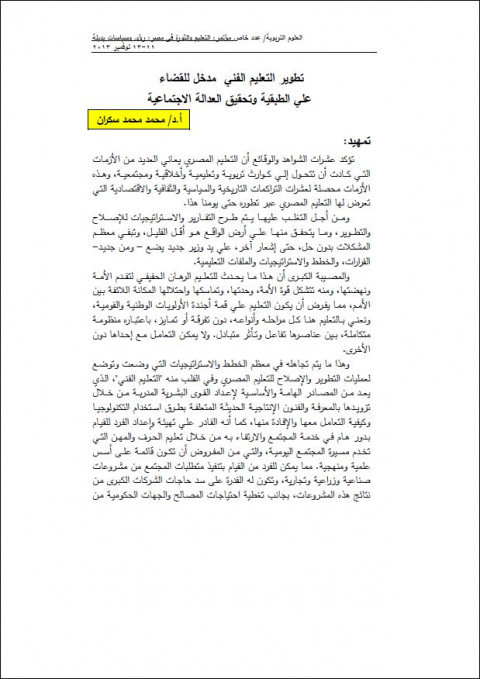 تطوير التعليم الفني : مدخل للقضاء على الطبقية وتحقيق العدالة الاجتماعية Год публикации: 2013 Автор: سكران، محمد محمد Организация-автор: Cairo University عرضت هذه الورقة لواقع التعليم الفني في مصر باعتباره يعاني وضعا مأساويا بسبب ظروف نشأته وموقعه بين نظم تعليمية لم تفسح للتعليم الفني مكانا فيها. من المشكلات التي تواجهه: 1) البطالة التي يعاني منها 80 % من خريجي هذه المدارس. 2) القصور الواضح في الإمكانيات المادية والبشرية، والنقص الواضح في المعدات والاعتماد في تدريب المجالات التطبيقية على الحفظ والاستظهار، وعدم الربط بين النظرية والتطبيق. 3) عدم وجود المشاركة والتنسيق بين التعليم الفني والمؤسسات الإنتاجية والخدمية، والعجز الشديد في العديد من التخصصات التي يحتاجها سوق العمل. 4) الغياب الواضح للقطاع الخاص في هذا النوع من التعليم. كما عرضت الورقة لبعض المقترحات التي يمكن أن تغير في الحد من الطبقية وتحقيق العدالة الاجتماعية للتعليم الفني في مصر، ومن هذه المقترحات: 1) ضرورة العمل على إعادة صياغة الأهداف الأساسية للتعليم الثانوي الفني في ضوء العوامل الاقتصادية والاجتماعية والسياسية المؤثرة في توجهات التنمية. 2) إعادة النظر في سياسة مؤسسات التعليم الثانوي الفني بحيث تتحول من مؤسسات تعليمية تقليدية إلى مؤسسات تعليمية إنتاجية وذلك من خلال تزويدها بالوسائل التعليمية الحديثة والاهتمام بالتأهيل والتدريب. 3) ضرورة الربط بين التخطيط للتعليم الفني والتخطيط للتنمية الاقتصادية والاجتماعية. 4) مواكبة سياسات وبرامج التعليم الفني للتقدم التكنولوجي المعاصر. Developing Vocational Education: An Introduction to Abolish Classism and Realize Social Justice Год публикации: 2013 Автор: سكران، محمد محمد Организация-автор: Cairo University The paper deals with technical education in Egypt that is going through a tragic situation due to its founding circumstances and its position among the education systems that do not allow technical education a space. The problems facing technical education include: 1) 80% unemployment among its graduates; 2) the obvious shortcomings in financial and human capacities, the obvious shortage in equipment, the relying on rote learning and the failure to connect theory to practice. 3) the lack of participation and coordination between technical education and institutions of production and services and the severe deficit in in the specializations that the labor market needs. 4) the clear absence of the role of the private sector in this type of education. The paper also presents some suggestions that could put a limit to class aspect in and create social justice for the technical education. The suggestions include: 1) the necessity to redefine the basic objectives of technical secondary education in light of the economic, social and political factors that influence the directions of development; 2) Reconsider the policies of the institutions of technical secondary education in order to transform them from traditional education institutions to productive technical ones by providing them with modern teaching means and attending to training and qualification; 3) the nescessity to connect technical education planning to the economic and social planning; 4) coping with the policies and programs of the of contemporary technological advancement.