
Ресурсы
Изучайте широкий спектр ценных ресурсов ВГГ, чтобы углубить своё понимание и повысить эффективность исследований, просветительской деятельности, преподавания и обучения.
Найдено: 2,275
 Centropa - Préservation de la mémoire uive - Apporter vie à l'histoire Centropa est un but non lucratif, institut historique juif dédié à la préservation du 20e histoires de famille juifs siècle et des photos de l'Europe centrale et orientale et les Balkans, et la diffusion de ces histoires et des photos à travers des films, des livres et des expositions. Les matériels pédagogiques disponibles sur ce site concernent des histoires individuelles et les aspects juifs way-de-vie de fournir une autre façon d'enseigner l'histoire.
 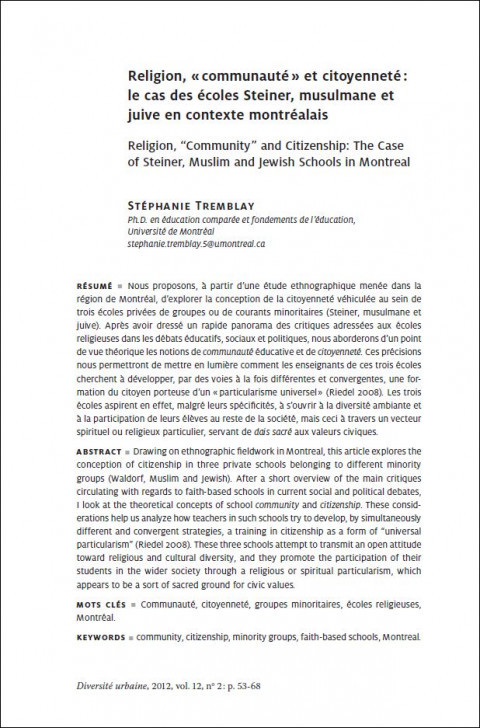 Religion, “Community” and Citizenship: The Case of Steiner, Muslim and Jewish Schools in Montreal Год публикации: 2012 Автор: Stéphanie Tremblay Организация-автор: Diversité urbaine Drawing on ethnographic fieldwork in Montreal, this article explores the conception of citizenship in three private schools belonging to different minority groups (Waldorf, Muslim and Jewish). After a short overview of the main critiques circulating with regards to faith-based schools in current social and political debates, I look at the theoretical concepts of school community and citizenship. These considerations help us analyze how teachers in such schools try to develop, by simultaneously different and convergent strategies, a training in citizenship as a form of “universal particularism” (Riedel 2008). These three schools attempt to transmit an open attitude toward religious and cultural diversity, and they promote the participation of their students in the wider society through a religious or spiritual particularism, which appears to be a sort of sacred ground for civic values.
 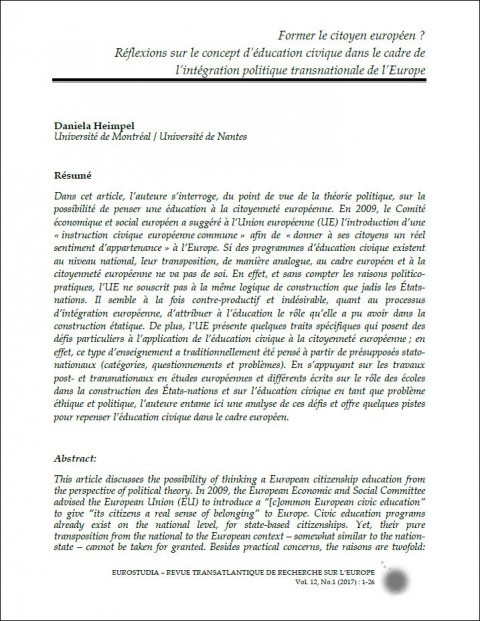 Training the European Citizen? Reflections on the Concept of Civic Education within the Framework of the European Transnational Integration Policy Год публикации: 2017 Автор: Daniela Heimpel Организация-автор: Eurostudia This article discusses the possibility of thinking a European citizenship education from the perspective of political theory. In 2009, the European Economic and Social Committee advised the European Union (EU) to introduce a “[c]ommon European civic education” to give “its citizens a real sense of belonging” to Europe. Civic education programs already exist on the national level, for state-based citizenships. Yet, their pure transposition from the national to the European context – somewhat similar to the nation-state – cannot be taken for granted. Besides practical concerns, the raisons are twofold: first, the EU does not follow the same logic of construction which once characterized the nation-state. It seems thus neither productive nor desirable to attribute education in the European integration process the same role it played in nation-building. Secondly, the EU has some specific features which pose challenges when civic education is applied to European citizenship; indeed, the concept of civic education has traditionally been thought on nation-state assumptions (categories, issues, problems). In this article, the author proposes an analysis of these challenges and indicates routes for re-thinking civic education in the framework of the EU. To do this, she relies on post- and transnational writings in European studies as well as on different studies on the role of schools in nation-state construction and research on civic education as a political and ethical problem. Former le citoyen européen ? Réflexions sur le concept d’éducation civique dans le cadre de l’intégration politique transnationale de l’Europe Год публикации: 2017 Автор: Daniela Heimpel Организация-автор: Eurostudia Dans cet article, l’auteure s’interroge, du point de vue de la théorie politique, sur la possibilité de penser une éducation à la citoyenneté européenne. En 2009, le Comité économique et social européen a suggéré à l’Union européenne (UE) l’introduction d’une « instruction civique européenne commune » afin de « donner à ses citoyens un réel sentiment d’appartenance » à l’Europe. Si des programmes d’éducation civique existent au niveau national, leur transposition, de manière analogue, au cadre européen et à la citoyenneté européenne ne va pas de soi. En effet, et sans compter les raisons politico-pratiques, l’UE ne souscrit pas à la même logique de construction que jadis les États-nations. Il semble à la fois contre-productif et indésirable, quant au processus d’intégration européenne, d’attribuer à l’éducation le rôle qu’elle a pu avoir dans la construction étatique. De plus, l’UE présente quelques traits spécifiques qui posent des défis particuliers à l’application de l’éducation civique à la citoyenneté européenne ; en effet, ce type d’enseignement a traditionnellement été pensé à partir de présupposés stato-nationaux (catégories, questionnements et problèmes). En s’appuyant sur les travaux post- et transnationaux en études européennes et différents écrits sur le rôle des écoles dans la construction des États-nations et sur l’éducation civique en tant que problème éthique et politique, l’auteure entame ici une analyse de ces défis et offre quelques pistes pour repenser l’éducation civique dans le cadre européen. The Holocaust Museum as an Educational Resource: A View from New York City This article deals with the role of the Holocaust museum as an educational resource. It presents a case study of the Museum of Jewish Heritage in New York City and considers its strengths and weaknesses in the light of research into how the Holocaust is taught in British and North American high schools. Among other things, the research shows that Jewish history tends to be equated with persecution and that anti-Semitism and the role of the church in sustaining it are often ignored. It further shows superficial treatment of a range of topics including Jewish resistance, rescue and the fate of non-Jewish minorities under the Nazis. The article pays particular attention to the way the museum deals with these issues and with the question of Jewish renewal in the post-Holocaust period. (By the author) Religion, « communauté » et citoyenneté : le cas des écoles Steiner, musulmane et juive en contexte montréalais Год публикации: 2012 Автор: Stéphanie Tremblay Организация-автор: Diversité urbaine Nous proposons, à partir d’une étude ethnographique menée dans la région de Montréal, d’explorer la conception de la citoyenneté véhiculée au sein de trois écoles privées de groupes ou de courants minoritaires (Steiner, musulmane et juive). Après avoir dressé un rapide panorama des critiques adressées aux écoles religieuses dans les débats éducatifs, sociaux et politiques, nous aborderons d’un point de vue théorique les notions de communauté éducative et de citoyenneté. Ces précisions nous permettront de mettre en lumière comment les enseignants de ces trois écoles cherchent à développer, par des voies à la fois différentes et convergentes, une formation du citoyen porteuse d’un « particularisme universel » (Riedel 2008). Les trois écoles aspirent en effet, malgré leurs spécificités, à s’ouvrir à la diversité ambiante et à la participation de leurs élèves au reste de la société, mais ceci à travers un vecteur spirituel ou religieux particulier, servant de dais sacré aux valeurs civiques.
 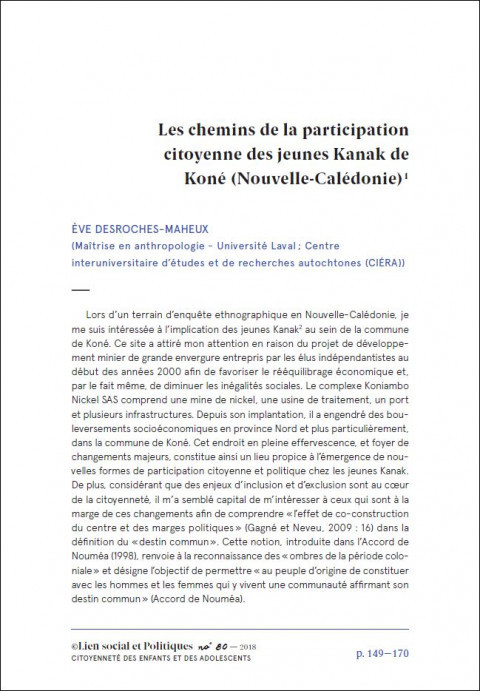 Paths Towards Citizen Participation Among Kanak Youth in Koné (New-Caledonia) Год публикации: 2018 Автор: Ève Desroches-Maheux Организация-автор: Lien social et Politiques Based on an ethnographic fieldwork, this article explores the forms and modalities taken by the civic participation of the Kanak youths living in Province Nord, New Caledonia. Being at the dawn of a referendum on its accession to a full sovereignty, this French territory of a sui generis status is now at a turning point in its history. In preparation for this event, the Nouméa Accord laid the foundations of a New-Caledonian citizenship, situated, for the moment, within the French citizenship. However, this citizenship in construction poses the question of the place given in it to the Kanak, the indigenous people of the territory. Approaching citizenship as a set of “political subjectivation processes” producing a citizenship simultaneously “determined by the state and by the subjects composing it ”, we explore the answers and “negotiation attempts” made by the Kanak youths toward it. Results show that despite some negative representations playing against them, the youths still appropriate possibilities opened up by public policies and programs in hope to make their grievances heard and to implement structuring projects. Furthermore, as those forms of civic practices are used as handles to resist French hegemony in Province Sud by youths that seek above all to strongly affirm their Kanak identities, north youth participation in the public space appears rather embedded in an inclusive approach toward other communities. Les chemins de la participation citoyenne des jeunes Kanak de Koné (Nouvelle-Calédonie) Год публикации: 2018 Автор: Ève Desroches-Maheux Организация-автор: Lien social et Politiques En partant d’un terrain ethnographique, cet article explore les formes et modalités de la participation « citoyenne » des jeunes Kanak vivant en province Nord, en Nouvelle-Calédonie. Étant à l’aube du référendum sur son accession à la pleine souveraineté, ce territoire français de statut sui gereris se situe à un moment charnière de son histoire. En préparation à cet événement, l’accord de Nouméa vint poser les bases d’une nouvelle citoyenneté néo-calédonienne située, pour le moment, à l’intérieur de la citoyenneté française. Cette citoyenneté en construction pose toutefois la question de la place qui y est accordée aux Kanak, peuple autochtone du territoire. Abordant la citoyenneté comme un ensemble de « processus de subjectivation politique », produisant une citoyenneté à la fois « déterminée par l’État et par les sujets qui la composent », nous explorerons les réponses et « tentatives de négociations » de jeunes Kanak envers cette dernière. Les résultats montrent que malgré les représentations négatives qui pèsent sur eux, les jeunes s’approprient les possibilités ouvertes par les politiques et les programmes publics dans l’espoir de faire entendre leurs doléances et de mettre en oeuvre des projets structurants. De plus, alors que ce type de pratiques citoyennes constituent un levier de résistance face à l’hégémonie française en province Sud pour les jeunes qui cherchent avant tout à y affirmer leur identité kanak, l’implication des jeunes du Nord dans l’espace public s’inscrit plutôt dans une démarche inclusive face aux autres communautés.
 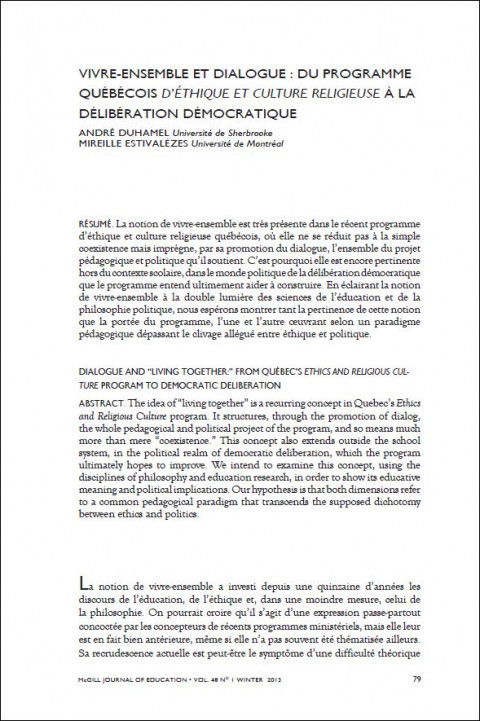 Vivre-ensemble et dialogue : du programme québécois d’éthique et culture religieuse à la délibération démocratique Год публикации: 2013 Автор: André Duhamel | Mireille Estivalèzes Организация-автор: McGill University. Faculty of Education La notion de vivre-ensemble est très présente dans le récent programme d’éthique et culture religieuse québécois, où elle ne se réduit pas à la simple coexistence mais imprègne, par sa promotion du dialogue, l’ensemble du projet pédagogique et politique qu’il soutient. C’est pourquoi elle est encore pertinente hors du contexte scolaire, dans le monde politique de la délibération démocratique que le programme entend ultimement aider à construire. En éclairant la notion de vivre-ensemble à la double lumière des sciences de l’éducation et de la philosophie politique, nous espérons montrer tant la pertinence de cette notion que la portée du programme, l’une et l’autre oeuvrant selon un paradigme pédagogique dépassant le clivage allégué entre éthique et politique. Dialogue and Living Together: From Québec’s Ethics and Religious Culture Program to Democratic Deliberation Год публикации: 2013 Автор: André Duhamel | Mireille Estivalèzes Организация-автор: McGill University. Faculty of Education The idea of “living together” is a recurring concept in Quebec’s Ethics and Religious Culture program. It structures, through the promotion of dialog, the whole pedagogical and political project of the program, and so means much more than mere “coexistence.” This concept also extends outside the school system, in the political realm of democratic deliberation, which the program ultimately hopes to improve. We intend to examine this concept, using the disciplines of philosophy and education research, in order to show its educative meaning and political implications. Our hypothesis is that both dimensions refer to a common pedagogical paradigm that transcends the supposed dichotomy between ethics and politics.