
Ресурсы
Изучайте широкий спектр ценных ресурсов ВГГ, чтобы углубить своё понимание и повысить эффективность исследований, просветительской деятельности, преподавания и обучения.
Найдено: 2,255
 UNESCO Malala Fund for Girls' Right to Education: 2017 annual report Год публикации: 2018 Организация-автор: UNESCO The brutal assassination attempt made against Pakistani teenager and activist for girls’ education Malala Yousafzai gave birth to the UNESCO Malala Fund for Girls’ Right to Education. Part of the “Better Life, Better Future” Global Partnership for Girls’ and Women’s Education, the fund was established in 2012 to expand girls’ access to quality and gender-responsive education and ensure safe learning environments, especially in countries affected by conflict and disaster. The Islamic Republic of Pakistan initially committed 10 million USD to the Fund, and since 2014 the CJ Group is another major contributor to the Fund, along with other supporters.Fund objectivesThe Fund supports the implementation of holistic programmes which aim to: Expand access to education for girls and women, especially those hardest to reach and affected by conflict and disaster Improve the quality and relevance of education, ensuring that content, teaching practices, learning processes and environments are gender-sensitive Strengthen policy and capacity to ensure safe learning environments
  Water Security and the Sustainable Development Goals (Global Water Security Issues Series, 1) Год публикации: 2019 Организация-автор: UNESCO | International Centre for Water Security and Sustainable Management (i-WSSM) The ‘Global Water Security Issues (GWSI) series’ is the product of synergy within the UNESCO system, in particular the International Water Security and Sustainable Management (i-WSSM).The first edition of the GWSI series also seeks to demonstrate that water has a central role in all aspects of economic development and social welfare, and that concerted action via a collective approach of the water-using sectors is needed to ensure water’s many benefits are maximized and shared equitably and that water-related development goals are achieved.While this publication is factual, containing the most current information available concerning the state of knowledge on water security in the perspective of sustainable development and covering the most recent developments that affect it, this publication also provides decision-makers with concrete examples of approaches and potential responses for addressing water security-related challenges from the perspectives of both the sustainable development goals (SDGs) and a broader political and sectoral scope, which covers development, financing, capacity-building, institutional reform and technology.It is hoped that this publication will be a reference source on water security as it covers all aspects of human development and the cases and solutions introduced in the GWSI series can be invaluable for decision-makers, their advisors and anyone interested in – and concerned about – water security, and that this first edition will reach an ever-widening audience that includes actors outside the ‘water box’ who make or influence broad socio-economic policies that can affect water security.
  Education for Sustainable Development: Partners in Action; Global Action Programme (GAP) Key Partners' Report (2015-2018) Год публикации: 2019 Организация-автор: UNESCO The Global Action Programme (GAP) on Education for Sustainable Development (ESD) was launched by UNESCO as a follow up to the United Nations Decade of ESD in order to accelerate progress on sustainable development and scale up action in all areas of education and learning. Its duration is from 2015 to 2019.To that end, UNESCO works with a network of 97 GAP Key Partners from government, civil society, the private sector and academia active in five Priority Action Areas: advancing policy, transforming learning environments, building the capacity of educators, empowering youth, and accelerating sustainable solutions at the local level. Each GAP Key Partner committed to meet specific targets by 2019. To measure progress in meeting the targets set by the GAP Key Partners, 10 indicators were identified, two in each Priority Action Area. Through surveys sent to them by UNESCO, GAP Key Partners report against these 10 indicators and toward the targets set for each indicator. In the surveys, GAP Key Partners are also invited to rate the benefits of participation in the GAP for their work and provide qualitative data concerning their implementation progress. Three progress reports are scheduled to be produced: The first report, covering progress between 2015 and 2016, was released by UNESCO in 2017 This second report, covering 2015-2018, is to be published in 2019 The third and final report, covering the entire period of the GAP, 2015-2019, will be published in 2020 This second report presents the results of the GAP Key Partners survey carried out at the end of 2018, with a response rate of 78%. The report presents the analysis of the quantitative responses of GAP Key Partners to each of the 10 indicators. Based on the qualitative responses provided by the GAP Key Partners, a short comment on each of the progress status is also provided. Éducation en vue du développement durable: Partenaires dans l’action; Rapport des partenaires clés du Programme d’action global (2015-2019) Год публикации: 2019 Организация-автор: UNESCO Le Programme d’action global pour l’éducation en vue du développement durable (EDD) a été lancé par l’UNESCO dans le cadre du suivi de la Décennie des Nations Unies pour l’éducation au service du développement durable afin de donner un coup d’accélérateur à la réalisation des objectifs de développement durable et d’intensifier l’action en faveur de l’EDD dans tous les domaines de l’éducation et de l’apprentissage. Le Programme a été mis en œuvre entre 2015 et 2019. L’UNESCO a travaillé avec un réseau constitué des 97 partenaires clés du Programme d’action global. Issus des gouvernements, de la société civile, du secteur privé et de l’université, ces partenaires interviennent dans cinq domaines d’action prioritaires : promouvoir des politiques, transformer les environnements d’apprentissage, renforcer les capacités des éducateurs, autonomiser les jeunes et accélérer la recherche de solutions durables à l’échelle locale. Les partenaires clés du Programme d’action global se sont engagés à atteindre des objectifs précis en 2019. Dix indicateurs, soit deux par domaine d’action prioritaire, ont été définis.Les partenaires clés du Programme d’action global ont rendu compte des progrès accomplis au regard de ces indicateurs à l’aide des trois enquêtes que l’UNESCO leur a envoyées au cours de la mise en œuvre du Programme.Les partenaires clés ont par ailleurs été invités à évaluer en quoi leur participation au Programme d’action global avait été bénéfique à leurs activités et à fournir des données qualitatives sur le déroulement de la mise en œuvre. Trois rapports d’étape ont ainsi été produits : le premier rapport, relatif aux progrès accomplis en 2015 et 2016, a été publié par l’UNESCO en 2017 ; le second, qui concerne la période de 2015 à 2018, est paru en 2019 ; le troisième et dernier rapport (le présent document) couvre l’ensemble de la période de mise en œuvre du Programme d’action global, de 2015 à 2019. Le présent rapport livre une analyse des données quantitatives fournies par les partenaires clés du Programme d’action global pour chacun des dix indicateurs. En s’appuyant sur ces données quantitatives, il indique brièvement quels ont été les progrès réalisés par rapport aux indicateurs. On trouvera en conclusion de ce bref rapport quelques-uns des enseignements tirés du Programme d’action global qui pourront utilement guider la mise en œuvre du nouveau cadre global établi pour la période 2020-2030, L’éducation en vue du développement durable : vers la réalisation des ODD (L’EDD pour 2030).
  Proposal for a Global Action Programme on Education for Sustainable Development as Follow-up to the United Nations Decade of Education for Sustainable Development (DESD) after 2014 Год публикации: 2013 Организация-автор: UNESCO The present document contains the proposal for a Global Action Programme on Education for Sustainable Development (ESD) and the comments and observations of the Executive Board thereon.
  برنامج الملك عبد الله بن عبد العزيز الدولي لثقافة السلام والحوار: أهم منجَزات المرحلة الأولى Год публикации: 2016 Организация-автор: منظمة الأمم المتحدة للتربية والعلم والثقافة (UNESCO) انبثق برنامج الملك عبد الله بن عبد العزيز الدولي لثقافة السلام والحوار من الإطار المؤسسي لبرنامج اليونسكو لثقافة السلام واللاعنف.إن ثقافة السلام لا تقتصر على كونها مفهوماً بل تتعداه إلى كونها التزاماً بجعل السلام واقعاً ملموساً للجميع. فهي تعبِّ عن “مجموعة من القيم والمواقف والتقاليدوأنماط السلوك وأساليب الحياة تستند إلى [...] احترام الحياة وإنهاء العنف [... و] التمسك بمبادئ الحرية والعدل والديمقراطية والتسامح والتضامنوالتعاون والتعددية والتنوع الثقافي والحوار والتفاهم على مستويات المجتمع كافة وفيما بين الأمم” (المادة 1 من إعلان وبرنامج العمل بشأن ثقافة السلام،اليونسكو، 1999 ). وتثابر اليونسكو على العمل لغرس ثقافة السلام مع مراعاة اعتبارات التنمية، بمضافرة القوى مع أصحاب المصلحة الملتزمين فيمجال التربية والعلوم والثقافة، والاتصال والإعلام.
  Promouvoir l’education a la citoyennete mondiale en afrique de l’ouest : Atelier international de renforcement de capacités des pays de la CEDEAO 07 – 09 Juillet 2015, Dakar, Sénégal Год публикации: 2015 Организация-автор: Организация Объединенных Наций по вопросам образования, науки и культуры (UNESCO) Ce rapport est le fruitde l’atelier international de renforcement de capacités organisé par l’UNESCO dans l’objectif de renforcer les capacités des pays membres de la Communauté économique des États de l'Afrique de l'Ouest (CEDEAO) pour la promotion de l’Education à la citoyenneté mondiale aux niveaux nationaux et régionaux. Autonomiser des citoyens du mon de actifs et construire un sens d’appartenance à une humanité commune ne font pas uniquement partie du mandat de l’UNESCO mais sont aussi des problèmes prioritaires pour l’Afrique de l’Ouest. Ce rapport d’atelier fournit des ressources, stratégies et feuilles de routes pour l’avancée et une meilleure intégration de l’ECM dans les politiques et les programmes éducatifs en Afrique de l’Ouest. Les feuilles de route ont été proposées par les Etats membres eux-mêmes et leur mise en œuvre dépendra de la disponibilité des ressources et des partenariats potentiels.
  The COVID-19 Pandemic of Disinformation and Hate Speech: How can Education and Digital Citizenship Help? ; Synthesis Report Год публикации: 2020 Организация-автор: UNESCO COVID-19 is not only one of the most significant health crises of our times, but is also an information crisis taking place in a dynamic and constantly evolving scientific environment with uncertainty on many fundamental issues. The information crisis is the result of the plethora of available information and the difficulty in differentiating true from false -or even fake- information, and identifying what content is in a grey and evolving scientific zone.In this context, education can play an important role in minimizing these risks and promoting values of solidarity and human rights by ensuring that young people, as well as their educators and parents, acquire core competencies of digital citizenship that build resilience to disinformation and misinformation and the exploitation of these by hate-mongers. Education can also help young people engage in the online environment in a safe, sensitive, critical, ethical and accountable way as well as encourage them to play a role in pioneering educational initiatives that contribute to promoting digital citizenship.
 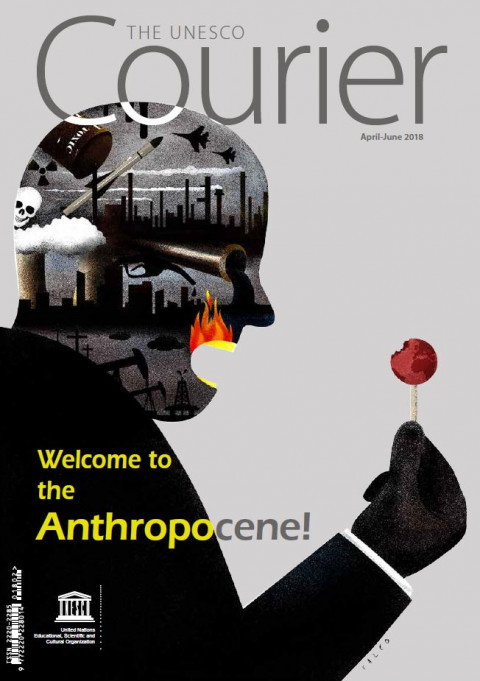 Welcome to the Anthropocene! (The UNESCO Courier no. 2, April-June 2018) Год публикации: 2018 Организация-автор: UNESCO In the Ideas section of this issue, three internationally celebrated academics consider the notion of diversity – Mireille Delmas-Marty, a member of the Institut de France; Souleymane Bachir Diagne, Senegalese philosopher; and Abdourahman Waberi, novelist and diarist from Djibouti. With these articles, the Courier marks the celebrations of the World Day for Cultural Diversity for Dialogue and Development (21 May) and the International Day for Biological Diversity (22 May).Our Guest for this issue is Bibi Russell, a fashion designer from Bangladesh. A former top model in London, she quit the catwalk to devote herself to using fashion for development. She is currently working in India, helping young women, some of whom were trafficked as children, to find their bearings and start a new life.To mark UNESCO’s Africa Week in May, we focus on youth in the West and the South of the continent, in our Current Affairs section. After visiting Athens, World Book Capital 2018, we travel to Canada’s Northwest territories, on the other side of the world, to discover the people of Great Bear Lake, in the Tsá Tué biosphere reserve – established and looked after by the indigenous community that lives there.Finally, Zoom invites us to follow an ordinary day in the life of Qello, a 13-year old girl in Ethiopia, hour by hour.The UNESCO Courier celebrates its 70th birthday in 2018. Each issue this year will feature an article that looks back at this extraordinary adventure. In this issue, Roberto Markarian, Rector of the University of the Republic, Uruguay, recounts the story of the role the Courier has played in his life. Bienvenue dans l'Anthropocène! (Le Courrier de l'UNESCO no. 2; Avril-Juin 2018) Год публикации: 2018 Организация-автор: Organisation des Nations Unies pour l'éducation, la science et la culture (UNESCO) Selon les uns, l’Anthropocène n’est qu’un autre nom pour l’époque que nous appelons Holocène, les humains ayant commencé à exercer une pression sur l’environnement depuis 10 000ans, c’est-à-dire depuis leur sédentarisation et l’invention de l’agriculture. Selon d’autres, l’Anthropocène commencerait autour de 1800, avec la révolution industrielle. D’autres encore voient l’Anthropocène éclore dupremier champignon atomique de 1945. Malgré ces divergences, très rares sont ceux qui ne reconnaissent pas qu’au cours du dernier demi-siècle l’état de la planète s’est dégradé plus rapidement et plus dramatiquement que jamais : amasgigantesques de plastique sur les plages et dans les mers, développement sans précédent de nouveaux matériaux qui couvrent la surface terrestre et ne se recyclent que très peu, sols gorgés d’engrais, augmentation du taux d’acidité des mers, tauxde pollution sans précédent, érosion des forêts tropicales, dérèglement desécosystèmes, extinction massive des espèces et diminution drastique de la biodiversité, réchauffement climatique...À qui la faute ? Auxhumains – répond lamajorité des scientifiques. Reste à savoir si nous devrions tous porter la même charge deresponsabilité. Certains blâmant avant tout le système capitaliste né en Occident, parlent de Capitalocène ou d’Occidentalocène. Courons-nous à la catastrophe? Des voix s’élèvent pour prophétiser la fin du monde! Des notions comme Chtulhucène ou Thanatocène sont avancées pour signifier que le monstre rôde, quela mort nous guette... Des experts, bien plus modérés, n’en sont pas moins inquiets face à l’indécision des décideurs. «Tout se passe comme si l’humanité, léthargique, attendait la fin du film et le moment où les héros viendront tout arranger et où nous serons tous heureux pour toujours», lira-t-on dans ces pages.Le débat fait rage, les solutions tardent à venir. Le Courrier fait le point.