
Ресурсы
Изучайте широкий спектр ценных ресурсов ВГГ, чтобы углубить своё понимание и повысить эффективность исследований, просветительской деятельности, преподавания и обучения.
Найдено: 2,255
 4th Meeting of the SDG-Education 2030 Steering Committee, Paris, 28 February-02 March 2018: meeting report Год публикации: 2018 Организация-автор: UNESCO This report summarizes the deliberations, the main recommendations adopted, and the decisions made at the 4th meeting of the SDG-Education 2030 Steering Committee (Paris, 28 February - 2 March 2018).The objectives of the meeting were: To define positions and recommendations of the SDG-Education 2030 Steering Committee on key strategic areas. To agree on a strategy for global review, monitoring and reporting process, in view of HLPF 2018 and the 2019 Reviews. To refine the advocacy, communication and outreach strategy of the SDG-Education 2030 Steering Committee To define next steps for the SDG-Education 2030 Steering Committee (next meeting, rotation of members, and the Global Education Meeting 2018). Quatrième Réunion du Comité directeur ODD-Education 2030, Paris, 28 février-02 mars 2018: rapport de la reunion Год публикации: 2018 Организация-автор: Organisation des Nations Unies pour l'éducation, la science et la culture (UNESCO) Le présent rapport résume les débats qui ont eu lieu lors de la quatrième réunion du Comité directeur ODD – Éducation 2030 (Paris, 28 février – 2 mars 2018) et reprend les principales recommandations et décisions adoptées.La réunion s’était fixé les objectifs suivants : Définir les positions et les recommandations du Comité directeur ODD – Éducation 2030 dans des domaines stratégiques clés. Convenir d’une stratégie globale portant sur le processus d’examen, de suivi et d’établissement de rapports en vue de l’examen du HLPF 2018 et 2019. Affiner la stratégie du Comité directeur ODD – Éducation 2030 en matière de plaidoyer, de communication et de sensibilisation. Définir les prochaines étapes du Comité directeur ODD – Éducation 2030 (prochaine réunion, renouvellement des membres et Réunion mondiale sur l’éducation 2018).
  Making evaluation work for the achievement of SDG 4 target 5: equality and inclusion in Education Год публикации: 2019 Организация-автор: UNESCO The adoption of the Sustainable Development Goals (SDGs) and the Education 2030 Framework for Action has placed gender parity, equality and inclusion in education at the heart of the international development agenda and is specifically formulated in SDG 4 Target 5. Now, as never before, relevant and contextualised evidence, driven in part by robust evaluation data, is needed to track and strengthen progress on educational equity. To this end, a group of international organisations, led by UNESCO, have combined efforts to explore how their education evaluations can better support Member States to strengthen progress on gender parity, equality and inclusion in education. The following report synthesises evidence from publicly available independent evaluations from 13 organisations, highlighting evidence gaps and summarising ‘what works’ for whom and in what contexts for advancing gender equality and equity for vulnerable groups. The study also reports on responses to the synthesis from national stakeholders in five countries: Ghana, Guatemala, Lebanon, Nepal and Peru. The report culminates in a discussion and recommendations, which outline the need for greater coordination and collaboration in four key areas to further enhance the contribution of evaluations to global and country level progress on SDG 4 Target 5.
  [Video] UNESCO - Futures of Education: Learning to Become Год публикации: 2019 Организация-автор: UNESCO UNESCO’s Futures of Education initiative aims to rethink how knowledge and learning can shape the future of humanity and the planet. Looking to 2050 and beyond, the initiative seeks to reimagine how education and knowledge can contribute to the global common good. The initiative is catalyzing a global debate on how knowledge, education and learning need to be reimagined in a world of increasing complexity, uncertainty, and precarity. This initiative mobilizes the many rich ways of being and knowing in order to leverage humanity’s collective intelligence. It relies on a broad, open consultative process that involves youth, educators, civil society, governments, business and other stakeholders. The work is being guided by a high-level International Commission of thought-leaders from diverse fields and different regions of the world. In late 2021, the commission will publish a global report designed to share a forward looking vision on how education and learning can enable us to become what we want to become.
  YouthXchange: green skills and lifestyles guidebook Год публикации: 2016 Автор: Ryder. Guy, Steiner. Achim Организация-автор: UNESCO | United Nations Environment Programme (UNEP) | UNESCO. Director-General, 2009-2017 (Bokova, I.G.) The YouthXchange Green Skills and Lifestyles Guidebook fills this gap. Developed by UNEP and UNESCO, in collaboration with the International Labour Organization (ILO), this Guidebook helps young people connect the talk about the green economy, green societies and green jobs to theirlifestyles. It focuses on the skills required to make these transitions – providing case studies and insight on green jobs and the skills they will require in terms of social innovation and entrepreneurship, the role of different stakeholders (government and private sector) and life skills. Young men and women are already driving change across the world. We must provide them with the skills they need to create new lifestyles and develop green jobs. Building a green future must start with training and education. It must start by listening to young people, by engaging their creativity and acting together.
 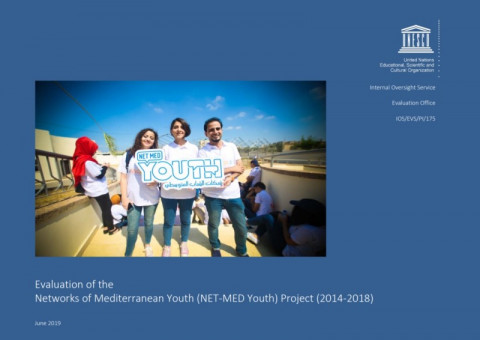 Evaluation of the Networks of Mediterranean Youth (NET-MED Youth) Project (2014-2018) Год публикации: 2019 Автор: Maksymilian Fras | Yael Ohana | Kimiko Hibri Pedersen | Christophe Dietrich | Mamoun Besaiso Организация-автор: UNESCO The Networks of Mediterranean Youth (NET-MED Youth) Project is a regional project funded by the European Union and implemented by UNESCO from 2014 until 2018. It followed a comprehensive approach through interdisciplinary activities in different thematic areas aimed at advancing youth legal and policy frameworks, enhancing youth representation in media, and reinforcing youth employability and skills in response to the challenges experienced by young women and men in the region regarding their transition to full autonomous citizenship in the civic, political, economic, social and cultural spheres. NET-MED Youth contributed to the creation of an enabling environment for young women and men from nine of the Southern countries of the European Neighbourhood Policy (i.e. Algeria, Israel, Jordan, Lebanon, Libya, Morocco, Palestine, Syria and Tunisia) to develop their competencies, to exercise their rights and meaningfully engage as active citizens in the development and implementation of national strategies on youth. The evaluation found that, overall, the NET-MED Youth Project was a successful initiative and created a momentum for Youth empowerment in the respective beneficiary countries. Its high relevance in the context of the Agenda 2030 resulted not least from UNESCO’s longstanding experience and good practices in working with youth organizations and youth-related stakeholders through youth engagement as partners and beneficiaries. The Project thus constituted a significant contribution to the UNESCO Operational Strategy on Youth 2014-2021. Gender equality was a central concern of NET-MED Youth, and systematically embedded throughout all activities as a transversal feature. In line with the Agenda 2030 commitment of leaving no one behind, several activities focused on issues of disadvantaged or traditionally underserved groups, such as youth with disabilities. Challenges identified are mainly related to the often difficult and in some countries unstable political environments. Together with the needs-based and rather context-specific approach in each country, this also affected to some extent the full implementation of the regional perspective. Furthermore, in the absence of a coherent and explicit longer-term exit strategy, the structures and results achieved risk not to be maintained, or scaled up over time, despite the strong local commitment and ownership created over the project duration. Through successfully incorporating youth aspirations in its design and implementation, the NET-MED Youth Project represented a new and innovative approach to youth engagement and empowerment in an interdisciplinary fashion, and should thus be considered as a basis for new thinking on which to build in the future. The high potential for replication of the NET-MED Youth Project, as a continuation or as an example of good practice for a comprehensive and interdisciplinary approach is thus to be further explored.
  Teaching and Learning Transformative Engagement Год публикации: 2019 Организация-автор: UNESCO While there is a large body of literature on citizenship and civic education, there is less clarity about the meaning of ‘responsible transformative engagement’ for young learners in relation to GCED and ESD – notably, the types of transformative engagement and the meaning of ‘responsible’. Understanding better the connection between learners’ engagement and education can clarify the knowledge, skills and competencies that schools may provide, as well as how the role of education can vary depending on context. In this light, this paper explores the meaning of ‘responsible transformative engagement’ with a view to clarifying the role of education in ways that may be reflected by UNESCO and other education stakeholders. Enseigner et apprendre l'engagement transformatif Год публикации: 2019 Организация-автор: Organisation des Nations Unies pour l'éducation, la science et la culture (UNESCO) Si les ouvrages consacrés à la citoyenneté et à l’éducation civique foisonnent, le sens d’un « engagement transformatif responsable » pour de jeunes apprenants dans le contexte de l’ECM et de l’EDD est moins clairement défini, notamment les types d’engagement transformatif et la notion de « responsabilité ». Mieux comprendre le lien entre l’engagement des apprenants et l’éducation permet de clarifier les connaissances, aptitudes et compétences que l’école peut enseigner, ainsi que le rôle variable que peut jouer l’éducation selon le contexte. Dans cette optique, le présent document s’interroge sur le sens d’un « engagement transformatif responsable » en vue d’apporter des éclaircissements sur le rôle de l’éducation qui peuvent être pris en compte par l’UNESCO et d’autres acteurs de l’éducation. Enseñando y aprendiendo para una participación transformadora Год публикации: 2019 Организация-автор: Organización de las Naciones Unidas para la Educación, la Ciencia y la Cultura (UNESCO) Si bien existe una extensa bibliografía sobre educación cívica y ciudadana, hay menos claridad acerca del significado del concepto de una "participación transformadora responsable" de jóvenes estudiantes en relación con la ECM y la EDS, en particular, los tipos de participación transformadora y la definición del término "responsable". Comprender mejor la relación entre la participación de los estudiantes y la educación puede contribuir a mejorar la definición de los conocimientos, aptitudes y competencias que las escuelas pueden enseñar, así como las maneras en que el papel de la educación puede variar según el contexto. En este sentido, el presente documento explora el significado de una "participación transformadora responsable", con miras a explicar el papel de la educación de formas que puedan reflejar la UNESCO y otros actores de la educación
  Her education, our future: snapshots of UNESCO's work Год публикации: 2019 Организация-автор: UNESCO This collection provides snapshots of some of UNESCO’s efforts to empower women and girls through education. It highlights core areas of work undertaken, as profiled on the next page. The aim is to give the reader a flavour of what it is that UNESCO, including its 53 field offices and specialized institutes, is doing to transform her education and our future.