
Ресурсы
Изучайте широкий спектр ценных ресурсов ВГГ, чтобы углубить своё понимание и повысить эффективность исследований, просветительской деятельности, преподавания и обучения.
Найдено: 1,828
 Justicia de Género, Ciudadanía y Diferencia en América Latina Год публикации: 2010 Автор: Maxine Molyneux Este artículo hace un recorrido por las prácticas feministas ciudadanas y los estudios sobre género, justicia, ciudadanía y derechos en América Latina. La crítica al privilegio patriarcal realizada desde el feminismo expresa un deseo moderno de mayor libertad individual y reconocimiento colectivo. Unas peticiones que han producido tensiones y algunas contradicciones en relación a la cuestión de la «diferencia», especialmente en el encuentro con los pueblos indígenas. No obstante, el feminismo siempre se ha dedicado a lograr tanto el reconocimiento como la redistribución; si bien, ha alcanzado más éxito en los terrenos legales y políticos que en la redistribución de recursos públicos y privados. El análisis de los logros del feminismo en América Latina revela una historia de éxitos significativos, pero parciales; y una serie de desafíos para futuras investigaciones al respecto.
  Metadata for the Global and Thematic Indicators for the Follow-up and Review of SDG 4 and Education 2030 Год публикации: 2017 Организация-автор: UNESCO Institute for Statistics (UIS) This document contains standardised metadata for each of the proposed global and thematic indicators for monitoring Sustainable Development Goal 4 (SDG 4) and the Education 2030 Agenda.The metadata included in this document have been developed by the UIS and are based on the set of thematic indicators approved by the Technical Cooperation Group on SDG 4–Education 2030 Indicators, a group set up in 2016 to provide the technical platform to support the implementation of the thematic indicator framework for the follow-up and review of SDG 4 and the Education 2030 Agenda. Метаданные глобальных и тематических показателей для сопровождения и обзора "ЦУР 4" и программы «Образование-2030" Год публикации: 2017 Организация-автор: UNESCO Institute for Statistics (UIS) Этот документ содержит стандартизованные метаданные для каждого из предлагаемых глобальных и тематических показателей для мониторинга Цели 4 устойчивого развития (SDG 4) и Повестки дня "Образование-2030".Метаданные, включенные в этот документ, были разработаны Институтом статистики ЮНЕСКО и основаны на наборе тематических показателей, одобренных Группой технического сотрудничества по индикаторам ЦУР 4 - "Образование-2030", созданной в 2016 году для предоставления технической платформы по поддержке реализации структуры тематических показателей для последующей деятельности и обзора ЦУР 4 и Повестки дня "Образование-2030".
  Mission impossible ? Créer un cadre de suivi pour l’éducation à la citoyenneté mondiale Год публикации: 2015 Автор: Amy Skinner Организация-автор: Éducation des Adultes et Développement Il faut considérer l’éducation à la citoyenneté mondiale (ECM) comme un processus complexe et multidimensionnel. L’ECM peut être une force transformatrice au niveau personnel, au niveau local et au niveau du système. Parvenir à effectuer un suivi de l’ECM en tenant compte de cette complexité serait d’une grande utilité. Cet article présente les résultats d’une recherche sur le suivi et explique les défi s que représente la mise en place d’un cadre de suivi.
  Genocide & The Shoah (The Holocaust) : Intellectual Tools for Education & Public Policy Decision The article reviews anti-Semitism from a multi-disciplinary perspective by focusing on the influence of American anti-Semitism on the German Nazis; exploring the endurance of anti-Semitism in Germany via its intellectual and scholastic elite; and exploring the political psychology of Hitlerism prior to the Second World War. The article then examines the problem that although anti-Semitism may be a necessary condition of genocide, it is not a sufficient one. This required the understanding of the jump from anti-Semitism, that is repressive and dominating, to the decision to exterminate a population of human beings completely. This also required a more carefully exploration of the specific features of the Nazi decision process as well as its framework of social control. With this background, the article focuses on developing the theoretical and methodological intellectual skills that have been developed in the context of the policy sciences in order to provide an approach to the challenges generated by the problems of mass murder and genocide, which would guide policy makers to more realistic, timely and effective interventions. The article then explores distinctive but interrelated intellectual tasks that are required for research to guide inquiry and policy making and which include a disciplined commitment to the clarification of the value goals implicated by the problems of mass murder and genocide. These intellectual tasks require a careful specification of the trends in past decisions that have sought, in some measure of efficacy, to respond to these problems. They would also require an understanding of the scientific conditions that have shaped the nature of these trends in order to be able to forecast about the prospect of genocide and mass murder, which could be understood as a tentative forecast of an optimistic and a pessimistic nature, and the possibility of constraining it. Finally, theory requires an element of creativity. That creativity would be expressed in terms of the provided interaction between human values and the art/aesthetic process, which is suggested as a tool for realizing the never again goal. The creative aspect of this would be the invention of strategies that might direct intervention of a trend in the direction of a more optimistic possible future. (By the author)
  Judaïsme et éducation : enjeux et défis pédagogiques The question of relations between ethnic groups defined by different markers, including religion, is more than ever necessary in our plural societies. This original work focuses on the role of education in the dynamics of relations between the Jewish community and fellow citizens of all origins in Quebec, Canada and in other countries. Indeed, while the Jewish communities are often well established in their host societies, they often remain little known to the population and especially of the majority groups. The authors address three issues that may challenge the stakeholder community and school, but also the general public interested in "living together" and its challenges : Education on Jewish communities in public schools; Education on the Holocaust and innovative practices in this regard; Moving Jewish schools and their impact. (By the publisher - Translation) The Holocaust and Historical Empathy: The Politics of Understanding It is difficult to choose secondary and primary sources for young historians. According to the author, two factors affect a student researcher’s decision when choosing sources. The first is in regards to his or her set of unique experiences and, secondly, how the researcher filters the available sources through a personal lens. Since we live in an information-rich world, student researchers often do not have a sustained attention of the past. This impedes historical understanding, which requires in-depth analysis and perspective taking. According to the author, history is one of the most controversial subjects taught. In reference to the Holocaust, since it is so politically charged, there are more issues than simple understanding. There may be difficulties in attempting to balance the cognitive and affective aspects of the Holocaust objectively. It is important for student researchers to build a framework around which to understand history through analysis of historical evidence. The author continues the article in three separate sections. The first deals with the politics of the Holocaust and how it is often a challenge to teach and sometimes creates a barrier to historical understanding. The second section discusses a methodological process and outcome interpretation of historical empathy in relation to the Holocaust. The final section critiques three popular curriculum guides on the Holocaust within the framework of historical empathy. The author concludes by discussing the considerations teachers face when teaching the Holocaust, such as whether to use prepared curriculum materials. The author also suggests that teachers employ the four constructs of historical empathy as outlined in the text and by Yeager, which provides students a framework for examining a historical event. Teachers must be cognizant of their positionalities and be clear about the reasons for teaching the Holocaust. (By the publisher)
 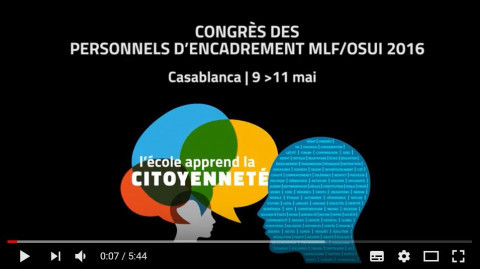 [Vidéo] L'école apprend la citoyenneté Год публикации: 2016 Организация-автор: Mission laïque française Organisé au Maroc en mai 2016, le congrès du réseau d'enseignement français à l'étranger mlfmonde a réuni 300 personnes autour du thème "l'école apprend la citoyenneté", élément central du projet éducatif de la Mission laïque française.
 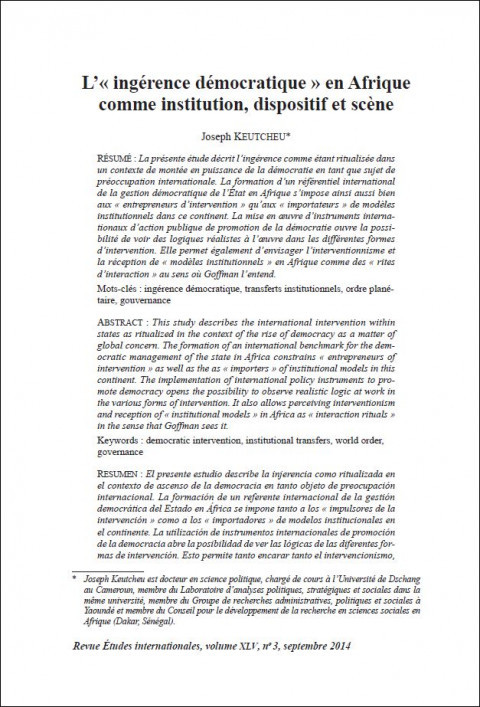 Democratic Interference in Africa as Institution and Context Год публикации: 2014 Автор: Joseph Keutcheu Организация-автор: Études internationales This study describes the international intervention within states as ritualized in the context of the rise of democracy as a matter of global concern. The formation of an international benchmark for the democratic management of the state in Africa constrains « entrepreneurs of intervention » as well as the as « importers » of institutional models in this continent. The implementation of international policy instruments to promote democracy opens the possibility to observe realistic logic at work in the various forms of intervention. It also allows perceiving interventionism and reception of « institutional models » in Africa as « interaction rituals » in the sense that Goffman sees it. L’« ingérence démocratique » en Afrique comme institution, dispositif et scène Год публикации: 2014 Автор: Joseph Keutcheu Организация-автор: Études internationales La présente étude décrit l’ingérence comme étant ritualisée dans un contexte de montée en puissance de la démocratie en tant que sujet de préoccupation internationale. La formation d’un référentiel international de la gestion démocratique de l’État en Afrique s’impose ainsi aussi bien aux « entrepreneurs d’intervention » qu’aux « importateurs » de modèles institutionnels dans ce continent. La mise en oeuvre d’instruments internationaux d’action publique de promotion de la démocratie ouvre la possibilité de voir des logiques réalistes à l’oeuvre dans les différentes formes d’intervention. Elle permet également d’envisager l’interventionnisme et la réception de « modèles institutionnels » en Afrique comme des « rites d’interaction » au sens où Goffman l’entend.