
Ресурсы
Изучайте широкий спектр ценных ресурсов ВГГ, чтобы углубить своё понимание и повысить эффективность исследований, просветительской деятельности, преподавания и обучения.
Найдено: 1,451
 The Meaning of Citizenship in Social Inequality Contexts: Guidelines for a Comprehensive Education Год публикации: 2016 Автор: Alma A Ramírez Iñiguez This article analyses the sense of citizenship education currently regarding the social inequality in the global era. For this, a conceptual framework about citizenship meaning is stablished and the need of a conceptual change is highlighted taking into account the social transformations, the increase of inequality in the worldwide and the neoliberal model hegemony in last decades. Based on this, some relevant Ibero American educational experiences in citizenship education are analyzed and their results are discussed. From this, some key elements involved in education for inclusive citizenship are pointed out as well as their contribution for social inequality decrease. El significado de la ciudadanía en contextos de desigualdad social: pautas para una educación incluyente Год публикации: 2016 Автор: Alma A Ramírez Iñiguez El presente artículo tiene el propósito de analizar el sentido de la educación para la ciudadanía en la actualidad, tomando en cuenta la desigualdad social existente en la era global. Para ello, se realiza una revisión conceptual sobre el significado de la ciudadanía en nuestros días, destacando la necesidad de un cambio de perspectiva para entender este concepto y considerando las transformaciones sociales de las últimas décadas, así como el predominio del modelo económico neoliberal, el cual ha tenido como consecuencia el incremento de la desigualdad social a nivel mundial. Con base en dicha revisión, se realiza un análisis documental de algunas experiencias educativas iberoamericanas relevantes por su propósito de crear ciudadanía a través de propuestas inclusivas. A partir de este análisis, se discuten los resultados de dichas experiencias, los elementos clave que propician una ciudadanía incluyente desde la educación y sus implicaciones en la reducción de la desigualdad social.
  Global Citizenship Education in Europe: A Comparative Study on Education Policies across 10 EU Countries Год публикации: 2016 Организация-автор: Global Schools | European Union (EU) This research, realised in the framework of the EU-funded project Global Schools, is a comparative qualitative analysis of educational policies of 10 European countries (Austria, Bulgaria, Czech Republic, France, Ireland, Italy, Latvia, Spain, Portugal, England) that support the introduction of Global Citizenship Education (GCE) in primary school curriculum. The analysis focuses on four main topics: 1) identification of key actors and definition of their roles; 2) conceptual and terminology analysis; 3) levels and modes of implementation of GCE in primary school; and 4) identification of barriers to introducing GCE in the primary school system.The research has highlighted that political actors, not only governmental ones, play a crucial role in implementing GCE policies, as well as in promoting GCE more generally, and in facilitating links between different actors, who in some countries may otherwise have little institutional coordination with schools. The conceptual analysis points out that, besides the choice of different wording of GCE national terms, the main topics composing GCE are very similar. The specific terminology often reflects the history, will and political discourse of the organisations promoting GCE in the different countries.
  Issue to Action: Science; Teaching Toolkit for a Fairer World Год публикации: 2020 Автор: Tracey Shaw | Claire Tatar | Krissie Davis Организация-автор: Scotdec | European Union (EU) Global Citizenship Education is essential in enabling young people to access and participate in shaping modern society. All teachers and subjects have a role to play in educating young people to enable them to participate as fully as possible in building a fair and just world for all. Global Citizenship provides a wealth of real-life contexts for learning Science. By using relevant and meaningful topics, young people are more motivated to learn and understand the key role Science plays in driving change for a more sustainable future. The materials in this resource have been written by Science teachers and tested in Scottish classrooms. They focus on sustainability, plastic waste, health and wellbeing and women in Science.
  Palestine & Israel: How Will There Be a Just Peace?; A Citizenship Education Resource for Transition Year and Key Stage 4 based on Human Rights and International Law Год публикации: 2012 Автор: Mary Gannon | Elaine Murtagh Организация-автор: City of Dublin Vocational Education Committee (CDVEC). Curriculum Development Unit | Centre for Cross Border Studies This resource is an important development in helping post-primary students throughout the island of Ireland to explore the Palestinian Israeli situation within the context of Human Rights and International Law.The resource addresses key issues underlying the origins of the conflict and current obstacles to bringing about a just peace.
  Bank of Actions for Global Citizens Год публикации: 2020 Организация-автор: Global Citizens Award The Bank of Actions guide can be used by anyone looking for creative inspiration to take action as global citizens. It is designed as a toolkit for engaging the public in global justice issues in meaningful ways that can help bring about positive change in our world.The Bank of Actions has been designed in the context of returned international volunteers participating in the Global Citizen Award programme.
  (Re)penser l’accès aux espaces intimes en contexte de handicap intellectuel: Une question de droit et de participation sociale (Revue générale de droit; vol. 47) Год публикации: 2017 Автор: Éditions Wilson & Lafleur, inc Организация-автор: Éditions Wilson & Lafleur, inc En contexte de handicap, la question de l’accès est constituée généralement de l’éventail des aménagements individuels et collectifs nécessaires afin de faciliter l’occupation d’espaces publics. A contrario, peu de choses sont dites à propos des aménagements possibles et potentiels requis afin de sécuriser l’espace privé des personnes identifiées comme ayant un handicap intellectuel. Ce sont pourtant ces lieux intimes, au sein desquels se développent et se déploient l’identité et l’expression affectives, qui sont susceptibles de contribuer à une reconnaissance plus soutenue de l’identité affective et de la citoyenneté sexuelle de ces personnes. Inspirée par les théories d’Erving Goffman et de Michel Foucault, une analyse phénoménologique interprétative (API) fut réalisée auprès des personnes ayant un handicap intellectuel et de leurs proches aidants afin d’explorer cette situation. Nos constats préliminaires suggèrent l’existence d’un processus de négociation complexe des acteurs, des lieux et des moments nécessaires afin de favoriser le développement de la vie affective et sexuelle. De ce fait, trois modes d’existence semblent cohabiter au sein d’une matrice complexe : la dépossession, l’habitation et l’occupation des espaces de socialisation et d’expression affective. Il est proposé d’aborder cette problématique en tant que dynamique géopolitique intégrant les processus d’exclusion des pratiques sexuelles des espaces privés, leur projection dans des espaces publics et, finalement, la juxtaposition de ces deux sphères, publique et privée dans des espaces mixtes. Nous discuterons enfin des implications de cette réflexion sur la « question de l’accès» et sur les politiques publiques visant à diminuer la discrimination systémique ciblant les personnes identifiées comme ayant un handicap intellectuel.
  De la capacité, de la compétence, de l’empowerment, repenser l’anthropologie de la participation (Politique et Sociétés; vol.34, no.1) Год публикации: 2013 Автор: Jean-Louis Genard Организация-автор: Société québécoise de science politique Le plus souvent étudiée dans le contexte des évolutions du politique et du passage présumé d’une démocratie représentative vers une démocratie davantage participative ou délibérative, la question de la participation est abordée ici sous l’angle d’une transformation de nos coordonnées anthropologiques. Les exigences et les attentes de participation se retrouvent en effet dans de multiples domaines qui excèdent de loin la seule sphère du politique, allant du monde de l’entreprise et de ses cercles de qualité jusqu’à la production de biens en kit sollicitant les capacités de montage des acheteurs. Cette extension du domaine de la participation s’appuie en réalité sur un certain nombre de présupposés anthropologiques. Ceux-ci prêtent aux acteurs des capacités et des compétences qu’ils sont censés détenir, à moins qu’ils ne soient appelés à les enrichir par des stratégies d’empowerment si elles leur font défaut ou sont insuffisantes. Ils leur attribuent aussi un potentiel de motivation indispensable à l’actualisation de ces compétences et capacités. Le texte soutient que l’évaluation des personnes ainsi que la configuration de nombreux dispositifs sociaux récents tendent de plus en plus à s’ajuster à ce nouveau référentiel anthropologique. Il en va ainsi de la participation politique bien sûr, mais aussi des nouvelles politiques sociales, des formations au «pouvoir d’agir », des objectifs éducatifs, des politiques de développement ou de santé. Revenant plus spécifiquement sur la question de la participation politique, le texte montre comment ces nouvelles coordonnées anthropologiques reconfigurent la question de l’expertise en réorganisant les partages entre expertises ordinaire et spécialisée et, du coup, le partage entre les espaces où peut prendre place une démocratie participative et ceux qui demeurent confiés à l’expertise technocratique.
  Thinkpiece: Are We Changing the World?; Reflections on Development Education, Activism and Social Change Год публикации: 2015 Автор: Stephen McCloskey Организация-автор: Centre for Global Education (CGE) This article has been published as part of a one year development education project delivered by the Centre for Global Education and funded by Trócaire. It aims to support reflection and debate on how development educators engage the public on international development issues. The article comes on the back of recent research, most notably Oxfam’s Finding Frames report, which suggests that the development sector is struggling to enhance and sustain citizenship engagement on the structural causes of poverty and inequality. The article probes some of the factors that may underpin this lack of engagement both within the development education sector specifically and the wider development sector more generally. It examines some of the challenges involved in engaging learners in actions on global issues. Some of these challenges relate to the sectors and environmental pressures in which development educators operate which can thwart in-depth engagement with learners.
 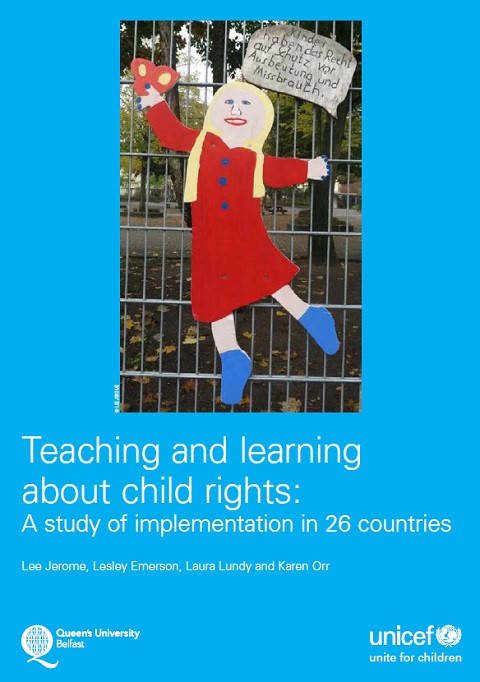 Teaching and Learning about Child Rights: A Study of Implementation in 26 Countries Год публикации: 2015 Автор: Lee Jerome | Lesley Emerson | Laura Lundy | Karen Orr Организация-автор: Queen’s University Belfast | United Nations Children's Fund (UNICEF) This research contributes to the global debate on child rights education (CRE). It explores implementation of CRE in early childhood education, primary and secondary schools in 26 countries with a UNICEF National Committee presence. It includes a literature review, results from an on-line survey completed by national experts, seven country case studies and a series of benchmarking statements for CRE implementation.