
Ресурсы
Изучайте широкий спектр ценных ресурсов ВГГ, чтобы углубить своё понимание и повысить эффективность исследований, просветительской деятельности, преподавания и обучения.
Найдено: 1,180
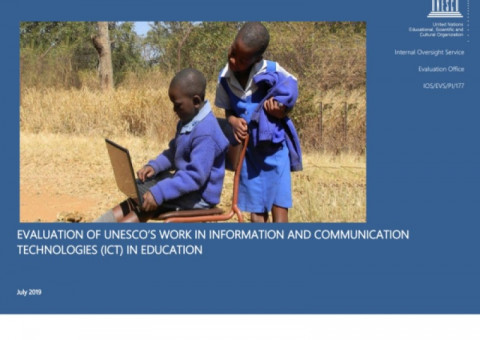 Evaluation of UNESCO's work in information and communication technologies (ICT) in education Год публикации: 2019 Автор: Seán Ó Siochru and Graham Attwell Организация-автор: UNESCO ICT in Education is a fast-growing area globally that offers many strategic opportunities. As the leader and coordinator of the SDG 4 – Education 2030 with the aim to “Ensure inclusive and equitable quality education and promote lifelong learning opportunities for all”, UNESCO has the mandate and expertise needed to strategically position itself as a world leader in this field. UNESCO’s work in ICT in Education aims at enhancing the quality and relevance of learning and at strengthening inclusion. While technology can facilitate wider access to education and bridge learning divides, can advance gender equality and inclusion as well as digital skills development, the rapidly changing technologies and work processes require the development of new pedagogies, both for the use of ICT for teaching and learning in the classroom and through open access and distance learning. Compared to other players, UNESCO leverages its comparative strengths in its ICT in Education interventions - especially its impartiality, convening power, and policy expertise - through an inclusive and humanistic approach to achieving quality education in coherence with Sustainable Development Agenda 2030. Its expertise across all levels of Education and its multidisciplinary potential of working across its Programme Sectors are also considered among UNESCO’s specific strengths. The evaluation revealed that UNESCO achieved important results, at the level of the learning environment, at the policy level and in institutional capacity building, but it also showed that UNESCO still needs to strengthen its positioning and visibility within the wider landscape of ICT in Education. For example, UNESCO has to continue positioning itself for producing forward-looking knowledge on ICT in Education and as a laboratory of ideas for future-oriented thinking. While the evaluation came across various specific interventions successfully addressing the needs of disadvantaged groups, the evaluation found that considerations of inclusion and gender equality were not consistently mainstreamed into policy-related and capacity building interventions. Other challenges are mainly linked to the current dispersion of resources and fragmentation of expertise across different entities within the Organization, which also leads to reduced visibility. While the key entities active in this area recognize that they are working within a common theme, collaboration and coordination still needs to be improved. The strategic measures proposed by the evaluation towards an overall organizational framework for ICT in Education aim at establishing an enabling environment for inter- and multidisciplinary approaches and greater coherence and collaboration.
 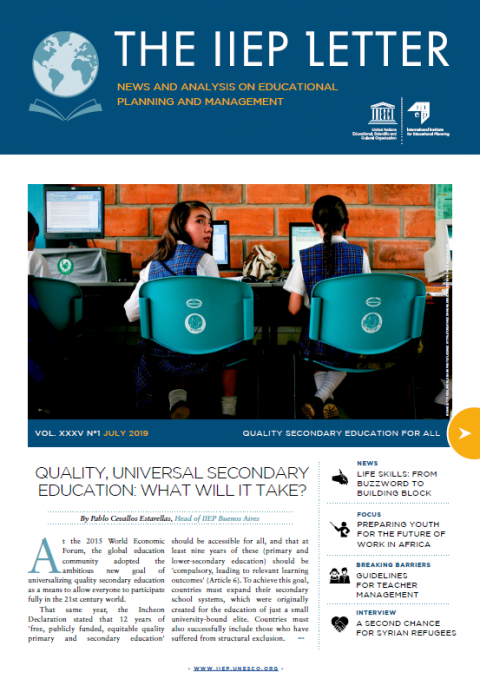 The IIEP letter: news and analysis on educational planning and management, vol. 35, no. 1 Год публикации: 2019 Организация-автор: UNESCO This issue is dedicated to addressing the challenges and opportunities for quality secondary education for all. It addresses the necessary structural and curricular changes secondary education must undergo in order to address long histories of segregation and inequality. Experiences from Latin America illustrate some key takeaways on how to match commitment with meaningful change.
 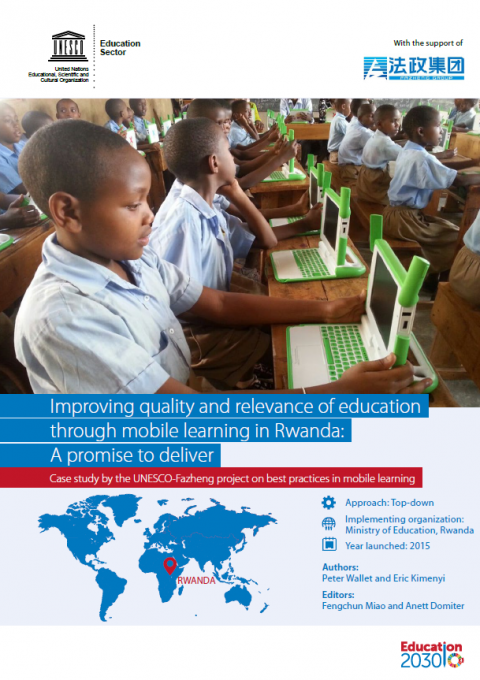 Improving quality and relevance of education through mobile learning in Rwanda: a promise to deliver: case study by the UNESCO-Fazheng project on best practices in mobile learning Год публикации: 2019 Автор: Wallet, Peter | Kimenyi, Eric | Miao, Fengchun | Domiter, Anett Организация-автор: UNESCO Rwanda’s education sector is evolving through the adoption of information and communication technology (ICT ). Whereas the focus was previously on the extensive deployment of laptop devices, it is shifting towards advancing adaptive child-centred learning and the use of ICT augmented environments to enrich teaching and learning. In developing countries, however, an orientation frequently remains to select strategies which have previously shown to be successful in developed contexts without taking into account the full range of elements required for effective implementation including a comprehensive assessment of the financial implications required to ensure longer term sustainability. This case study aims to showcase Rwanda’s customised approach to the integration of ICT in classrooms adapted to meet the particular needs of the Rwandan education system. The SMARTRwanda Master Plan lays out a vision to transform Rwanda’s economy by leveraging the use of ICT. Aligned to SMART Rwanda, the Ministry of Education (MINEDUC) is implementing the SMARTClassroominitiative under its ICT in Education Master Plan to reach all schools by 2020. Although there have been several challenges encountered during the various phases of implementation, more than half of all schools across the country are now equipped with ICT devices and many teachers have undergone various capacity-building initiatives to make better use of ICT in teaching and learning. More work is required in order to develop a fully functioning ICT in education ecosystem in Rwanda; nevertheless, this case study demonstrates progress made thus far and describes the various system stakeholders, their roles, responsibilities and contributions to date to improve access, quality and relevance of education through ICT adoption.
  Education transforms lives: empowering people and ensuring inclusiveness and equality Год публикации: 2019 Организация-автор: UNESCO This brochure compiles the main elements of progress on Sustainable Development Goal 4 (SDG 4) highlighted in the submission by UNESCO, on behalf of the SDG-Education 2030 Steering Committee, to the Office of the Under-Secretary-General, Department of Economic and Social Affairs (DESA) on the occasion of the High-level Political Forum (HLPF) 2019 - Empowering people and ensuring inclusiveness and equality. L'éducation transforme la vie: autonomiser les individus et assurer l'inclusion et l'égalité Год публикации: 2019 Организация-автор: UNESCO Cette brochure rassemble les principaux éléments des progrès accomplis dans la réalisation de l'objectif 4 du développement durable (ODD 4) mis en évidence dans la communicationprésentée par l'UNESCO, au nom du Comité directeur de l'ODD-Éducation 2030, au Bureau du Secrétaire général adjoint aux affaires économiques et sociales (DESA) à l'occasion du Forum politique de haut niveau (HLPF) 2019 –Donner aux populations les moyens d'agir et assurer l'intégration. La educación transforma vidas: empoderar a las personas y garantizar la inclusión y la igualdad Год публикации: 2019 Организация-автор: UNESCO Este folleto recopila los principales elementos de progreso en relación con el Objetivo de Desarrollo Sostenible 4 (ODS 4) destacados en la presentación de la UNESCO, en nombre del Comité Directivo del ODS-Educación 2030, a la Oficina del Secretario General Adjunto del Departamento de Asuntos Económicos y Sociales (DESA) con motivo del Foro Político de Alto Nivel (HLPF) 2019 - Empoderar a las personas y garantizar la inclusión y la igualdad.
  The Big conversation: handbook to address violence against women in and through the media Год публикации: 2019 Организация-автор: UNESCO This handbook provides guidance, tools and promising practices from countries across the globe for those working with and within media. It is our intention that this handbook provides entry points for accelerating progress towards gender equality in the systems and structures of organizations. We hope that it leverages what we know works in order to promote the values of diversity, equality and non-violence in the content that media produces.
 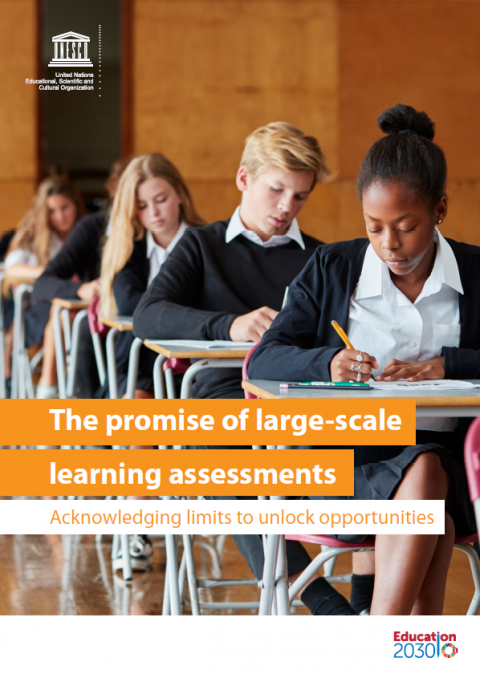 The promise of large-scale learning assessments Год публикации: 2019 Организация-автор: UNESCO The benefits and advantages of Large-scale learning assessments(LSLAs) have been extensively reviewed in specialized literature, and there is growing recognition of the potential of assessment data to inform policy in a variety of ways. As a result, increasingly higher expectations have been placed on LSLAs as drivers of policy change over the past few decades. They are indeed expected to serve a range of uses, including monitoring, accountability, agenda-setting and analysis. The potential of such tools reaches far beyond reporting purposes. They can provide insight into areas in need of improvement and help pinpoint the most appropriate, promising and effective policy interventions. However, both national and cross-national learning assessments have raised some concerns. A growing volume of evidence calls attention to a range of unexpected and even negative effects resulting from such exercises. Drawing on a diverse body of evidence, including scholarly literature and the experience of a range of international organizations, development partners and assessment specialists, this publication reflects on the possible unintended consequences of LSLAs. Some concerns stem directly from the characteristics inherent to their design while others centre around the (mis)uses of data to inform agenda-setting and policy formulation.
 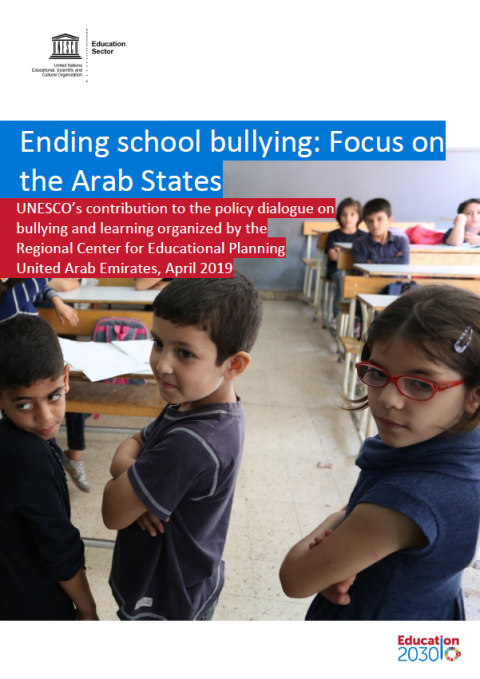 Ending school bullying: Focus on the Arab States and North Africa UNESCO’s contribution to the policy dialogue on bullying and learning organized by the Regional Center for Educational Planning United Arab Emirates Год публикации: 2019 Организация-автор: UNESCO Bullying is a form of school violence. According to an agreed international definition, bullying is characterised by aggressive behaviour that involves unwanted, negative actions and an imbalance of power or strength between the perpetrator or perpetrators and the victim. Unlike isolated incidents of school violence, bullying is also characterised by repetition over time. The number of repetitions may vary and, for example, major surveys that collect data on bullying measure the frequency of bullying in different ways. The international Sustainable Development Goal Thematic Indicator 4.a.2 that measures the ‘percentage of students who experienced bullying during the past 12 months, by sex’, which was adopted in 2018, defines that the frequency of aggressions should be at least once or twice a month or more for a student to be considered a victim of bullying. It is important to note that here is no standard definition of bullying across the six international surveys that collect data on the prevalence of bullying. Some of them do not even provide a definition. These surveys are the following:Two international surveys that measure the health behaviours of students as well as protective factors including school climate: the WHO Global School-based Student Health Survey (GSHS) and the Health Behaviours in School-aged Child survey (HBSC) conducted by the HBSC Consortium.Four international surveys that focus mostly on the measurement of learning outcomes of students but also ask questions on the school climate including bullying: the Regional Comparative and Explanatory Study in Latin America (Estudio Regional Comparativo y Explicativo, ERCE in Spanish); theProgress in International Reading Literacy Study (PIRLS); the Programme for International Students Assessment (PISA); and the Trends in Mathematics and Science Study (TIMSS).
  School, Identity and Discrimination Год публикации: 2011 Автор: Néstor López Организация-автор: UNESCO IIEP Office for Latin America and the Caribbean Education, identity and school is just one more link, within the many wills that work for full equality of opportunities. As in other publications of the Institute, the wealth of perspectives is added, which give shape to sometimes pressing realities with a demand for urgent action. The publication is a new opportunity for the voices of different interlocutors to give an account, in their countries and contexts, both of the construction of identity processes, and of their recognition and respect. This also implies raising the obstacles, the contributions and the advances, to face the challenges still pending. In each work presented here, the authors-whose participation and effort we deeply appreciate-offer sharp insights on various tasks and contexts. We wish, to conclude, that this text also contributes to the reflection on the possible courses that have been adopted or that require a deepening of the educational policies, specifically in the agendas related to the themes of this publication.