
Ресурсы
Изучайте широкий спектр ценных ресурсов ВГГ, чтобы углубить своё понимание и повысить эффективность исследований, просветительской деятельности, преподавания и обучения.
Найдено: 3,446
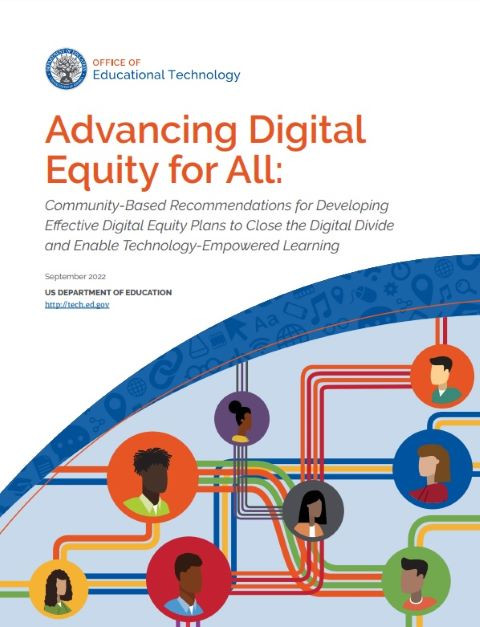 Advancing Digital Equity for All: Community-Based Recommendations for Developing Effective Digital Equity Plans to Close the Digital Divide and Enable Technology-Empowered Learning Год публикации: 2022 Организация-автор: USA. Department of Education. Office of Educational Technology In spring 2022, the U.S. Department of Education’s Office of Educational Technology (OET) committed to advancing digital equity through the Digital Equity Education Roundtables (DEER) Initiative. Through DEER, OET hosted a series of national conversations with leaders from community-based organizations, as well as families and learners furthest from digital opportunities. The “Advancing Digital Equity for All” resource illuminates insights from these conversation to highlight the barriers faced by learner communities and promising solutions for increasing access to technology for learning.The historic federal investments authorized by the Infrastructure Investment and Jobs Act offer critical opportunities for broadband planning that can identify and equitably address the various availability, affordability, and adoption challenges described. Using this guidance resource as a starting point, it is essential that leaders collaborate with those most impacted by the digital divide to develop comprehensive digital equity plans that outline strategies to meet the needs of learners, their families/caregivers, and communities effectively and sustainably.
  The Digitization of School Through the Prism of Citizenship Год публикации: 2021 Автор: Lionel Alvarez | Mathieu Payn Организация-автор: Éthique en éducation et en formation Digital devices have colonized many facets of our daily lives, and compulsory schools are now appropriating this evolution. The announced learning goals are often associated with the notion of digital citizenship. At the same time, educational institutions are defining the digital learning environments that teachers and students must adopt. Positioning themselves in the digital humanities, the authors question the posted definitions of digital citizenship, confront them with the sui generis nature of the digital and its industry, and finally question the connection between these and the public school. Issues of citizen empowerment, autonomy, and governance serve the analysis and allow us to conclude that it is necessary to debate the pedagogical-digital contradictions. La numérisation de l’école au prisme de la citoyenneté Год публикации: 2021 Автор: Lionel Alvarez | Mathieu Payn Организация-автор: Éthique en éducation et en formation La citoyenneté au sens moderne implique certains devoirs, parmi lesquels le devoir fiscal. Si les États ont toujours eu à faire face à des tentatives d’évitement de l’impôt par les contribuables, la mondialisation a introduit une dynamique inédite d’évasion fiscale. Face aux « citoyens du monde », les États peuvent déplorer le manque de civisme par rapport à l’impôt ou entrer dans le jeu de la compétition fiscale. En s’appuyant sur une connaissance intime du sujet par l’auteur qui a mené une première carrière de fiscaliste international, sur des apports théoriques sur la citoyenneté et sur une enquête sociologique auprès de trente-cinq individus appartenant à l’élite économique mondiale, cet article analyse le cercle vicieux qui mine l’un Les dispositifs numériques ont colonisé de nombreuses facettes de notre quotidien et l’école obligatoire s’approprie maintenant cette évolution. Les finalités annoncées sont souvent associées à la notion de citoyenneté numérique. Parallèlement, les institutions scolaires définissent les environnements numériques d’apprentissage que les enseignants et élèves doivent adopter. Se positionnant dans les humanités numériques, les auteurs interrogent les définitions affichées de la citoyenneté numérique, les confrontent à la nature sui generis du numérique et de son industrie, pour enfin questionner le rapprochement entre ceux-ci et l’école publique. Des enjeux d’émancipation citoyenne, d’autonomie et de gouvernance servent l’analyse et permettent de conclure à la nécessité de débattre les contradictions pédago-numériques.
  Interculturality of Disability Situations: From Designation to Recognition Год публикации: 2021 Автор: Geneviève Piérart | Mélissa Arneton Организация-автор: Alterstice Alterstice has been offering, for ten years, a unique space for scientific production responding to socially acute questions related to the consideration of inter-individual, social, and societal diversity. This thematic issue is linked to the creation in 2017 of a thematic axis within the International Association for Intercultural Research (ARIC). This network has enabled researchers to organize symposia questioning disability, intersectionality, and how the work carried out in more mainstream currents take into account or not the intercultural dimension to study the paradigm shift of disability. Fifteen years after the launch of the International Convention on the Rights of Persons with Disabilities (CRPD) marks a societal desire to renew living together at the international level as well as at the national level for the countries that have ratified it, as revealed by the work scientific studies carried out from an intercultural perspective. After an introduction to the notions of disability and interculturality, which also refer to designation processes, which may or may not be crossed and compared in scientific analysis. From a multidisciplinary perspective, different angles relating to the diversity of representations of disability and the issues it raises in situations of contact between cultures are discussed. Interculturalité des situations de handicap: De la désignation à la reconnaissance Год публикации: 2021 Автор: Geneviève Piérart | Mélissa Arneton Организация-автор: Alterstice Alterstice propose depuis dix ans un espace unique de production scientifique répondant à des questions socialement aiguës liées à la prise en compte de la diversité interindividuelle, sociale et sociétale. Ce numéro thématique est lié à la création en 2017 d'un axe thématique au sein de l'Association internationale pour la recherche interculturelle (ARIC). Ce réseau a permis aux chercheurs d'organiser des colloques questionnant le handicap, l'intersectionnalité, et comment les travaux menés dans des courants plus mainstream prennent en compte ou non la dimension interculturelle pour étudier le changement de paradigme du handicap. Quinze ans après le lancement de la Convention Internationale des Droits des Personnes Handicapées (CDPH) marque une volonté sociétale de renouveler le vivre ensemble au niveau international comme au niveau national pour les pays qui l'ont ratifiée, comme le révèle la travaux d'études scientifiques menées dans une perspective interculturelle. Après une introduction aux notions de handicap et d'interculturalité, qui renvoient également à des processus de désignation, qui peuvent ou non être croisés et comparés dans l'analyse scientifique. Dans une perspective pluridisciplinaire, différents angles relatifs à la diversité des représentations du handicap et aux enjeux qu'il soulève dans les situations de contact entre cultures sont abordés.
  The Genesis of the Category of “LGBT Refugee” Within the United Nations High Commissioner for Refugees Год публикации: 2021 Автор: Ahmed Hamila Организация-автор: Alterstice The international protection system is governed by the Geneva Convention of 1951, supplemented by the New York Protocol of 1967. These international conventions list five grounds for granting refugee status: persecution based on race, religion, nationality, membership of a certain social group, and political opinions. These international instruments do not explicitly recognize persecution based on sexual orientation and gender identity as grounds for granting refugee status. However, over the past three decades, the Office of the United Nations High Commissioner for Refugees (UNHCR) has come to recognize such persecution as grounds for granting international protection. In this article, I focus on the genesis of the "LGBT refugee" category within the UNHCR in the early 2000s. The essay argue that the emergence of this new category of refugees is part of two parallel dynamics, which both led to the development of the UNHCR Guidelines, which explicitly recognize persecution based on sexual orientation as a ground for granting refugee status. On the one hand, it is in the context of greater attention paid to refugee women, and in particular to gender-related persecutions, that persecutions related to sexual orientation are for the first time discussed. On the other hand, the category of “LGBT refugee” also appears in the context of the interpretation of the notion of “belonging to a certain social group”. La genèse de la catégorie de « réfugié LGBT » au sein du Haut-Commissariat des Nations Unies pour les réfugiés Год публикации: 2021 Автор: Ahmed Hamila Организация-автор: Alterstice Le système de protection international est régi par la Convention de Genève de 1951, complétée par le Protocole de New York de 1967. Ces conventions internationales énumèrent cinq motifs d’octroi du statut de réfugié : les persécutions du fait de la race, de la religion, de la nationalité, de l’appartenance à un certain groupe social et des opinions politiques. Ces instruments internationaux ne reconnaissent pas explicitement les persécutions du fait de l’orientation sexuelle et de l’identité de genre en tant que motifs d’octroi du statut de réfugié. Cependant, au cours des trois dernières décennies, le Haut-Commissariat des Nations Unies pour les réfugiés (HCR) a été amené à reconnaître ces persécutions en tant que motifs d’octroi de la protection internationale. Dans cet article, je m’intéresse à la genèse de la catégorie de « réfugié LGBT » au sein du HCR au début des années 2000. Je soutiens que l’émergence de cette nouvelle catégorie de réfugiés s’inscrit dans deux dynamiques parallèles, qui ont toutes les deux débouché sur l’élaboration des Principes directeurs du HCR, qui reconnaissent explicitement les persécutions du fait de l’orientation sexuelle en tant que motif d’octroi du statut de réfugié. D’une part, c’est dans le contexte d’une plus grande attention portée aux femmes réfugiées, et notamment aux persécutions liées au genre, qu’il est pour la première fois question des persécutions liées à l’orientation sexuelle. D’autre part, la catégorie de « réfugié LGBT » apparaît aussi dans le contexte de l’interprétation de la notion d’« appartenance à un certain groupe social ».
  “Racism, Sexism, Homophobia, Which Card do You Want?” The Post-Migration Experience of Northern LGBTQ People Global and Global South Год публикации: 2021 Автор: Barbara Andrade de Sousa | Line Chamberland Организация-автор: Alterstice This article examines the life stories of seven LGBTQ immigrants, from the Global North and South, who live in Montreal. The research on immigration has long been carried out according to a framework heteronormative, which sets aside a whole series of questions relating to the impact of sexual orientation and non-normative gender identity on the migratory experience. Societies impose distinct constraints on LGBTQ people. Once settled in the host society, these subjects can experience more sexual possibilities. However, their origin can become a marker that places them inside a relationship of power with the majority group. This article aims to shed light on how LGBTQ immigrants construct their life stories in a context where their experience is crossed by the interweaving of several aspects of identities such as sexual orientation, gender identity, ethnicity, and religion, to name a few. The intersectional approach makes it possible to identify the systems of binding powers which participants face daily. The thematic analysis gave us allowed to listen to individuals to know the categories of power and the systems of oppression they talk about — the goal being to position respondents as knowledgeable subjects, not mere study objects. Analysis of the interviews shows that LGBTQ individuals who express a diverse combination of identities face specific challenges linked to the migratory route. « Racisme, sexisme, homophobie, quelle carte tu veux ? » L’expérience post-migratoire des personnes LGBTQ du Nord global et du Sud global Год публикации: 2021 Автор: Barbara Andrade de Sousa | Line Chamberland Организация-автор: Alterstice Cet article examine l’histoire de vie de sept immigrants ou immigrantes LGBTQ, originaires du Nord et du Sud global, qui habitent à Montréal. Les recherches sur l’immigration ont longtemps été réalisées selon un cadrage hétéronormatif, ce qui met à l’écart toute une série de questions relatives à l’impact de l’orientation sexuelle et de l’identité de genre non normative sur l’expérience migratoire. Les sociétés imposent des contraintes distinctes vis-à-vis des personnes LGBTQ. Une fois installées dans la société d’accueil, ces sujets peuvent expérimenter plus de possibilités sur le plan sexuel ; néanmoins leur origine peut devenir un marqueur qui les place à l’intérieur d’un rapport de pouvoir avec le groupe majoritaire. Notre article vise à mettre en lumière la manière dont les immigrants LGBTQ construisent leurs histoires de vie dans un contexte où leur vécu est traversé par l’imbrication de plusieurs aspects identitaires comme l’orientation sexuelle, l’identité de genre, l’ethnicité et la religion, pour n’en nommer que quelques-uns. L’approche intersectionnelle rend possible l’identification des systèmes de pouvoirs contraignants auxquels les participants font face quotidiennement. L’analyse thématique nous a permis d’être à l’écoute des individus afin de connaître les catégories de pouvoir et les systèmes d’oppression dont ils parlent — le but étant de positionner les répondants comme des sujets connaissants, et non de simples objets d’étude. L’analyse des entrevues montre que les individus LGBTQ qui expriment une combinaison variée d’identités affrontent des défis spécifiques liés au parcours migratoire.
  Advocacy Note: The Role of Cross-Border Trade in Security Food in Border Areas During Periods of COVID-19 Pandemic Год публикации: 2022 Организация-автор: Centre for International Cooperation and Study (CECI) The Role of Cross-Border Trade in Security food in border areas during periods of COVID-19 pandemic To limit the spread of Covid-19, the governments of Burkina Faso and Senegal have decided to close the borders in March 2020, thus limiting the movement of goods and people and cross-border exchanges. Faced with the measures taken and faced with the absolute necessity of survival, the Traders in cross-border areas bypass official checkpoints to continue trade. cross-border exchanges, necessary for their survival and food security, despite the risks of gender-based violence (GBV). In the event of a pandemic, for countries with still fragile economies such as Burkina Faso and Senegal, selective sanitary measures should rather be applied to enable formal trade and the movement of food across borders.