
Ресурсы
Изучайте широкий спектр ценных ресурсов ВГГ, чтобы углубить своё понимание и повысить эффективность исследований, просветительской деятельности, преподавания и обучения.
Найдено: 1,448
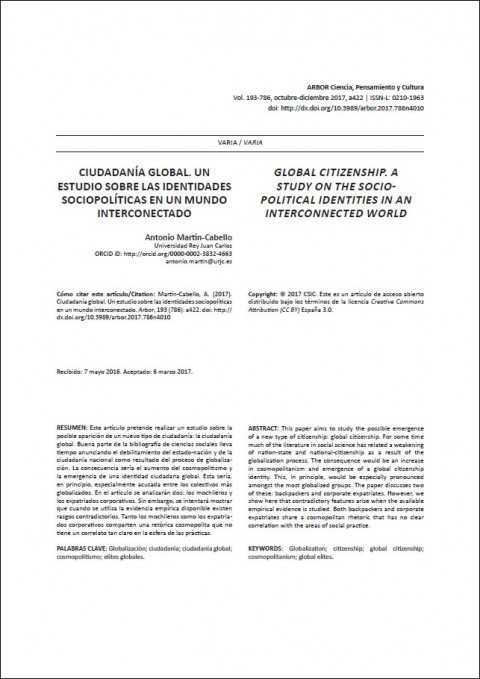 Global Citizenship: A Study on the Socio-political Identities in an Interconnected World Год публикации: 2017 Автор: Antonio Martín-Cabello This paper aims to study the possible emergence of a new type of citizenship: global citizenship. For some time much of the literature in social science has related a weakening of nation-state and national-citizenship as a result of the globalization process. The consequence would be an increase in cosmopolitanism and emergence of a global citizenship identity. This, in principle, would be especially pronounced amongst the most globalized groups. The paper discusses two of these: backpackers and corporate expatriates. However, we show here that contradictory features arise when the available empirical evidence is studied. Both backpackers and corporate expatriates share a cosmopolitan rhetoric that has no clear correlation with the areas of social practice. Ciudadanía global. Un estudio sobre las identidades sociopolíticas en un mundo interconectado Год публикации: 2017 Автор: Antonio Martín-Cabello Este artículo pretende realizar un estudio sobre la posible aparición de un nuevo tipo de ciudadanía: la ciudadanía global. Buena parte de la bibliografía de ciencias sociales lleva tiempo anunciando el debilitamiento del estado-nación y de la ciudadanía nacional como resultado del proceso de globalización. La consecuencia sería el aumento del cosmopolitismo y la emergencia de una identidad ciudadana global. Esta sería, en principio, especialmente acusada entre los colectivos más globalizados. En el artículo se analizarán dos: los mochileros y los expatriados corporativos. Sin embargo, se intentará mostrar que cuando se utiliza la evidencia empírica disponible existen rasgos contradictorios. Tanto los mochileros como los expatria- dos corporativos comparten una retórica cosmopolita que no tiene un correlato tan claro en la esfera de las prácticas.
  What is Global Citizenship? Год публикации: 2017 Организация-автор: Spanish Agency for International Development Cooperation (AECID) | Spain. Ministry of Education, Culture and Sport Inteviews carried out to experts that participated in a debate regarding global citizenship during the V National Teachers' Meeting for development. Coordinated by AECID and MECD (Spain). ¿Qué es la ciudadanía global? Год публикации: 2017 Организация-автор: Agencia Española de Cooperación Internacional para el Desarrollo (AECID) | Ministerio de Educación, Cultura y Deporte (España) Entrevistas realizadas a los expertos que colaboraron en la mesa de debate sobre Ciudadanía global llevada a cabo durante la realización del V Encuentro nacional de Docentes para el desarrollo: creando redes coordinada por la AECID y el MECD.
 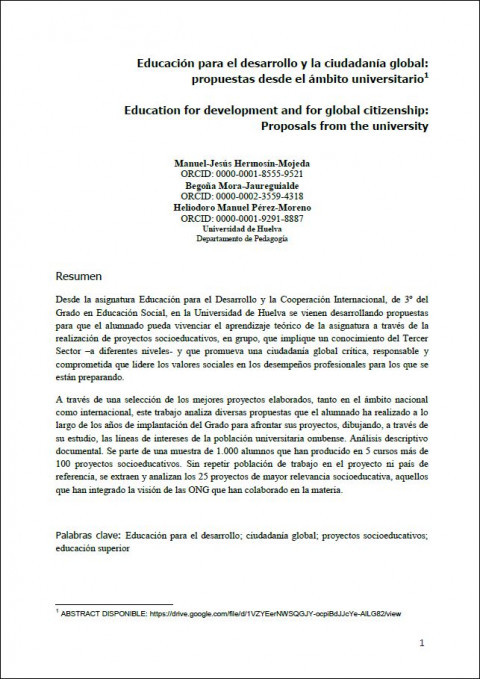 Education for Develpment and for Global Citizenship: Proposals from the University Год публикации: 2018 Автор: Manuel- Jesús Hermosín-Mojeda | Begoña Mora-Jaureguialde | Heliodoro Manuel Pérez-Moreno From the “Education for Development and International Cooperation” course, which is part of the Social Education career at the University of Huelva, students are performing some social activities to experience different theoretical concepts through social-educational projects that the students, in teams, organize and carry out during the semester. These projects promote, committed and responsible global citizens who can promote social changes in the careers they are persuing. Educación para el desarrollo y la ciudadanía global: propuestas desde el ámbito universitario Год публикации: 2018 Автор: Manuel- Jesús Hermosín-Mojeda | Begoña Mora-Jaureguialde | Heliodoro Manuel Pérez-Moreno Desde la asignatura Educación para el Desarrollo y la Cooperación Internacional, de 3º del Grado en Educación Social, en la Universidad de Huelva se vienen desarrollando propuestas para que el alumnado pueda vivenciar el aprendizaje teórico de la asignatura a través de la realización de proyectos socioeducativos, en grupo. Estos proyectos promueven ciudadanos globales críticos, responsables y comprometidas capaces de promover cambios sociales en las carreras para los que se están preparando.
 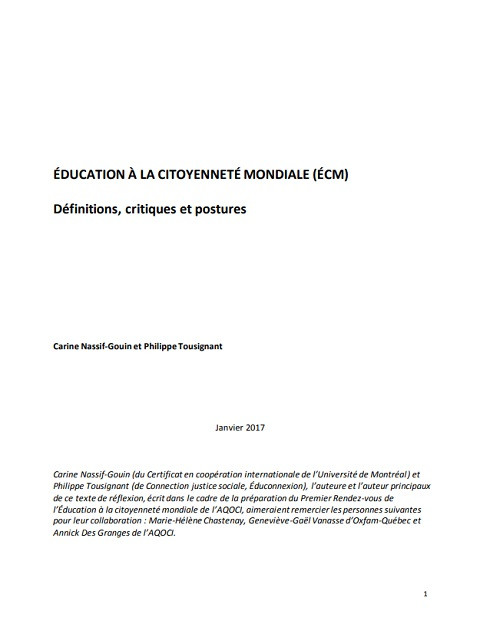 Éducation à la citoyenneté mondiale (ÉCM): Définitions, critiques et postures Год публикации: 2017 Автор: Carine Nassif-Gouin | Philippe Tousignant Организация-автор: Association québécoise des organismes de coopération internationale (AQOCI) La plupart des organismes de coopération internationale (OCI) se sont engagés dans un long processus d’information, de sensibilisation, d’engagement et d’éducation du public. Ce document cherche à soutenir la réflexion quant à l’approche émergente de l’éducation à la citoyenneté mondiale (ÉCM) et la question suivante : en quoi l’ÉCM est-elle nouvelle ou différent de l’engagement du public ou, par exemple, de l’éducation aux droits humains ? Les OCI mettent à la disposition des apprenants (stagiaires, coopérants, bénévoles, salariés, jeunes en milieu scolaire ou communautaire, entreprises, etc.) de l’information, des formations, des ateliers, des documents voire des trousses, et bien plus encore, qui favorisent l’autonomisation et la responsabilisation des individus. Ces activités sont souvent de nature pédagogique, mais elles peuvent également être d’une toute autre nature. Les OCI ont des pratiques riches et variées en éducation, formation, mobilisation, sensibilisation, etc. Certaines pratiques ont fait leurs preuves et nous encouragent à nous en inspirer ou encore à les adopter. Parmi les facteurs contribuant à la réussite de l’ÉCM, le choix de la définition, la qualité, la précision d’un cadre de références commun jouent un rôle crucial. Ainsi, ce guide tente d’offrir un certain nombre d’informations essentielles à la réalisation et la réussite de l’ÉCM. Du fait qu’il y ait très peu de littérature consacrée à l’éducation à la citoyenneté mondiale au Québec, nous nous sommes beaucoup tourné vers celle qui est issue d’autres pays et contextes. Ce document est conçu à l’intention de toutes les personnes qui souhaitent comprendre ce qu’est l’ÉCM pour en développer des activités et s’approprier ses définitions et contenus. Il faut reconnaître d’emblée que chaque organisme, chaque programme présente des spécificités et qu’il n’est pas souhaitable ou même possible d’uniformiser les guides ou de les rendre conformes à un modèle particulier. Il faut surtout garder à l’esprit que nous tenons à offrir à chacun des acteurs une information de qualité et préparer avec tout le soin nécessaire un guide clair et nourrissant. Ce guide est composé de six (6) parties et d’une note de synthèse. Ainsi, chacun pourra y puiser les informations et ressources ou encore les outils de références souhaités.
  Mobiliser les réseaux socionumériques: L’espace public traditionnel à l’épreuve de la critique de musulmans Français Год публикации: 2019 Автор: Mohamed Sakho Jimbira Организация-автор: Sens public Cet article qui repose sur deux enquêtes s’attache à proposer une réflexion sur l’articulation entre trois problématiques : l’usage des réseaux socionumériques, l’islam en France, et l’espace public traditionnel. Depuis plusieurs années, ce dernier est confronté à la visibilité des dogmes et pratiques religieuses islamiques. Ainsi, la laïcité et la place des religions au sein de cet espace public se trouvent-elles questionnées comme le montrent les dernières controverses sur le port du voile intégral, ou encore du burkini. Sur cet horizon, certains citoyens musulmans qui affirment faire l’objet de discriminations dans l’espace hors-ligne, à cause de leur identité musulmane, mobilisent les réseaux socionumériques pour y reconstituer des espaces éditoriaux de visibilité et d’audibilité, ce qui participe de l’élargissement des contours de l’espace public traditionnel.
  Préparer les citoyens d’aujourd’hui à la société de l’information de demain: Quels rôles pour les bibliothécaires et documentalistes ? (Documentation et bibliothèques; Vol.64, No.4) Год публикации: 2018 Автор: Thierry Karsenti Организация-автор: Association pour l'avancement des sciences et des techniques de la documentation (ASTED) Dans un monde où la place du numérique s’affirme chaque jour davantage, et où les jeunes sont captivés par les technologies, les bibliothécaires et documentalistes ne semblent avoir d’autre option que de donner une place de choix au numérique dans le cadre de leur mission de formation. Il est dorénavant impossible pour eux de rester sourds aux transformations sociétales et aux nouvelles avenues que le numérique offre pour la recherche d’information, tout comme il est impossible de rester indifférent à la place grandissante que l’intelligence artificielle gagne dans tous les secteurs de notre société, y compris celui de l’accès à l’information. Ce texte a également pour but de montrer le rôle primordial que sont appelés à jouer bibliothécaires et documentalistes pour préparer les citoyens d’aujourd’hui à la société de l’information de demain. Il y est notamment question de leur rôle-clé pour amener tout apprenant à développer des compétences informationnelles actuelles, à agir en citoyen numérique éclairé et responsable, et à contribuer au développement de l’intelligence collective planétaire, et ce, afin de participer à sa façon à l’édification de la société de demain
  L’immigration transnationale africaine francophone en milieu minoritaire et son impact sur l’intégration dans la société canadienne Год публикации: 2019 Автор: Amal Madibbo Организация-автор: Les Presses de l'Université d'Ottawa | Centre de recherche en civilisation canadienne-française Dans un monde où la place du numérique s’affirme chaque jour davantage, et où les jeunes sont captivés par les technologies, les bibliothécaires et documentalistes ne semblent avoir d’autre option que de donner une place de choix au numérique dans le cadre de leur mission de formation. Il est dorénavant impossible pour eux de rester sourds aux transformations sociétales et aux nouvelles avenues que le numérique offre pour la recherche d’information, tout comme il est impossible de rester indifférent à la place grandissante que l’intelligence artificielle gagne dans tous les secteurs de notre société, y compris celui de l’accès à l’information. Ce texte a également pour but de montrer le rôle primordial que sont appelés à jouer bibliothécaires et documentalistes pour préparer les citoyens d’aujourd’hui à la société de l’information de demain. Il y est notamment question de leur rôle-clé pour amener tout apprenant à développer des compétences informationnelles actuelles, à agir en citoyen numérique éclairé et responsable, et à contribuer au développement de l’intelligence collective planétaire, et ce, afin de participer à sa façon à l’édification de la société de demain.