
Ресурсы
Изучайте широкий спектр ценных ресурсов ВГГ, чтобы углубить своё понимание и повысить эффективность исследований, просветительской деятельности, преподавания и обучения.
Найдено: 134
 De la diversité ethnoculturelle au vivre ensemble: représentations de futurs enseignants de l’approche multiculturelle en éducation Год публикации: 2010 Автор: Mirela Moldoveanu Организация-автор: McGill University. Faculty of Education Ce texte explore les sens que de futurs enseignants attribuent à l’éducation multiculturelle, afin d’en déceler l’importance et les objectifs dans une perspective de vivre ensemble. Une recherche exploratoire utilisant des données qualitatives a été menée auprès de neuf étudiants-maîtres inscrits au programme de formation initiale à l’enseignement dans une université ontarienne. L’interprétation des résultats a conduit à la construction d’un modèle d’éducation multiculturelle qui essaie de la légitimiser dans le cadre d’une approche pédagogique différenciée.
  Can “Living Together” Be Taught? Год публикации: 2013 Автор: Maxime Plante Организация-автор: McGill University. Faculty of Education The need to teach how to “live together” demonstrates its problematic nature. Indeed, is not living together problematic because it implies that we must by all means coexist, self and other, that is to say, to “live together” despite difference? Is it really possible to bring about a respect for this injunction through education? Two pitfalls are to be avoided. On one hand, that of an hermeneutical approach to education, which may violate the principle of respect for otherness even as it purports to teach it. On the other hand, that of considering ethics simply as total openness to difference. Between these two pitfalls is a difficult path to negotiate, that of a responsibility to educational choices inevitably bound to betray the Other. Peut-on enseigner le vivre-ensemble ? Год публикации: 2013 Автор: Maxime Plante Организация-автор: McGill University. Faculty of Education La nécessité de former au vivre-ensemble témoigne du caractère problématique de celui-ci. Pourquoi le vivre-ensemble est-il problématique sinon parce qu’il sous-entend qu’il nous faut à tout prix coexister, soi et l’autre, c’est-à-dire vivre ensemble dans la différence ? Le respect d’une telle injonction grâce au support de l’éducation est-il possible ? Deux écueils à éviter tracent la voie à emprunter. Celui, d’une part, d’une éducation dont l’herméneutique ne peut que violer le principe de respect de l’altérité au moment même où elle prétend l’enseigner. De l’autre, celui de considérer l’éthique simplement comme ouverture totale à la différence. Entre ces deux écueils, une voie difficile à négocier, celle d’une responsabilité face à des choix éducatifs immanquablement voués à trahir l’Autre.
  Interculturalism in the Classroom: Taking into Consideration Cultural Specificity in Interventions Год публикации: 2011 Автор: Geneviève Audet Организация-автор: McGill University. Faculty of Education This article presents an analysis of narratives of intercultural education practices at the preschool level. This analysis has lead to the sequencing of seven markers towards an ideal type of engagement with the child “of another culture.” The narratives of two of these markers point towards the necessity of taking into consideration cultural specificity in interventions from the perspective of establishing a rapport with the Other. L’interculturel en classe: pour une prise en compte de la spécificité culturelle dans l’intervention Год публикации: 2011 Автор: Geneviève Audet Организация-автор: McGill University. Faculty of Education Cet article présente des résultats issus d’une analyse de récits de pratique d’éducation interculturelle en maternelle, analyse ayant mené à un ordonnancement en sept jalons en progression vers un idéaltype d’engagement envers l’enfant « d’une autre culture ». Plus spécifiquement, c’est la mise en dynamique de récits témoignant de deux de ces jalons qui nous permettra de pointer la nécessité d’une prise en compte de la spécificité culturelle dans l’intervention, sous l’angle du rapport à l’Autre qu’elle permet d’instaurer.
  Together in Citizenship Education: Intervention Principles to Support the Social Participation of People with Intellectual Disabilities Год публикации: 2016 Автор: Raphaëlle Beaudoin | Émilie Raymond Организация-автор: Service social This article presents the outcomes of an intervention’s evaluation that was intended to contribute to the renewal of practices in favour of greater social participation of people with intellectual disabilities (ID). Although much has been achieved for the social integration of this population since deinstitutionalization, these citizens still frequently see their rights and their independence questioned, presenting obstacles to the full achievement of life habits. To address these challenges, this intervention project took the form of a citizenship education group led by adults with ID. This intervention project aimed to highlight the prospects of intervention, inspired by an empowerment approach, the most likely to support these people to lead a participatory and self-determined life. Based on the Disability Creation Process model (DCP), this project involved both personal and environmental factors, which are recognized as key elements for social participation. In doing so, it stands out from most intervention programs created to date, which tend to focus on the individual experiences of people, omitting the influence of structural conditions. Yet, the results of this intervention support the relevance of focusing on the interaction between these factors, illustrated through three promising intervention principles: to build on an active learning process, to create a new distribution of power and to seek a balance between support and freedom. This approach asks social professionals to consider the impact of their intervention on self-determination in attaining social participation. It also aims to better equip these professionals to avoid reproducing the dynamics of oppression and to become true facilitators of the social participation of people with ID.
 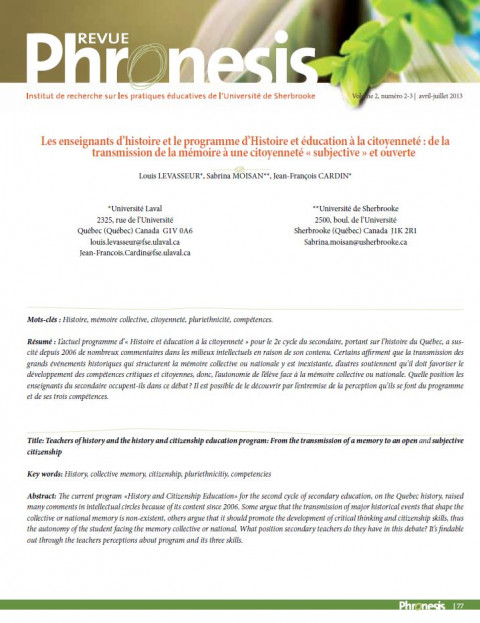 Teachers of History and the History and Citizenship Education Program: From the Transmission of a Memory to an Open and Subjective Citizenship Год публикации: 2013 Автор: Louis LeVasseur | Sabrina Moisan | Jean-François Cardin Организация-автор: Phronesis The current program «History and Citizenship Education» for the second cycle of secondary education, on the Quebec history, raised many comments in intellectual circles because of its content since 2006. Some argue that the transmission of major historical events that shape the collective or national memory is non-existent, others argue that it should promote the development of critical thinking and citizenship skills, thus the autonomy of the student facing the memory collective or national. What position secondary teachers do they have in this debate? It’s findable out through the teachers perceptions about program and its three skills. Les enseignants d’histoire et le programme d’Histoire et éducation à la citoyenneté: de la transmission de la mémoire à une citoyenneté « subjective » et ouverte Год публикации: 2013 Автор: Louis LeVasseur | Sabrina Moisan | Jean-François Cardin Организация-автор: Phronesis L’actuel programme d’« Histoire et éducation à la citoyenneté » pour le 2e cycle du secondaire, portant sur l’histoire du Québec, a suscité depuis 2006 de nombreux commentaires dans les milieux intellectuels en raison de son contenu. Certains affirment que la transmission des grands événements historiques qui structurent la mémoire collective ou nationale y est inexistante, d’autres soutiennent qu’il doit favoriser le développement des compétences critiques et citoyennes, donc, l’autonomie de l’élève face à la mémoire collective ou nationale. Quelle position les enseignants du secondaire occupent-ils dans ce débat ? Il est possible de le découvrir par l’entremise de la perception qu’ils se font du programme et de ses trois compétences.
 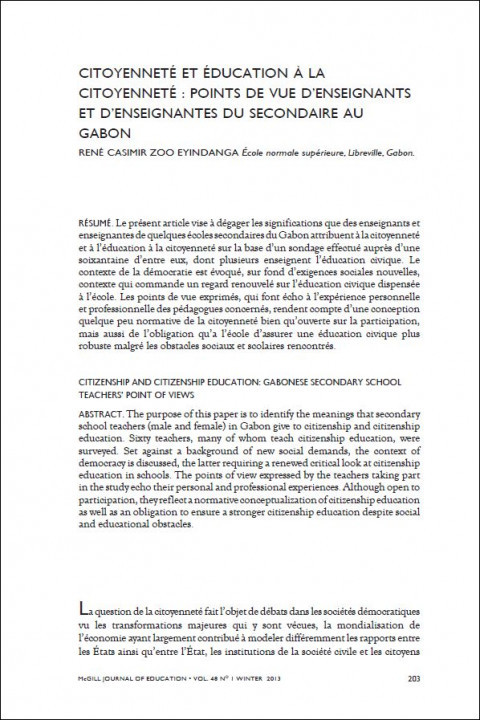 Citizenship and Citizenship Education: Gabonese Secondary School Teachers’ Point of Views Год публикации: 2013 Автор: René Casimir Zoo Eyindanga Организация-автор: McGill University. Faculty of Education The purpose of this paper is to identify the meanings that secondary school teachers (male and female) in Gabon give to citizenship and citizenship education. Sixty teachers, many of whom teach citizenship education, were surveyed. Set against a background of new social demands, the context of democracy is discussed, the latter requiring a renewed critical look at citizenship education in schools. The points of view expressed by the teachers taking part in the study echo their personal and professional experiences. Although open to participation, they reflect a normative conceptualization of citizenship education as well as an obligation to ensure a stronger citizenship education despite social and educational obstacles. Citoyenneté et éducation à la citoyenneté: points de vue d’enseignants et d’enseignantes du secondaire au Gabon Год публикации: 2013 Автор: René Casimir Zoo Eyindanga Организация-автор: McGill University. Faculty of Education Le présent article vise à dégager les significations que des enseignants et enseignantes de quelques écoles secondaires du Gabon attribuent à la citoyenneté et à l’éducation à la citoyenneté sur la base d’un sondage effectué auprès d’une soixantaine d’entre eux, dont plusieurs enseignent l’éducation civique. Le contexte de la démocratie est évoqué, sur fond d’exigences sociales nouvelles, contexte qui commande un regard renouvelé sur l’éducation civique dispensée à l’école. Les points de vue exprimés, qui font écho à l’expérience personnelle et professionnelle des pédagogues concernés, rendent compte d’une conception quelque peu normative de la citoyenneté bien qu’ouverte sur la participation, mais aussi de l’obligation qu’a l’école d’assurer une éducation civique plus robuste malgré les obstacles sociaux et scolaires rencontrés.