
Ресурсы
Изучайте широкий спектр ценных ресурсов ВГГ, чтобы углубить своё понимание и повысить эффективность исследований, просветительской деятельности, преподавания и обучения.
Найдено: 1,180
 Cumbre 2022 sobre la Transformación de la Educación: Notas sinópticas sobre los Futuros de la Educación Год публикации: 2022 Организация-автор: UNESCO Las consultas nacionales que apuntan a desarrollar una visión compartida, un compromiso y una alineación de la acción entre los grupos constituyen uno de los flujos de trabajo clave de TES. El informe Reimaginando juntos nuestro futuro se propone como un marco para examinar cómo deben cambiar los sistemas educativos para servir mejor a los estudiantes y las sociedades en el futuro. Se ha preparado una serie de notas informativas en consonancia con las cinco vías de acción de la cumbre: o Escuelas inclusivas, equitativas, seguras y saludableso Aprendizaje y habilidades para la vida, el trabajo y el desarrollo sostenibleo Docentes, docencia y profesión docenteo Aprendizaje y transformación digitalo Financiamiento de la educación Sommet 2022 sur la Transformation de l’Education: Notes de synthèse sur Les futurs de l’éducation Год публикации: 2022 Организация-автор: Organisation des Nations Unies pour l'éducation, la science et la culture (UNESCO) Les consultations nationales qui visent à développer une vision, un engagement et un alignement des actions partagés entre les groupes constitutifs sont l'un des principaux axes de travail de la TES. Le rapport Reimagining our futures together est proposé comme un cadre pour examiner comment les systèmes éducatifs doivent changer pour mieux servir les apprenants et les sociétés à l'avenir. Une série de notes d'information a été préparée conformément aux cinq pistes d'action du sommet : o Des écoles inclusives, équitables, sûres et saineso Apprentissage et compétences pour la vie, le travail et le développement durableo Enseignants, enseignement et profession enseignanteo Apprentissage et transformation numériqueso Financement de l'éducation
  Education for Global Citizenship as a Transformative Methodological Proposal: Reflections and Practical Proposals Год публикации: 2019 Автор: Isarel García | Joan Gratacós | Desiderio De Paz | Mercè Gil | Assumta Zapata Организация-автор: Oxfam International This publication, the result of the collaborative work of the Network of educators for global citizenship, is a proposal for reflection and practical examples regarding the transformative nature of Education for global citizenship, being essential that for this educational approach that its actions educational activities are aimed at promoting critical thinking, dialogue, collaboration, solidarity and commitment to transform inequalities and promote social justice, equity and sustainable development. The methodological approach, therefore, must also be transformative and the strategies that accompany processes, promote this social transformation. Transformative methodologies are inherent to Education for global citizenship and the methodological processes that contribute to the construction of schools for global citizenship, in our opinion, should be based on three different pillars: promote the transformative dimension of education to build another world possible and necessary, promote a socio-affective approach focused on solidarity and cosmopolitan empathy and promote the construction of a more participatory and integrated curriculum that generates meaning in teachers and students. La educación para la ciudadanía global como propuesta metodológica transformadora: Reflexiones y propuestas prácticas Год публикации: 2019 Автор: Isarel García | Joan Gratacós | Desiderio De Paz | Mercè Gil | Assumta Zapata Организация-автор: Oxfam Intermón Esta publicación, fruto del trabajo colaborativo de la Red de educadores y educadoras para una ciudadanía global, es una propuesta de reflexión y ejemplos prácticos en torno al carácter transformador de la Educación para la ciudadanía global, siendo esencial que para este enfoque educativo que sus acciones educativas vayan encaminadas a fomentar el pensamiento crítico, el diálogo, la colaboración, la solidaridad y el compromiso para la transformación de las desigualdades y la promoción de la justicia social, la equidad y el desarrollo sostenible. El enfoque metodológico, por lo tanto, debe ser también transformador y las estrategias que acompañen procesos, fomentar esta trasformación social. Las metodologías transformadoras son consustanciales a la Educación para la ciudadanía global y los procesos metodológicos que contribuyen a la construcción de escuelas para la ciudadanía global, a nuestro entender, deberían basarse en tres pilares distintos: promover la dimensión transformadora de la educación para construir otro mundo posible y necesario, promover un enfoque socio afectivo centrado en la solidaridad y la empatía cosmopolita y promover la construcción de un currículo más participativo e integrado que genero sentido en docentes y alumnado.
  Participatory Diagnosis of Youth Perceptions and Attitudes Towards Hate Speech and Denialism of Gender Violence and Rights of Migrants From the Approaches of Global Citizenship Education Год публикации: 2024 Автор: Bárbara Biglia | Aloe Cubero Организация-автор: InteRed | Agencia Española de Cooperación Internacional para el Desarrollo (AECID) This diagnosis seeks to respond to the need to explore the perceptions and attitudes of youth regarding hate speech, specifically those that deny gender violence and the rights of migrants. We wanted to carry out this process recognizing the agency of young people and therefore we seek to generate collective and mobilizing reflections that increase their commitment as agents of change in our society. To this end, we place ourselves within the framework of Feminist Activist Research (IAF) using photovoice as a research strategy. Diagnóstico participativo a través de photovoice sobre percepciones y actitudes de la juventud en torno a los discursos de odio y negacionistas de la violencia de género y de los derechos de las personas migrantes desde los enfoques de la educación para Год публикации: 2024 Автор: Bárbara Biglia | Aloe Cubero Организация-автор: InteRed | Agencia Española de Cooperación Internacional para el Desarrollo (AECID) Este diagnóstico busca responder a la necesidad de explorar las percepciones y actitudes de la juventud en torno a los discursos de odio, específicamente sobre aquellos negacionistas de las violencias de género y en contra de los derechos de las personas migrantes. Hemos querido hacer este proceso reconociendo la agencia de las personas jóvenes y por ello buscamos generar reflexiones colectivas y movilizadoras que aumenten su compromiso como agentes de cambio en nuestra sociedad. Para tal fin, nos ubicamos en el marco de la Investigación Activista Feminista (IAF) haciendo uso del photovoice como estrategia de investigación.
 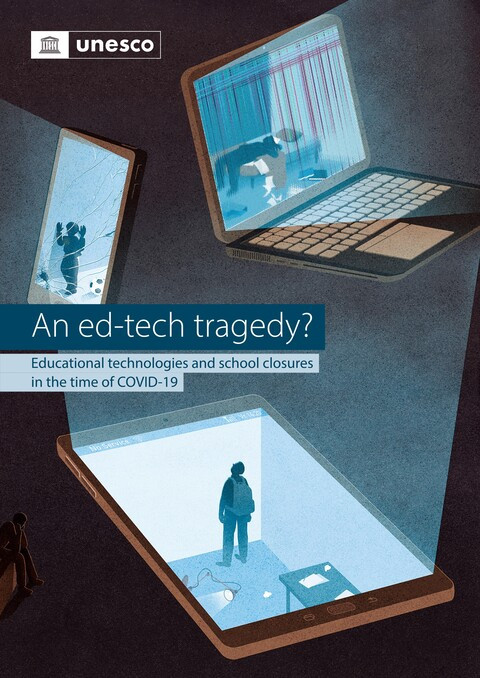 An Ed-Tech Tragedy? Educational Technologies and School Closures in the Time of COVID-19 Год публикации: 2023 Организация-автор: UNESCO Charting a new course for the transformation of education in a digital age An Ed-Tech Tragedy? is a detailed analysis of what happened when education became largely reliant on connected technology during school closures stemming from the COVID-19 pandemic, the largest global disruption to education in history.Many claim that this experience was chiefly one of forced progress and transformations that have, however haltingly, helped propel education into desirable digital futures. Others underline an experience of imperfect salvation – technology saving the day in an emergency and preserving learning continuity for significant numbers of students, even if not all students were helped. But the global evidence reveals a more sombre picture. It exposes the ways unprecedented educational dependence on technology often resulted in unchecked exclusion, staggering inequality, inadvertent harm and the elevation of learning models that place machines and profit before people. This publication examines the promises of educational technologies against the reality of what was delivered during periods of pandemic school closures, which stretched for various durations from early 2020 to the end of 2022. Dedicated sections consider alternate possibilities that had the potential to be more inclusive and equitable.The analysis extracts lessons and recommendations to chart new and more humanistic directions for the development, integration and use of technology in education.
  Harnessing the Era of Artificial Intelligence in Higher Education: A Primer for Higher Education Stakeholders Год публикации: 2023 Автор: Bosen Lily Liu | Diana Morales | Jaime Roser-Chinchilla | Emma Sabzalieva | Arianna Valentini | Daniele Vieira do Nascimento | Clarisa Yerovi Организация-автор: UNESCO | UNESCO International Institute for Higher Education in Latin America and the Caribbean (IESALC) The International Institute for Higher Education in Latin America and the Caribbean (UNESCO IESALC) is one of UNESCO’s key education-focused institutes and is the only institute in the United Nations with a specific mandate for higher education. Taking a holistic and integrated intersectoral and cross-sectoral approach to higher education, UNESCO IESALC provides support to Member States through policy-driven and action-oriented research and publications, capacity development, training, advocacy and networking. Following the release of a Quick Start Guide on using ChatGPT and Artificial Intelligence (AI) in higher education, UNESCO IESALC is pleased to offer to the wider community of higher education stakeholders worldwide this Primer on AI and higher education. Providing information and tips for developing further thinking and policies related to the use of AI processes and outcomes in higher education institutions, the Primer is a comprehensive and comprehensible introduction to AI. It also serves as a practical tool for guidance and reference with recommendations for its use in higher education. Oportunidades y desafíos de la era de la inteligencia artificial para la educación superior: Una introducción para los actores de la educación superior Год публикации: 2023 Автор: Bosen Lily Liu | Diana Morales | Jaime Roser-Chinchilla | Emma Sabzalieva | Arianna Valentini | Daniele Vieira do Nascimento | Clarisa Yerovi Организация-автор: UNESCO | UNESCO International Institute for Higher Education in Latin America and the Caribbean (IESALC) El Instituto Internacional de la UNESCO para la Educación Superior en América Latina y el Caribe (UNESCO IESALC) es uno de los institutos clave de la UNESCO centrado en la educación y es el único instituto de las Naciones Unidas con un mandato específico para la educación superior. Adoptando un enfoque holístico e integrado de manera intersectorial y transectorial de la educación superior, el IESALC presta apoyo a los Estados miembros mediante investigaciones y publicaciones orientadas a la formulación de políticas y a la acción, al desarrollo de capacidades, la formación, la abogacía y la creación de redes. Tras la publicación de una Guía de inicio rápido sobre el uso de ChatGPT y la Inteligencia Artificial (IA) en la educación superior, UNESCO IESALC se complace en ofrecer a la comunidad en general interesada en la educación superior global este Manual en IA y educación superior. Proporcionando información y consejos para el desarrollo de pensamiento y de políticas relacionadas con el uso de la IA en las instituciones de educación superior, este Manual es una introducción comprensible y exhaustiva a la IA. También sirve como herramienta práctica de orientación y referencia con recomendaciones para su uso en la enseñanza superior.
  Arts Education: An Investment in Quality Learning Год публикации: 2023 Автор: Vivek Venkatesh | Lydia Ruprecht | Martha K. Ferede Организация-автор: UNESCO This paper reviews key research on the impact and outcomes of Arts Education (AE), with the objective of demonstrating how AE and its conceptualizations, methodological approaches, theoretical foundations and applications are closely aligned with the objectives and expectations of quality education as notably envisioned by Sustainable Development Goal 4 (SDG 4) on education. For UNESCO (2006), AE is understood to include two different approaches: o the teaching of art as an individual study subject and AE as developing learners’ artistic skills, abilities and sensibilities; o the mobilization of the arts, its tools, methods and stakeholders as a pedagogical approach, also referred to as 'arts in education' or 'learning through the arts.”The evidence gathered in this paper points to six main conclusions. • Arts education contributes to the humanistic outcomes associated with quality education as captured in Target 4.7 of SDG 4 on education, namely the promotion of values grounded in global peace, sustainability, justice and respect for cultural diversity and the development of social and emotional skills such as empathic concern and perspective-taking, all of which support personal and collective well-being and indices associated with increased societal happiness1 such as healthy life expectancy, freedom and generosity. • The evidence demonstrates that the “learning of the arts” positively impacts learning in ways that are relevant to broader academic and non-academic outcomes(see Tables 1 and 2).It has been associated with improvements in mathematics performance, writing skills, reading achievements, creativity, student engagement and attendance, as well as perseverance in pursuit of educational goals and classroom behaviours. • Arts education fosters teacher innovation and collaboration, positively impacting school culture and can help students gain a sense of mastery and accomplishment and engage with their communities. • By linking formal and non-formal learning settings, including both in-person and digital cultural spaces such as museums, festivals, performance venues and cultural centres, AE supports the capacity-building of artists and cultural bearers, while expanding the pedagogical role of cultural institutions and spaces. • Considering the nature of local and Indigenous knowledge in spanning language, cultural practices, land use practices, social interactions, ritual and spirituality, AE holds the potential to support knowledge revitalization for Indigenous peoples, which have been historically compromised or delegitimized within traditional education settings. • Last but not least, by building on the economic potential of the arts and creative industries, AE creates opportunities for employment and economic growth, which cannot be underestimated. • On a methodological note, the review of existing research highlights the limitations of quantitative methods and the absence of evaluation mechanisms to assess the contribution and impact of AE to learning.