
Ресурсы
Изучайте широкий спектр ценных ресурсов ВГГ, чтобы углубить своё понимание и повысить эффективность исследований, просветительской деятельности, преподавания и обучения.
Найдено: 1,448
 Lignes directrices à l’intention des enseignants: Comment repérer et combattre la désinformation Год публикации: 2021 Организация-автор: European Commission La présente boîte à outils a été conçue pour sensibiliser les jeunes au phénomène de la désinformation, en leur faisant comprendre les menaces qu’elle représente, en leur expliquant comment trouver des informations pour s’en protéger et en leur donnant l’occasion de s’attarder sur certains exemples. La boîte à outils est gratuite et libre d’utilisation par tout établissement d’enseignement. Bien qu’elle puisse être adaptée et personnalisée pour n’importe quel groupe d’âge, le principal groupe cible est constitué des adolescents de 15 à 18 ans.
  민주시민이 미래다 Год публикации: 2017 Организация-автор: 중앙선거관리위원회 선거연수원 이 책자에 실린 내용은 중앙선거관리위원회 선거연수원의 「이종희 정치살롱」 (http://blog.naver.com/jongheesalon)에 지난 1여 년간 블로그에 축적된 다양한 선거·정치이야기 등을 모아서 제작한 것이다.
  Ouverture sur le monde Год публикации: 2019 Организация-автор: Annoncer la Couleur (ALC) L’ECM est une éducation holistique qui ouvre les yeux des individus aux réalités du monde et les incite à œuvrer pour davantage de justice d’équité et de droits pour toutes et tous.Les activités proposées dans ce dossier s’adressent aux élèves du type 1 ayant un retard mental léger et éprouvant des difficultés scolaires mais étant aptes à s’intégrer de façon autonome dans la société à l’âge adulte. Les activités proposées prennent en compte les difficultés potentielles inhérentes à ce type d’élèves à besoins spécifiques comme les difficultés de concentration, un manque d’autonomie, etc.
  Les autres, mon corps et moi Год публикации: 2020 Автор: Aline Bosuma | Audrey Boucksom Организация-автор: Belgïk Mojaïk Le dossier pédagogique "Les autre, mon corps et moi" a pour objectif de mettre en évidence les processus des stéréotypes et de la discrimination, d'y réfléchir et de permettre d’amener du changement dans les comportements. Il est composé de 2 activités introductives et généralistes ainsi que de 5 activités thématiques. Les enseignants peuvent utiliser celles qu'ils·elles souhaitent et dans n'importe quel ordre.
  L’Éducation aux médias en 12 questions Год публикации: 2019 Автор: Olivier Gobert | Philippe Delmotte | Catherine Soudon | Corine Dufour | Laurent Abraham | Aurore Leprêtre Организация-автор: Conseil supérieur de l’éducation aux médias (CSEM) La brochure "L'éducation aux médias en 12 questions" a pour objectif de vous aider à mieux appréhender l’éducation aux médias dans divers contextes. Les 12 questions et leurs réponses sont accompagnées d’activités qui, bien qu’elles ne soient pas forcément liées aux questions qui les précèdent, servent à illustrer le champ de l’éducation aux médias.
  Éducation aux médias et compétences initiales: Activités pédagogiques à vivre en classe de maternelle Год публикации: 2020 Организация-автор: Conseil supérieur de l’éducation aux médias (CSEM) Cet outil du Conseil supérieur de l’éducation aux médias propose aux enseignant.e.s, une série d’activités pédagogiques directement reliées aux visées transversales.Souple et modulable, ce recueil de quinze activités d’analyse et de production médiatiques complètera le panel d’activités déjà menées en classe. Chaque fiche proposée est adaptable en fonction des objectifs poursuivis, des moyens et du temps disponibles.
 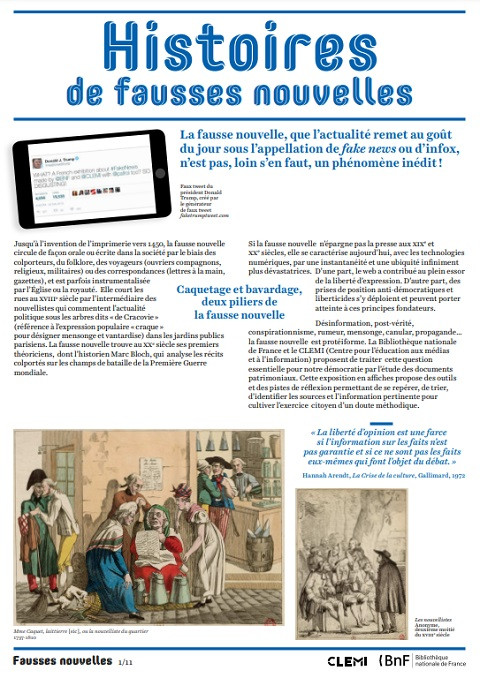 Histoires de fausses nouvelles Организация-автор: Centre pour l’éducation aux médias et à l’information (CLEMI) | Bibliothèque nationale de France (BnF) Désinformation, mensonge, canular, propagande, la « fausse nouvelle » a été remise au goût du jour sous l’appellation de « fake news » puis de« infox ». Mais elle ne date pourtant pas d'hier. Le CLEMI s’est associé a Bibliothèque nationale de France pour traiter cette question essentielle pour notre démocratie par l’étude des documents patrimoniaux. Cette exposition pédagogique en affiches propose des outils et des pistes de réflexion permettant de se repérer, de trier, d’identifier les sources et l’information pertinente pour cultiver l’exercice citoyen d’un doute méthodique.
  Éducation aux médias et à l’information: École primaire Год публикации: 2018 Организация-автор: Centre pour l’éducation aux médias et à l’information (CLEMI) | Réseau Canopé Dans un monde complexe où l’information est surabondante, instantanée et en flux continu, l’éducation aux médias et à l’information (EMI) est devenue une priorité. À l’école primaire, elle peut s'intégrer à tous les enseignements. Son objectif est de favoriser la compréhension et un usage raisonné des médias, notamment numériques.Avec cette brochure, nous souhaitons encourager les professeurs des écoles à mettre en œuvre des activités en EMI, tout en répondant à leurs besoins spécifiques. Chaque fiche pédagogique propose des références aux programmes, un déroulement avec des activités concrètes, une durée indicative, des repères pour l’évaluation, des suggestions de traces écrites et des ressources. Ces fiches ont été validées et enrichies par un comité pédagogique, garant de la qualité et de la pertinence du contenu. Nous remercions les membres de ce comité pour leur implication active et leur engagement dans ce projet collectif.Cette brochure présente également une diversité de témoignages et d’entretiens qui démontrent que l’éducation aux médias et à l’information est une priorité éducative partagée. Apprendre à chercher, vérifier et publier l’information de manière responsable est essentiel au développement de l’esprit critique des élèves. Pensée comme outil de formation et support pour l’action, nous espérons vivement que cette brochure saura répondre efficacement aux besoins des enseignements.
  Cultura de paz y resolución de conflictos Год публикации: 2018 Автор: Patricia García Maza | Luis Miguel Ferrer Bueno Организация-автор: Asociación Conexión Tejiendo Cuidados | Global Schools | Comisión Europea La primera tarea está enfocada hacia el trabajo con uno mismo, fundamental a la hora de resolver conflictos. Saber cómo reacciono, cuáles son mis potencialidades y debilidades, aprender a manejar mis emociones, facilitará la interacción con el otro. La segunda tarea se centra en esa interacción, somos personas diferentes, reaccionamos de distintas maneras, por lo que ver al otro, descubrir qué siente y piensa, exige la suficiente flexibilidad para tolerar la diferencia. 4 La tercera tarea está más enfocada a la cultura de paz para una ciudadanía global, pues esta también debe ser abordada desde una visión de bien común. Su línea estratégica es relacional hacia el bien común; solamente así se pueden enfrentar conflictos más globales.
 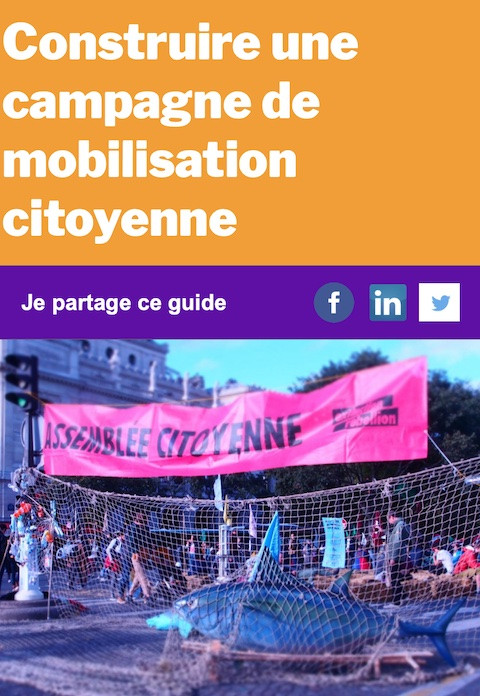 Construire une campagne de mobilisation citoyenne: Je partage ce guide Организация-автор: L'accélérateur de la mobilisation (France) Ce kit est pour partager les bases de la création de campagnes de mobilisation citoyenne, générer de l’inspiration et donner l’envie à des groupes de citoyen.ne.s d’aller gagner des victoires concrètes.