
Ресурсы
Изучайте широкий спектр ценных ресурсов ВГГ, чтобы углубить своё понимание и повысить эффективность исследований, просветительской деятельности, преподавания и обучения.
Найдено: 3,777
 Education and Conflict: Complexity and Chaos Год публикации: 2003 Автор: Lynn Davies Based on the author's extensive research and experience of education in several areas afflicted by conflict, the book explores the relationship between schooling and social conflict and looks at conflict internal to schools. It posits a direct link between the ethos of a school and the attitudes of future citizens towards 'others'. It also looks at the nature and purpose of peace education and war education, and addresses the role of gender and masculinity. Education and Conflict: Complexity and Chaos Год публикации: 2003 Автор: Lynn Davies Basé sur une recherche approfondie de l'auteur et sur son expérience en terme d'éducation dans plusieurs zones affectées par des conflits, ce livre analyse la relation entre le fait d'aller à l'école et le conflit social, et s'attache aux conflits qui surviennent au sein des établissements scolaires. L’auteur postule un lien direct entre l'éthos adopté par une école donnée et le comportement de ses futures citoyens envers « les autres ». Il s'attache également à la nature et à l'objet de l'éducation pour la paix et de l'enseignement des conflits, et aborde la question du rôle joué par le genre et la masculinité.
  Schools and war: urgent agendas for comparative and international education Год публикации: 2005 Автор: Lynn Davies Организация-автор: Taylor & Francis This paper looks first at the contributions that education makes to conflict, through the reproduction of inequality and exclusion, through perpetuation of ethnic or religious divisions, through its acceptance of dominant aggressive masculinities, through selection, competition and fear, and through distorted curricular emphases on narrow cognitive areas of learning. However, the paper also outlines some ‘possibilities for hope’, such as resilient schools, the impact of peace education initiatives and the rise of global citizenship education. Schools and war: urgent agendas for comparative and international education Год публикации: 2005 Автор: Lynn Davies Организация-автор: Taylor & Francis Cet article examine en premier lieu les contributions de l'éducation aux conflits, à travers la reproduction de l'inégalité et de l’exclusion, la perpétuation des divisions ethniques ou religieuses, l’acceptation de la dominance de l’agressivité masculine ; à travers la sélection, la compétition et la peur, et à travers une déformation des programmes scolaires mettant l’accent sur des zones cognitives étroites de l'apprentissage. Toutefois, le document décrit également quelques « notes positives », telles que les écoles de la résilience, l'impact des initiatives de l'éducation à la paix et l’importance croissante donnée à l'éducation à la citoyenneté mondiale.
  Education Reform in Pakistan Год публикации: 2014 Организация-автор: International Crisis Group In April 2010, the eighteenth constitutional amendment committed Pakistan to free and compulsory education for all children between the ages of five and sixteen. Yet millions are still out of school, and the education system remains alarmingly impoverished. The madrasa (religious school) sector flourishes, with no meaningful efforts made to regulate the seminaries, many of which propagate religious and sectarian hatred. Militant violence and natural disasters have exacerbated the dismal state of education. The public education system needs to foster a tolerant citizenry, capable of competing in the labour market and supportive of democratic norms within the country and peace with the outside world. Education Reform in Pakistan Год публикации: 2014 Организация-автор: International Crisis Group En Avril 2010, le Pakistan s’est engagé, l'amendement constitutionnel XVIII, à mettre en place une éducation gratuite et obligatoire pour tous les enfants âgés de cinq à seize ans. Pourtant, des millions d’enfants ne sont encore à l'école et le système éducatif s’appauvrit d’une façon alarmante. Le secteur de la madrasa (école religieuse) fleurit, sans que des efforts significatifs soient déployés pour réglementer les séminaires, qui propagent souvent la haine religieuse et le sectarisme. La violence militante et les catastrophes naturelles ont aggravé l'état lamentable de l'éducation. Le système public de l'éducation doit favoriser une citoyenneté tolérante, compétitive sur le marché du travail et apportant son soutien aux normes démocratiques dans le pays et à la paix avec le monde extérieur.
 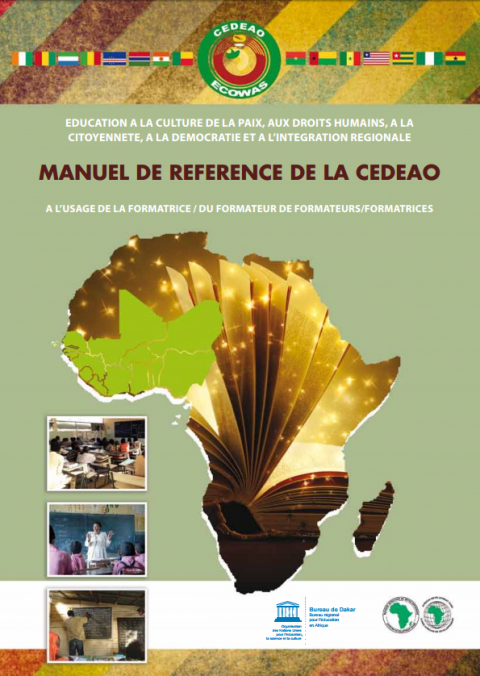 EDUCATION A LA CULTURE DE LA PAIX, AUX DROITS HUMAINS, A LA CITOYENNETE, A LA DEMOCRATIE ET A L’INTEGRATION REGIONALE MANUEL DE REFERENCE DE LA CEDEAO A L’USAGE DE LA FORMATRICE / DU FORMATEUR DE FORMATEURS/FORMATRICES Год публикации: 2013 Организация-автор: UNESCO Dakar | Economic Community of West African States (ECOWAS) The manual comprises seven modules dealing with the Culture of Peace and Conflict Management; Human Rights; Civism and Citizenship; Democracy and Good Governance; Gender and Development; Public Health, Environment and Sustainable Development; and Regional Integration. Each module has sub-themes with introductions, reference materials, general objectives to guide the trainer and generic pedagogical tables that are flexible enough to be adapted to available teaching resources in the different ECOWAS countries. It is also suitable and adaptable to the training of teachers involved in both formal and non-formal education delivery at different levels of teaching and learning. The ultimate goal of the Manual is to build a critical mass of ECOWAS citizens equipped with competent skills, not only for cognitive and psycho-motor domains of education, but also affective skills for positive values, attitudes and behaviors that promote peace, tolerance and peaceful co-existence of community citizens.
  Guide d'utilisation du manuel d'apprentissage de la démocratie pour les jeunes en Tunisie, à l'attention des formateurs et adultes-relais Год публикации: 2013 Организация-автор: UNESCO Rabat The main aim of these manual and guide is to raise awareness among Tunisian youth about the values of democracy, human rights and responsible citizenship, and empower youth to make their voice heard during this critical period in the Tunisian democratic transition.
  Guide on Human Rights Education Curriculum Development Год публикации: 2021 Автор: Cecilia Decara | Carol Rask | Felisa Tibbitts Организация-автор: Danish Institute for Human Rights This document aims to bring conceptual clarity on human rights education and curriculum development and provide concrete suggestions on how to build human rights curricula ft for 21st century human rights challenges, while contributing to the realisation of the SDG goals and targets set by the international community.
  2023 Asia-Pacific Regional Global Citizenship Education (GCED): Network Activities Summary Report Год публикации: 2023 Автор: Seek Ling Tan Организация-автор: UNESCO Bangkok This is a summary report from the Global Citizenship Education (GCED) network activities in Asia-Pacific in 2023. The Asia-Pacific Regional Global Citizenship Education Network, spearheaded by UNESCO Bangkok and the Asia-Pacific Centre of Education for International Understanding (APCEIU), has illuminated the path to empower learners to become global citizens since its inception in 2018. In 2023, their journey was punctuated by significant milestones and a revitalized commitment to propel GCED across the region. This commitment is particularly evident in the key priority areas of advocacy, capacity building, learning/teaching materials, policy and research and the synergizing of regional collaboration towards Education 2030.