
Ресурсы
Изучайте широкий спектр ценных ресурсов ВГГ, чтобы углубить своё понимание и повысить эффективность исследований, просветительской деятельности, преподавания и обучения.
Найдено: 3,451
 Research Models Laying the Foundation for the Unesco Chair: Democracy, Global Citizenship and Transformative Education (DCMÉT) Год публикации: 2018 Автор: Paul R. Carr | Gina Thésée Организация-автор: Chaire UNESCO Démocratie, citoyenneté mondiale et éducation transformatoire (DCMÉT) The conceptual and theoretical models presented in this document were developed over a roughly twelve-year period, starting in 2005, by the Chair (Paul R. Carr, Université du Québec en Outaouais) and Co-Chair (Gina Thésée, Université du Québec à Montréal) of the UNESCO Chair DCMÉT. These models have been published in diverse academic journals in either English or French, and have been translated and adapted herein to produce an updated and bilingual representation of the Education for Democracy research that Carr and Thésée have produced. In some cases, the models have been refined (and improved) over time, and they are presented as a means of attempting to elucidate, interrogate and highlight the meaning of the three themes that underpin the UNESCO Chair DCMÉT.
 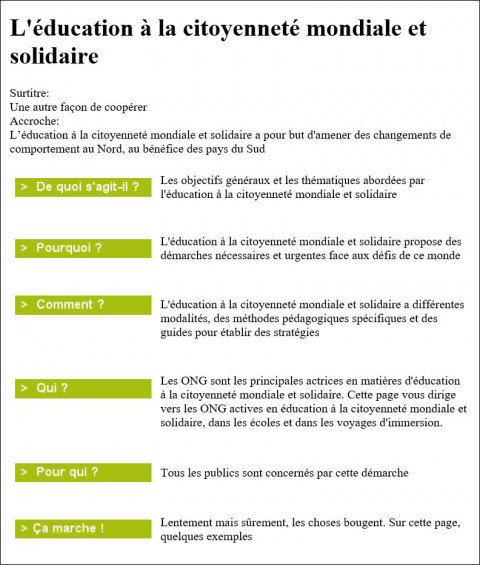 L'éducation à la citoyenneté mondiale et solidaire : Une autre façon de coopérer Организация-автор: Les ONG membres d'ACODEV L’éducation à la citoyenneté mondiale et solidaire est un processus qui vise le changement social. Elle a pour but de permettre aux individus de s’approprier une conviction empreinte de solidarité internationale et de la manifester par des engagements concrets, individuels et collectifs. Objectifs généraux: Faciliter une compréhension globale des enjeux du développement et des mécanismes d’exploitation injustes qui engendrent des relations inégalitaires entre le Nord et le Sud ; Accompagner l’acquisition d’un regard conscient et critique de la réalité, tant au niveau de relations microsociales qu’au niveau macro ; Favoriser un meilleur dialogue entre les citoyens à travers une approche interculturelle basée sur le respect mutuel et l’égalité ; Promouvoir des valeurs, attitudes, et aptitudes liées à la solidarité
  The Psyche of a Good Citizen: On the Psychology of Civic Virtue Год публикации: 2015 Автор: Shelley Burtt Организация-автор: Les ateliers de l'éthique What are the psychological sources of civic virtue in the republican tradition? This article identifies three: the education of the passions, the manipulation of interests, and the compulsion to duty. The author explores each and concludes that an appreciation of their distinctions suggests possibilities for reviving republican virtue in the modern world. La psyché du bon citoyen : sur la psychologie de la vertu civique Год публикации: 2015 Автор: Shelley Burtt Организация-автор: Les ateliers de l'éthique Quelles sont les sources psychologiques de la vertu civique dans la tradition républicaine? Cet article en identifie trois : l’éducation des passions, la manipulation des intérêts et la contrainte du devoir. L’auteure explore chacune de ces sources et conclut qu’une meilleure appréciation de ce qui les distingue est porteuse de nouvelles possibilités pour raviver la vertu républicaine dans le monde moderne.
  Can “Living Together” Be Taught? Год публикации: 2013 Автор: Maxime Plante Организация-автор: McGill University. Faculty of Education The need to teach how to “live together” demonstrates its problematic nature. Indeed, is not living together problematic because it implies that we must by all means coexist, self and other, that is to say, to “live together” despite difference? Is it really possible to bring about a respect for this injunction through education? Two pitfalls are to be avoided. On one hand, that of an hermeneutical approach to education, which may violate the principle of respect for otherness even as it purports to teach it. On the other hand, that of considering ethics simply as total openness to difference. Between these two pitfalls is a difficult path to negotiate, that of a responsibility to educational choices inevitably bound to betray the Other. Peut-on enseigner le vivre-ensemble ? Год публикации: 2013 Автор: Maxime Plante Организация-автор: McGill University. Faculty of Education La nécessité de former au vivre-ensemble témoigne du caractère problématique de celui-ci. Pourquoi le vivre-ensemble est-il problématique sinon parce qu’il sous-entend qu’il nous faut à tout prix coexister, soi et l’autre, c’est-à-dire vivre ensemble dans la différence ? Le respect d’une telle injonction grâce au support de l’éducation est-il possible ? Deux écueils à éviter tracent la voie à emprunter. Celui, d’une part, d’une éducation dont l’herméneutique ne peut que violer le principe de respect de l’altérité au moment même où elle prétend l’enseigner. De l’autre, celui de considérer l’éthique simplement comme ouverture totale à la différence. Entre ces deux écueils, une voie difficile à négocier, celle d’une responsabilité face à des choix éducatifs immanquablement voués à trahir l’Autre.
  Interculturalism in the Classroom: Taking into Consideration Cultural Specificity in Interventions Год публикации: 2011 Автор: Geneviève Audet Организация-автор: McGill University. Faculty of Education This article presents an analysis of narratives of intercultural education practices at the preschool level. This analysis has lead to the sequencing of seven markers towards an ideal type of engagement with the child “of another culture.” The narratives of two of these markers point towards the necessity of taking into consideration cultural specificity in interventions from the perspective of establishing a rapport with the Other. L’interculturel en classe: pour une prise en compte de la spécificité culturelle dans l’intervention Год публикации: 2011 Автор: Geneviève Audet Организация-автор: McGill University. Faculty of Education Cet article présente des résultats issus d’une analyse de récits de pratique d’éducation interculturelle en maternelle, analyse ayant mené à un ordonnancement en sept jalons en progression vers un idéaltype d’engagement envers l’enfant « d’une autre culture ». Plus spécifiquement, c’est la mise en dynamique de récits témoignant de deux de ces jalons qui nous permettra de pointer la nécessité d’une prise en compte de la spécificité culturelle dans l’intervention, sous l’angle du rapport à l’Autre qu’elle permet d’instaurer.
  Together in Citizenship Education: Intervention Principles to Support the Social Participation of People with Intellectual Disabilities Год публикации: 2016 Автор: Raphaëlle Beaudoin | Émilie Raymond Организация-автор: Service social This article presents the outcomes of an intervention’s evaluation that was intended to contribute to the renewal of practices in favour of greater social participation of people with intellectual disabilities (ID). Although much has been achieved for the social integration of this population since deinstitutionalization, these citizens still frequently see their rights and their independence questioned, presenting obstacles to the full achievement of life habits. To address these challenges, this intervention project took the form of a citizenship education group led by adults with ID. This intervention project aimed to highlight the prospects of intervention, inspired by an empowerment approach, the most likely to support these people to lead a participatory and self-determined life. Based on the Disability Creation Process model (DCP), this project involved both personal and environmental factors, which are recognized as key elements for social participation. In doing so, it stands out from most intervention programs created to date, which tend to focus on the individual experiences of people, omitting the influence of structural conditions. Yet, the results of this intervention support the relevance of focusing on the interaction between these factors, illustrated through three promising intervention principles: to build on an active learning process, to create a new distribution of power and to seek a balance between support and freedom. This approach asks social professionals to consider the impact of their intervention on self-determination in attaining social participation. It also aims to better equip these professionals to avoid reproducing the dynamics of oppression and to become true facilitators of the social participation of people with ID.
  La formation interculturelle et inclusive du personnel enseignant: conceptualisation et opérationnalisation de compétences professionnelles Год публикации: 2016 Автор: Julie Larochelle-Audet | Corina Borri-Anadon | Maryse Potvin Организация-автор: Éducation et francophonie Dans un contexte de mondialisation, les systèmes éducatifs, du primaire à l’université, doivent prendre en compte des réalités de plus en plus complexes qui les interpellent, notamment quant aux compétences que doivent développer les enseignants et les enseignantes. À cet égard, l’importance d’une formation relative à la diversité ethnoculturelle, religieuse et linguistique est régulièrement rappelée, tant sur le plan politique que scientifique. Pourtant, un portrait de cette formation dans les universités québécoises a montré que celle-ci demeure globalement lacunaire (Larochelle-Audet, Borri-Anadon, Mc Andrew et Potvin, 2013). Alors que prévaut depuis 2001 une approche par compétences pour la formation à l’enseignement, un groupe de travail interuniversitaire a entrepris de pallier ce manque en enrichissant le référentiel ministériel de compétences professionnelles du personnel enseignant. Les travaux du groupe, présentés dans l’article, s’appuient sur une analyse critique du référentiel, qui révèle l’absence de considérations concrètes quant à la diversité ethnoculturelle et aux finalités d’une formation interculturelle et inclusive en enseignement. Les membres du groupe ont élaboré deux modalités visant à insérer au référentiel des compétences interculturelles et inclusives : la première propose d’intégrer 21 composantes à même les 12 compétences professionnelles existantes et la seconde privilégie l’ajout d’une nouvelle compétence dite interculturelle et inclusive. Leur opérationnalisation comporte certaines limites et certains risques, qui font ici l’objet d’une discussion.