
Ресурсы
Изучайте широкий спектр ценных ресурсов ВГГ, чтобы углубить своё понимание и повысить эффективность исследований, просветительской деятельности, преподавания и обучения.
Найдено: 3,385
 [Video] The World’s Largest Lesson Part 2 - With Thanks to Sir Ken Robinson and Emma Watson Год публикации: 2016 Организация-автор: World’s Largest Lesson Sir Ken Robinson, Emma Watson and Aardman Animations invite children to get involved in the Global Goals for Sustainable Development by inventing, innovating and campaigning.To show the version with English subtitles please go to: vimeo.com/181766755
 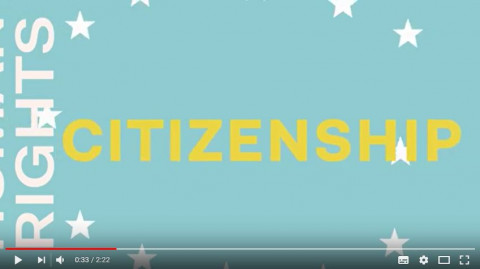 [Video] Citizenship and Human Rights Education for Change Год публикации: 2019 Организация-автор: Global Campus of Human Rights In increasingly selective, violent and intolerant times, it becomes crucial to reinforce our capacities to deal with topical, controversial and contested issues undermining our human dignity and to promote the supportive values of non-discrimination, democracy, intercultural dialogue and peace. Teaching and learning about democratic citizenship, human rights and EU common values represents an opportunity to react and counter the negative forces of our time.This MOOC aims to foster the promotion of Human Rights Education and EU common values through the transfer of knowledge about the definitions, frameworks and content of Human Rights Education as well as the analysis of existing and innovative practices on teaching styles, approaches and methods.
 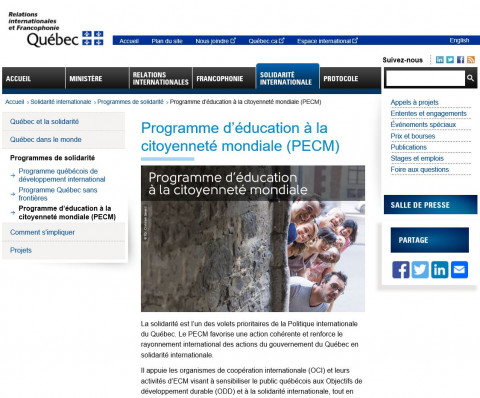 Programme d’éducation à la citoyenneté mondiale (PÉCM) Год публикации: 2018 Организация-автор: Ministère des Relations internationales et de la Francophonie La solidarité est l’un des volets prioritaires de la Politique internationale du Québec. Le PECM favorise une action cohérente et renforce le rayonnement international des actions du gouvernement du Québec en solidarité internationale.Il appuie les organismes de coopération internationale (OCI) et leurs activités d’ECM visant à sensibiliser le public québécois aux Objectifs de développement durable (ODD) et à la solidarité internationale, tout en favorisant l’acquisition de connaissances, de valeurs et de comportements qui contribuent à la mise en place d’un monde plus juste, durable et équitable.
 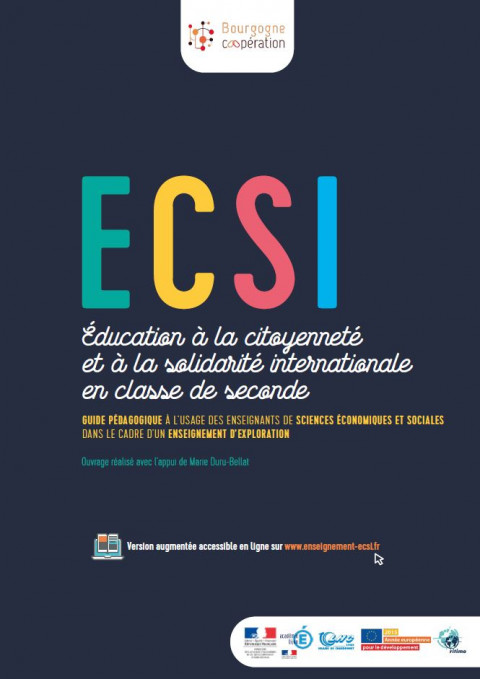 Éducation à la citoyenneté et à la solidarité internationale en classe de seconde : Guide pédagogique à l’usage des enseignants de sciences économiques et sociales dans le cadre d’un enseignement d’exploration Год публикации: 2016 Автор: Denis Bousquet | Hugo Cassagnaud | Benjamin Leger | Agathe Procar Организация-автор: Bourgogne Coopération L’éducation met aujourd'hui de plus en plus l’accent sur les valeurs, les attitudes et les compétences des élèves, complétant ainsi une approche fondée sur l'acquisition de connaissances et le développement de capacités cognitives. Partout, dans les institutions, les collectivités locales, les établissements scolaires ou les associations, une attention grandissante est donnée à la compréhension et à la résolution des problèmes mondiaux, qu'ils soient sociopolitiques, économiques, environnementaux ou culturels.Dans ce contexte, l'éducation apparaît comme l'un des piliers du développement des sociétés contemporaines, globalisées et interdépendantes, garant de la promotion des droits de l'homme, de la cohésion sociale ou encore du succès de la lutte contre le réchauffement climatique.Ce guide pédagogique présente le contenu détaillé d'un enseignement dédié à l'éducation à citoyenneté et à la solidarité internationale (ECSI) proposé initialement au lycée Hilaire de Chardonnet de Chalon-sur-Saône.Il s'appuie sur le programme national de l'enseignement d'exploration de sciences économiques et sociales proposé en classe de seconde. Enseigné aux moyens de méthodes spécifiques, il est enrichi par de nombreux outils, ressources et témoignages de chercheurs, de professionnels, de responsables associatifs et d'enseignants.Principalement à destination des enseignants en sciences économiques et sociales, ce guide s'adresse également à tous les enseignants du secondaire qui souhaitent aborder de nouvelles thématiques. Acteurs associatifs, responsables institutionnels ou élus locaux y trouveront une initiative inspirante pour promouvoir l'ouverture au monde et à la citoyenneté.
 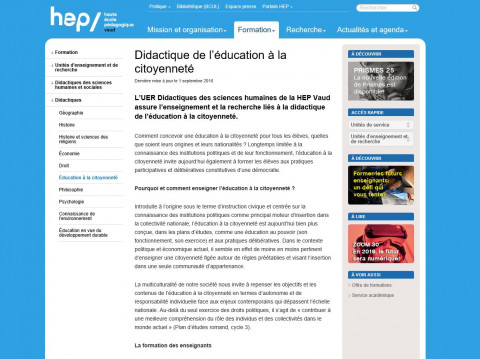 Didactique de l’éducation à la citoyenneté Год публикации: 2016 Организация-автор: Haute école pédagogique Vaud L’UER Didactiques des sciences humaines de la HEP Vaud assure l’enseignement et la recherche liés à la didactique de l’éducation à la citoyenneté.Comment concevoir une éducation à la citoyenneté pour tous les élèves, quelles que soient leurs origines et leurs nationalités ? Longtemps limitée à la connaissance des institutions politiques et de leur fonctionnement, l’éducation à la citoyenneté invite aujourd’hui également à former les élèves aux pratiques participatives et délibératives constitutives d’une démocratie. Introduite à l’origine sous le terme d’instruction civique et centrée sur la connaissance des institutions politiques comme principal moteur d’insertion dans la collectivité nationale, l’éducation à la citoyenneté est aujourd’hui bien plus conçue, dans les plans d’études, comme une éducation au pouvoir (son fonctionnement, son exercice) et aux pratiques délibératives. Dans le contexte politique et économique actuel, il semble en effet de moins en moins pertinent d’enseigner une citoyenneté figée autour de règles préétablies et visant l’insertion dans une seule communauté d’appartenance.
  Éducation à la citoyenneté 3e année (Ressources pour l’éducation à la citoyenneté : L’enseignement intentionnel et direct des compétences essentielles à la citoyenneté) Организация-автор: Concentus Fondation pour L'education a la citoyennete Les citoyens engagés remettent en question, examinent de manière critique, soutiennent et défendent les droits et responsabilités d’une démocratie sur des plans multiples. Ils travaillent à comprendre les problèmes, dissimulés ou manifestes, qui relèvent des enjeux de la citoyenneté et d’élaborer les plans d’action appropriés pour y apporter des solutions. Ils développent aussi leur compréhension des avantages et de la richesse que la diversité et le multiculturalisme apportent aux Canadiens.Les citoyens engagés s’efforcent d’aborder les questions depuis une variété de points de vue. Les élèves vont commencer à explorer les méthodes de résolution des conflits et à examiner et à pratiquer les actions qui contribuent à la paix et à l’ordre. L’exploration du raisonnement critique dans ce domaine de la citoyenneté encourage les élèves à essayer de comprendre un point de vue différent du leur.
  Resilience, violent extremism and religious education Год публикации: 2013 Автор: Joyce Miller Cet article essaie d'apporter une justification éducative au projet REsilience financé par le gouvernement anglais, et dont l'objet est de traiter de sujets controversés par l'éducation religieuse (RE). Ce projet est mené par le Conseil d'éducation religieuse de l'Angleterre et du pays de Galles. La présence de l’extrémisme violent d’inspiration religieuse au sein des programmes scolaires, dans les définitions mais aussi aux niveaux politique et éducatif, soulève un certain nombre de problèmes.
  Third collection of good practices: intercultural dialogue in support of quality education Год публикации: 2013 Организация-автор: UNESCO Associated Schools Project Network (ASPnet) The UNESCO Associated Schools Project Network (ASPnet) conducts pilot projects aimed at reinforcing the humanistic and ethical principles of UNESCO in school curricula and throughout the learning process, often within the framework of UN and UNESCO International Day, Years and Decades, Promoting intercultural dialogue is thus an ASPnet priority. The initiatives presented in this Third Collection of ASPnet Good Practices were carried out by ASPnet schools and their partner institutions in the context of the International Year for the Rapprochement of Cultures (2010). The selected projects illustrate both multicultural education and intercultural education in action. Troisième recueil de bonnes pratiques: le dialogue interculturel à l'appui de l'éducation de qualité Год публикации: 2013 Организация-автор: UNESCO Associated Schools Project Network (ASPnet) Les écoles associées de l'UNESCO (réSEAU) mènent des projets pilotes visant à renforcer les principes humanistes et éthiques de l'UNESCO dans les programmes scolaires et tout au long du processus d'apprentissage, souvent dans le cadre de l'ONU et de la Journée internationale de l'UNESCO, années et décennies, la promotion du dialogue interculturel est donc une priorité Reseau. Les initiatives présentées dans ce troisième Collection de Reseau bonnes pratiques ont été réalisées par les écoles Reseau et leurs institutions partenaires dans le cadre de l'Année internationale du rapprochement des cultures (2010). Les projets sélectionnés illustrent à la fois l'éducation multiculturelle et l'éducation interculturelle dans l'action.
  Promoting the culture of dialogue between cultures in the Arab world Год публикации: 2013 Автор: Selim El Sayegh Организация-автор: UNESCO Beirut The major challenge of the Arab uprisings resides in the youth drive. Accounting for 60 per cent of the Arab population, Youth have been calling for political and economic reforms. During the revolts, these claims have become more radical seeking a fundamental change. This gradual evolution, from a relatively partial change to a more absolute comprehensive one, ushers in a new era with a different intellectual construct. With the ousting of dictatorships, all civil society forces are unleashed with huge actual and potential resources mobilized to contribute to building up the new order. Groups of solidarity, communities, parties, associations, and organizations of all nature among many others put forward new ideas and adequate action plans. Liberty thus acclaimed becomes the outcry for dignity, honor and pride. Never before in the Arab world has the individual had such a central place as it does today. An individual fully grasping the possibilities of restored liberty and recognized dignity gives birth to a new citizen acting in a new paradigm; a new citizen that seeks a transcendence of the ego to relate the individual to the common good. This fresh paradigm empowers the individual as a citizen in the name of equality, while simultaneously recognizing the right of difference of each citizen when it comes to belonging to a culture or sub‐culture. The right to be different involves more than the right to differ and to dispute and by the same token, the obligation of peaceful settlement. The right to be different, by belonging to a culture or a sub‐culture means in a new era of liberty and dignity, the obligation to conduct a transformation of the patterns generating disputes and conflicts among cultures. Henceforth, the issue of promoting the culture of intercultural dialogue in the aftermath of the Arab revolts represents major characteristics that will be reflected hereafter.