
Ресурсы
Изучайте широкий спектр ценных ресурсов ВГГ, чтобы углубить своё понимание и повысить эффективность исследований, просветительской деятельности, преподавания и обучения.
Найдено: 2,668
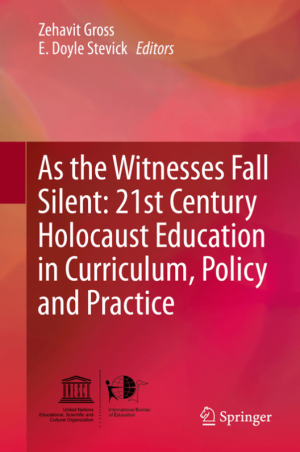 As the witnesses fall silent : 21st century Holocaust education in curriculum, policy and practice Год публикации: 2015 Организация-автор: UNESCO International Bureau of Education (IBE) This UNESCO/IBE publication represents the most comprehensive collection ever produced of empirical research on Holocaust education around the world. It comes at a critical time, as the world observes the 70th anniversary of the liberation of Auschwitz. The policies and practices of Holocaust education around the world are as diverse as the countries that grapple with its history and its meaning. Educators around the globe struggle to reconcile national histories and memories with the international realities of the Holocaust and its implications for the present. These efforts take place at a time when scholarship about the Holocaust itself has made great strides. In this book, these issues are framed by some of the leading voices in the field, including Elie Wiesel and Yehuda Bauer, and then explored by many distinguished scholars who represent a wide range of expertise. (By the publisher) Comme les témoins se taire: 21e siècle Holocauste éducation dans les programmes, les politiques et la pratique Год публикации: 2015 Организация-автор: UNESCO International Bureau of Education (IBE) Cette publication de l'UNESCO/BIE représente la collection la plus complète jamais produit de la recherche empirique sur l'Holocauste dans le monde entier. Il arrive à un moment critique, alors que le monde observe le 70e anniversaire de la libération d'Auschwitz. Les politiques et les pratiques de l'Holocauste dans le monde sont aussi diverses que les pays qui se débattent avec son histoire et sa signification. Les éducateurs autour de la lutte globe pour réconcilier des histoires et des mémoires nationales avec les réalités internationales de l'Holocauste et de ses implications pour le présent. Ces efforts ont lieu à un moment où la bourse de l'Holocauste lui-même a fait de grands progrès. Dans ce livre, ces questions sont encadrées par quelques-unes des principales voix dans le domaine, y compris Elie Wiesel et Yehuda Bauer, puis exploré par de nombreux spécialistes éminents qui représentent un large éventail d'expertise. (Par l'éditeur)
 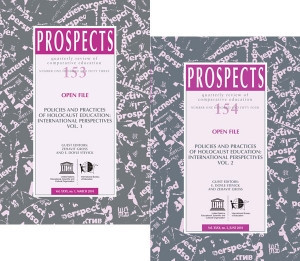 Policies and practices of holocaust education : international perspectives (Vol 40) Issue 153-154 Год публикации: 2010 Организация-автор: UNESCO International Bureau of Education (IBE) This double issue of Prospects (UNESCO/IBE) includes important contributions and new insights from researchers who have examined the practices of Holocaust education in various parts of the world. An open call for papers for this issue brought more than 30 contributions, a pool of high quality papers that greatly exceeded expectations, leading to the production of a double issue on the topic. The broad interest and new research are a testimony both to the significance of the field and to its challenges. The articles in the first volume contribute empirical research about the actual policies and practice of Holocaust education and carry direct lessons from school and classroom practices not only for countries in Europe but also for human rights and peace education worldwide. The second volume continues to reflect its authors’ practical and intellectual engagement with the implications of Holocaust education for human rights, multicultural, peace, and civic education. (By the publisher) Politiques et pratiques de l'éducation holocauste: perspectives internationales (Vol 40) Émission 153-154 Год публикации: 2010 Организация-автор: UNESCO International Bureau of Education (IBE) Ce double numéro de Perspectives (UNESCO / BIE) comprend des contributions importantes et de nouvelles perspectives de chercheurs qui ont examiné les pratiques de l'éducation de l'Holocauste dans diverses parties du monde. Un appel à communications pour cette question a plus de 30 contributions, un pool de documents de qualité qui ont largement dépassé les attentes, conduisant à la production d'un numéro double sur le sujet. L'intérêt général et de nouvelles recherches sont un témoignage à la fois l'importance du champ et à ses défis. Les articles dans le premier volume contribuent la recherche empirique sur les politiques et les pratiques réelles de l'Holocauste et portent des enseignements directs de pratiques scolaires et en classe, non seulement pour les pays d'Europe, mais aussi pour les droits de l'homme et éducation à la paix à travers le monde. Le deuxième volume continue de refléter l'engagement pratique et intellectuel de ses auteurs avec les conséquences de l'Holocauste pour les droits de l'homme, multiculturel, la paix et l'éducation civique. (Par l'éditeur)
 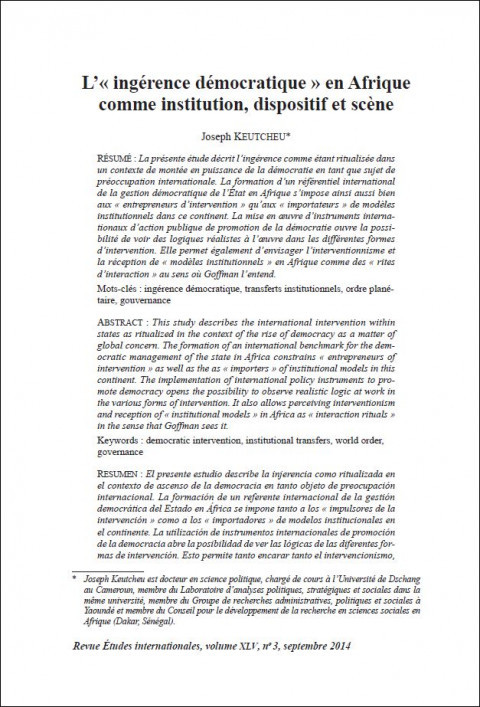 Democratic Interference in Africa as Institution and Context Год публикации: 2014 Автор: Joseph Keutcheu Организация-автор: Études internationales This study describes the international intervention within states as ritualized in the context of the rise of democracy as a matter of global concern. The formation of an international benchmark for the democratic management of the state in Africa constrains « entrepreneurs of intervention » as well as the as « importers » of institutional models in this continent. The implementation of international policy instruments to promote democracy opens the possibility to observe realistic logic at work in the various forms of intervention. It also allows perceiving interventionism and reception of « institutional models » in Africa as « interaction rituals » in the sense that Goffman sees it. L’« ingérence démocratique » en Afrique comme institution, dispositif et scène Год публикации: 2014 Автор: Joseph Keutcheu Организация-автор: Études internationales La présente étude décrit l’ingérence comme étant ritualisée dans un contexte de montée en puissance de la démocratie en tant que sujet de préoccupation internationale. La formation d’un référentiel international de la gestion démocratique de l’État en Afrique s’impose ainsi aussi bien aux « entrepreneurs d’intervention » qu’aux « importateurs » de modèles institutionnels dans ce continent. La mise en oeuvre d’instruments internationaux d’action publique de promotion de la démocratie ouvre la possibilité de voir des logiques réalistes à l’oeuvre dans les différentes formes d’intervention. Elle permet également d’envisager l’interventionnisme et la réception de « modèles institutionnels » en Afrique comme des « rites d’interaction » au sens où Goffman l’entend.
  Discussion Papers Journal (Vol 3) Volume III presents a diverse group of authors writing on a wide range of topics. Among the contributors are academics, researchers, and sociologists, the chairman of a world-renowned Holocaust museum, the Special Advisers to the Secretary-General on the Prevention of Genocide and the Responsibility to Protect, a Hollywood filmmaker, and a former United Nations intern. They are from Canada, Denmark, Israel, Morocco, Senegal, Serbia, the United Kingdom and the United States. Their articles deal with a fascinating wide range of issues including Holocaust education in Denmark, and in Morocco; the International Holocaust Remembrance Alliance; music and the Holocaust; rescue; the preservation of former Nazi concentration and death camps; crimes committed against the Roma and Sinti during the Second World War; the post-Holocaust memory of German-Jewish achievements; and the prevention of atrocity crimes. (By the publisher) Discussion Papers Journal (Vol 3) Volume III présente un groupe diversifié d'auteurs écrivant sur un large éventail de sujets. Parmi les contributeurs sont des universitaires, des chercheurs et des sociologues, le président d'un musée de l'Holocauste de renommée mondiale, les Conseillers spéciaux du Secrétaire général sur la prévention du génocide et la responsabilité de protéger, un cinéaste d'Hollywood, et un ancien stagiaire des Nations Unies . Ils sont du Canada, le Danemark, Israël, le Maroc, le Sénégal, la Serbie, le Royaume-Uni et aux États-Unis. Leurs articles traitent d'un large éventail fascinant de questions, y compris l'Holocauste au Danemark et au Maroc; l'Alliance internationale Holocauste; la musique et l'Holocauste; porter secours; la préservation des anciens camps de concentration et d'extermination nazis; les crimes commis contre les Roms et les Sintis pendant la Seconde Guerre mondiale; la mémoire post-Holocauste des réalisations juifs allemands; et la prévention des crimes atroces. (Par l'éditeur)
  Seeing the world from today from a different viewpoint: The impact of the lessons from Auschwitz project on schools in Scotland Auschwitz remains the epitome of inhumanity and barbarism. In 2007, the Holocaust Educational Trust organised the first Lessons from Auschwitz (LFA) project for Scottish schools. Its participants were two plane-loads of Scottish pupils and teachers from 31 local authorities – typically two pupils from a school accompanied by a teacher. This research, funded by the Holocaust Educational Trust and the Pears Foundation, involved these participants being invited to complete an online questionnaire with selected follow-up interviews. The aims were to evaluate the LFA project and provide insight into the impact this project had on individuals, schools and communities. This paper will report on: Student evaluation of the LFA project ; The impact of the LFA project on individuals, schools and local communities. Conclusions as to the value of the LFA project in Scotland. (By the author)
  Learning from genocide: a study in the failure of Holocaust education The importance of learning lessons from the Holocaust and from the mass slaughter in Rwanda was recognised in the theme underpinning Britain’s Holocaust Memorial Day in 2004. This article is principally concerned with the lessons learnt from the Holocaust by a culturally diverse group of students aged 14 to 16. They all attended schools in an outer London borough and were interviewed after taking part in a local event held to mark the 2004 commemoration. The article concludes with a discussion of the main findings of the investigation. (By the author)