
Ресурсы
Изучайте широкий спектр ценных ресурсов ВГГ, чтобы углубить своё понимание и повысить эффективность исследований, просветительской деятельности, преподавания и обучения.
Найдено: 3,385
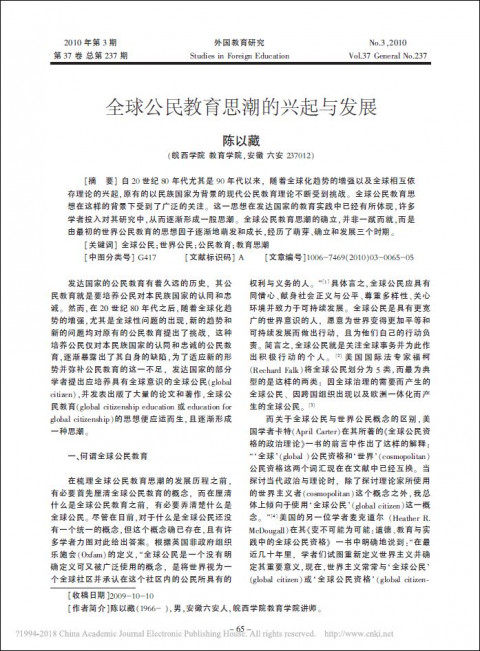 The Rising and Development of the Global Citizenship Education Thoughts Год публикации: 2010 Автор: Chen Yicang Since the 1980s, especially the 1990s,modern citizenship education theories which are based on nation states have been increasingly challenged with the strengthening of the trend of globalization and the rising of the theory about global interconnectedness. The thought of global citizenship education has been discussed intensely and been partly put into practice in some developed countries,and gradually the ideological trend of global citizenship education has come into being. The establishment of global citizenship education thoughts is not finished overnight,which has experienced three stages of sprouting,establishment and development based on the growth of initial worldwide citizenship education thought factors. 全球公民教育思潮的兴起与发展 Год публикации: 2010 Автор: Chen Yicang 自20世纪80年代尤其是90年代以来,随着全球化趋势的增强以及全球相互依存理论的兴起,原有的以民族国家为背景的现代公民教育理论不断受到挑战。全球公民教育思想在这样的背景下受到了广泛的关注。这一思想在发达国家的教育实践中已经有所体现,许多学者投入对其研究中,从而逐渐形成一股思潮。全球公民教育思潮的确立,并非一蹴而就,而是由最初的世界公民教育的思想因子逐渐地萌发和成长,经历了萌芽、确立和发展三个时期。
 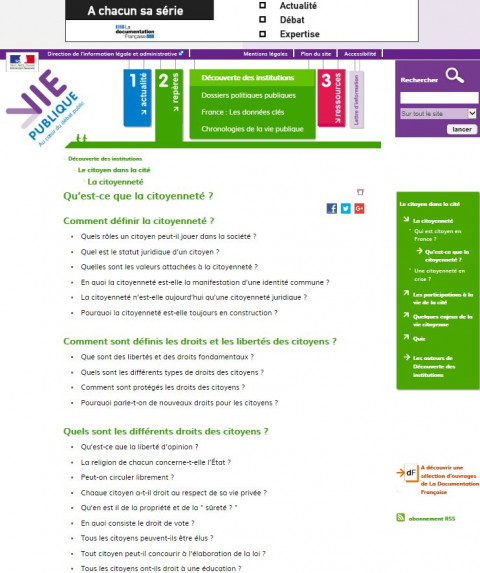 Qu’est-ce que la citoyenneté ? Год публикации: 2018 Организация-автор: Direction de l'information légale et administrative Qu’est-ce que la citoyenneté ? Comment définir la citoyenneté ? Comment sont définis les droits et les libertés des citoyens ? Quels sont les différents droits des citoyens ? Les citoyens ont-ils des devoirs ? Quels sont les devoirs des citoyens ?
 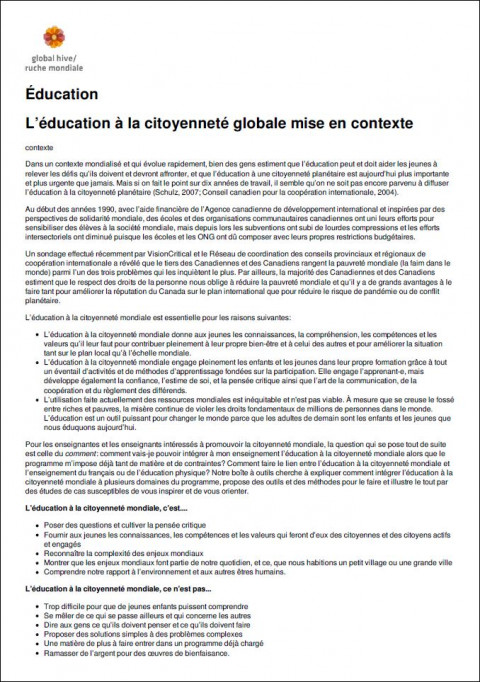 L'éducation à la citoyenneté globale mise en contexte Организация-автор: Global Hive L’éducation à la citoyenneté mondiale est essentielle pour les raisons suivantes:L’éducation à la citoyenneté mondiale donne aux jeunes les connaissances, la compréhension, les compétences et les valeurs qu’il leur faut pour contribuer pleinement à leur propre bien-être et à celui des autres et pour améliorer la situation tant sur le plan local qu’à l’échelle mondiale.L’éducation à la citoyenneté mondiale engage pleinement les enfants et les jeunes dans leur propre formation grâce à tout un éventail d’activités et de méthodes d’apprentissage fondées sur la participation. Elle engage l’apprenant-e, mais développe également la confiance, l’estime de soi, et la pensée critique ainsi que l’art de la communication, de la coopération et du règlement des différends.L’utilisation faite actuellement des ressources mondiales est inéquitable et n'est pas viable. À mesure que se creuse le fossé entre riches et pauvres, la misère continue de violer les droits fondamentaux de millions de personnes dans le monde.L’éducation est un outil puissant pour changer le monde parce que les adultes de demain sont les enfants et les jeunes que nous éduquons aujourd’hui.Pour les enseignantes et les enseignants intéressés à promouvoir la citoyenneté mondiale, la question qui se pose tout de suite est celle du comment: comment vais-je pouvoir intégrer à mon enseignement l’éducation à la citoyenneté mondiale alors que le programme m’impose déjà tant de matière et de contraintes? Comment faire le lien entre l’éducation à la citoyenneté mondiale et l’enseignement du français ou de l’éducation physique? Notre boîte à outils cherche à expliquer comment intégrer l’éducation à la citoyenneté mondiale à plusieurs domaines du programme, propose des outils et des méthodes pour le faire et illustre le tout par des études de cas susceptibles de vous inspirer et de vous orienter.
 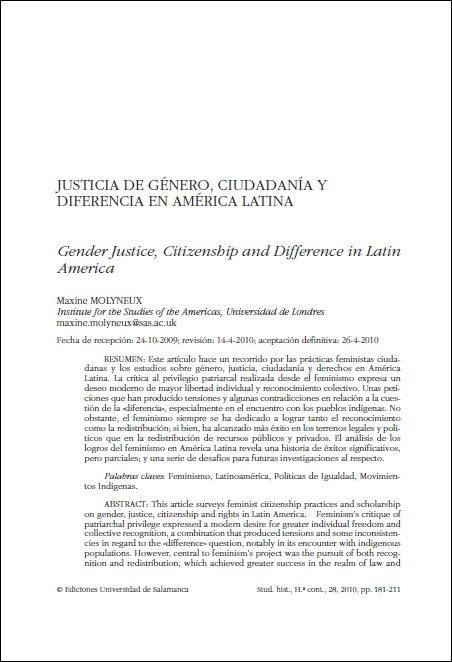 Gender Justice, Citizenship and Difference in Latin America Год публикации: 2010 Автор: Maxine Molyneux This article surveys feminist citizenship practices and scholarship on gender, justice, citizenship and rights in Latin America. Feminism’s critique of patriarchal privilege expressed a modern desire for greater individual freedom and collective recognition, a combination that produced tensions and some inconsistencies in regard to the «difference» question, notably in its encounter with indigenous populations. However, central to feminism’s project was the pursuit of both recognition and redistribution, which achieved greater success in the realm of law and politics than in the distribution of public and private goods. A review of Latin American feminism’s achievements reveals a history of substantial advances but a striking persistence of gender inequality, which provides a rich agenda for further investigation. Justicia de Género, Ciudadanía y Diferencia en América Latina Год публикации: 2010 Автор: Maxine Molyneux Este artículo hace un recorrido por las prácticas feministas ciudadanas y los estudios sobre género, justicia, ciudadanía y derechos en América Latina. La crítica al privilegio patriarcal realizada desde el feminismo expresa un deseo moderno de mayor libertad individual y reconocimiento colectivo. Unas peticiones que han producido tensiones y algunas contradicciones en relación a la cuestión de la «diferencia», especialmente en el encuentro con los pueblos indígenas. No obstante, el feminismo siempre se ha dedicado a lograr tanto el reconocimiento como la redistribución; si bien, ha alcanzado más éxito en los terrenos legales y políticos que en la redistribución de recursos públicos y privados. El análisis de los logros del feminismo en América Latina revela una historia de éxitos significativos, pero parciales; y una serie de desafíos para futuras investigaciones al respecto.
  Education and Countering Violent Extremism: a case study of schools in Pakistan Год публикации: 2015 Автор: Hussain-Mohiud-Din Qadri This paper explores the role of education in combating the violent extremism by using the Pakistani education system as a case study. It undertakes a historical perspective of growth of the educational sector in Pakistan by delving deep into the pre-partition system. Education and Countering Violent Extremism: a case study of schools in Pakistan Год публикации: 2015 Автор: Hussain-Mohiud-Din Qadri Cet article analyse le rôle de l'éducation dans la lutte contre l'extrémisme violent en prenant pour exemple le système éducatif pakistanais. Il développe une approche historique de la croissance du secteur éducatif, en analysant en détail le système précédant la partition du pays.
 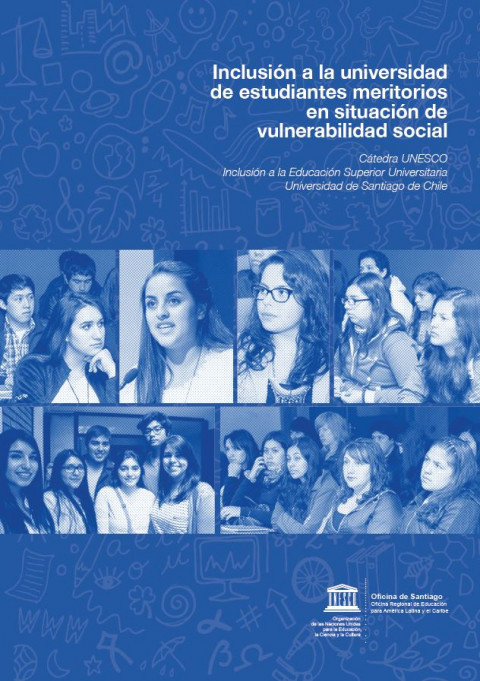 Inclusion at the University of Meritorious Students in Situations of Social Vulnerability Год публикации: 2015 Автор: Marcela Orellana | Karla Moreno | Francisco Javier Gil Организация-автор: UNESCO Santiago | UNESCO Chair on Inclusion in Higher Education The first edition of this work was published by the OREALC / UNESCO Santiago for its dissemination among those attending the Education for All Ministerial Meeting in Latin America and the Caribbean: Balance and Challenges post 2015, within the framework of the Regional Education Project for America Latin America and the Caribbean (PRELAC), held in Lima, Peru on October 30 and 31, 2014. In this second edition, we are pleased to add other inclusion mechanisms that arise from the commitment of the UNESCO Chair in Inclusion in Higher Education, the valuable support from non-profit private foundations and the support of OREALC / UNESCO Santiago. The generation of these alliances constitutes a fundamental contribution to the collection of relevant information for the design of public policy proposals aimed at reducing the inequality gaps in higher education, guaranteeing the right to a quality education and to collaborate in the construction of societies with greater social justice. Inclusión a la universidad de estudiantes meritorios en situación de vulnerabilidad social Год публикации: 2015 Автор: Marcela Orellana | Karla Moreno | Francisco Javier Gil Организация-автор: UNESCO Santiago | UNESCO Chair on Inclusion in Higher Education La primera edición de este trabajo fue publicada por la OREALC/UNESCO Santiago para su difusión entre los asistentes a la Reunión Ministerial Educación para Todos en América Latina y el Caribe: Balance y desafíos post 2015, en el marco del Proyecto Regional de Educación para América Latina y el Caribe (PRELAC), realizada en Lima, Perú el 30 y 31 de octubre de 2014. En esta segunda edición, nos complace sumar otros mecanismos de inclusión que surgen del compromiso de la Cátedra UNESCO de Inclusión en la Educación Superior, el valioso apoyo de fundaciones privadas sin fin de lucro y el apoyo de la OREALC/UNESCO Santiago. La generación de estas alianzas constituye un aporte fundamental para el levantamiento de información relevante para el diseño de propuestas de políticas públicas tendientes a disminuir las brechas de desigualdad en la educación superior, a garantizar el derecho a una educación de calidad y a colaborar a la construcción de sociedades con mayor justicia social.