
Ресурсы
Изучайте широкий спектр ценных ресурсов ВГГ, чтобы углубить своё понимание и повысить эффективность исследований, просветительской деятельности, преподавания и обучения.
Найдено: 3,385
 Le concept de « citoyenneté mondiale » : un apport potentiel pour l’éducation multiculturelle ? Год публикации: 2013 Автор: Sobhi Tawil Организация-автор: Revue internationale d’éducation de Sèvres Parmi les trois priorités de l’initiative mondiale « l’éducation avant tout » (Education First) lancée en 2012 par les Nations-Unies, on trouve l’idée de « favoriser la citoyenneté mondiale ». Cependant, cette notion reste vague sinon contestée, et par conséquent difficile à concrétiser dans le domaine de l’éducation. S’il est vrai que la mondialisation et la multiculturalité croissante des sociétés contemporaines transforment progressivement la conception et la pratique traditionnelle de la citoyenneté, la réalité juridique de la citoyenneté, ainsi que sa pratique, restent encore largement ancrées au niveau de l’État-nation. Cet article tente de clarifier la notion de « citoyenneté mondiale », son application possible dans le domaine de l’éducation à la citoyenneté et sa contribution potentielle à l’enrichissement de l’éducation multiculturelle.
  L'éducation à la citoyenneté Год публикации: 2008 Автор: Audric Vitiello Организация-автор: Raisons politiques Notion récente, l'éducation à la citoyenneté se présente comme une inflexion de la formation civique, visant un renouvellement de sa forme pour mieux assurer sa fonction institutionnelle d'intégration des individus au collectif. Mais, l'éducation ôtant une praxis où moyens et fins sont interdépendants, une modification des modalités de l'éducation induit logiquement celle de la finalité. De fait, l'éducation à la citoyenneté s'indexe à une conception originale du politique pensé non plus comme lieu, mais comme moment spécifique dédié à la régulation de tout collectif. Le mécanisme d'abstraction civique perdure, mais il s'effectue à partir des situations concrètes dans lesquelles l'individu est inscrit, et par une réflexion à fondement dialogique. Se dessine alors une forme de démocratie générale et dialogique, où le politique est déconcentré et démultiplié mais où la décision prise en commun après délibération reste le mode de structuration privilégié du collectif. Mais la démocratie procédurale et dialogique a des limites, dans la mesure où elle suppose d'être fondée dans un corpus substantiel de valeurs qui lui confère sa légitimité.
  Citoyenneté des enfants et des adolescents Год публикации: 2018 Автор: Stéphanie Gaudet Организация-автор: Lien social et Politiques Chacune des contributions de ce numéro révèle clairement un ou plusieurs de ces défis selon différences échelles d’analyse. La première partie du numéro porte sur les normativités et les représentations sociales de la citoyenneté enfantine et adolescente véhiculées par les instruments de politiques publiques en France et au Québec. La deuxième section porte sur les institutions qui répondent directement des politiques publiques et qui ont pour mandat de socialiser et d’éduquer les enfants et les adolescents aux pratiques de citoyenneté démocratique. La troisième section de ce numéro présente deux contributions qui rendent compte de l’agencéité (agency) des jeunes et de leurs pratiques citoyennes, c’est-à-dire leur capacité à développer des intentions politiques et à les mettre en action les uns avec les autres. Ce terme se distingue de celui d’agentivité qui est utilisé davantage en sciences cognitives et s’intéresse plus spécifiquement aux mécanismes de l’action individuelle (Glossaire, 2009). Finalement, nous terminons le numéro par des analyses à l’échelle des quartiers et des organisations jeunesse. On y voit comment les intervenants de première ligne, et leurs organisations locales, négocient différentes visions de l’éducation citoyenne, allant de l’éducation à la civilité jusqu’à l’intervention démocratique. Ces échelles d’analyse nous permettent d’observer les représentations de la citoyenneté en fonction des rapports de classe et d’ethnicité.
 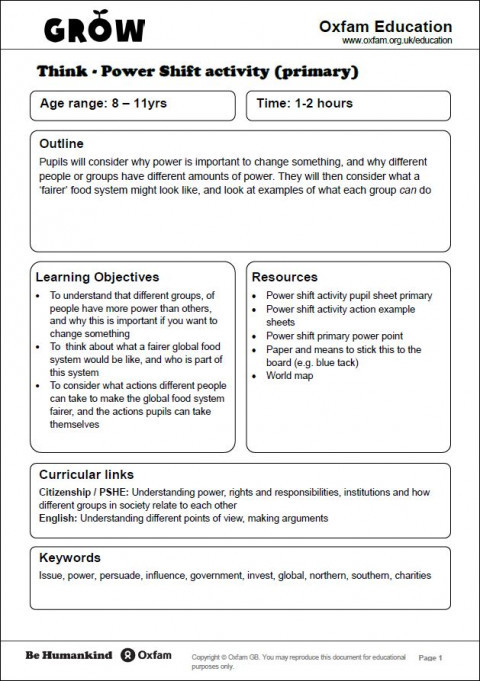 Think: Power-Shift Activity Teachers Guide for Primary Schools Организация-автор: Oxfam GB Linked to Oxfam's GROW campaign, the Food for Thought school resources get young people learning, thinking and taking action for a fairer food system.Through this activity pupils will consider why power is important to change something, and why different people or groups have different amounts of power. They will then consider what a ‘fairer’ food system might look like, and look at examples of what each group can do.
 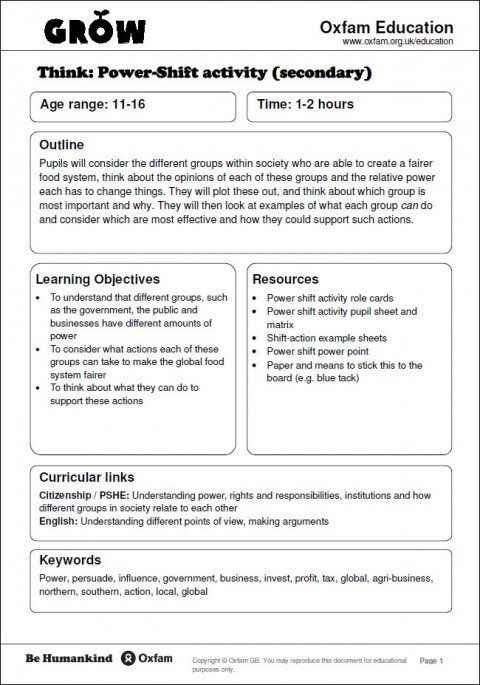 Think: Power-Shift Activity Teachers Guide for Secondary Schools Организация-автор: Oxfam GB Linked to Oxfam's GROW campaign, the Food for Thought school resources get young people learning, thinking and taking action for a fairer food system.Through this activity pupils will consider the different groups within society who are able to create a fairer food system, think about the opinions of each of these groups and the relative power each has to change things. They will plot these out, and think about which group is most important and why. They will then look at examples of what each group can do and consider which are most effective and how they could support such actions.
 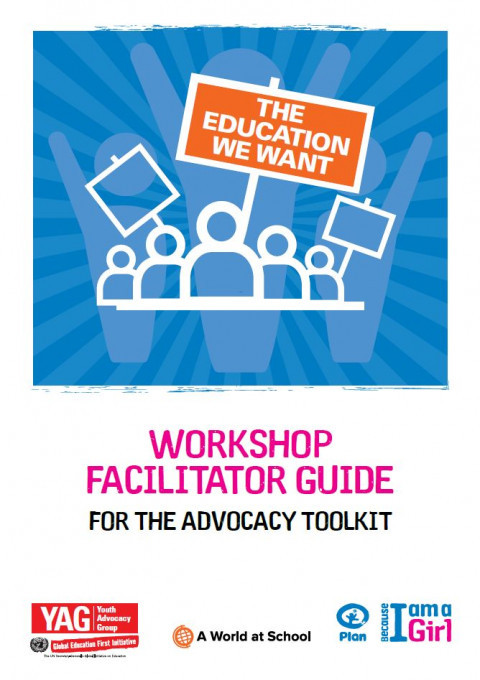 The Education We Want: Workshop Facilitator Guide For the Advocacy Toolkit Год публикации: 2014 Автор: Daniel Smith | James Edleston | Tom Burke | Emily Laurie Организация-автор: A World at School | UN Global Education First Initiative - Youth Advocacy Group (YAG) | Plan International This guide is intended as a resource to accompany the ‘Education we want: An Advocacy’. It aims to provide a wide range of workshop activities for those who intend to Understand, Plan or Do their education advocacy using workshop based approaches.Workshops are an effective way of involving others in advocacy. They can support you in carrying out research, drafting a plan and building skills for action.The successful delivery of workshops relies on effective preparation, good facilitation skills and a commitment to support people’s learning and development.
 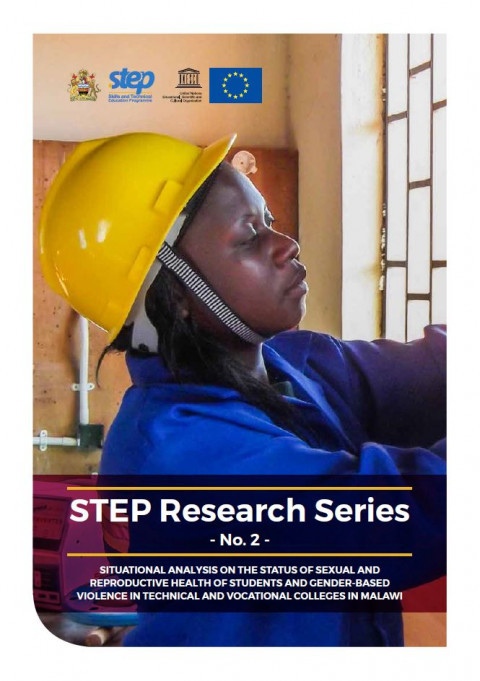 Situational Analysis on the Status of Sexual and Reproductive Health of Students and Gender-based Violence in Technical and Vocational Colleges in Malawi (STEP Research Series No. 2) Год публикации: 2017 Организация-автор: Skills and Technical Education Programme (STEP) Funded by the EU and implemented by UNESCO in collaboration with the Government of Malawi, the Skills and Technical Education Programme (STEP) is dedicated to reinforcing Technical, Entrepreneurial and Vocational Education and Training (TEVET) in Malawi.The programme will run from 2016-2020 and aims to improve TEVET at post-secondary level with a focus on equal access to enrolment, with particular emphasis on female learners; improving quality in the sector; and the establishment of clear governance structures. The STEP Research Series presents the highlights of the research undertaken by the programme.The situational analysis on the status of sexual and reproductive health of students and gender-based violence in technical and vocational colleges in Malawi is the second report in the STEP Research Series.
 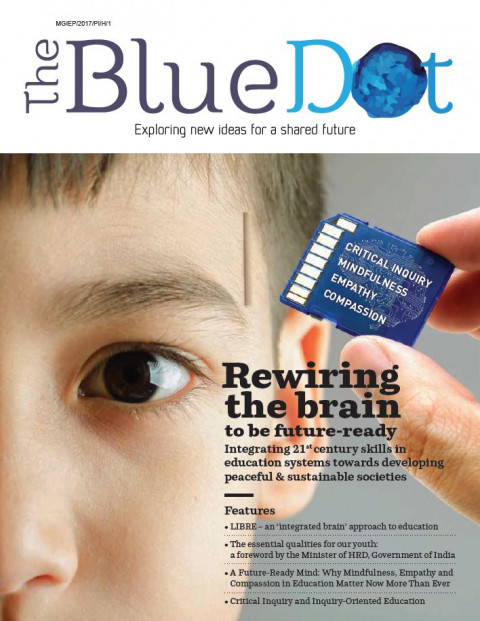 Rewiring the Brain to be Future-ready: Integrating 21st Century Skills in Education Systems Towards Developing Peaceful & Sustainable Societies (The Blue Dot Issue 6, 2017) Год публикации: 2017 Организация-автор: Mahatma Gandhi Institute of Education for Peace and Sustainable Development (MGIEP) In the sixth issue of the Blue Dot, we focus on the importance of these 21st century skills for the young. The issue includes a foreword by the Minister of Human Resource Development, Government of India on the importance of inculcating 21st century skills in education systems and our Cover Story, which introduces UNESCO MGIEP’s LIBRE programme that follows an ‘integrated brain’ approach to education.Additionally, we feature opinions by specialists from academia, research and the industry on the lacuna present in existing education systems and the opportunities available to address this gap by introducing socio-emotional skills and inquiry oriented learning into curricula. Amongst various experts, we hear from Ines Kudo and Joan Hartley from The World Bank on the importance of ‘Teaching empathy and compassion in schools’; Prof. K.P. Mohanan on ‘Critical Inquiry and Inquiry oriented education’ and Dr. Marilee Bresciani Ludvik on how mindfulness forms the foundation for cultivating compassion.Further, we present excerpts from a collection of ‘Ask me Anything’ sessions focused on socioemotional skills, hosted on Knowledge Commons, UNESCO MGIEP’s knowledge sharing platform.We have been honoured to have the opportunity to host and learn from experts such as Dr. Richard Davidson, recognised as one of ‘The 100 most influential people in the world’ in 2006 by the Time Magazine and Chade-Meng Tan, currently the Chairman of Search Inside Yourself Leadership Institute and Co-chair of One Billion Acts of Peace, which has been nominated eight times for the Nobel Peace Prize.
 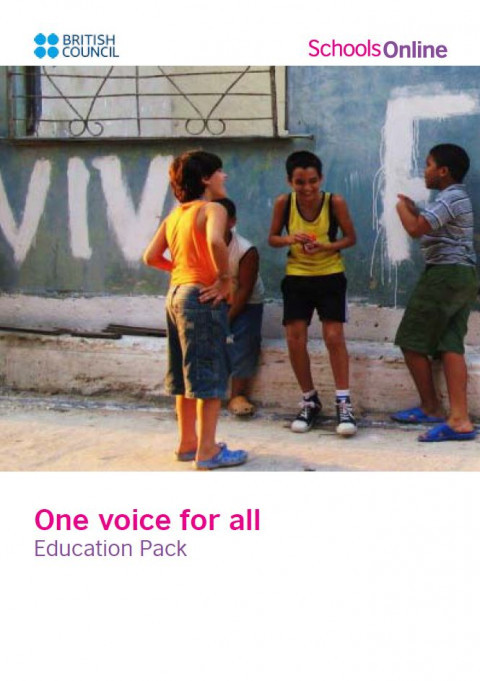 One Voice for All: Education Pack Год публикации: 2013 Организация-автор: British Council One Voice for All is a set of resources designed to help teachers work on the Connecting Classrooms themes of Rights and Responsibilities and Fairness and Equality through an exploration of human rights and street children. Its focus is the UN Convention on the Rights of the Child and it aims to allow learners to develop understanding of the key concepts of global citizenship, universal rights and justice.This resource aims to give young people the opportunity to understand the complexity of the wider world in which they live by exploring inequality and steps to address it.
 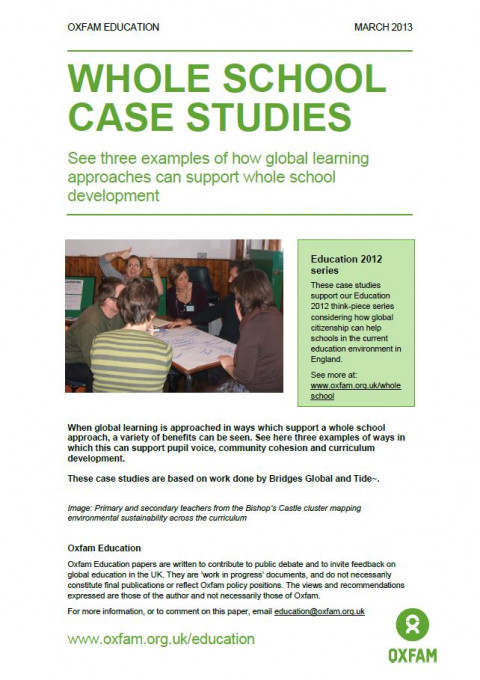 Whole School Case Studies: See Three Examples of How global Larning Approaches Can Support Whole School Development Год публикации: 2013 Организация-автор: Oxfam GB These case studies support our Education 2012 think-piece series considering how global citizenship can help schools in the current education environment in England.When global learning is approached in ways which support a whole school approach, a variety of benefits can be seen. See here three examples of ways in which this can support pupil voice, community cohesion and curriculum development.These case studies are based on work done by Bridges Global and Tide~.See more at: www.oxfam.org.uk/wholeschool