
Ресурсы
Изучайте широкий спектр ценных ресурсов ВГГ, чтобы углубить своё понимание и повысить эффективность исследований, просветительской деятельности, преподавания и обучения.
Найдено: 3,797
 Dialogue and transformation in Holocaust education? Reweaving the tapestry of experience, research and practice. This article draws upon Habermas's three human interests to discuss different goals in Holocaust education research, namely the technical/instrumental interest in changing others' racist views, the communicative interest in understanding how such views make sense to others from their own perspective through dialogue, and the emancipatory interest in self-knowledge through which the researcher can uncover both implicit values about how things should be and implicit, and perhaps even subconscious theories of how things work. Achieving greater clarity about these implicit normative and empirical foundations of researchers' design decisions and interpretations has several positive outcomes: first, it enhances subjectivity, positionality and transparency in a field that is often highly personal for its participants; second, it enables the field to deliberate about the ethical dimensions of the work, while making theories about how things work explicit opens them up for critical examination; third, it has heuristic value, sharing ways of thinking, meaningful narratives and metaphors that may enhance Habermas's second, communicative interest in understanding. In practice, Habermas's three interests are not cleanly differentiated in Holocaust education research and practice, but are interconnected. This article focuses upon the emancipatory interest by exploring the interrelationships between experience and inquiry, or more specifically, how the author's encounter with tragedy shaped an evolving research agenda in Holocaust education. It revealed a set of implicit theories and commitments that, once unearthed and made explicit, are available for reflection and critique. It also clarified the ethical and empirical grounds for certain theories and commitments. (By the publisher)
  Transferring findings from genocide education research into strategies for teaching and learning about genocide in schools In recent years interest in schools outreach and academic enrichment has increased dramatically, reflecting a greater social conscience and awareness of the impact that universities can have on the wider community. The transferable skills that academics bring to schools need to be honed for this new learning environment, as delivery methods and success benchmarks are radically different in a schools context. This collection addresses the numerous issues raised when arts and humanities academics become involved with schools, bringing together practitioners from a broad range of fields within the arts and humanities to share experiences and insights. (By the author) What can we learn from the dark chapters in our history? Education about the Holocaust in Poland in a comparative perspective The article investigates what research tells us about the dynamics of educational practice in both formal and informal education about the Holocaust. It poses such questions as whether it is possible to identify good practices on a political and/or educational level, whether there are links between education about the Holocaust and human rights education, and how education about the Holocaust relates to attitudes toward Jews. Examples of both international studies (such as those by the Fundamental Rights Agency of the EU and the American Jewish Committee) and some national surveys on education about the Holocaust are discussed, followed by an analysis of empirical studies from Poland based on focus group interviews and individual interviews with educators. The choice of case study was based on the historical fact that occupied Poland was the site of the murder of almost 5 million Jews, including 3 million Polish Jews. In many cases a strong association with a Polish sense of victimhood based on the memory of the terror and the murder of almost 2 million ethnic Poles during WWII creates conflictingapproaches and generates obstacles to providing education about Jewish victims. Nevertheless, following the fall of communism, the number of educational initiatives designed to teach and learn about the Shoah is steadily increasing. The article presents tips for successful programmes of education about the Holocaust which can be generalized for any type of quality education, but are primarily significant for education about tolerance and education aimed at reducing prejudice, counteracting negative stereotypes and preventing discrimination. (By the author) Arab Teachers and Holocaust Education: Arab Teachers Study Holocaust Education in Israel This paper examined whether change occurred in the attitudes of Arab teachers in Israel toward Holocaust education following an in-service study course. Survey and interview data indicated that after the course, teachers had a better understanding of what occurred during the Holocaust, and their willingness to know about its effects on Jewish people increased. However, the Israeli-Palestinian conflict impacted participants' views. (By the author)
  Does the Singularity of the Holocaust make it Incomparable and Inoperative for Commemorating, Studying and Preventing Genocide? Britain’s Holocaust Memorial Day as a Case Study This article is a response to the controversy surrounding the first national Holocaust Memorial Day in Britain, held on 27 January 2001. The discussion is centred on the British experience, but it is intended to have a wider resonance and relevance. It begins by summarizing the aims of Holocaust Memorial Day and then looks at some of the significant interventions in the nationwide debate about it. Much of the discussion was informed by the work of the American historian Peter Novick, so the article examines his influential argument about Holocaust commemoration and education. It concludes with an attempt to answer the question set out in the title, showing briefly that researching and teaching about the Holocaust as well as the work of remembrance and memorialization are crucial to commemorating, studying and preventing genocide. (By the author) Teaching and Learning about the Holocaust through Visiting an Exhibition This article evaluates a teaching initiative that aimed to teach about the Holocaust through a traveling exhibit on Anne Frank. Data from 10 case study schools show the success of the approach and some ways in which the teaching relevance might have been strengthened. (By the author) History at the gates: How teacher and school characteristics relate to implementation of a state mandate on Holocaust education This quantitative study examines implementation by one Florida school district's fifth grade teachers of a state mandate to teach about the Holocaust. Teachers' responses to survey questions were analyzed to determine the relationships between choosing to teach about the Holocaust and factors like exposure to Holocaust content and teacher/school demographics. In addition, this study explores descriptive data about the nature of resources, materials, and teaching methods used to teach about the Holocaust in elementary classrooms. The findings of this study demonstrate the background knowledge and resources that teachers need to increase their implementation of Holocaust education in the classroom. Suggestions for the development of more effective workshops, information dissemination strategies, and teacher resources for Holocaust education and other mandated areas are also included in this study. To provide the necessary background for the exploration of the implementation of Florida's Holocaust education mandate, this study examines: the importance of Holocaust education; effective instructional practices in Holocaust education; connections between Holocaust education and multicultural goals; and the history of the passage of legislation related to Holocaust education. As the title suggests, teachers are the final "gatekeepers" of the curriculum: their decisions determine the extent to which topics will be taught. For this reason, this study examines the connections between teachers, their experiences, and their decisions to teach about crucial, mandated subjects like the Holocaust. (By the author)
  A Whole School Approach: Involving the School Community in Reducing its Carbon Footprint Год публикации: 2010 Организация-автор: Carbon Trust Reducing energy use has many advantages for schools – it saves money, reduces carbon emissions (helping to combat climate change), improves the learning environment and can enhance a school’s reputation.To be really effective, the whole school must be involved in energy saving. This guide outlines an approach to energy management which involves pupils, teachers and other staff. By motivating staff and pupils through lessons, as well as providing practical advice on how to go about saving energy, a whole school approach to energy management can reduce the school’s carbon footprint and provide long-term benefits for the school, its people and the environment.
 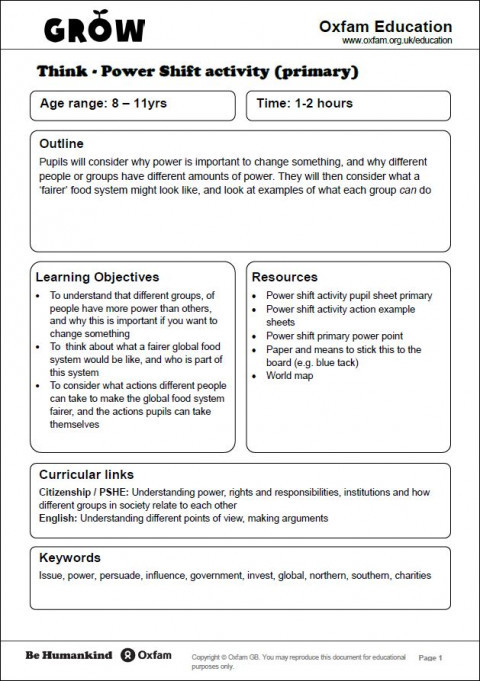 Think: Power-Shift Activity Teachers Guide for Primary Schools Организация-автор: Oxfam GB Linked to Oxfam's GROW campaign, the Food for Thought school resources get young people learning, thinking and taking action for a fairer food system.Through this activity pupils will consider why power is important to change something, and why different people or groups have different amounts of power. They will then consider what a ‘fairer’ food system might look like, and look at examples of what each group can do.
 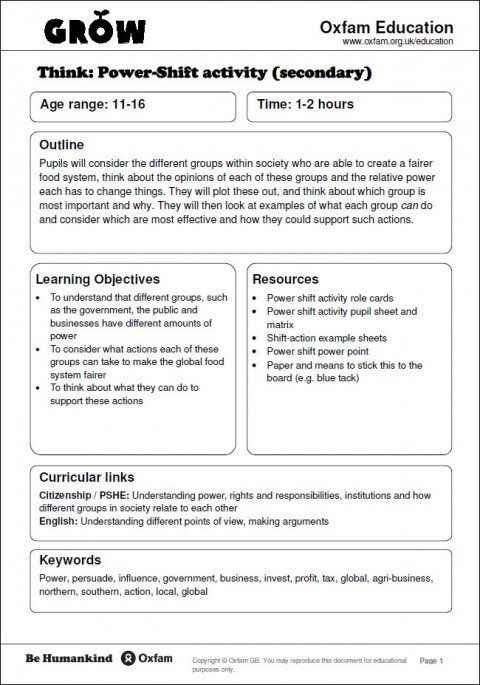 Think: Power-Shift Activity Teachers Guide for Secondary Schools Организация-автор: Oxfam GB Linked to Oxfam's GROW campaign, the Food for Thought school resources get young people learning, thinking and taking action for a fairer food system.Through this activity pupils will consider the different groups within society who are able to create a fairer food system, think about the opinions of each of these groups and the relative power each has to change things. They will plot these out, and think about which group is most important and why. They will then look at examples of what each group can do and consider which are most effective and how they could support such actions.