
Ресурсы
Изучайте широкий спектр ценных ресурсов ВГГ, чтобы углубить своё понимание и повысить эффективность исследований, просветительской деятельности, преподавания и обучения.
Найдено: 3,453
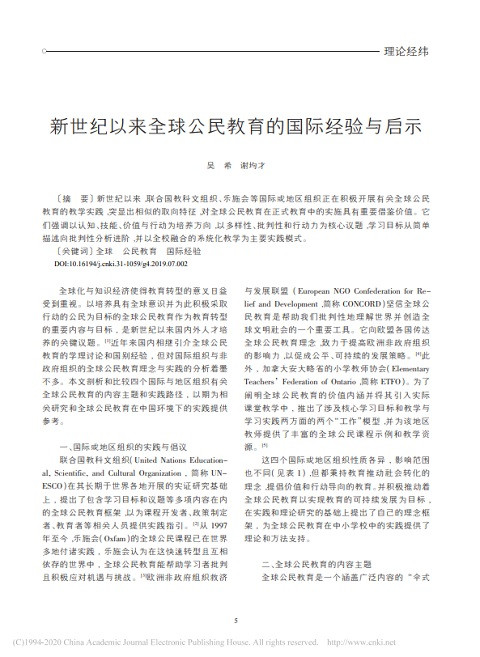 新世纪以来全球公民教育的国际经验与启示 (上海教育科研) Год публикации: 2019 Автор: Wuxi | Thomas Tse Организация-автор: Shanghai Educational Research 新世纪以来,联合国教科文组织、乐施会等国际或地区组织正在积极开展有关全球公民 教育的教学实践,突显出相似的取向特征,对全球公民教育在正式教育中的实施具有重要借鉴价值。它 们强调以认知、技能、价值与行动为培养方向,以多样性、批判性和行动力为核心议题,学习目标从简单 描述向批判性分析进阶,并以全校融合的系统化教学为主要实践模式。
  Global Citizenship Education: Critical and International Perspectives Год публикации: 2020 Автор: Abdeljalil Akkari | Kathrine Maleq Организация-автор: Springer Nature | Swiss National Science Foundation This open access book takes a critical and international perspective to the mainstreaming of the Global Citizenship Concept and analyses the key issues regarding global citizenship education across the world. In that respect, it addresses a pressing need to provide further conceptual input and to open global citizenship agendas to diversity and indigeneity.Social and political changes brought by globalisation, migration and technological advances of the 21st century have generated a rise in the popularity of the utopian and philosophical idea of global citizenship. In response to the challenges of today’s globalised and interconnected world, such as inequality, human rights violations and poverty, global citizenship education has been invoked as a means of preparing youth for an inclusive and sustainable world.In recent years, the development of global citizenship education and the building of students’ global citizenship competencies have become a focal point in global agendas for education, international educational assessments and international organisations. However, the concept of global citizenship education still remains highly contested and subject to multiple interpretations, and its operationalisation in national educational policies proves to be challenging.This volume aims to contribute to the debate, question the relevancy of global citizenship education’s policy objectives and to enhance understanding of local perspectives, ideologies, conceptions and issues related to citizenship education on a local, national and global level. To this end, the book provides a comprehensive and geographically based overview of the challenges citizenship education faces in a rapidly changing global world through the lens of diversity and inclusiveness.
  Basic Elements of Forgiveness and Reconciliation Theory Год публикации: 2018 Автор: Leonel Narváez Gómez Организация-автор: Fundación para la Reconciliación This text presents the theoretical bases for forgiveness and reconciliation that support the pedagogy and actions of the Foundation for Reconcilation. Elementos básicos de la teoría del Perdón y la Reconciliación Год публикации: 2018 Автор: Leonel Narváez Gómez Организация-автор: Fundación para la Reconciliación En este texto se presentan las bases teóricas para el perdón y la reconciliación que sustentan la pedagogía y acciones de la Fundación para la Reconcliación.
  )7112( القرار 7128 التخذ امجتخم مجلس الأمنل ت 2727 ، المعقفي ة 72 أيلفي سبتمبر 71 Год публикации: 2014 Организация-автор: United Nations Security Council This resolution expanded the counter-terrorism framework by imposing obligations on member states to respond to the threat of foreign terrorist fighters. Through the resolution, the Council condemned violent extremism and decided that Member States shall, consistent with international law, prevent the "recruiting, organizing, transporting or equipping of individuals who travel to a State other than their States of residence or nationality for the purpose of the preperation, planning of, of participation in terrorist acts." Expressing concern over the establishment of international terrorist networks, the Council underscored the "particular and urgent need" to prevent the travel and support for foreign terrorist fighters associated with the Islamic State and the Levant (ISIL), Al-Nusra Front (ANL) and other affiliates or splinter groups of Al-Qaida. In that context, the Council, through the resolution, decided that all States shall ensure that their legal systems provide for the prosecution, as serious criminal offences, of travel for terrorism or related training, as well as the financing or facilitation of such activities. Member States, it also decided, shall prevent entry or transit through their territories of any individual about whom that state had credible information of their terrorist-related intentions, without prejudice to transit necessary for the furtherance of judicial processes. It called on States to require airlines to provide passenger lists for that purpose. Outlining further measures for international cooperation to counter international terrorism and prevent the growth of violent extremism, it expressed readiness to designate additional individuals for sanctions listings, and directed the United Nations counter-terrorism subsidiary bodies to devote special focus to foreign terrorist fighters, assessing the threat they posed and reporting on principal gaps in Member States' abilities to suppress their travel. Резолюция 2178 (2014) принятая Советом Безопасности на его 7272-м заседании 24 сентября 2014 года Год публикации: 2014 Организация-автор: United Nations Security Council This resolution expanded the counter-terrorism framework by imposing obligations on member states to respond to the threat of foreign terrorist fighters. Through the resolution, the Council condemned violent extremism and decided that Member States shall, consistent with international law, prevent the "recruiting, organizing, transporting or equipping of individuals who travel to a State other than their States of residence or nationality for the purpose of the preperation, planning of, of participation in terrorist acts." Expressing concern over the establishment of international terrorist networks, the Council underscored the "particular and urgent need" to prevent the travel and support for foreign terrorist fighters associated with the Islamic State and the Levant (ISIL), Al-Nusra Front (ANL) and other affiliates or splinter groups of Al-Qaida. In that context, the Council, through the resolution, decided that all States shall ensure that their legal systems provide for the prosecution, as serious criminal offences, of travel for terrorism or related training, as well as the financing or facilitation of such activities. Member States, it also decided, shall prevent entry or transit through their territories of any individual about whom that state had credible information of their terrorist-related intentions, without prejudice to transit necessary for the furtherance of judicial processes. It called on States to require airlines to provide passenger lists for that purpose. Outlining further measures for international cooperation to counter international terrorism and prevent the growth of violent extremism, it expressed readiness to designate additional individuals for sanctions listings, and directed the United Nations counter-terrorism subsidiary bodies to devote special focus to foreign terrorist fighters, assessing the threat they posed and reporting on principal gaps in Member States' abilities to suppress their travel. Résolution 2178 (2014) Adoptée par le Conseil de sécurité à sa 7272 séance, le 24 septembre 2014 Год публикации: 2014 Организация-автор: United Nations Security Council This resolution expanded the counter-terrorism framework by imposing obligations on member states to respond to the threat of foreign terrorist fighters. Through the resolution, the Council condemned violent extremism and decided that Member States shall, consistent with international law, prevent the "recruiting, organizing, transporting or equipping of individuals who travel to a State other than their States of residence or nationality for the purpose of the preperation, planning of, of participation in terrorist acts." Expressing concern over the establishment of international terrorist networks, the Council underscored the "particular and urgent need" to prevent the travel and support for foreign terrorist fighters associated with the Islamic State and the Levant (ISIL), Al-Nusra Front (ANL) and other affiliates or splinter groups of Al-Qaida. In that context, the Council, through the resolution, decided that all States shall ensure that their legal systems provide for the prosecution, as serious criminal offences, of travel for terrorism or related training, as well as the financing or facilitation of such activities. Member States, it also decided, shall prevent entry or transit through their territories of any individual about whom that state had credible information of their terrorist-related intentions, without prejudice to transit necessary for the furtherance of judicial processes. It called on States to require airlines to provide passenger lists for that purpose. Outlining further measures for international cooperation to counter international terrorism and prevent the growth of violent extremism, it expressed readiness to designate additional individuals for sanctions listings, and directed the United Nations counter-terrorism subsidiary bodies to devote special focus to foreign terrorist fighters, assessing the threat they posed and reporting on principal gaps in Member States' abilities to suppress their travel.
 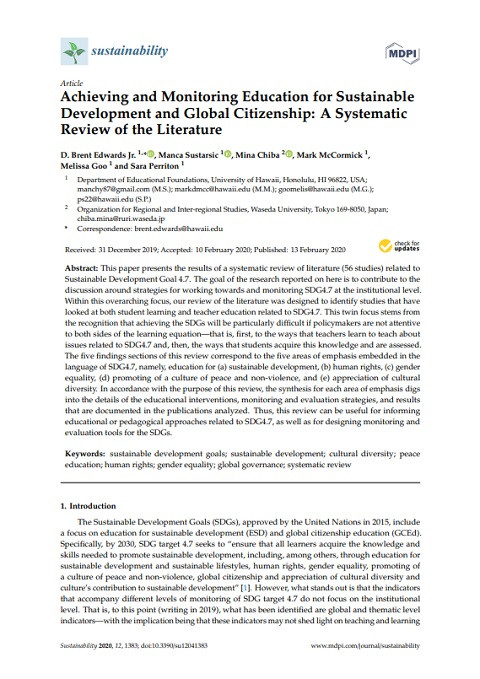 Achieving and Monitoring Education for Sustainable Development and Global Citizenship: A Systematic Review of the Literature (Sustainability 2020; Vol. 12, No. 4) Год публикации: 2020 Автор: Brent Edwards | Manca Sustarsic | Mina Chiba | Mark McCormick | Melissa Goo | Sara Perriton Организация-автор: Multidisciplinary Digital Publishing Institute (MDPI) This paper presents the results of a systematic review of literature (56 studies) related to Sustainable Development Goal 4.7. The goal of the research reported on here is to contribute to the discussion around strategies for working towards and monitoring SDG4.7 at the institutional level. Within this overarching focus, our review of the literature was designed to identify studies that have looked at both student learning and teacher education related to SDG4.7. This twin focus stems from the recognition that achieving the SDGs will be particularly difficult if policymakers are not attentive to both sides of the learning equation—that is, first, to the ways that teachers learn to teach about issues related to SDG4.7 and, then, the ways that students acquire this knowledge and are assessed. The five findings sections of this review correspond to the five areas of emphasis embedded in the language of SDG4.7, namely, education for (a) sustainable development, (b) human rights, (c) gender equality, (d) promoting of a culture of peace and non-violence, and (e) appreciation of cultural diversity. In accordance with the purpose of this review, the synthesis for each area of emphasis digs into the details of the educational interventions, monitoring and evaluation strategies, and results that are documented in the publications analyzed. Thus, this review can be useful for informing educational or pedagogical approaches related to SDG4.7, as well as for designing monitoring and evaluation tools for the SDGs.
  Education and Migration: An Assessment of the Types and Range of IOM’s Education and Vocational Training Projects Год публикации: 2018 Автор: Rocio Sanz Организация-автор: International Organization for Migration (IOM) This report presents the results of the assessment of the range and types of IOM’s education and vocational training programmes as of December 2017. Within an overall framework of reviewing the Organization’s role in supporting the development and implementation of migration policy, the purpose of this assessment is to understand how these programmes contribute to education and vocational training outcomes, especially in the specific context of SDG 4 (Quality Education) of the 2030 Agenda for Sustainable Development.
  La migration et le Programme 2030 : Un guide à l’usage des praticiens Год публикации: 2018 Автор: Elisa Mosler Vidal Организация-автор: International Organization for Migration (IOM) Ce guide est destiné aux acteurs gouvernementaux, à la fois nationaux et locaux, qui sont impliqués dans des activités de mise en œuvre des Objectifs de développement durable, y compris ceux qui travaillent spécifiquement dans le domaine de la migration et ceux d’autres secteurs qui souhaitent intégrer la question de la migration. Il s’adresse également aux acteurs gouvernementaux qui travaillent dans le domaine de la migration et souhaitent intégrer les ODD dans leur travail.L’objectif de ce guide est d’aider les responsables politiques à mettre en œuvre les aspects des ODD qui touchent à la migration. Les responsables politiques peuvent utiliser ce guide pour intégrer la migration dans les activités de développement à l’échelle locale ou nationale, par l’élaboration et la mise en œuvre d’interventions qui portent sur la migration dans le cadre des ODD. Ces interventions peuvent se présenter sous forme de lois, de politiques, de programmes, de projets ou d’autres activités et peuvent être liées à des thèmes de base de la migration ou intégrer la migration dans les activités d’un autre secteur. Par exemple, les responsables politiques peuvent utiliser ce guide pour élaborer des interventions qui sont directement consacrées à la traite des personnes, ainsi que des interventions dans le secteur de la santé qui permettent de protéger les victimes de la traite des personnes.Pour les acteurs disposant d’une expérience de l’intégration de la migration, ce guide offre une nouvelle approche qui repose sur le Programme 2030. Pour ceux qui ne possèdent aucune expérience de l’intégration de la migration, il présente les liens entre la migration et le développement dans le cadre des ODD, et les mesures à prendre compte tenu de ces liens.