
Ресурсы
Изучайте широкий спектр ценных ресурсов ВГГ, чтобы углубить своё понимание и повысить эффективность исследований, просветительской деятельности, преподавания и обучения.
Найдено: 3,227
 [Resumen] Enseñanza y aprendizaje en el siglo XXI : Metas, políticas educativas y currículo en seis países Год публикации: 2016 Автор: Fernando Reimers | Connie K. Chung Организация-автор: Global Education Innovation Initiative Este libro pretende promover discusiones sobre cómo las políticas educativas nacionales ayudan a los estudiantes a prepararse para la vida, el trabajo y la participación ciudadana en el siglo XXI. Revisa además cómo los objetivos educativos, los retos y las oportunidades que se perciben, reflejan los contextos histórico, político, y cultural de los sistemas educativos, los cuales a su vez varían en tamaño, mecanismos de gobernanza y condiciones demográficas, entre otros factores.
  Supporting the Continuation of Teaching and Learning during the COVID-19 Pandemic: Annotated Resources for Online Learning Год публикации: 2020 Автор: Fernando Reimers | Andreas Schleicher | Jaime Saavedra | Saku Tuominen Организация-автор: Organisation for Economic Co-operation and Development (OECD) | Global Education Innovation Initiative | HundrED This resource discusses the second module of a series which presents the results of a comparative analysis of emerging educational needs and responses as the pandemic unfolds across countries around the world. The overall goal of this series is to facilitate the rapid design process and implementation of adaptive responses to the emerging education challenges, and to protect young people’s educational opportunities during and following the pandemic. This second module presents a first set of online educational resources to support the continuity of teaching and learning during the 2019-20 COVID-19 Pandemic with education leaders around the world. The resources were compiled from responses to the same survey used to produce the first module: A framework to guide an education response to the COVID-19 Pandemic, and additional online sources were included to enhance the list in order to support the continuity of learning for students who have access to the internet and digital devices.
  Connecting Classrooms through Global Learning: Education for Sustainable Development and Global Citizenship; Preparing Pupils for Life in an Interconnected World Год публикации: 2020 Организация-автор: British Council | UK aid This resource contributes to the development of pupils’ core skills, enabling them to think critically, to consider how to resolve problems, to take informed and reflective action and to develop personal leadership skills. During the course, pupils will analyse global issues, and will plan, implement and evaluate action. This course can be linked to a variety of curriculum areas, including English, Social Studies, Geography, Modern Foreign Languages, Maths, History and Art and Design. It can be used with or without an overseas partner school.
  Teach the Change: 8 Steps to Be a Global Teacher Год публикации: 2018 Организация-автор: Start the Change | European Union (EU) These guidelines are a result of consultation with 45 teachers from across Europe, drawing on their combined experiences to reflect on the main challenges of developing educational activities on global issues and with a particular focus on the Sustainable Development Goals (SDGs) and migration.
 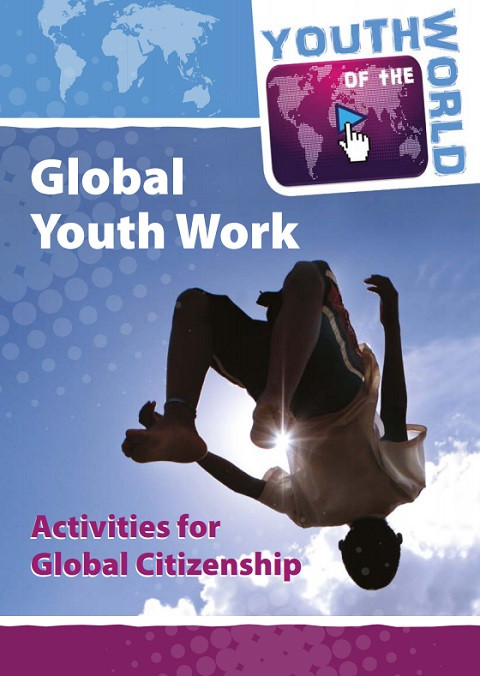 Global Youth Work: Activities for Global Citizenship Год публикации: 2014 Автор: Kate Allen | Charlotte Dwyer Организация-автор: Scotdec | European Union (EU) | Government of Scotland This resource has been designed for youth workers and other professionals working with young people to promote global youth work as a mainstream practice across Scotland. Each chapter contains practical activities, background information and resources aimed at encouraging young people to think about their own lives and how they connect with others. Examining these topics within the framework of social justice, human rights and sustainable development enables young people to reflect on how their behaviour and actions impact on people and issues locally and globally.
 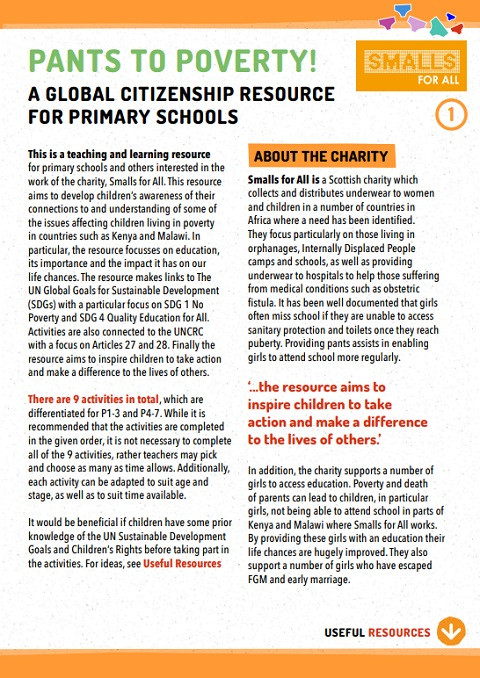 Pants to Poverty: A Global Citizenship Resource for Primary Schools Год публикации: 2018 Автор: Stephanie Brown | Jennifer McMillan Организация-автор: Smalls for All | Scotdec | International Development Education Association Scotland (IDEAS) With a focus on the right to an education, this series of 9 lessons explores issues affecting children living in poverty and encourages young people to take action for positive change. This resource aims to develop children’s awareness of their connections to and understanding of some of the issues affecting children living in poverty. There is a particular focus on the importance of education and its impact on our life chances.
 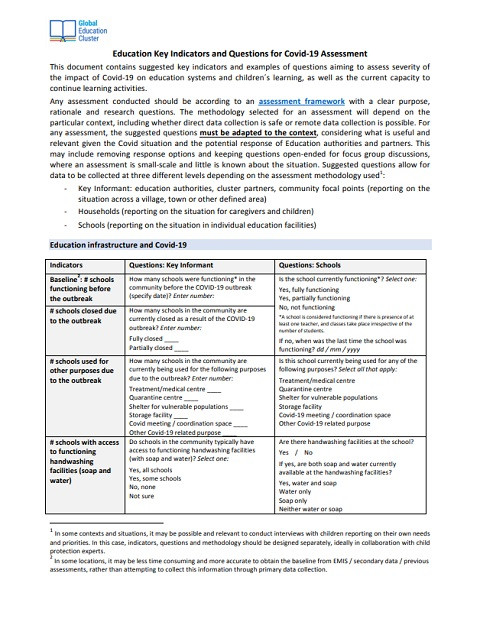 Education Key Indicators and Questions for Covid-19 Assessment Год публикации: 2020 Организация-автор: Global Education Cluster This document contains suggested key indicators and examples of questions aiming to acess severity of the impact of Covid-19 on education systems and children’s learning, as well as the current capacity to continue learning activities.
  Global education in Lithuania: challenges and opportunities Год публикации: 2014 Автор: Indrė Augutienė | Zina Baltrėnienė Организация-автор: Lithuanian Development Education and Cooperation Network of Non-governmental Institutions (Association LITDEA) | Lithuanian National Non-Governmental Development Cooperation Organisations‘ Platform (NGDO Platform) The publication has been produced implementing the project ‘‘Quality Partnership for Development-EU Presidency project for the Lithuanian EU Presidency, 2013“ (no. DCINSA ED/2013/319-124). Today we live in a constantly changing world which is bound by the spirit of relations between people, countries and cultures and which presents various challenges and opportunities. Every day we have to solve numerous economic, social and environmental issues connecting us with other countries, their cultures and citizens and providing an opportunity for all of us to become part of a global society.In order to accept the opportunities provided by the globalisation processes and cope with the emerging challenges it is necessary to create the conditions for people to acquire the knowledge on global realities, emerging global development problems and to relate them with their own life. It is also important to provide the opportunities for people to acquire the skills and enhance own values facilitating active global citizenship and responsibility. Global problems increasingly impact on the lives of everybody throughout the world, therefore we must realise that we are part of the world with the still prevailing poverty, social inequality, climate change and global warming problems. In the current society it is especially important to ensure that different forms of education enhance people‘s understanding about the above challenges and their impact on personal, communal, national and global development.Global Education is directed toward formation and development of people‘s skills, knowledge and values facilitating understanding and response to the challenges of the 21st century. So far the concept of Global Education was not validated in any national documents. Today non-governmental organisations are actively discussing this issue with the academic society and with the Ministries of Foreign Affairs/and Education and Science representing the state in the above area. Besides, Lithuania has not developed a uniform Global Education strategy yet, but the dimension of Global Education is included in several specific national policy documents. In view of this, this article reviews the prerequisites for integration of global education set forth in the main legal acts defining Lithuania‘s sustainable development, development cooperation and education. This document provides a review of the Global Education concept, prerequisites for its implementation and description of the current situation in Lithuania. It also includes the proposals for a successful development of Global Education activities in our country. Éducation globalein Lithuania: challenges and opportunities Год публикации: 2014 Автор: Indrė Augutienė | Zina Baltrėnienė Организация-автор: Lithuanian Development Education and Cooperation Network of Non-governmental Institutions (Association LITDEA) | Lithuanian National Non-Governmental Development Cooperation Organisations‘ Platform (NGDO Platform) La publication a été réalisée la mise en œuvre du projet « Partenariat Qualité pour le projet de développement de l'UE Présidence de la présidence lituanienne de l'UE, 2013 »(no. DCINSA ED / 2013 / 319-124). Aujourd'hui, nous vivons dans un monde en constante évolution qui est lié par l'esprit des relations entre les peuples, les pays et les cultures, et qui présente divers défis et opportunités. Chaque jour, nous devons résoudre de nombreux problèmes économiques, sociaux et environnementaux qui nous relie avec d'autres pays, leurs cultures et leurs citoyens et de fournir une occasion pour nous tous de faire partie d'une société mondiale. Pour acept les possibilités offertes par les processus de mondialisation et faire face aux nouveaux défis, il est nécessaire de créer les conditions pour les gens à acquérir les connaissances sur les réalités mondiales, les problèmes de développement mondiaux émergents et à les relier à leur propre vie. Il est également important de fournir les possibilités pour les personnes à acquérir les compétences et de renforcer les valeurs propres à faciliter la citoyenneté mondiale active et la responsabilité. Les problèmes mondiaux de plus en plus d'impact sur la vie de tout le monde à travers le monde, nous devons donc réaliser que nous faisons partie du monde avec la pauvreté qui prévaut encore, les inégalités sociales, le changement climatique et les problèmes de réchauffement planétaire. Dans la société actuelle, il est particulièrement important de veiller à ce que les différentes formes d'éducation d'améliorer la compréhension des gens sur les défis ci-dessus et de leur impact sur le développement personnel, communautaire, national et mondial. Éducation globaleis dirigée vers la formation et le développement des compétences, les connaissances des personnes et des valeurs qui facilitent la compréhension et la réponse aux défis du 21e siècle. Jusqu'à présent, le concept de l'éducation globalewas pas validée dans les documents nationaux. Aujourd'hui, les organisations non-gouvernementales discutent activement de cette question avec la société académique et avec les Ministères des Affaires Étrangères / et de l'éducation et de la science représentant l'état dans la zone ci-dessus. Par ailleurs, la Lituanie n'a pas encore mis au point une formation globalestrategy uniforme, mais la dimension de l'éducation globaleis inclus dans plusieurs documents spécifiques de la politique nationale. Compte tenu de cela, cet article examine les conditions préalables à l'intégration de l'éducation globaleset énoncées dans les principaux actes juridiques définissant le développement durable, la coopération au développement et de l'éducation de la Lituanie. Ce document fournit un examen de la globaleconcept Éducation, conditions préalables à sa mise en œuvre et la description de la situation actuelle en Lituanie. Il comprend également les propositions pour un développement réussi d’activités mondiales de l'éducation dans notre pays.
 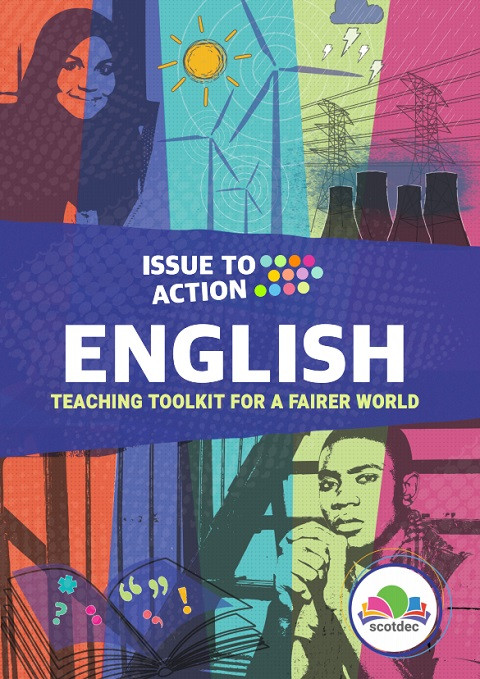 Issue to Action: English; Teaching Toolkit for a Fairer World Год публикации: 2020 Автор: Stephanie Flett | Lesley Bloomer Организация-автор: Scotdec | European Union (EU) These materials were created by English teachers in Scotland. The first activity introduces the need to hear multiple stories of the world and our place in it. There then follows three units with a focus on climate change, refugees and how we engage with the ‘other’. They include short introductory activities as well as a series of lessons exploring the topics in more detail. A range of stimuli is included – poetry, biography, images and film clips. All activities are mapped to Curriculum for Excellence benchmarks and reference the relevant SDG.