
Ресурсы
Изучайте широкий спектр ценных ресурсов ВГГ, чтобы углубить своё понимание и повысить эффективность исследований, просветительской деятельности, преподавания и обучения.
Найдено: 3,450
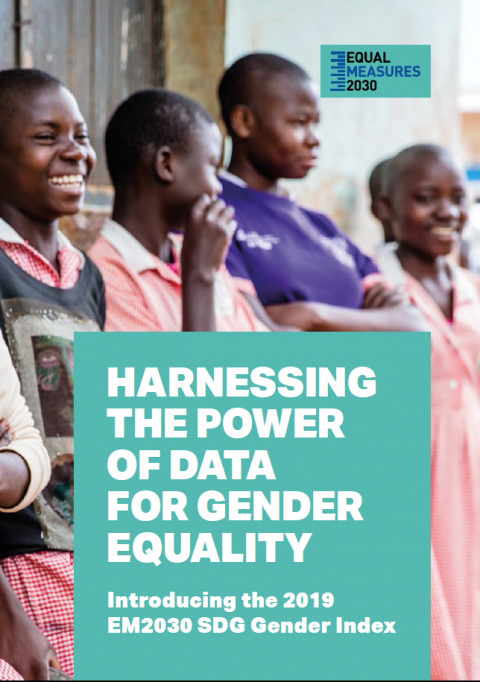 HARNESSING THE POWER OF DATA FOR GENDER EQUALITY: Introducing the 2019 EM2030 SDG Gender Index Год публикации: 2019 Организация-автор: Equal Measures 2030 In the 2019 Global Report “Harnessing the power of data for gender equality: Introducing the 2019 EM2030 SDG Gender Index”, the Equal Measures 2030 (EM2030) introduces the 2019 SDG Gender Index. The index is a comprehensive tool available to explore the state of gender equality across 129 countries (covering 95% of the world’s girls and women), 14 of the 17 Sustainable Development Goals (SDGs), and 51 targets linked to issues inherent in the SDGs. The 2019 SDG Gender Index finds that, with just 11 years to go until 2030, nearly 40% of the world’s girls and women – 1.4 billion – live in countries failing on gender equality. Another 1.4 billion live in countries that “barely pass”. Even the highest-scoring countries have more to do, particularly on complex issues such as climate change, gender budgeting and public services, equal representation in powerful positions, gender pay gaps, and gender-based violence. No country in the world has reached the “last mile” on gender equality. 2019 Global Report overview: Section 1: A foreword from Equal Measures 2030’s partners: The African Women’s Development and Communication Network (FEMNET), The Asian-Pacific Resource & Research Centre for Women (ARROW), Bill & Melinda Gates Foundation, the Committee for Latin America and the Caribbean for the Defense of Women’s Rights (CLADEM), Data2X, International Women’s Health Coalition (IWHC), KPMG, ONE Campaign, Plan International, Women Deliver. Section 2: Key findings from the 2019 SDG Gender Index. Section 3: Introducing the 2019 SDG Gender Index, the approach, what makes this index unique and how the findings should be interpreted. Section 4: Key global findings, patterns and comparisons of index scores between and within the different regions: Asia and the Pacific, Europe and North America, Latin America and the Caribbean, the Middle East and North Africa, Sub-Saharan Africa. Section 5: Regional overviews of index scores and gender equality context, and thematic deep drives on 1) inequalities in girls’ education, 2) women in science and technology research positions, 3) girls’ and women’s physical safety, 4) legal barriers for women, 5) women in government. Section 6: Leaving no one behind: multiple and intersecting forms of discrimination of girls and women. Section 7: Recommendations for action.
  Trends Shaping Education 2019 Год публикации: 2019 Организация-автор: Organisation for Economic Co-operation and Development (OECD) This book, published every two to three years, is designed to give policy makers, researchers, educational leaders, administrators and teachers a robust, non-specialist source to inform strategic thinking and stimulate reflection on the challenges facing education, whether in schools, universities or programmes for older adults. Trends Shaping Education 2019 is designed to support long-term strategic thinking in education. It provides an overview of key economic, social, demographic and technological trends and raises pertinent questions about their impact on education. This book fills an important need: decision makers and practitioners in education often have only anecdotal or local information on the megatrends that play out in their context; too often they do not have solid facts in front of them, especially about trends.` Les grandes mutations qui transforment l'éducation 2019 Год публикации: 2019 Организация-автор: Organisation for Economic Co-operation and Development (OECD) Vous êtes-vous déjà demandé si l’éducation avait un rôle à jouer dans la préparation de nos sociétés à l’ère de l’intelligence artificielle ? Ou quel peut être l’impact du réchauffement climatique sur nos établissements scolaires, nos familles et collectivités ? La publication Les grandes mutations qui transforment l’éducation 2019 donne un aperçu des principales tendances économiques, politiques, sociales et technologiques qui affectent l’éducation. Si les mesures sont robustes, les questions soulevées dans ce recueil sont suggestives et ont pour objet d’informer la pensée stratégique et de stimuler une réflexion sur les défis de l’éducation – et montrer si et comment l’éducation peut influencer ces tendances. L’ouvrage couvre une riche variété de sujets liés à la mondialisation, la démocratie, la sécurité, le vieillissement et les cultures modernes. Le contenu pour l’édition 2019 a été révisé et étendu avec une large sélection d’indicateurs. En plus des différentes tendances et de leur interaction avec l’éducation, la publication inclut également une nouvelle section dédiée à la réflexion sur le futur, inspirée par des méthodologies de la prospective stratégique. Cet ouvrage a pour objet de fournir aux décideurs politiques, aux chercheurs, aux chefs d’établissements, aux administrateurs scolaires et aux enseignants, une source non spécialisée de tendances qui affectent l’éducation comparables à l’échelle internationale, dans les écoles, les universités ou encore dans les programmes de formation pour adultes. Cet ouvrage s’adresse également aux élèves/ étudiants et à la société dans son ensemble, notamment aux parents.
  서울교육 2018년 겨울호 (제60권 통권 233호) Год публикации: 2018 Организация-автор: 서울특별시교육청 교육연구정보원 권두칼럼:통일교육 패러다임 전환 키워드: #평화특별기획:평화시대를 여는 새로운 통일교육 – 평화와 민주시민교육을 담는 통일교육으로 –화해로 나아가는 평화와 공존의 통일교육한반도 대변혁기의 학교 평화·통일교육 방향 – 통일교육연구학교 운영사례를 중심으로 –해외교육:독일 통일교육이 한국 통일교육에 주는 시사점통일독일의 동독청소년 사회통합을 통해 보는 21세기 통일한국의 청소년 사회통합 정책연구:평화에 대한 비판적 공부: 평화학 출처 URL:http://www.serii.re.kr/photo/viw.do?method=getView&mcode=S029a&seq=1081
  Central Asian integration in the context of a single cultural and civilizational space Год публикации: 2013 Автор: Erkin Baydarov The article discusses the prospects for regional integration in Central Asia, the need to understand the unity of the historical, cultural and civilizational heritage of the region. Центральноазиатская интеграция в контексте единого культурно-цивилизационного пространства Год публикации: 2013 Автор: Erkin Baydarov В статье рассматривается перспективы региональной интеграции в Центральной Азии, необходимость понимания единства исторического, культурного и цивилизационного наследия региона.
  The role of the education system in preventing manifestations of religious extremism in Central Asia Год публикации: 2013 Автор: A. Abdirayymova | R. Zharkynbaeva The article discusses the role of the education system in preventing the manifestation of religious extremism through the prism of social, economic and cultural development. Роль системы образования в предотвращении проявлений религиозного экстремизма в Центральной Азии Год публикации: 2013 Автор: A. Abdirayymova | R. Zharkynbaeva В статье рассматривается роль системы образования предоствращения проявления религиозного экстремизма через призму социального, экономического и культурного развития.
  D’une pensée coloniale à une pensée du colonial ?: La question de la restitution des œuvres africaines issues de la colonisation Год публикации: 2019 Автор: Aurélie Duvivier En 2013, le Musée de Tervuren fermait ses portes pour la première grande rénovation de son histoire. Ce samedi 8 décembre 2018, flambant neuf, il a pu à nouveau accueillir des visiteurs. Comme nous le fait remarquer le magazine Culture Remains, au fil des temps, le musée a changé de dénominations : appelé successivement Musée du Congo, Musée du Congo belge puis Musée Royal de l’Afrique centrale, son nom a été dorénavant anglicisé en Africa Museum, l’ancrant ainsi symboliquement dans son époque. Mais ce n’est pas tout : considéré comme « trop colonialiste » par certains, la rénovation a permis une profonde modification de la scénographie plus en adéquation avec la pensée de son siècle.
  Alternative bilingual Miskito-Spanish intercultural literacy education linked to the exercise of citizenship and community production Год публикации: 2008 Организация-автор: Regional Literacy and CONFINTEA VI Preparatory Conference in Latin America and the Caribbean: From Literacy to Lifelong Learning: Towards the Challenges of the 21st Century, Mexico City, 2008 The Alternative Bilingual Intercultural Literacy Education project is carried out in five rural indigenous communities and eleven urban neighbourhoods of Bilwi (Puerto Cabezas) in the North Atlantic Autonomous Region (RAAN) of Nicaragua. In this region, illiteracy is the result of poverty, historical social exclusion and the lack of any official or State programme of adult literacy education in the Miskito language. This constitutes a negation of the right to bilingual intercultural education of the young and adult indigenous population and an obstacle to individual, social and regional development. The project provides literacy classes for young people and adults in their mother tongue Miskito and in Spanish, and deals with intercultural themes of their world view, the environment and indigenous rights. In Nicaragua, this experiment is a unique and alternative model of literacy provision in Miskito, with a Miskito-Spanish bilingual intercultural curriculum of its own. The texts have been produced by authors from the Miskito ethnic group, with contents determined on the basis of a needs analysis and the identification of fundamental features of the Miskito world view.