
Ресурсы
Изучайте широкий спектр ценных ресурсов ВГГ, чтобы углубить своё понимание и повысить эффективность исследований, просветительской деятельности, преподавания и обучения.
Найдено: 3,450
 Éducation Interculturelle bilingue Miskito-Espagnol liée à l'exercice de la citoyenneté et de la communauté production Год публикации: 2008 Организация-автор: Regional Literacy and CONFINTEA VI Preparatory Conference in Latin America and the Caribbean: From Literacy to Lifelong Learning: Towards the Challenges of the 21st Century, Mexico City, 2008 Le projet de l'éducation interculturelle bilingue est réalisée dans cinq communautés autochtones rurales et onze quartiers urbains de Bilwi (Puerto Cabezas) dans la région de l'Atlantique Nord autonome (RAAN) du Nicaragua. Dans cette région, l'analphabétisme est le résultat de la pauvreté, l'exclusion sociale historique et l'absence de tout programme officiel ou de l'Etat de l'alphabétisation des adultes dans la langue Miskito. Ceci constitue une négation du droit à l'éducation interculturelle bilingue des jeunes et des adultes population indigène et un obstacle au développement individuel, social et régional. Le projet offre des cours d'alphabétisation pour les jeunes et les adultes dans leur Miskito langue maternelle et en espagnol, et traite des thèmes interculturels de leur vision du monde, l'environnement et les droits des autochtones. Au Nicaragua, cette expérience est un modèle unique et alternatif de la prestation de l'alphabétisation en Miskito, avec un bilingue Miskito-espagnol curriculum interculturel propre. Les textes ont été rédigés par des auteurs du groupe ethnique Miskito, avec des contenus déterminés sur la base d'une analyse des besoins et l'identification des caractéristiques fondamentales de la vision du monde Miskito.
  Out-of-School Children and Adolescents: Left Behind on the Road to Learning Opportunities for All Год публикации: 2017 Организация-автор: UNESCO Institute for Statistics (UIS) | UNESCO Bangkok This document shows the most recent data from UIS (2017) on the rates and numbers of out-of-school children and adolescents since 2000, first globally and then within this region, examining common characteristics these young people share to provide insights into which groups are more likely to find themselves excluded from national education systems. The focus then turns to a closer examination of the obstacles out-of-school children and adolescents face in this regard and introduces educational programmes that can help them overcome these challenges. URL:http://www.flexlearnstrategies.net/out-of-school-children-and-adolescents-left-behind-on-the-road-to-learning-opportunities-for-all-2/
  Identity, DNA Typing and Citizenship: Philosophical Reflections Год публикации: 2010 Автор: Marie-Hélène Parizeau Организация-автор: Sociologie et sociétés In a context of globalization, migratory flows and the hunt for terrorists, how are biometrics, and, more specifically, the notion of the human DNA Typing, changing the individual’s relationship to his or her citizenship ?To try to answer this question, we review some of the theoretical aspects of citizenship and briefly outline the history of identification measures linked to the advent of citizenship. We then examine the current context of the use of biometrics for identification purposes and the reasons for its use as cited by the European Community and the United States. We more particularly look at the case of the human DNA Typing, using examples from Canada and the United States. The genetic footprint is related to personal identity based on Paul Ricoeur’s concept of narrative identity. We show how the ethno-racial criteria used by biometrics, together with the ideology of multiculturalism, are constructing, in the West, a new narration of the Other, of foreigners, which excludes them from the sphere of citizenship. Identité, empreinte génétique et citoyenneté: réflexions philosophiques Год публикации: 2010 Автор: Marie-Hélène Parizeau Организация-автор: Sociologie et sociétés Dans quelle mesure la biométrie, et plus spécifiquement l’empreinte génétique, dans un contexte de globalisation, de flux migratoires, et de chasse au terrorisme, vient-elle modifier le rapport de l’individu à sa citoyenneté ?Pour tenter de répondre à cette question, nous rappellerons quelques aspects théoriques de la citoyenneté. L’historique des mesures d’encartement liées à l’avènement de la citoyenneté y sera aussi rapidement présenté. Nous évoquerons ensuite le contexte actuel de l’usage de la biométrie à des fins d’identification et les motifs invoqués par la Communauté européenne et les États-Unis. Nous examinerons plus attentivement le cas précis de l’empreinte génétique avec les exemples du Canada et des États-Unis. Finalement, l’empreinte génétique et l’identité personnelle seront mises en relation à partir du concept d’identité narrative de Paul Ricoeur. Nous montrerons comment les critères ethno-raciaux utilisés par la biométrie ; concomitamment avec l’idéologie du multiculturalisme ; construisent une nouvelle narration occidentale de l’Autre, qui l’exclut de la sphère de la citoyenneté.
  Connections Between Environmental Justice, Popular Ecologism and Eco-citizenship Год публикации: 2006 Автор: Nayla Naoufal Организация-автор: Université du Québec à Montréal (UQAM) | Éditions en environnement VertigO Citizen movements connected to socio-ecological issues are increasing around the world : In the global North and South, people and communities are struggling against mining projects, against mega-projects, for the development of responsible and urban agriculture, against the inequities engendered by climate change, etc. This article examines historic and contemporary citizen movements linked to socio-ecological issues and underscores the evolution in their claims : Initially, environmental justice was exclusively reactive and focused on local cases of disproportional exposure to environmental problems ; today, it is also proactive, increasingly transnational and, in some cases, holistic. I also address the current of popular environmentalism and its links with environmental justice. Then, I probe environmental justice theoretical discourses and identify a framework that is relevant in light of contemporary struggles. Last, I present the concept of ecocitizenship, as well as a typology pertaining to this term, based on an exhaustive review of the scientific literature and on the study of ecocitizenships developed by young community gardeners. It appears that the ecocitizenship that is both critical and participative is of particular interest for environmental justice. Connexions entre la justice environnementale, l’écologisme populaire et l’écocitoyenneté Год публикации: 2006 Автор: Nayla Naoufal Организация-автор: Université du Québec à Montréal (UQAM) | Éditions en environnement VertigO Les mouvements citoyens liés à des problématiques socio-écologiques prennent de plus en plus d’ampleur à travers le monde : dans les « Nords » et dans les « Suds », des personnes et des communautés luttent contre des projets miniers, contre la construction de mégaprojets, pour le développement d’une agriculture urbaine et responsable, contre les inégalités générées par les changements climatiques, etc. Qu’ils soient historiques ou contemporains, cet article examine ces mouvements en s’attardant à l’évolution de leurs revendications. De réactive et basée sur des cas locaux d’exposition disproportionnelle aux problèmes environnementaux, la justice environnementale est devenue également proactive, de plus en plus transnationale et, dans certains cas, holistique. Je me penche également sur le courant de l’écologisme populaire et sur ses liens avec la justice environnementale. J’explore ensuite les fondements théoriques de la justice environnementale, ce qui permet d’identifier un cadre pertinent en la matière au regard des mobilisations contemporaine. J’analyse enfin le concept d’écocitoyenneté, présentant une typologie en la matière, en me basant sur une recension exhaustive de la littérature scientifique et sur l’étude des écocitoyennetés construites par des apprentis jardiniers en contexte communautaire. Il apparaît que la forme d’écocitoyenneté à la fois participative et critique contribue particulièrement à la justice environnementale.
  Intercultural and Inclusive Teacher Training: The Conceptualization and Operationalization of Professional Skills Год публикации: 2016 Автор: Julie Larochelle-Audet | Corina Borri-Anadon | Maryse Potvin Организация-автор: Éducation et francophonie In the context of globalization, educational systems, from elementary to university, must take into account the increasingly complex realities they face, especially in terms of skills that teachers need to develop. In this respect, on both political and scientific levels, the importance of training on ethnocultural, religious and linguistic diversity comes up regularly. However, a portrait of teacher training in Québec universities has revealed an overall deficiency in this area (Larochelle-Audet, Borri-Anadon, McAndrew and Potvin, 2013). While a competency-based approach has prevailed since 2001 in teacher training, an inter-university work group has begun to address this gap by enriching the Department of Education’s professional frame of reference on teacher competencies. The work of the group, presented in this article, is based on a critical analysis of the department’s frame of reference, which reveals an absence of tangible considerations on ethnocultural diversity and the objectives of intercultural and inclusive teacher training. The members of the group developed two methods aiming to add intercultural and inclusive competencies to the reference framework: the first proposes the integration of 21 components into the 12 existing professional competencies, and the second favours the addition of a new intercultural and inclusive competency. Their operationalization entails some limitations and risks, which are the subject of a discussion in this article. La formación intercultural e incluyente del personal docente: conceptualización y operacionalización de competencias Год публикации: 2016 Автор: Julie Larochelle-Audet | Corina Borri-Anadon | Maryse Potvin Организация-автор: Éducation et francophonie En el contexto de la globalización, los sistemas educativos, desde la primaria hasta la universidad, deben tomar en cuenta las realidades cada vez más complejas que les interpelan, sobre todo en lo referente a las competencias que deben desarrollar los docentes. Al respecto, con frecuencia se recuerda la importancia de una formación relacionada con la diversidad etnocultural, religiosa y lingüística, tanto sobre el plano político que científico. Sin embargo, una evocación de dicha formación en las universidades quebequenses muestra que aun es, en su conjunto, incompleta (Larochelle-Audet, Borri-Anadon, Mc Andrew et Potvin, 2013). Si bien desde 2001 prevalece un enfoque por competencias profesionales en la formación magisterial, un grupo de trabajo interuniversitario se dedicó a corregir esa falta enriqueciendo el referencial ministerial de competencias profesionales del personal docente. Los trabajos del grupo, que presentamos en este artículo, se fundan en un análisis crítico de dicho referencial, el cual muestra la ausencia de consideraciones concretas en lo referente a la diversidad etnocultural y a las finalidades de una formación intercultural incluyente en enseñanza. Los miembros del grupo elaboraron dos modalidades con el objetivo de insertar en el referencial las competencias culturales y incluyentes: la primera propone integrar 21 competencias directamente en las 12 competencias profesionales ya existentes y la segunda privilegia la adjunción de una nueva competencia denominada intercultural e incluyente. Su operacionalización comporta algunos límites y ciertos riesgos que constituyen el tema que aquí se discute.
 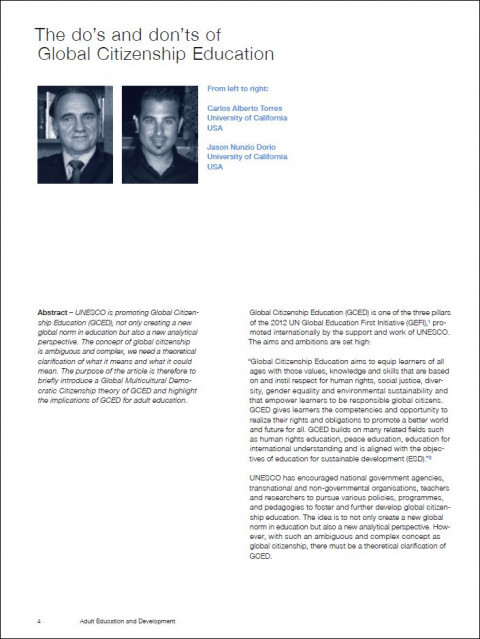 The Do's and Don’ts of Global Citizenship Education Год публикации: 2015 Автор: Carlos Alberto Torres | Jason Nunzio Dorio Организация-автор: Éducation des Adultes et Développement UNESCO is promoting Global Citizenship Education (GCED), not only creating a new global norm in education but also a new analytical perspective. The concept of global citizenship is ambiguous and complex, we need a theoretical clarification of what it means and what it could mean. The purpose of the article is therefore to briefly introduce a Global Multicultural Democratic Citizenship theory of GCED and highlight the implications of GCED for adult education. Qué hacer y qué evitar en la educación para la ciudadanía mundial Год публикации: 2015 Автор: Carlos Alberto Torres | Jason Nunzio Dorio Организация-автор: Éducation des Adultes et Développement La UNESCO está promoviendo la educación para la ciudadanía mundial (ECM), no solo creando una nueva normativa mundial sobre educación, sino introduciendo además una nueva perspectiva de análisis. Como el concepto de ciudadanía mundial es ambiguo y complejo, se requiere una aclaración teórica de lo que signifi ca y de lo que podría denotar. El objetivo de este artículo es, por tanto, exponer brevemente una teoría de ECM basada en una ciudadanía mundial democrática y multicultural, y subrayar las implicaciones de la ECM para la educación de adultos.