
Ресурсы
Изучайте широкий спектр ценных ресурсов ВГГ, чтобы углубить своё понимание и повысить эффективность исследований, просветительской деятельности, преподавания и обучения.
Найдено: 2,668
 2016 UN Global Citizenship Education Seminar Год публикации: 2016 Организация-автор: United Nations (UN) 2016 UN Global Citizenship Education SeminarSeminar on “Global Citizenship Education: An emerging agenda for peace and preventing violent extremism and promoting sustainable development and human dignity”. This seminar was co-organized by the Permanent Missions of Andorra, Croatia, Jordan and the Republic of Korea; and the Asia-Pacific Centre of Education for International Understanding (APCEIU), the United Nations Educational, Scientific and Cultural Organization/Global Education First Initiative (UNESCO/GEFI), the United Nations Academic Impact (UNAI), the UN-Women, InterPress Service, and the Coalition for Global Citizenship 2030.
  Beyond Bali Education Package Год публикации: 2012 Автор: Lily Taylor | Saul Karnovsky The Beyond Bali Project funded by Building Community Resilience (BCR) aims to develop and produce an education resource for secondary school students (years 8/9) on the Bali bombings and the Bali Peace Park. The resource is designed to build social resilience to violent extremism by: - providing students with the skills and tools to critically analyze and challenge violent extremism, its causes and consequences - raising awareness and education on the social impacts of violent extremism - encouraging students to think about how societies can resist the influence of violent extremism - engaging students through activities and discussion about the Bali Peace Park as social resistance to terrorism. Beyond Bali Education Package Год публикации: 2012 Автор: Lily Taylor | Saul Karnovsky Le projet Beyond Bali financé par Building Community Resilience (BCR) a pour objectif l’élaboration d’une ressource pédagogique pour les collégiens (de 5ème et 4ème) qui porte sur les attentats survenus à Bali et le Bali Peace Park. Cette ressource est conçue afin de renforcer la résilience sociale à l’extrémisme violent. Pour ce faire, elle :- Fournit aux étudiants les compétences et les outils nécessaires pour analyser de façon critique et remettre en question l’extrémisme violent, ses causes et ses conséquences,- Sensibilise aux impacts sociaux de l’extrémisme violent- Encourage les étudiants à réfléchir sur les façons dont les sociétés peuvent résister à l’influence de l’extrémisme violent- Propose aux étudiants de participer à des activités et à engager des discussions autour du Bali Peace Park.
 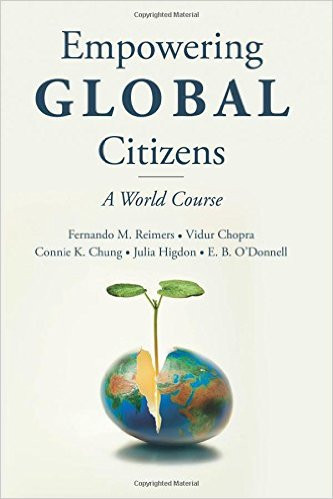 Empowering Global Citizens: A World Course Год публикации: 2016 Автор: Fernando Reimers | Vidur Chopra | Connie K. Chung | Julia Higdon | E. B. O'Donnell The world is changing rapidly and shcools must evolve to prepare young people to invent the future. Reinventing education requires thinking anew about how to help students develop competencies that will empower them as architects of their own lives and contributing members of their communities. Drawing on a synthesis of research and practice in global citizenship education, this book presents The World Course - a rigorous and coherent curriculum to foster student agency, empathy, and deep knowledge and skills to recognize the biggest global challenges and opportunities of our times, and to advance sustainability, human rights, and peace. Integrating current thinking on twenty-first-centry competencies and deeper learning, and deploying pedagogies that cultivate student responsibility, imagination, and creativity, such as project-based learning and design thinking, this book is a blueprint to reinvent education to empower global citizens.
  Intercultural Education : special issue on Holocaust Education in North America and Europe (Vol 14) Issue 2 "Intercultural Education is a global forum for the analysis of issues dealing with education in plural societies. It provides educational professionals with the knowledge and information that can assist them in contributing to the critical analysis and the implementation of intercultural education." This special issue concerns Holocaust Education in North America and Europe.
  Intercultural Education : Supplement 1 : Teaching the Holocaust in diverse classrooms : Opportunities and Challenges (Vol 21) Supplement 1 "Intercultural Education is a global forum for the analysis of issues dealing with education in plural societies. It provides educational professionals with the knowledge and information that can assist them in contributing to the critical analysis and the implementation of intercultural education." This special issue is about the opportunities and challenges about teaching the Holocaust in diverse classrooms.
  Rewriting the nation: World War II narratives in Polish history textbooks This chapter examines the processes of rewriting nationhood in educational narratives regarding the Second World War (WWII) in Poland. Using mixed methods, this case study analyzes narrative change in state-approved history textbooks published between 1977 and 2008, thus covering the period of political transition from a communist to a democratic Poland. Although trends in learning theory and international norms suggest that attention to diversity should have increased in textbooks, in Poland these trends have been subsumed by more long-lasting Polish specific cultural tropes. WWII narratives, in particular, emphasize an ethnically homogeneous nation. Throughout the 31-year sample, educating youth about WWII in Poland continues to be focused on reclaiming “Polishness” rather than on espousing global understandings and citizenship. (By the author)
  Enseigner le nazisme et la Shoah : Une étude comparée des manuels scolaires en Europe How have the Nazi period and the Shoah been presented in history textbooks for secondary schools published since 1950 in Germany, the United Kingdom, French-speaking Belgium and France? This volume compares their contents by underlining the evolution of this content and the influence of historical research as well as the various events that have been topical over the last fifty years. While European public opinion often mentions the deep silence shrouding this Nazi period and the Shoah up to the late 1990s, German textbooks from the 1950s provided pupils, aged 14 to 16, with important information. Although incomplete and imperfect at the beginning, this knowledge was quickly made available and broke the silence before vastly increasing and becoming more precise at the turn of the century. As far as quantity and quality are concerned, there is a sharp contrast between the German and French textbooks and the British ones, which deal much less with this topic. As for Walloon textbooks, they were scarce from the 1970s until 2000. (By the publisher) An Unimagined Community? Examining Narratives of the Holocaust in Lithuanian Textbooks 2011 marked 20 years since the collapse of the Soviet Union. This represented a change not just in the content of education or ideologies, but in the relationships between individuals, institutions and systems. During this time, the post-Soviet Republic of Lithuania not only had to reimagine its national identity in a local context, but it also had to reimagine itself as a community within the political, economic, and historical imaginations of the North Atlantic Treaty Organization (NATO) and the European Union (EU). Therefore, in Lithuania, as in many other post-Soviet countries, debates over which events should or should not be included as part of the national identity, and thus represented in the school curriculum, are more than just discussions about educational content; they are debates over the moral legitimacy of certain narratives and the ability of sovereign states to define them. (By the publisher) Holocaust education and human rights: Holocaust discussions in social science textbooks worldwide, 1970-2008 This paper examines discussions of the Holocaust in 465 secondary school social science textbooks (history, civics, and social studies) from 69 countries published between 1970 and 2008. It finds that textbooks from Western countries are more likely to discuss the Holocaust early on, but the rate is increasing in other regions of the world. Moreover, these discussions are increasingly framed in terms of a universal violation of human rights. Today, over half of Holocaust discussions in textbooks use the language of human rights or a crime against humanity. I argue the shift towards more abstract discourse depicting some events as culturally relevant worldwide reflects the construction of a globalized culture and society. (By the author)