
Ресурсы
Изучайте широкий спектр ценных ресурсов ВГГ, чтобы углубить своё понимание и повысить эффективность исследований, просветительской деятельности, преподавания и обучения.
Найдено: 3,433
 지속가능발전교육과 국제이해교육의 통합: 지속가능성 문제 해결에 대한 교사 교육의 개념적 문제와 교육학적 원칙 Год публикации: 2006 Автор: Swee-Hin Toh Организация-автор: UNESCO Bangkok 이것은 ESD(지속가능한발전 혹은 지속가능성을 위한 교육)와 EIU(국제이해교육)이라는 교육 혁신과 전 세계의 변화, 이 두 가지 확장 개념과 활동을 ‘통합’하고자 한다. 아울러 이 두 운동의 주요 개념적 문제와 주제는 명확히 되고, 공유된 가치와 이해가 강조될 것이다. 또한 평화롭고 지속가능한 세계 질서 구축이라는 목표를 효과적으로 수행하기 위해서, ESD와 EIU는 몇 가지 주요 공통 교수법과 과정에 그 성패가 달려있다고 보인다. 여기에 또 다른 입문주의 사항(introductory caveat), 즉 패러다임의 문제가 필수적이다. 정책 입안자, 이론가 및 실무자 사이에선 결과적으로 정책과 관행에 대한 대안적 함의와 함께 그들의 패러다임 해석에 따른 개념화의 뚜렷한 차이점이 종종 나타날 수 있다. Address by Irina Bokova, Director-General of UNESCO, on the occasion of Senior Official Meeting on the Role of Education and Countering Violent Extremism organized by the International Centre of Excellence for Countering Violent Extremism (Hedayah) Год публикации: 2013 Организация-автор: UNESCO. Director-General, 2009-2017 (Bokova, I.G.) This address was presented by Irina Bokova, Director-General of UNESCO, on the occasion of Senior Official Meeting on the Role of Education and Countering Violent Extremism organized by the International Centre of Excellence for Countering Violent Extremism (Hedayah). Address by Irina Bokova, Director-General of UNESCO, on the occasion of Senior Official Meeting on the Role of Education and Countering Violent Extremism organized by the International Centre of Excellence for Countering Violent Extremism (Hedayah) Год публикации: 2013 Организация-автор: UNESCO. Director-General, 2009-2017 (Bokova, I.G.) Cette adresse a été présentée par Irina Bokova, Directrice générale de l'UNESCO, à l'occasion de la Réunion des Hauts Fonctionnaires sur le Rôle de l'Éducation et de la Lutte contre l'Extrémisme Violent organisé par le Centre International d'Excellence pour la Lutte contre l'Extrémisme Violent (Hedayah). 폭력적 극단주의(Hedayah) 대응을 위한 국제우수연구센터(International Centre of Excellence)가 주최한 ‘교육의 역할과 폭력적 극단주의의 대응’ 고위급 회의에서 이리나 보코바 유네스코 사무총장의 연설. 2013년 9월 25일, 뉴욕. Год публикации: 2013 Организация-автор: UNESCO. Director-General, 2009-2017 (Bokova, I.G.) 이 연설은 폭력적 극단주의(Hedayah)에 대응하기 위한 국제우수연구센터(International Centre of Excellence)가 주최한 ‘교육의 역할과 폭력적 극단주의의 대응’에 관한 고위급 회의에서 이리나 보코바 유네스코 사무총장이 발표한 것이다. Address by Irina Bokova, Director-General of UNESCO, on the occasion of Seminar on Global Citizenship Education, UNHQ; New York, 6 March 2015 Год публикации: 2015 Организация-автор: UNESCO. Director-General, 2009-2017 (Bokova, I.G.) This document is an address by Irina Bokova, Director-General of UNESCO on the occasion of "Seminar on Global Citizenship Education" in New York, 6 March 2015. She highlights the importance of GCED for education in the 21st century. Democracy and diversity: principles and concepts for educating citizens in a global age Год публикации: 2005 Автор: James A. Banks | Cherry A. McGee Banks | Carlos E. Cortes | Carole L. Hahn | Merry M. Merryfield | Kogila A. Moodley | Stephen Murphy-Shigematsu | Audrey Osler | Caryn Park | Walter C. Parker Организация-автор: Center of Multicultural Education, University of Washington The Center for Multicultural Education at the University of Washington convened—with support from the Spencer Foundation—a Diversity, Citizenship, and Global Education Consensus Panel. The Panel’s goal was to develop a set of principles, concepts, and guidelines that school practitioners can use to build or renew citizenship education programs that balance diversity and unity and prepare students to become effective citizens in a global context. An important resource for the Panel’s work was the book that resulted from an earlier conference sponsored by the Center, Diversity and Citizenship Education: Global Perspectives (Banks, 2004a).The Consensus Panel developed four principles and identified ten concepts, which are detailed in this publication. The Panel also developed a checklist that is designed for use by educators who want to consider the extent to which the principles and concepts identified by the Panel are reflected in their classrooms and schools.PRINCIPLESSection I Diversity, Unity, Global Interconnectedness, and Human Rights1. Students should learn about the complex relationships between unity and diversity in their local communities, the nation, and the world.2. Students should learn about the ways in which people in their community, nation, and region are increasingly interdependent with other people around the world and are connected to the economic, political, cultural, environmental, and technological changes taking place across the planet.3. The teaching of human rights should underpin citizenship education courses and programs in multicultural nation-states.Section II Experience and Participation4. Students should be taught knowledge about democracy and democratic institutions and provided opportunities to practice democracy. Démocratie et diversité: principes et concepts pour l'éducation des citoyens dans un âge global Год публикации: 2005 Автор: James A. Banks | Cherry A. McGee Banks | Carlos E. Cortes | Carole L. Hahn | Merry M. Merryfield | Kogila A. Moodley | Stephen Murphy-Shigematsu | Audrey Osler | Caryn Park | Walter C. Parker Организация-автор: Center of Multicultural Education, University of Washington Le Centre pour l'éducation multiculturelle à l'Université de Washington a convoqué-avec le soutien de la Fondation-a Spencer Diversité, Citoyenneté et Éducation Globale Panel Consensus . L'objectif du Groupe est de développer un ensemble de principes, des concepts et des lignes directrices que les praticiens de l'école peuvent utiliser pour construire ou de renouveler les programmes d'éducation à la citoyenneté que la diversité de l'équilibre et de l'unité et de préparer les étudiants à devenir des citoyens efficaces dans un contexte mondial. Une ressource importante pour les travaux du Groupe spécial était le livre qui résulte d'un earlierconférencesponsored par le Centre, la diversité et l'éducation à la citoyenneté: perspectives mondiales (banques, 2004a). Le groupe de concertation a élaboré quatre principes et identifi é dix concepts, qui sont détaillées dans cette publication. Le Groupe spécial a également mis au point une liste de contrôle qui est conçu pour être utilisé par les éducateurs qui veulent examiner la mesure dans laquelle les principes et les concepts identifi és par le Groupe sont refl ète dans leurs salles de classe et les écoles. PRINCIPES Section I Diversité, Unité, Global interconnectivité et droits de l'homme 1. Les élèves devraient en apprendre davantage sur les relations complexes entre l'unité et la diversité dans leurs communautés locales, la nation et le monde. 2. Les élèves devraient en apprendre davantage sur les façons dont les gens dans leur communauté, de la nation et de la région sont de plus en plus interdépendantes avec d'autres personnes dans le monde et sont reliés aux changements économiques, politiques, culturels, environnementaux et technologiques qui ont lieu à travers la planète. 3. L'enseignement des droits de l'homme devrait soutenir les cours et les programmes d'éducation à la citoyenneté dans les États-nations multiculturelles. Section II Expérience et participation 4. Les élèves doivent apprendre les connaissances sur la démocratie et les institutions démocratiques et a fourni des occasions de pratiquer la démocratie. Citizenship, identity and education: examining the public purposes of schools in an age of globalization Год публикации: 2006 Автор: Fernando Reimers Организация-автор: UNESCO International Bureau of Education (IBE) Educational institutions exist to achieve public purposes. One of those purposes is to develop citizenship. In the 21st century, citizenship includes global citizenship. In an era of globalization effective citizenship includes the knowledge, ability and disposition to engage peacefully and constructively across cultural differences for purposes of addressing personal and collective needs and of achieving sustainable human–environmental interactions, this requires internalizing global values. Addressing these challenges of globalization will require making citizenship education and the development of global values an explicit objective of efforts to improve quality throughout the world, critically examining theories and evidence about the effectiveness of various approaches to developing citizenship and global citizenship and supporting activities aligned with this public purpose. This public purpose should support the development of a political culture that fosters the rule of national and international law and respect of human rights, the development of understanding to support trade and economic and peaceful bilateral and international diplomacy as the preferred means to solve international disputes, the development of the capability to understand and address the serious environmental challenges facing humanity and to collaborate across national boundaries in the creation of sustainable forms of human–environmental interactions and in the development of the skills to promote rationality in deliberation and action, and to advance science and technology as means to improve human health and well-being. At present, however, many education systems and reforms are insufficiently focused on quality, or focus instead on a very narrow and self-referenced definition of quality. It is possible to educate people to understand and appreciate cultural differences and to understand and accept human rights in a framework of global values that includes compassion and caring, concern for others, respect and reciprocity. These values, dispositions, knowledge and skills can be developed in a range of institutions that societies have to pass on what they value to the young, and to re-create culture: families, religious institutions, the media, workplaces, political institutions and also schools. While there is no reason to assume that schools can be more effective in this task than any of these other institutions, they have greater potential to be aligned with transnational efforts to promote global civility. They are a public space, and consequently also a globally public space, in ways in which families and religious institutions are not. If schools actively engage in teaching hatred or intolerance, or if they fail to prepare students adequately for global civility, these failures can be noted by international institutions that can potentially mobilize resources to support national and local efforts to prepare students for global citizenship. There is not a similar network linking national and transnational institutions, public and private, governmental and non-governmental, that attends to the dynamics of families and other ‘‘private’’ spaces. Citoyenneté, identité et de l'éducation: l'examen des fins publiques des écoles à l'ère de la mondialisation Год публикации: 2006 Автор: Fernando Reimers Организация-автор: UNESCO International Bureau of Education (IBE) Les établissements d'enseignement existent pour parvenir à des fins publiques. L'un de ces objectifs est de développer la citoyenneté. Au 21e siècle, la citoyenneté comprend la citoyenneté mondiale. Dans une ère de mondialisation citoyenneté effective comprend les connaissances, la capacité et la disposition à engager pacifique et constructive entre les différences culturelles aux fins de répondre aux besoins personnels et collectifs et de réaliser des interactions humaines-environnementales durables, ce qui nécessite l'intériorisation des valeurs globales. Pour relever ces défis de la mondialisation, il faudra faire de l'éducation à la citoyenneté et le développement des valeurs mondiales un objectif explicite des efforts pour améliorer la qualité dans le monde entier, l'examen critique des théories et des preuves sur l'efficacité des différentes approches pour développer la citoyenneté et la citoyenneté mondiale et soutenir les activités alignées cet effet public. Cet objectif public devrait soutenir le développement d'une culture politique qui favorise la primauté du droit national et international et le respect des droits de l'homme, le développement de la compréhension pour soutenir le commerce et la diplomatie bilatérale et internationale économique et pacifique comme le moyen privilégié pour résoudre les conflits internationaux, le développement de la capacité à comprendre et à relever les défis environnementaux humanité face à de graves et de collaborer à travers les frontières nationales dans la création de formes durables d'interactions homme-environnement et dans le développement des compétences pour promouvoir la rationalité dans la délibération et de l'action, et de faire avancer la science et la technologie comme moyen d'améliorer la santé humaine et le bien-être. À l'heure actuelle, cependant, de nombreux systèmes d'éducation et les réformes ne sont pas suffisamment axées sur la qualité, ou se concentrent plutôt sur une définition très étroite et auto-référencé de la qualité. Il est possible d'éduquer les gens à comprendre et à apprécier les différences culturelles et à comprendre et à acept droits de l'homme dans un cadre de valeurs globales qui comprend la compassion et la compassion, le souci des autres, le respect et la réciprocité. Ces valeurs, les dispositions, les connaissances et les compétences peuvent être développées dans un éventail d'institutions que les sociétés doivent passer sur ce qu'ils apprécient le jeune, et de recréer la culture: les familles, les institutions religieuses, les médias, les milieux de travail, les institutions politiques et aussi écoles. Bien qu'il n'y ait aucune raison de supposer que les écoles peuvent être plus efficaces dans cette tâche que l'une de ces autres institutions, ils ont un plus grand potentiel pour être aligné avec les efforts transnationaux visant à promouvoir la civilité mondiale. Ils sont un espace public, et par conséquent aussi un espace public à l'échelle mondiale, dans les façons dont les familles et les institutions religieuses ne sont pas. Si les écoles participent activement à l'enseignement à la haine ou l'intolérance, ou si elles ne parviennent pas à préparer les étudiants de manière adéquate pour la civilité mondiale, ces échecs peuvent être notées par les institutions internationales qui peuvent potentiellement mobiliser des ressources pour soutenir les efforts nationaux et locaux pour préparer les élèves à la citoyenneté mondiale. Il n'y a pas un réseau similaire reliant les institutions nationales et transnationales, publiques et privées, gouvernementales et non-gouvernementales, qui assiste à la dynamique des familles et d'autres «espaces» «privés».
 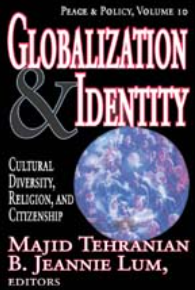 Globalization and Identity: Cultural Diversity, Religion and Citizenship Год публикации: 2006 Автор: Majid Tehranian | B. Jeannie Lum Организация-автор: Transaction Publishers In the first decade of the twenty-first century, globalization and identity have emerged as the most critical challenges to world peace. This volume of Peace & Policy addresses the overarching question, "What are the effects of globalization in the areas of culture, ethnic diversity, religion, and citizenship, and how does terrorism help groups attain a sense of global identity?"Part I, "Citizenship in a Globalizing World," reexamines globalization in light of the traditions from which human civilizations have evolved. Linda Groff focuses on Samuel R. Huntington's thesis that the Cold War would be followed by a clash of civilizations. Joseph A. Camilleri traces the history of the concept of citizenship and its transformation through the ages to modern times. Kamran Mofid argues that the marketplace is not just an economic sphere but one where economic and business interests must embrace the spiritual assets of the community. Majid Tehranian raises the problem of identity and advocates the assumption of global identity, responsibility, and citizenship. Part II, "Convergence in Global Cultures," explores the complex issues of diversity in religions. Christopher Leeds, Vladimir Korobov, and Bharapt Gupt show how the reconceptualization of the world both geographically and regionally can recreate new sensibilities needed to overcome differences. Part III, "Divergence in Global Conflicts," discusses the multiple dimensions of the globalizing effects of economic expansion and political strife experienced by different cultures at local and regional levels. Audrey Kitigawa and Ade Ogunrinade use Nigeria as an example of political manipulation of religious and ethnic groups to divert attention from the real problems of social and economic marginalization. Fred Riggs looks at how the Web has become a medium in the globalization of religious movements.The authors maintain that continuing efforts for dialogue across cultural and religious boundaries in today's interreligious and interfaith organizations can become a force for healing.