
Ресурсы
Изучайте широкий спектр ценных ресурсов ВГГ, чтобы углубить своё понимание и повысить эффективность исследований, просветительской деятельности, преподавания и обучения.
Найдено: 3,451
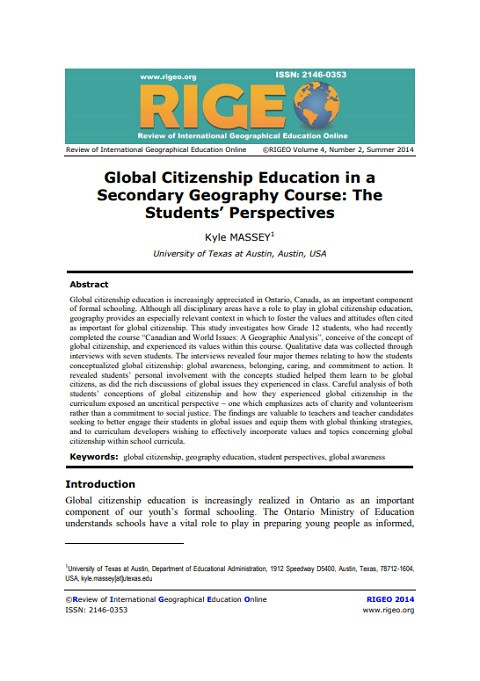 Global Citizenship Education in a Secondary Geography Course: The Students’ Perspectives (Review of International Geographical Education Online; Vol. 4, No. 2) Год публикации: 2014 Автор: Kyle Massey Организация-автор: Eskisehir Osmangazi University Global citizenship education is increasingly appreciated in Ontario, Canada, as an important component of formal schooling. Although all disciplinary areas have a role to play in global citizenship education, geography provides an especially relevant context in which to foster the values and attitudes often cited as important for global citizenship. This study investigates how Grade 12 students, who had recently completed the course “Canadian and World Issues: A Geographic Analysis”, conceive of the concept of global citizenship, and experienced its values within this course. Qualitative data was collected through interviews with seven students. The interviews revealed four major themes relating to how the students conceptualized global citizenship: global awareness, belonging, caring, and commitment to action. It revealed students’ personal involvement with the concepts studied helped them learn to be global citizens, as did the rich discussions of global issues they experienced in class. Careful analysis of both students’ conceptions of global citizenship and how they experienced global citizenship in the curriculum exposed an uncritical perspective – one which emphasizes acts of charity and volunteerism rather than a commitment to social justice. The findings are valuable to teachers and teacher candidates seeking to better engage their students in global issues and equip them with global thinking strategies, and to curriculum developers wishing to effectively incorporate values and topics concerning global citizenship within school curricula.
 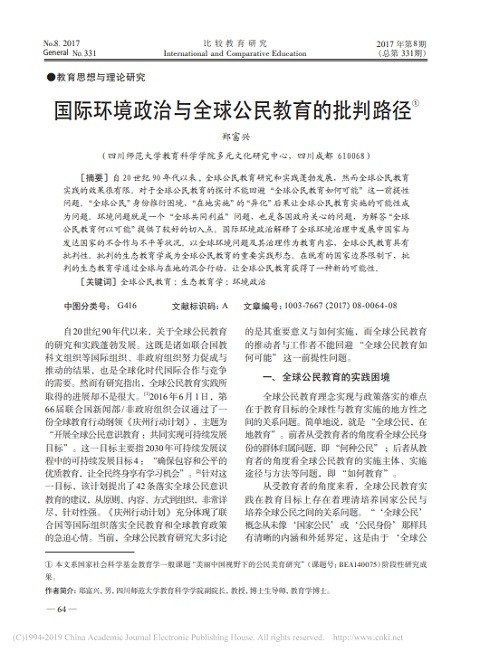 International Environmental Politics and Critical Approach to Global Citizenship Education (International and Comparative Education; No. 8) Год публикации: 2017 Автор: Zheng Fuxing Организация-автор: Beijing Normal University The research and practice of global citizenship education have thrived since 1990s, but the effectiveness of global citizenship education is limited. The researcher cannot avoid the problematic premise of the possibility of global citizenship education. The identity predicament of global citizen and alienation of local implementing make probability of the global citizenship education problematic. The practical predicament of the global citizenship education manifests that the nation state is the key factor of policy implementation. Environmental question, which is about global common good, attracts the attention from the government of most of nations, and becomes the good case for exploring the feasibility of global citizenship education. Environmental politics explain the inequality and injustice in the globally environmental governance which made the global citizenship education critical. The critical ecopedagogy becomes the new form of global citizenship. The practice of the global citizenship education becomes viable by hybrid activism generated by dialectical movement between local and global in the limit of nation-state. 国际环境政治与全球公民教育的批判路径 (比较教育研究; No. 8) Год публикации: 2017 Автор: Zheng Fuxing Организация-автор: Beijing Normal University 自 20 世纪 90 年代以来 , 全球公民教育研究和实践蓬勃发展,然而全球公民教育 实践的效果很有限。对于全球公民教育的探讨不能回避“全球公民教育如何可能”这一前提性 问题。“全球公民”身份推衍困境、“在地实施”的“异化”后果让全球公民教育实施的可能性成 为问题。环境问题既是一个“全球共同利益”问题,也是各国政府关心的问题,为解答“全球 公民教育何以可能”提供了较好的切入点。国际环境政治解释了全球环境治理中发展中国家与 发达国家的不合作与不平等状况。以全球环境问题及其治理作为教育内容,全球公民教育具有 批判性。批判的生态教育学成为全球公民教育的重要实践形态。在既有的国家边界限制下,批 判的生态教育学通过全球与在地的混合行动,让全球公民教育获得了一种新的可能性。
 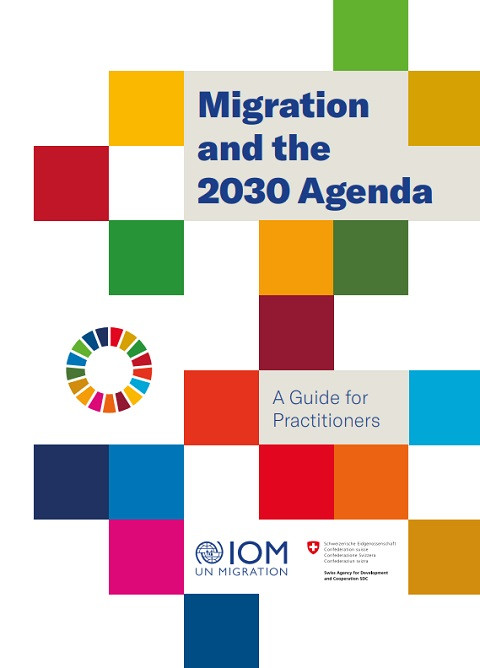 La migration et le Programme 2030 : Un guide à l’usage des praticiens Год публикации: 2018 Автор: Elisa Mosler Vidal Организация-автор: International Organization for Migration (IOM) Ce guide est destiné aux acteurs gouvernementaux, à la fois nationaux et locaux, qui sont impliqués dans des activités de mise en œuvre des Objectifs de développement durable, y compris ceux qui travaillent spécifiquement dans le domaine de la migration et ceux d’autres secteurs qui souhaitent intégrer la question de la migration. Il s’adresse également aux acteurs gouvernementaux qui travaillent dans le domaine de la migration et souhaitent intégrer les ODD dans leur travail.L’objectif de ce guide est d’aider les responsables politiques à mettre en œuvre les aspects des ODD qui touchent à la migration. Les responsables politiques peuvent utiliser ce guide pour intégrer la migration dans les activités de développement à l’échelle locale ou nationale, par l’élaboration et la mise en œuvre d’interventions qui portent sur la migration dans le cadre des ODD. Ces interventions peuvent se présenter sous forme de lois, de politiques, de programmes, de projets ou d’autres activités et peuvent être liées à des thèmes de base de la migration ou intégrer la migration dans les activités d’un autre secteur. Par exemple, les responsables politiques peuvent utiliser ce guide pour élaborer des interventions qui sont directement consacrées à la traite des personnes, ainsi que des interventions dans le secteur de la santé qui permettent de protéger les victimes de la traite des personnes.Pour les acteurs disposant d’une expérience de l’intégration de la migration, ce guide offre une nouvelle approche qui repose sur le Programme 2030. Pour ceux qui ne possèdent aucune expérience de l’intégration de la migration, il présente les liens entre la migration et le développement dans le cadre des ODD, et les mesures à prendre compte tenu de ces liens. 移民与《2030 年可持续发展议程》 Год публикации: 2018 Автор: Elisa Mosler Vidal Организация-автор: International Organization for Migration (IOM) 本指南旨在为参与可持续发展目标实施过程的国家和地方政府行为体提供指导,对象包括专门从事移民工作的人员以及有兴趣将移民事物纳入工作活动中的其他部门人员。这也适用于希望将可持续发展目标纳入其移民领域工作的政府行为体。本指南的重点是帮助决策者实施可持续发展目标中与移民相关的部分。政策制定者可以使用该指南,通过设计和实施与可持续发展目标相关的与移民有关的干预措施,将移民纳入地方或国家发展计划。这些干预措施可以采取立法、政策制定、方案、项目或其他活动的形式,并可能涉及核心移民问题,或在其他部门的活动里将移民问题纳入其中。例如,决策者可以使用本指南来设计直接针对人口贩运的干预措施以及有助于保护人口贩运受害者的卫生部门的干预措施。对于在移民主流化方面有经验的行为体,本指南提供了一种基于2030年议程的新方法。对于那些没有移民主流化相关经验的人,它介绍了如何在可持续发展目标的背景下将移民和发展联系在一起,以及如何针对这些联系采取行动。它附有两个辅助工具,用以说明移民与可持续发展目标之间的联系:(i)一本全方位阐述移民与每个可持续发展目标之间关系的手册,以及(ii)一张概括这些关系的导图。
 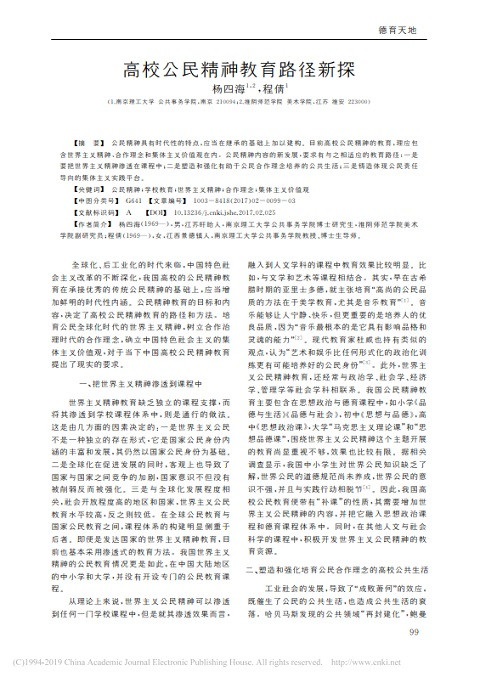 A New Approach to Civic Spirit Education in Universities (Jiangsu Higher Education; No. 2) Год публикации: 2017 Автор: Yang Sihai | Cheng Qian Организация-автор: Jiangsu Education Press The civic spirit has the characteristics of The Times and should be constructed on the basis of inheritance. At present, the education of civic spirit in universities should include the spirit of cosmopolitanism, the idea of cooperation and the value of collectivism. The new development of civic spirit requires the corresponding educational path: First, the spirit of cosmopolitanism should be infiltrated into the curriculum; Second, to shape and strengthen the public life conducive to the cultivation of the concept of citizen cooperation; Thirdly, casting the collectivism practice platform that embodies the orientation of civic responsibility. 高校公民精神教育路径新探 (江苏高教; No. 2) Год публикации: 2017 Автор: Yang Sihai | Cheng Qian Организация-автор: Jiangsu Education Press 公民精神具有时代性的特点,应当在继承的基础上加以建构。目前高校公民精神的教育,理 应 包 含世界主义精神、合作理念和集体主义价值观在内。公民精神内容的新发展,要求有与之相适应的教育路径:一是 要把世界主义精神渗透在课程中;二是塑造和强化有助于公民合作理念培养的公共生活;三是铸造体现公民责任 导向的集体主义实践平台。
  The Connective “Public” and the Chinese Logic of Citizenship Education (Journal of Educational Studies; Vol. 13, No. 2) Год публикации: 2017 Автор: Qiu Kunshu | Yan Yajun Организация-автор: Beijing Normal University Cultural tradition has pre-conditionality on citizenship education. From the point of view of cultural tradition, the “public” in citizenship education has different meaning in China and the West: Chinese “public” is mainly a kind of connective “public”, while the western “public” mainly means domanial “public”. This lead to the difference in Chinese and modern western main stream values. The former emphasizes the common goodness of the whole society, social responsibility and virtue which is favorable to harmony, while the later emphasizes individualist rights and priority of freedom. They represent two kinds of ethics language and position. It is essential to maintain high cultural awareness for the implementation of citizenship education in China and the localization of exotic “citizenship education”. Guided by Marxism and rooted in Chinese cultural tradition, Chinese citizenship education should be based on “people in relation”, use the actual support of “state-society” cooperation, and offer ultimate concern to “the free and comprehensive development of human”. 连带的“公”与公民教育的中国理路 (教育学报; Vol. 13, No. 2) Год публикации: 2017 Автор: Qiu Kunshu | Yan Yajun Организация-автор: Beijing Normal University 文化传统对公民教育具有预制性。从文化传统来看,中西方社会和文化语境中的“公”并不相同:中国 的“公”主要是连带的“公”,而西方的“公”主要是领域的“公”,由此而导致中华文明的价值与现代西方主流价值的 差异,前者强调社会共同的善、社会责任和有益于和谐的美德,后者则强调个人主义的权利和自由优先,它 们 分 别 代表了两种不同的伦理学语言和立场。在中国开展公民教育,只有保持高度的文化自觉,作 为 舶 来 品 的“公 民 教 育”才可能落地生根。以马克思主义为指导,根植于中 华 文 化 传 统,中国公民教育需要以“关 系 中 的 人”为 立 足 点, 以“国家—社会”的互构合作为现实支撑,以“人的自由全面发展”为终极关怀。
  The Theory of Civic Education in the Context of Key Competence (Educational Science Research) Год публикации: 2017 Автор: Wang Min Организация-автор: Beijing Open University From quality-oriented education to key competence, Chinese education has always been committed to cultivating “well-rounded people” who meet the needs of individual lifelong development and social development. In the context of key competence, it is necessary to clarify the logical relationship between key competence and civic education. On the basis of understanding the essence of quality education, the pursuit of key competence and the connotation of civic education, this paper attempts to answer the question of “who to train” in civic education through theoretical reflection on the legal, educational and practical provisions of “qualified citizen”. Through thinking about the subject orientation, curriculum implementation and evaluation system of civic education, this paper seeks the way of “how to train people”.