
Ресурсы
Изучайте широкий спектр ценных ресурсов ВГГ, чтобы углубить своё понимание и повысить эффективность исследований, просветительской деятельности, преподавания и обучения.
Найдено: 2,161
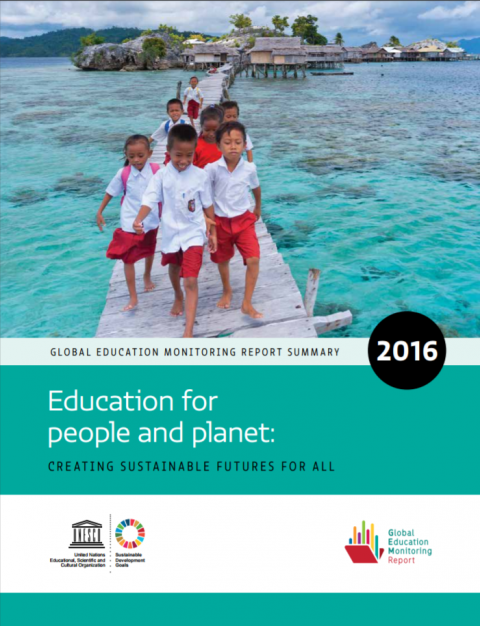 [Summary] Education for People and Planet: Creating sustainable Futures for All, Global Education Monitoring Report, 2016; Summary Год публикации: 2016 Организация-автор: UNESCO Education for People and Planet: Creating Sustainable Futures for All explores the complex relationship between education and the new 2030 Agenda for Sustainable Development, covering six fundamental pillars – Planet, Prosperity, People, Peace, Place and Partnerships. This report shows that education will not deliver its full potential unless participation rates increase dramatically and sustainable development guides education system reform. It also warns of the destructive impact that climate change, conflict, unsustainable consumption and the increasing gap between rich and poor have on education. A huge transformation is needed if we are to create sustainable futures for all.
  Sandwatch: adapting to climate change and educating for sustainable development Год публикации: 2010 Автор: Gillian Cambers | Paul Diamond Организация-автор: UNESCO Sandwatch provides a framework for children, youth and adults, with the help of teachers and local communities, to work together to critically evaluate the problems and conflicts facing their beach environments, and to develop sustainable approaches to address these issues. It also helps beaches become more resilient to climate change. The preliminary chapters of this publication focus on how to get started with Sandwatch activities and examine ways to address climate change impacts. The principle aim of this publication is to document the Sandwatch methodology: monitoring, analysing, sharing and taking action. An activities-orientated approach is used to provide step-by-step instructions to cover monitoring methods and data analysis, including observation and recording, erosion and accretion, beach composition, human activities, beach debris, water quality, waves, longshore currents, plants and animals. The activities are related to (a) sustainable development issues, including: beach ownership, mining beaches for construction material, conflict resolution between different beach users, pollution, conservation of endangered species, and (b) climate change adaptation issues: sea level rise, rising temperatures, ocean acidification and increased extreme events. Ways to share findings and create a Sandwatch network are detailed including methods such as the use of local media, websites, social networking and video production. Finally, ways are discussed to design, plan and implement a Sandwatch project to fulfill one or all of the following criteria: (a) addressing a particular beach-related issue, (b) enhancing the beach, and (c) promoting climate change adaptation. Sandwatch stands as an example of Education for Sustainable Development in action, and is being targeted as one of several flagship projects for the United Nations Decade of Education for Sustainable Development (2005–2014). As the world confronts the growing threat of climate change, Sandwatch presents an opportunity to help people and ecosystems respond to present and future changes in a practical manner. Beaches are among the ecosystems most at risk from climate change as they face rising sea levels and increased more intense storms. By contributing to ecosystem health and resilience, Sandwatch can help people from all walks of life learn about climate change and how their actions can contribute to the adaptation process. التربية من أجل التنمية المستدامة: كتاب مرجعي Год публикации: 2013 Организация-автор: UNESCO The target audiences for the Education for Sustainable Development Sourcebook are primary and secondary teachers and mid-level decision-makers, who have responsibility for primary and secondary education. Another primary audience is teacher educators who work with pre-service and in-service primary and secondary school teachers. The purpose of the publication is to describe ways in which education for sustainable development (ESD) can be integrated into primary and secondary schooling. This collection of briefs is designed to complement other ESD materials published by UNESCO. The topics for the briefs were selected in consultation with UNESCO Field Offices and Institutes. The briefs for primary and secondary teachers are specifically written for professional educators who work in formal education settings. The briefs for teachers as well as those for decision-makers address “gaps” in the UNESCO ESD literature. Educación para el desarollo sostenible: libro de consulta Год публикации: 2012 Организация-автор: UNESCO The target audiences for the Education for Sustainable Development Sourcebook are primary and secondary teachers and mid-level decision-makers, who have responsibility for primary and secondary education. Another primary audience is teacher educators who work with pre-service and in-service primary and secondary school teachers. The purpose of the publication is to describe ways in which education for sustainable development (ESD) can be integrated into primary and secondary schooling. This collection of briefs is designed to complement other ESD materials published by UNESCO. The topics for the briefs were selected in consultation with UNESCO Field Offices and Institutes. The briefs for primary and secondary teachers are specifically written for professional educators who work in formal education settings. The briefs for teachers as well as those for decision-makers address “gaps” in the UNESCO ESD literature. L'Education pour le développement durable: ouvrage de référence Год публикации: 2012 Организация-автор: UNESCO The target audiences for the Education for Sustainable Development Sourcebook are primary and secondary teachers and mid-level decision-makers, who have responsibility for primary and secondary education. Another primary audience is teacher educators who work with pre-service and in-service primary and secondary school teachers. The purpose of the publication is to describe ways in which education for sustainable development (ESD) can be integrated into primary and secondary schooling. This collection of briefs is designed to complement other ESD materials published by UNESCO. The topics for the briefs were selected in consultation with UNESCO Field Offices and Institutes. The briefs for primary and secondary teachers are specifically written for professional educators who work in formal education settings. The briefs for teachers as well as those for decision-makers address “gaps” in the UNESCO ESD literature. Education for sustainable development: sourcebook Год публикации: 2012 Организация-автор: UNESCO The target audiences for the Education for Sustainable Development Sourcebook are primary and secondary teachers and mid-level decision-makers, who have responsibility for primary and secondary education. Another primary audience is teacher educators who work with pre-service and in-service primary and secondary school teachers. The purpose of the publication is to describe ways in which education for sustainable development (ESD) can be integrated into primary and secondary schooling. This collection of briefs is designed to complement other ESD materials published by UNESCO. The topics for the briefs were selected in consultation with UNESCO Field Offices and Institutes. The briefs for primary and secondary teachers are specifically written for professional educators who work in formal education settings. The briefs for teachers as well as those for decision-makers address “gaps” in the UNESCO ESD literature.
  지속가능발전교육길잡이 Год публикации: 2013 Организация-автор: 유네스코 『지속가능발전교육 길잡이』는 초·중등 교사와 초·중등교육을 담당하는 중진급 정책결정자들을 위한 책이다. 또한 초·중등 예비 (pre-service) 및 현직(in-service) 교사들을 교육시키는 교사교육가들도 본 책의 주요 대상이다. 본 책은 초·중등 학교 교육 안에 지속가능발전교육(Education for Sustainable Development, ESD)을 통합시키기 위한 방안을 모색하는 데 목적을 두고 있다. 본 책에 제시된 지침서들은 유네스 코에서 발간한 여타 지속가능발전교육(ESD) 자료들을 보완하며, 그 주제는 유네스코 지역사무소 및 부속기구들의 자문을 통해 선정되었다. 초·중등 교사들을 위한 지침서는 현 형식교육의 환경 안에서 활동하고 있는 전문 교육가들에게 초점을 맞추고 있다. 교사뿐만 아니라 정책결정자들을 위한 지침서는 유네스코 지속가능 발전교육(ESD) 문헌 내 ‘간극’을 다루고 있다.
  Teaching respect for all: implementation guide Год публикации: 2014 Организация-автор: UNESCO Teaching Respect for All is a joint UNESCO-United States of America-Brazil project launched in January 2012 to counteract discrimination both in and through education. Acknowledging that discrimination is on the rise worldwide, Teaching Respect for All promotes an educational response to counter discrimination and violence through strengthening the foundations of mutual tolerance and cultivating respect for all people, regardless of colour, gender, class, sexual orientation, national, ethnic, or religious orientation/identity. Teaching Respect for All has chosen to focus efforts on the formal and informal classroom, targeting learners of 8-16 years old, and aims to build curiosity, openness, critical thinking and understanding among youth learners, thus equipping them with the awareness, knowledge, and skills to cultivate respect and stop discrimination on all levels. The project is founded on the universal values and core principles of human rights, while acknowledging each country has its own history and mechanism for addressing the issue of discrimination in education. Enseigner le respect pour tous: guide de mise en oeuvre Год публикации: 2014 Организация-автор: Organisation des Nations Unies pour l'éducation, la science et la culture (UNESCO) Respect Pédagogique pour Tous est un UNESCO-États-Unis conjointe de projet Amérique-Brésil a lancé en Janvier 2012 pour lutter contre la discrimination à la fois dans et par l'éducation. Reconnaissant que la discrimination est à la hausse dans le monde entier, Respect Pédagogique pour Tous favorise une réponse éducative pour lutter contre la discrimination et la violence en renforçant les fondements de la tolérance mutuelle et de cultiver le respect pour toutes les personnes, indépendamment de la couleur, le sexe, la classe, l'orientation sexuelle, nationale, ethnique ou religieuse orientation / identité. Respect Pédagogique pour Tous a choisi de concentrer les efforts sur la salle de classe formelle et informelle, en ciblant les apprenants de 8-16 ans, et vise à développer la curiosité, l'ouverture, la pensée critique et la compréhension entre les apprenants de la jeunesse, en les dotant ainsi avec la prise de conscience, la connaissance, et les compétences nécessaires pour cultiver le respect et arrêter la discrimination à tous les niveaux. Le projet est fondé sur les valeurs universelles et les principes fondamentaux des droits de l'homme, tout en reconnaissant que chaque pays a sa propre histoire et un mécanisme pour régler le problème de la discrimination dans l'éducation. ‘모두를 존중하는 방법’ 실행 가이드 Год публикации: 2014 Организация-автор: 유네스코 ‘모두를 존중하는 방법(Teaching Respect for All)’은 교육을 통해 차별을 근절하기 위하여 2012년 1월에 시작된 유네스코 미국-브라질 합작 프로젝트이다. 차별이 전 세계적으로 부상하고 있음을 인식하는 요즘, ‘모두를 존중하는 방법’은 인종, 성별, 계급, 성적 성향, 국가, 민족 또는 종교적 정체성에 관계없이 상호 관용의 기초 토대를 강화하고 모든 사람들을 존중하는 문화를 배양함으로써 차별과 폭력에 대응하는 교육적 반응을 고취시킨다. ‘모두를 존중하는 방법’은 8~16세 학습자를 대상으로 정식 및 약식 수업을 하도록 포커스를 맞춰, 이들에게 호기심, 개방성, 비판적 사고와 이해심, 의식과 지식을 키워주며 모든 수준에서의 차별을 중단하고 존경심을 키울 수 있는 방법을 가르쳐주는 것이다. 본 프로젝트는 각국이 교육 차별 문제를 해결할 수 있는 자체적 역사와 메커니즘을 소유하고 있음을 인정하며, 인권의 보편적 가치와 그 핵심 원칙에 기초를 두고 있다.