
Ресурсы
Изучайте широкий спектр ценных ресурсов ВГГ, чтобы углубить своё понимание и повысить эффективность исследований, просветительской деятельности, преподавания и обучения.
Найдено: 2,161
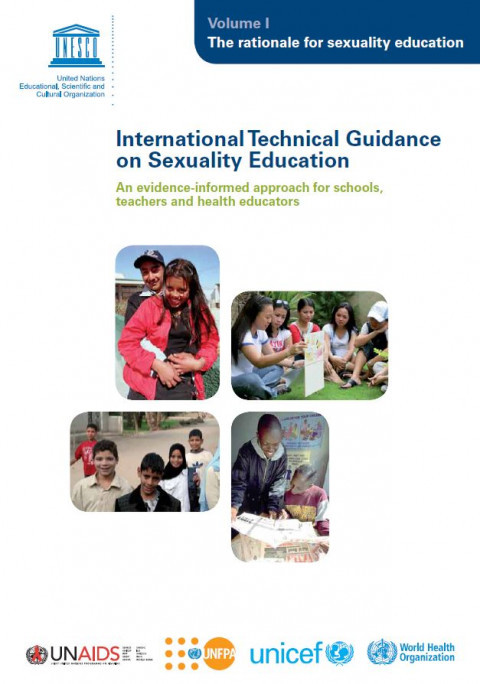 Principes directeurs internationaux sur l'éducation sexuelle: une approche factuelle à l'intention des établissements scolaires, des enseignants et des professionnels de l'éducation à la santé Год публикации: 2009 Организация-автор: UNESCO S’appuyant sur un examen rigoureux et actuel des donnees de programmes d’education sexuelle, ces Principes directeurs internationaux sur l’education sexuelle s’adressent aux decideurs et professionnels des secteurs de l’education et de la sante. Ils sont destines a aider les autorites en charge de ces deux secteurs et autres secteurs connexes a elaborer et mettre en oeuvre des programmes et des materiels d’education sexuelle en milieu scolaire. Le Volume I met l’accent sur le bien-fonde d’une education sexuelle et fournit des conseils techniques avises sur les caracteristiques des programmes efcaces. Il s’accompagne d’un document parallele (Volume II) qui decrit les themes a aborder et les objectifs d’apprentissage a atteindre dans le cadre d’un ‘cours de base minimum’ d’education sexuelle destine aux enfants et aux jeunes ages de 5 a 18 ans et plus, et qui contient une bibliographique de ressources utiles. Ces Principes directeurs internationaux sont d’une grande utilite non seulement pour les pays les plus affectes par le VIH et le SIDA, mais aussi pour les pays qui connaissent une prevalence faible et un contexte d’epidemie concentree.
 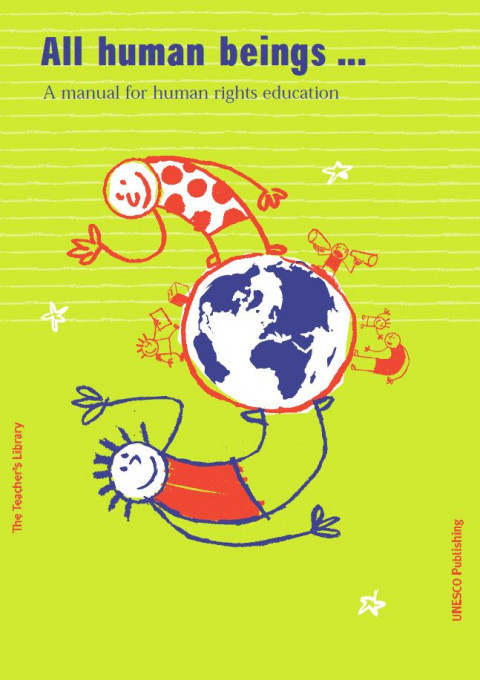 All human beings... a manual for human rights education Год публикации: 1998 Автор: Kaisa Savolainen | Francine Best | Patrice Meyer-Bisch | Betty Reardon Организация-автор: UNESCO The World Conference on Human Rights (Vienna, 1993) took the position that human rights education, training and public information were essential in order to create and promote stable and harmonious relations among different communities and to foster mutual understanding, tolerance and peace.UNESCO has prepared this Manual for Human Rights Education as a contribution to the fiftieth anniversary of the Universal Declaration of Human Rights on 10 December 1998 and to the United Nations Decade for Human Rights Education (1995–2004). While intended mainly for educators, it may also be useful to secondary-school students and in the context of non-formal education.The Manual is the result of teamwork, with participation by numerous educators and experts from various regions of the world. A preliminary version was submitted to the delegates of UNESCO Member States at the 29th session of the Organization’s General Conference and has since been tested in several schools throughout the world.The Manual is addressed to primary- and secondary-school teachers and to instructors in non-formal education for children and adults. It is a teaching aid providing both theory and practical advice. However, parts of it can be used directly, without any teacher, by young people from the age of 14 upwards.Part 1 sets out an approach to the concepts essential if human rights education is to be rigorous, have a scientific basis, expand knowledge and promote thought. This part is to be read by teachers who wish to impart human rights education. It can be understood by secondary students aged 14 and over. It incorporates the basic components of the Declaration and Integrated Framework of Action on Education for Peace, Human Rights and Democracy (1994).Part 2 is addressed to schoolteachers and those in positions of responsibility. It is essentially a tool for teaching. It opens up avenues, makes suggestions and gives advice on how all educational disciplines can embrace the objectives inherent in human rights education. Obviously all teachers are free, in the light of their own cultures and individual pedagogical choices, to invent and create approaches and situations different from those suggested here.Part 3 presents a number of pedagogical examples that have been tried out and that provide an approach for educational work concerning a specific right. The plan follows that of the Universal Declaration of Human Rights, which is quoted and referred to at length. This part may be regarded as an educational demonstration of the features of this declaration, the fiftieth anniversary of which is being celebrated by UNESCO and the United Nations in 1998.All teachers and organizers can be guided by the experiments presented here to encourage information, training and reflection. There is no need to follow any particular order. As the need arises, a particular right (such as the right to health care or the right to live in a well-balanced environment) can be introduced before or after another right, or the focus may be on a single right.The Manual does not seek to be exhaustive but rather to propose material which can be developed and supplemented in an ongoing process. It will be for educators and learners, in their own cultural contexts, to discover how human rights can acquire meaning in their daily lives. Tous les êtres humains ... un manuel pour l'éducation aux droits de l'homme Год публикации: 1998 Автор: Kaisa Savolainen | Francine Best | Patrice Meyer-Bisch | Betty Reardon Организация-автор: UNESCO La Conférence Mondiale sur les Droits de l'Homme (Vienne, 1993) a pris la position que l'éducation aux droits de l'homme, la formation et l'information du public sont essentiels afin de créer et de promouvoir des relations stables et harmonieuses entre les différentes communautés et de favoriser la compréhension mutuelle, la tolérance et la paix. L'UNESCO a préparé ce manuel pour l'éducation aux droits de l'homme en tant que contribution au cinquantième anniversaire de la Déclaration Universelle des Droits de l'Homme, le 10 Décembre,1998 et à la Décennie des Nations Unies pour l'Éducation aux Droits Humains (1995-2004). Bien que destiné principalement aux éducateurs, il peut également être utile pour les élèves du secondaire et dans le cadre de l'éducation non formelle. Le manuel est le résultat du travail d'équipe, avec la participation de nombreux éducateurs et experts de différentes régions du monde. Une version préliminaire a été soumis aux délégués des Etats membres de l'UNESCO à la 29e session de la Conférence générale de l'Organisation et a depuis été testé dans plusieurs écoles à travers le monde. Le manuel est adressé au primaire et les enseignants du secondaire et aux instructeurs dans l'éducation non formelle pour les enfants et les adultes. Il est un outil pédagogique fournissant à la fois la théorie et des conseils pratiques. Toutefois, certaines parties peuvent être utilisées directement, sans enseignant, par les jeunes dès l'âge de 14 vers le haut. Partie 1 énonce une approche des concepts essentiels si l'éducation aux droits de l'homme est d'être rigoureux, ont une base scientifique, développer les connaissances et promouvoir la pensée. Cette partie doit être lu par les enseignants qui souhaitent donner une éducation aux droits de l'homme. Il peut être compris par les élèves du secondaire âgés de 14 ans et plus. Il intègre les composants de base de la Déclaration et Cadre d'action intégré concernant l'éducation pour la paix, droits de l'homme et la démocratie (1994). Partie 2 est adressée aux enseignants et ceux des postes de responsabilité. Il est essentiellement un outil pour l'enseignement. Il ouvre des pistes, fait des suggestions et donne des conseils sur la façon dont toutes les disciplines d'enseignement peuvent embrasser les objectifs inhérents à l'éducation des droits de l'homme. Il est évident que tous les enseignants sont libres, à la lumière de leurs propres cultures et les choix pédagogiques individuels, d'inventer et de créer des approches et des situations différentes de celles suggérées ici. Partie 3 présente un certain nombre d'exemples pédagogiques qui ont été expérimentées et qui fournissent une approche pour le travail éducatif concernant un droit spécifique. Le plan suit celle de la Déclaration universelle des droits de l'homme, qui est cité et renvoyé à la longueur. Cette partie peut être considérée comme une démonstration éducative des caractéristiques de cette déclaration, le cinquantième anniversaire de ce qui est célébrée par l'UNESCO et l'Organisation des Nations Unies en 1998. Tous les enseignants et les organisateurs peuvent être guidés par les expériences présentées ici pour encourager l'information, la formation et de réflexion. Il n'y a pas besoin de suivre un ordre particulier. Comme le besoin, un droit particulier (tel que le droit aux soins de santé ou le droit de vivre dans un environnement bien équilibré) peut être introduit avant ou après un autre droit, ou la mise au point peut être sur une seule droite. Le manuel ne cherche pas à être exhaustive, mais plutôt de proposer du matériel qui peut être développée et complétée en un processus continu. Ce sera pour les éducateurs et les apprenants, dans leurs propres contextes culturels, de découvrir comment les droits humains peuvent acquérir un sens dans leur vie quotidienne.
  The International status of education about the Holocaust : A global mapping of textbooks and curricula Год публикации: 2015 Организация-автор: UNESCO This publication by UNESCO and the Georg Eckert Institute documents ways in which the Holocaust is presented in secondary school level history and social studies curricula worldwide, and conceptualized and narrated in textbooks from twenty-six countries, with all continents represented. Historical understandings of the Holocaust are defined in terms of the spatial and temporal scales with which the event is portrayed, the protagonists involved, interpretative patterns (according to definitions, comprehensiveness, causes, relativization or banalization), narrative techniques and viewpoints, didactic methods, and national idiosyncrasies. The study is based on 272 currently valid curricula from 135 countries, and on 89 textbooks published in 26 countries since 2000. The aim of the study is primarily to document information in such a way that it reflects local understandings of the Holocaust, principally by recording concepts and narratives of the Holocaust found in educational media currently in use in schools. The findings show both convergence and divergence in the representations analysed. The Holocaust is subject to shared patterns of representation, which include selectivity, personalization, appropriation, screening and omission. It is also subject to narrative idiosyncrasies. One of the main trends worldwide is domestication, a process whereby countries place emphasis on the local significance of the event or appropriate them in the interests of local populations. Drawing on such national and international patterns of representation, the publication concludes by formulating recommendations for future curricula and textbook narratives about the Holocaust. These recommendations relate to such issues as the use of terms, the comprehensiveness of historical facts, the definition of causes, the combination of universal and local approaches, and the development of historical literacy. (By the publisher) Le statut international de l'éducation sur l'Holocauste: Une cartographie mondiale des manuels et des programmes Год публикации: 2015 Организация-автор: Organisation des Nations Unies pour l'éducation, la science et la culture (UNESCO) Cette publication par l'UNESCO et l'Institut Georg Eckert documente façons dont l'Holocauste est présenté dans l'histoire du niveau de l'école et de programmes d'études sociales secondaire dans le monde, et conceptualiser et narré dans les manuels de vingt-six pays, avec tous les continents représentés. compréhensions historiques de l'Holocauste sont définis en fonction des échelles spatiales et temporelles avec laquelle l'événement est dépeint, les acteurs impliqués, les modèles d'interprétation (selon les définitions, l'intégralité, causes, relativisation ou banalisation), les techniques narratives et des points de vue, des méthodes didactiques, et les particularités nationales. L'étude est basée sur 272 programmes en cours de validité à partir de 135 pays, et 89 manuels publiés dans 26 pays depuis 2000. L'objectif de l'étude est d'abord de documenter l'information de façon à ce qu'il reflète la vision locale de l'Holocauste, principalement par l'enregistrement les concepts et les récits de la Shoah trouvés dans les médias éducatifs actuellement en usage dans les écoles. Les résultats montrent à la fois la convergence et de divergence dans les représentations analysées. L'Holocauste est soumis à des modèles communs de représentation, qui comprennent la sélectivité, la personnalisation, l'appropriation, le dépistage et l'omission. Il est également soumis à des particularités narratives. L'une des principales tendances dans le monde est la domestication, un processus par lequel les pays mettent l'aCECnt sur l'importance locale de l'événement ou les approprient dans l'intérêt des populations locales. Dessin sur ces modèles nationaux et internationaux de représentation, de la publication conclut en formulant des recommandations pour les futurs programmes et manuels scolaires récits sur l'Holocauste. Ces recommandations portent sur des questions telles que l'utilisation des termes, l'exhaustivité des faits historiques, la définition des causes, la combinaison des approches universelles et locales, ainsi que le développement de l'alphabétisation historique. (Par l'éditeur)
 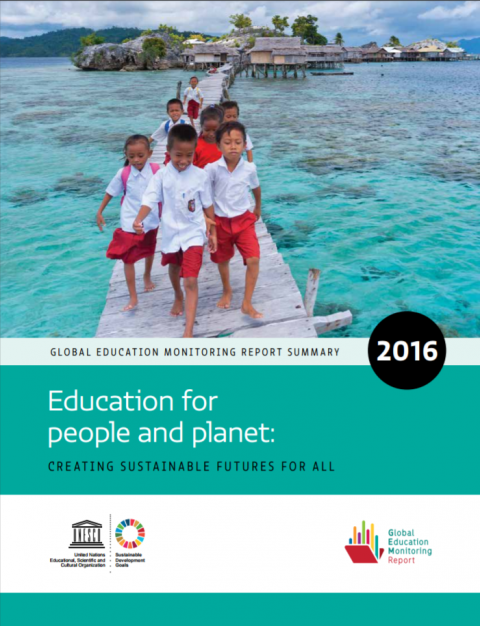 [Summary] Education for People and Planet: Creating sustainable Futures for All, Global Education Monitoring Report, 2016; Summary Год публикации: 2016 Организация-автор: UNESCO Education for People and Planet: Creating Sustainable Futures for All explores the complex relationship between education and the new 2030 Agenda for Sustainable Development, covering six fundamental pillars – Planet, Prosperity, People, Peace, Place and Partnerships. This report shows that education will not deliver its full potential unless participation rates increase dramatically and sustainable development guides education system reform. It also warns of the destructive impact that climate change, conflict, unsustainable consumption and the increasing gap between rich and poor have on education. A huge transformation is needed if we are to create sustainable futures for all.
  Sandwatch: adapting to climate change and educating for sustainable development Год публикации: 2010 Автор: Gillian Cambers | Paul Diamond Организация-автор: UNESCO Sandwatch provides a framework for children, youth and adults, with the help of teachers and local communities, to work together to critically evaluate the problems and conflicts facing their beach environments, and to develop sustainable approaches to address these issues. It also helps beaches become more resilient to climate change. The preliminary chapters of this publication focus on how to get started with Sandwatch activities and examine ways to address climate change impacts. The principle aim of this publication is to document the Sandwatch methodology: monitoring, analysing, sharing and taking action. An activities-orientated approach is used to provide step-by-step instructions to cover monitoring methods and data analysis, including observation and recording, erosion and accretion, beach composition, human activities, beach debris, water quality, waves, longshore currents, plants and animals. The activities are related to (a) sustainable development issues, including: beach ownership, mining beaches for construction material, conflict resolution between different beach users, pollution, conservation of endangered species, and (b) climate change adaptation issues: sea level rise, rising temperatures, ocean acidification and increased extreme events. Ways to share findings and create a Sandwatch network are detailed including methods such as the use of local media, websites, social networking and video production. Finally, ways are discussed to design, plan and implement a Sandwatch project to fulfill one or all of the following criteria: (a) addressing a particular beach-related issue, (b) enhancing the beach, and (c) promoting climate change adaptation. Sandwatch stands as an example of Education for Sustainable Development in action, and is being targeted as one of several flagship projects for the United Nations Decade of Education for Sustainable Development (2005–2014). As the world confronts the growing threat of climate change, Sandwatch presents an opportunity to help people and ecosystems respond to present and future changes in a practical manner. Beaches are among the ecosystems most at risk from climate change as they face rising sea levels and increased more intense storms. By contributing to ecosystem health and resilience, Sandwatch can help people from all walks of life learn about climate change and how their actions can contribute to the adaptation process. التربية من أجل التنمية المستدامة: كتاب مرجعي Год публикации: 2013 Организация-автор: UNESCO The target audiences for the Education for Sustainable Development Sourcebook are primary and secondary teachers and mid-level decision-makers, who have responsibility for primary and secondary education. Another primary audience is teacher educators who work with pre-service and in-service primary and secondary school teachers. The purpose of the publication is to describe ways in which education for sustainable development (ESD) can be integrated into primary and secondary schooling. This collection of briefs is designed to complement other ESD materials published by UNESCO. The topics for the briefs were selected in consultation with UNESCO Field Offices and Institutes. The briefs for primary and secondary teachers are specifically written for professional educators who work in formal education settings. The briefs for teachers as well as those for decision-makers address “gaps” in the UNESCO ESD literature. Educación para el desarollo sostenible: libro de consulta Год публикации: 2012 Организация-автор: UNESCO The target audiences for the Education for Sustainable Development Sourcebook are primary and secondary teachers and mid-level decision-makers, who have responsibility for primary and secondary education. Another primary audience is teacher educators who work with pre-service and in-service primary and secondary school teachers. The purpose of the publication is to describe ways in which education for sustainable development (ESD) can be integrated into primary and secondary schooling. This collection of briefs is designed to complement other ESD materials published by UNESCO. The topics for the briefs were selected in consultation with UNESCO Field Offices and Institutes. The briefs for primary and secondary teachers are specifically written for professional educators who work in formal education settings. The briefs for teachers as well as those for decision-makers address “gaps” in the UNESCO ESD literature. L'Education pour le développement durable: ouvrage de référence Год публикации: 2012 Организация-автор: UNESCO The target audiences for the Education for Sustainable Development Sourcebook are primary and secondary teachers and mid-level decision-makers, who have responsibility for primary and secondary education. Another primary audience is teacher educators who work with pre-service and in-service primary and secondary school teachers. The purpose of the publication is to describe ways in which education for sustainable development (ESD) can be integrated into primary and secondary schooling. This collection of briefs is designed to complement other ESD materials published by UNESCO. The topics for the briefs were selected in consultation with UNESCO Field Offices and Institutes. The briefs for primary and secondary teachers are specifically written for professional educators who work in formal education settings. The briefs for teachers as well as those for decision-makers address “gaps” in the UNESCO ESD literature.