
Ресурсы
Изучайте широкий спектр ценных ресурсов ВГГ, чтобы углубить своё понимание и повысить эффективность исследований, просветительской деятельности, преподавания и обучения.
Найдено: 3,385
 Pursuing the Sustainable Development Goals in a World Reshaped by COVID-19: Foundational Research Report Год публикации: 2021 Автор: Barry B. Hughes | Taylor Hanna | Kaylin McNeil | David K. Bohl | Jonathan D. Moyer Организация-автор: United Nations Development Programme (UNDP) | Frederick S. Pardee Center for International Futures This report advances existing monitoring and forecasting initiatives in three ways. First, it provides, for selected goals and targets, especially those related to human development, projections for the path of progress that the world seemed to be on prior to the outbreak of the COVID-19 pandemic. Second, despite the still very high levels of uncertainty around the ultimate course of the pandemic, it considers the possible impact on longer-term progress. Third, it explores the potential impact of a broad and integrated program of initiatives intended to move us more quickly toward achieving the goals.The SDG Push scenario successfully increases the rate of progress toward the targets sufficiently to overcome the global losses of even the High Damage COVID scenario before 2030 for most target variables. On top of the baseline COVID scenario it greatly increases the number of countries reaching target levels by 2030 and 2050.
  First National Voluntary Review on Sustainable Development Goals 2019: Iraq (The Triumph of National Will) Год публикации: 2019 Организация-автор: Iraq. Ministry of Planning This national review is part of the first National Voluntary Report (NVR) as a national effort and a necessary step to monitor the progress toward the SDFs, using a participatory approach and assisted by national consultations (workshops and forums) organized in various Iraqi areas to discuss the development challenges facing Iraq in the upcoming stages. The Voluntary National Reviews (VNRs) constitute a key tool to monitor the progress of the National Development Plan (NDP) and promote it locally. The VNRs also contribute to presenting the country’s experience, expertise and lessons to be shared with other countries. التقرير الطوعي الأول حول أهداف التنمية المستدامة ٢٠١٩: العراق (انتصار إرادة وطن) Год публикации: 2019 Организация-автор: Iraq. Ministry of Planning اداةً مهمةً في رصد التقدم المحرز على (VNRs) وتُعدُّ التقارير الوطنية الطوعية طريق تحقيق خطة التنمية الوطنية والترويج لها محلياً، فضلاً عن انها تسهم في عرض خبرة البلد والدروس التي يمكن ان يقدمها للعالم انطلاقاً من تجربته الذاتية وأنْ توفر هذه الخبرات فرصاً ودروساً للتعلم من الاخرين والافادة من تجاربه.
  An Atlas of Social Indicators of Children in China 2018 Год публикации: 2018 Организация-автор: United Nations Children's Fund (UNICEF) | National Working Committee on Children and Women (NWCCW) | National Bureau of Statistics (NBS). Department of Social, Science, Technology and Cultural Statistics By bringing together the latest authoritative, official data on the main indicators of child survival, development and protection and presenting them in a visual manner, the Atlas has faithfully reflected the achievements, as well as issues and challenges in realizing children’s rights in China. 中国儿童发展指标图集 2018 Год публикации: 2018 Организация-автор: United Nations Children's Fund (UNICEF) | National Bureau of Statistics (NBS). Department of Social, Science, Technology and Cultural Statistics | National Working Committee on Children and Women (NWCCW) 本图集汇集了有关中国儿童生存、发展、保护状况的主要指标和最新权威数据信息,以可视化图表的形式,集中展现了中国儿童发展取得的成就,客观反映了中国实现儿童权利所面临的问题和挑战。
  A Training Manual: Women in Preventing and Countering Violent Extremism Год публикации: 2021 Автор: Anne Speckhard Организация-автор: United Nations Entity for Gender Equality and the Empowerment of Women (UN Women) This publication serves as guidance for actors involved in the prevention and countering of violent extremism (P/CVE) in Europe and Central Asia including state officials, members of non-governmental organizations, community activists, staff of UN agencies, international and regional organizations to help them understand violent extremism’s gender dimensions. It is designed as a training guide, for staff and trainers who are working with different counterparts engaged in P/CVE, and want to help create more effective and gender-sensitive responses. Participants may for example include civil society activists, women leaders, teachers, journalists, lawyers, social workers, religious authorities, youth, police, local and national governmental officials. The five modules in this guide include learning objectives, explanatory text, warm-up activities, practical exercises, references for further reading and empirical experiences from the region of Europe and Central Asia. Modules may be used all together or one-by-one. The ideal timeframe for delivering the training using all the modules is at least two and a half days (half day per unit). The training is suitable for groups of five to twenty-five people. When organizing the workshop consider gender, age and diversity factors to have the richest learning experience possible. Participants should feel that they are in a safe space where they can openly share their ideas and experiences. Needed materials are indicated for the different exercises. As the guide is aimed at increasing the awareness of persons with different levels of sensitivity and knowledge on violent extremism and gender equality, across Europe and Central Asia, it is an introduction which readers should complement with other resources for deeper and more technical insights. The training should also be tailored to the participants’ interests and needs and to the local context.
 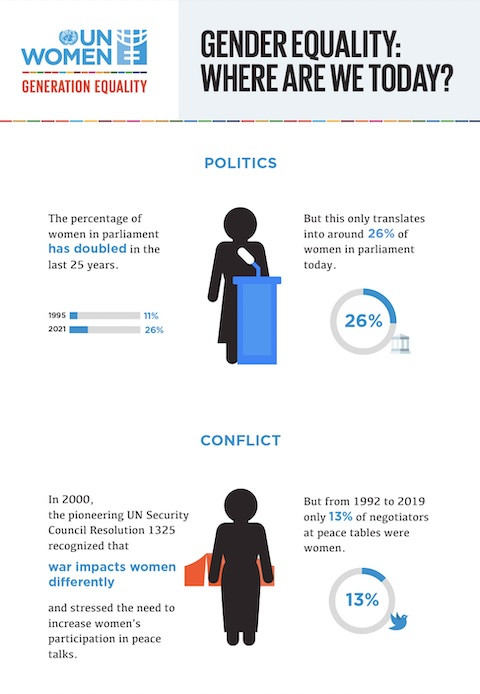 Gender Equality: Where Are We Today? Год публикации: 2021 Организация-автор: United Nations Entity for Gender Equality and the Empowerment of Women (UN Women) This infographic highlights progress and remaining challenges for women in a range of areas, from politics, to literacy, to wages and media representation. Égalité des sexes : Où en sommes-nous actuellement? Год публикации: 2021 Организация-автор: United Nations Entity for Gender Equality and the Empowerment of Women (UN Women) Cette infographie souligne les avancées réalisées à ce jour ainsi que les nombreux défis restant à affronter pour achever l'égalité des sexes. Igualdad de género : ¿Dónde nos encontramos hoy? Год публикации: 2021 Организация-автор: United Nations Entity for Gender Equality and the Empowerment of Women (UN Women) Esta infografía resalta todo el camino recorrido y los numerosos retos pendientes de superar para lograr la igualdad.
  Progress on the Sustainable Development Goals: The Gender Snapshot 2021 Год публикации: 2021 Организация-автор: United Nations Entity for Gender Equality and the Empowerment of Women (UN Women) | UN. Department of Economic and Social Affairs (UN. DESA) The pandemic has tested and even reversed progress in expanding women’s rights and opportunities. Women have not recovered lost jobs and income, hunger is on the rise, and school closures threaten girls’ educational gains. Women’s participation in government, research and resource management remains far from equal. Vulnerable groups of women, including migrants, those with disabilities and those affected by conflict, are frequently left behind. Disparities between rich and poor countries are preventing equal access to lifesaving COVID-19 vaccines and treatments, putting women in poorer countries at disproportionate risk. Moreover, despite women’s central roles in responding to COVID-19, including as front-line health workers, they do not have the leadership positions they deserve. Building forward differently and better will require placing women and girls at the centre of all aspects of response and recovery, including through gender- responsive laws, policies and budgeting.Progress on the Sustainable Development Goals: The Gender Snapshot 2021 presents the latest evidence on gender equality across all 17 Sustainable Development Goals, highlighting the progress made since 2015 but also the continued alarm over the COVID-19 pandemic, its immediate effect on women’s well-being and the threat it poses to future generations.