
Ресурсы
Изучайте широкий спектр ценных ресурсов ВГГ, чтобы углубить своё понимание и повысить эффективность исследований, просветительской деятельности, преподавания и обучения.
Найдено: 3,385
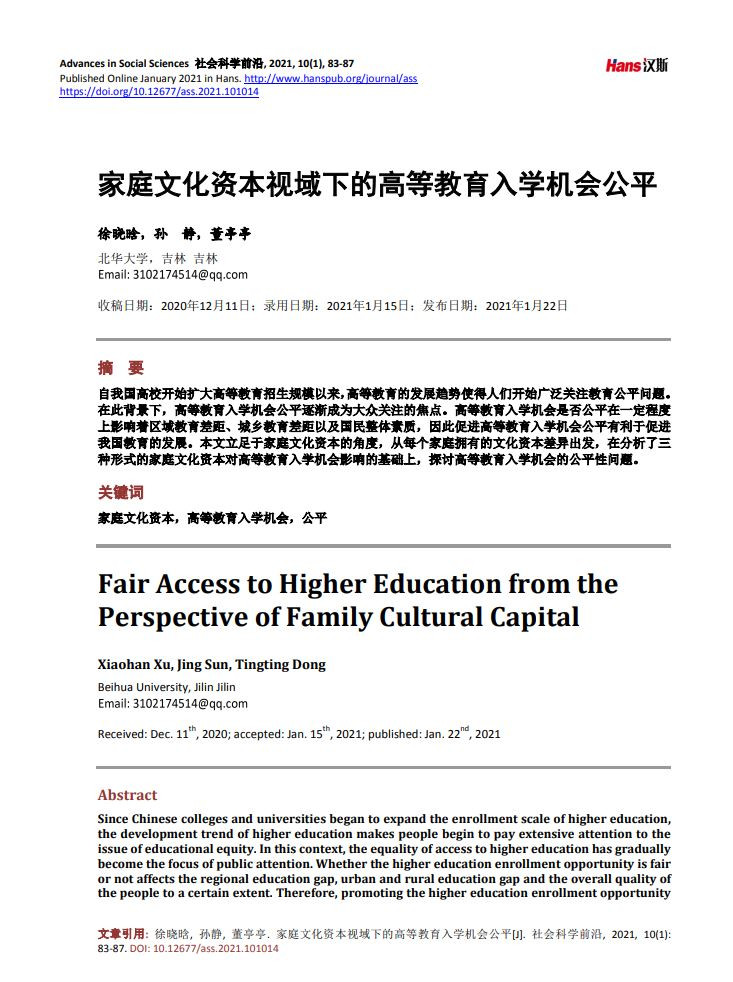 家庭文化资本视域下的高等教育入学机会公平 Год публикации: 2021 Автор: Xu Xiaohan | Sun Jing | Dong Tingting 本文使用法国学者布迪厄的家庭文化资本概念,分析中国高等教育入学机会中的不公平机制。
  The Art of Inclusive Exclusions: Educating the Palestinian Refugee Students in Lebanon (Refugee Survey Quarterly, Vol. 33, No. 2) Год публикации: 2014 Автор: Maha Shuayb Организация-автор: Centre for Arab Unity Studies For more than 65 years, Palestinian refugees have been living in Lebanon in a “temporary” State in over-crowded camps, deprived of basic rights such as the right to have a professional job. It has been argued that these restrictions have had a major effect on the fair provision and quality of education, an effect manifested in the increasing number of Palestinian students who are dropping out of school. This article examines the quality of education offered in United Nations Relief and Works Agency for Palestine Refugees schools and the impact of Lebanese legal restrictions on students’ educational motivation and aspirations.A quantitative survey of the educational experiences and aspirations of 404 secondary students and 48 teachers in five secondary schools of the United Nations Relief and Works Agency for Palestine Refugees was carried out. An in-depth study of a primary school also took place. The findings revealed that Palestinian refugee students are confronted by a paradox: forced inclusion because of having to learn the Lebanese curriculum, but exclusion because of simultaneously being pushed to the periphery of Lebanese society as a result of the Lebanon’s discriminatory laws and regulations. فن الإقصاء الإدماجي : تعليم الطلاب الفلسطينيين اللاجئين في لبنان Год публикации: 2014 Автор: Maha Shuayb Организация-автор: Centre for Arab Unity Studies ترمي هذه الدراسة إلى إبراز المفارقة التي تواجه اللاجئين الفلسطينيين في لبنان مُتَجَلّيةً في إدماجهم قسراً عبر تلقّي المقرر الدراسي اللبناني مع اضطرارهم في الوقت ذاته إلى البقاء على هامش المجتمع اللبناني نتيجة للقوانين والترتيبات اللبنانية التمييزية. بغية استقصاء ذلك؛ فحصتِ هذه الدراسة، نوعية التربية المتوافرة للفلسطينيين الدارسين في مدارس الأنروا (وكالة الأمم المتحدة لغوث وتشغيل اللاجئين الفلسطينيين) ووَقْع التضييقات القانونية اللبنانية على حافزهم التعليمي وتطلعاتهم التربوية. يتوزّع محتوى الورقة على قسمين اثنين يعرض الأوّل منهما تقويماً عامّاً للظروف الاجتماعية والسياسية والاقتصادية والتعليمية التي يعيشها اللاجئون الفلسطينيون في لبنان.
 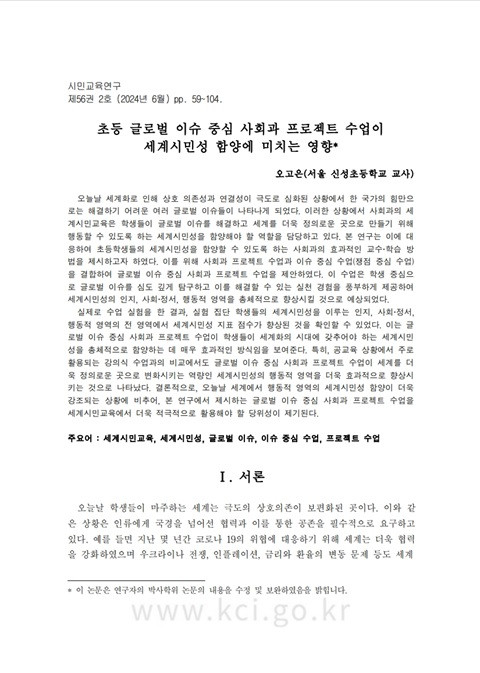 초등 글로벌 이슈 중심 사회과 프로젝트 수업이 세계시민성 함양에 미치는 영향 (시민교육연구; Vol. 56, No. 2) Год публикации: 2024 Автор: 오고은 Организация-автор: 한국사회과교육학회 오늘날 세계화로 인해 상호 의존성과 연결성이 극도로 심화된 상황에서 한 국가의 힘만으로는 해결하기 어려운 여러 글로벌 이슈들이 나타나게 되었다. 이러한 상황에서 사회과의 세계시민교육은 학생들이 글로벌 이슈를 해결하고 세계를 더욱 정의로운 곳으로 만들기 위해 행동할 수 있도록 하는 세계시민성을 함양해야 할 역할을 담당하고 있다. 본 연구는 이에 대응하여 초등학생들의 세계시민성을 함양할 수 있도록 하는 사회과의 효과적인 교수-학습 방법을 제시하고자 하였다. 이를 위해 사회과 프로젝트 수업과 이슈 중심 수업(쟁점 중심 수업)을 결합하여 글로벌 이슈 중심 사회과 프로젝트 수업을 제안하였다. 이 수업은 학생 중심으로 글로벌 이슈를 심도 깊게 탐구하고 이를 해결할 수 있는 실천 경험을 풍부하게 제공하여 세계시민성의 인지, 사회-정서, 행동적 영역을 총체적으로 향상시킬 것으로 예상되었다. 실제로 수업 실험을 한 결과, 실험 집단 학생들의 세계시민성을 이루는 인지, 사회-정서, 행동적 영역의 전 영역에서 세계시민성 지표 점수가 향상된 것을 확인할 수 있었다. 이는 글로벌 이슈 중심 사회과 프로젝트 수업이 학생들이 세계화의 시대에 갖추어야 하는 세계시민성을 총체적으로 함양하는 데 매우 효과적인 방식임을 보여준다. 특히, 공교육 상황에서 주로 활용되는 강의식 수업과의 비교에서도 글로벌 이슈 중심 사회과 프로젝트 수업이 세계를 더욱 정의로운 곳으로 변화시키는 역량인 세계시민성의 행동적 영역을 더욱 효과적으로 향상시키는 것으로 나타났다. 결론적으로, 오늘날 세계에서 행동적 영역의 세계시민성 함양이 더욱 강조되는 상황에 비추어, 본 연구에서 제시하는 글로벌 이슈 중심 사회과 프로젝트 수업을 세계시민교육에서 더욱 적극적으로 활용해야 할 당위성이 제기된다.
  Leave No One Behind Год публикации: 2016 Организация-автор: Global Goals At the heart of the Sustainable Development Goals is a commitment to leave no one behind. That’s because, although we have made huge progress towards a better world, too many people have been left behind because of who they are or where they live.
 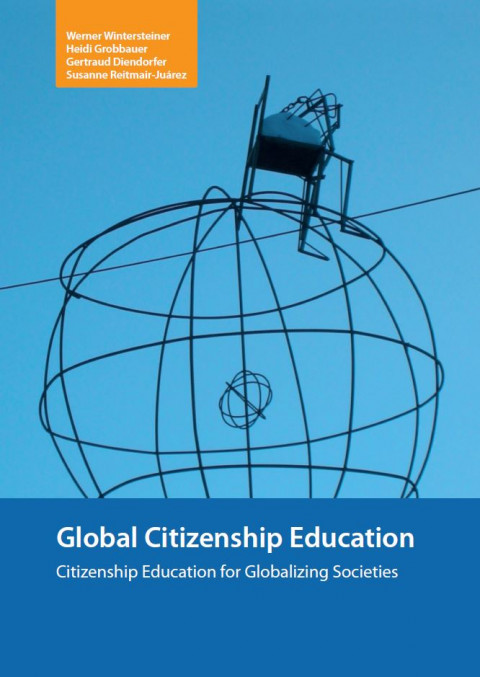 Global citizenship education: citizenship education for globalizing societies Год публикации: 2015 Автор: Werner Wintersteiner | Heidi Grobbauer | Gertraud Diendorfer | Susanne Reitmair-Juárez Организация-автор: Austrian Commission for UNESCO This text reflects the work we have been doing for many years in the area of Global Citizenship Education (GCED) in Austria. Two endeavors particularly stand out: first, the continuing Masters programme GCED at the Alps-Adriatic University (Alpen-Adria Universität) in Klagenfurt, which is a specialized course of study for educationalists, teacher trainers, NGO associates and teachers (participants may either graduate with a certificate after two years or an MA degree after three years respectively), and second, our cooperation with the Austrian UNESCO Associated Schools Project Network. This was the originally intended audience for the German version of this brochure, which constitutes the programmatic basis for our training programs. We understand GCED as a concept that is located at the interface between civic education, global education and peace education, as well as education for sustainable development and intercultural learning. Our approach is characterized by these four features:* theoretical grounding and a particular focus on terminology in order to foster competence of judgment regarding political concepts* investigating the historical dimension of GCED in depth in order to account for colonialism and neocolonialism* socio-critical orientation in order to set us apart from strands of GCED that ultimately perpetuate concepts of Western hegemony* didactic implementation that is systematic and based on appropriate theoretical work in order to avoid pragmatismWith this English edition (the section specific to the Austrian context was omitted) we wish to initiate a dialog with colleagues in the whole world and hope to engage in lively exchange. Education à la citoyenneté mondiale: éducation à la citoyenneté pour les sociétés de mondialisation Год публикации: 2015 Автор: Werner Wintersteiner | Heidi Grobbauer | Gertraud Diendorfer | Susanne Reitmair-Juárez Организация-автор: Austrian Commission for UNESCO Ce texte reflète le travail que nous faisons depuis de nombreuses années dans le domaine de l'éducation à la citoyenneté mondiale (ECM) en Autriche. Deux projets se démarquent particulièrement: d'abord, le programme de maîtrise ECM à l'Université alpine-adriatique de Klagenfurt, qui est un cours spécialisé pour les pédagogues, les formateurs d'enseignants, les associés des ONG et les enseignants (les participants peuvent soit être diplômés Avec un certificat après deux ans ou un MA après trois ans respectivement), et deuxièmement, notre coopération avec le Réseau autrichien du projet des écoles associées de l'UNESCO. Il s'agissait du public initialement destiné à la version allemande de cette brochure, qui constitue la base programmatique de nos programmes de formation. Nous considérons l'ECM comme un concept situé à l'interface entre éducation civique, éducation globale et éducation à la paix, ainsi que l'éducation pour le développement durable et l'apprentissage interculturel. Notre approche se caractérise par ces quatre caractéristiques: fondement théorique et un accent particulier sur la terminologie afin de favoriser la compétence de jugement sur les concepts politiques étudier la dimension historique de l'ECM en profondeur afin de rendre compte du colonialisme et néocolonialisme orientation socio-critique afin Nous distinguent des filières de l'ECM qui, en fin de compte, perpétuent les concepts d'une mise en œuvre didactique de l'hégémonie occidentale systématique et basée sur un travail théorique approprié pour éviter le pragmatisme. Avec cette édition en anglais (la section spécifique au contexte autrichien a été omis), nous souhaitons initier un dialogue avec des collègues dans le monde entier et espérer engager des échanges animés.
  A Comparative Study on Global Citizenship Education between Korea and ASEAN Год публикации: 2015 Организация-автор: Korea Institute for Curriculum and Evaluation (KICE) This research is the second-year study for a three-year project (2013-2015) focused on the global citizenship education of ASEAN (Association of Southeast Asian Nations). In the first-year study (2013), the current global citizenship education presented in the social studies curriculum of each country was analyzed based on literature research, and the global citizenship of students from each country was examined through surveys. Based on the analysis of the current global citizenship education of Korea and ASEAN overall and the characteristics of global citizenship of students from each country, this study is designed to make an in-depth analysis of global citizenship education and to seek direction for the joint global citizenship education programs between Korea and ASEAN to be employed in the third-year research.The students from the two countries, Indonesia and Thailand, among the 10 ASEAN countries are selected as participants because these two countries also participated in the previous international comparison study. The purposes of this study are as follows; (1) comparing the current global citizenship education of the national-level curriculum of Korea, Indonesia, and Thailand, (2) finding the similarities and differences by analysing the characteristics of global citizenship education of Korean, Indonesian, and Thai students, and (3) proposing the direction and themes of global citizenship education which will be mutually applied in Korea and ASEAN countries based on the research results.To conduct this study, various methods including literature study, interviews through visits to local schools, conferences for specialists, and international seminars were used. First, the meaning and goals of global citizenship education were established by reviewing literature and the concepts of ‘Humanity’, ‘Global Identity’, and ‘Global Participation’, which are the three sub-indices for global citizenship extracted from the first-year study, were used. Based on this framework, interview protocols for students, teachers, and policy makers were composed.The research team visited Indonesia and Thailand, carried out semi-structured interviews with students, teachers, and policy makers of national-level curriculum and classroom observations, and collected data related to global citizenship education. In addition, by conducting an international seminar with policy makers of curriculum of each country’s Ministry of Education and UNESCO specialists, we aimed to seek direction for joint global citizenship education in Korea and ASEAN and to reinforce educational cooperation.The major findings of this research can be suggested according to the research purposes in the following way.First, in the analysis of the national-level curriculum made for the comparison of current global citizenship education of Korea, Indonesia, and Thailand, the curriculum of each country is found to include elements of global citizenship education. However, countries show discrepancies in their actualization of curriculum, and citizenship education is still centered on national citizenship rather than global citizenship. Therefore, a more systematic attempt is needed for the advancement of citizenship education from nation-centered to globally oriented.Second, the findings from the interviews with students of each country carried out to define the characteristics of global citizenship of Korean, Indonesian, and Thai students indicate that while students’ responses showed a number of similarities in general, differences were found in specific answers as well. High school students provided more logical answers with greater depth compared to middle school students, and their responses differed based on their cultural contexts and experiences rather than their gender or religion. Therefore, while taking an approach which considers the level of students’ cognitive development as well as the cultural distinctiveness of each country, a way to expand opportunities for specific activities and experiences rather than an abstract way of teaching should be considered.Third, based on the analysis results, the directions and themes for global citizenship education to be jointly applied in Korea and ASEAN countries are proposed as follows: (1) The curriculum for global citizenship education should be focused on reinforcing the competency of citizens to participate in communities rather than that of individuals to ensure international competitiveness. (2) It is necessary to educate students to confront various conflicts and solve them by themselves rather than teaching them the abstract answers to the conflicts. (3) Global citizenship education should move beyond knowledge-based education and aim to lead bring changes in students’ behavior thereby empowering them to settle global issues. (4) For the actual implementation of curriculum, the cultural distinctiveness of each country and the differences by groups should be considered. (5) It is important to help students spread their interest to diverse countries beyond Western countries or ‘developed countries’.With these points in consideration, the objective of global citizenship education to be jointly promoted in Korea and ASEAN is suggested as the following: “Citizens are cultivated to form their identity as Asians based on their interest and knowledge of Asia and to participate in settling global issues. Through this, their qualities to participate in issues concerning all humanity are eventually cultivated.” The specific themes may include understanding Asia and ASEAN, social justice and equality, diversity, globalization and interdependence, conflict and peace, as well as sustainable development and environment. To improve effectiveness of joint global citizenship education of Korea and ASEAN and to reinforce educational cooperation, we made the following three suggestions.First, the standardization of global citizenship education across the nation is required. Having defined global citizenship education as the cultivation of the qualities of citizens based on the perception of human rights (Humanity) and with the identity as a global citizen (Global Identity) who can participate in settling the issues of global society (Participation), global citizenship education will yield the greatest efficiency when carried out together by all beyond national boundaries. Therefore, it is suggested that research for developing and expanding the joint curriculum by regions be supported and close cooperation be formed between policy makers of national curriculum and officials of International Training and Cooperation.Second, the reinforcement of global citizenship education through teacher training is required. For the effective implementation of joint global citizenship education in each country through the standardization of global citizenship education, the cultural diversity and distinctiveness of each country should be reflected. For these reasons, various practical bottom-up strategies are needed. Teacher training is a mandatory prerequisite for global citizenship education that is appropriate for the situations and contexts of each country. Therefore, it is suggested that researchers find out how to reinforce global citizenship education in teacher training based on solid research.Third, global citizenship education should be expanded by the exchange of human resources. As confirmed in this study, the exchange itself can bring a positive influence on the cultivation of global citizenship, and the sharing of the strategies for global citizenship education in each country can contribute to the development of a model for better global citizenship education. Therefore, it is suggested that the research for the joint promotion of project-based global citizenship education and the opportunities for mutual exchange of students and teachers between Korea and ASEAN countries should be expanded. Une Étude Comparative sur L'éducation à la Citoyenneté Mondiale (ECM) entre le Coréen et l'ASEAN Год публикации: 2015 Организация-автор: Korea Institute for Curriculum and Evaluation (KICE) Pour réaliser cette étude, diverses méthodes, y compris l'étude de la littérature, des entrevues par des visites dans les écoles locales, des conférences pour les spécialistes et séminaires internationaux ont été utilisés. Premièrement, le sens et les objectifs de L'éducation à la citoyenneté Mondiale (ECM) ont été établies en examinant la littérature et les concepts de «l'humanité», «Global Identity» et «Participation globale», qui sont les trois sous-indices pour mondiale la citoyenneté extraite de l'étude de première année, ont été utilisés. Sur la base de ce cadre, les protocoles d'entrevue pour les étudiants, les enseignants et les responsables politiques ont été composées.L'équipe de recherche a visité l'Indonésie et de la Thaïlande, a mené des entretiens semi-structurés avec les étudiants, les enseignants et les décideurs des observations du curriculum et de la classe au niveau national, et a recueilli des données relatives à l'éducation à la citoyenneté mondiale. En outre, en procédant à un séminaire international avec les décideurs du curriculum du ministère de l'Éducation et de l'UNESCO spécialistes de chaque pays, nous avons cherché à obtenir des directives pour joint L'éducation à la citoyenneté Mondiale (ECM) en Corée et l'ASEAN et de renforcer la coopération éducative.Les principaux résultats de cette recherche peuvent être proposées en fonction des fins de recherche de la manière suivante.Tout d'abord, dans l'analyse du programme au niveau national fait pour la comparaison du courant L'éducation à la citoyenneté Mondiale (ECM) de la Corée, l'Indonésie et la Thaïlande, le programme d'études de chaque pays se trouve à inclure des éléments d'éducation à la citoyenneté mondiale. Toutefois, les pays montrent des divergences dans leur actualisation du programme, et de l'éducation à la citoyenneté est toujours centrée sur la citoyenneté nationale plutôt que la citoyenneté mondiale. Par conséquent, une tentative plus systématique est nécessaire pour l'avancement de l'éducation à la citoyenneté d'un pays centré à vocation mondiale.Deuxièmement, les résultats des entrevues avec les étudiants de chaque pays menées pour définir les caractéristiques de la citoyenneté mondiale de la Corée, l'Indonésie, et les étudiants thaïlandais indiquent que, bien que les réponses des élèves ont montré un certain nombre de similitudes en général, des différences ont été trouvées dans des réponses précises que bien. Les élèves du secondaire ont fourni des réponses plus logiques avec une plus grande profondeur par rapport aux élèves des écoles moyennes, et leurs réponses différaient en fonction de leurs contextes et des expériences culturelles plutôt que de leur sexe ou de religion. Par conséquent, tout en adoptant une approche qui tient compte du niveau de développement cognitif des élèves, ainsi que les particularités culturelles de chaque pays, un moyen d'accroître les possibilités pour les activités et les expériences spécifiques plutôt que d'une manière abstraite de l'enseignement devrait être considéré.Troisièmement, sur la base des résultats d'analyse, les orientations et les thèmes de L'éducation à la citoyenneté Mondiale(ECM) à appliquer conjointement en Corée et les pays de l'ASEAN sont proposées comme suit: (1) Le programme de L'éducation à la citoyenneté Mondiale (ECM) devrait se concentrer sur le renforcement de la compétence des citoyens à participer à des communautés plutôt que celle des individus pour assurer la compétitivité internationale. (2) Il est nécessaire d'éduquer les étudiants pour faire face à divers conflits et de les résoudre par eux-mêmes plutôt que de leur enseigner les réponses abstraites aux conflits. (3) L'éducation à la citoyenneté Mondiale (ECM) devrait aller au-delà de la connaissancel'éducation et visent à entraîner apporter des changements dans le comportement des élèves autonomisation qui leur permet de régler les problèmes mondiaux. (4) Pour la mise en œuvre effective du programme, la spécificité culturelle de chaque pays et les différences par groupes devraient être considérés. (5) Il est important d'aider les élèves propagent leur intérêt de divers pays au-delà de l'Ouestpays ou «pays développés».Avec ces points en considération, l'objectif de L'éducation à la citoyenneté Mondiale (ECM) pour être promu conjointement en Corée et l'ASEAN est proposé comme suit: «Les citoyens sont cultivées pour former leur identité en tant Asiatiques en fonction de leur intérêt et de connaissance de Asie et de participer dans le règlement des problèmes mondiaux. Grâce à cela, leurs qualités de participer à des questions concernant toute l'humanité sont finalement cultivées. "Les thèmes spécifiques peuvent inclure la compréhension de l'Asie et de l'ASEAN, la justice sociale et l'égalité, la diversité, la mondialisation et l'interdépendance, les conflits et la paix, ainsi que le développement durable et l'environnement. Pour améliorer l'efficacité de l'articulation L'éducation à la citoyenneté Mondiale (ECM) de Corée et l'ASEAN etde renforcer la coopération éducative, nous avons fait les trois suggestions suivantes. Premièrement, la normalisation de L'éducation à la citoyenneté Mondiale (ECM) à travers le pays est nécessaire. Après avoir défini L'éducation à la citoyenneté Mondiale (ECM) comme la culture des qualités de citoyens fondées sur la perception des droits de l'homme (l'humanité) et de l'identité en tant que citoyen du monde (GlobalIdentity) qui peut participer au règlement des problèmes de la société globale (Participation), L'éducation à la citoyenneté Mondiale (ECM) donnera la plus grande efficacité lorsqu'elle est effectuée conjointement par tous au-delà des frontières nationales. Par conséquent, il est suggéré que la recherche pour le développement et l'expansion du programme commun par les régions être soutenu et une coopération étroite se former entre les décideurs du curriculum national et les responsables de la formation et la coopération internationale.Deuxièmement, le renforcement de L'éducation à la citoyenneté Mondiale (ECM) à travers la formation des enseignants est nécessaire. Pour la mise en œuvre effective de l'articulation L'éducation à la citoyenneté Mondiale (ECM) dans chaque pays grâce à la normalisation de l'éducation à la citoyenneté mondiale, la diversité culturelle et la spécificité de chaque pays doivent être pris en compte. Pour ces raisons, diverses stratégies ascendantes pratiques sont nécessaires. La formation des enseignants est une condition préalable obligatoire pour L'éducation à la citoyenneté Mondiale (ECM) qui est approprié pour les situations et les contextes de chaque pays. Par conséquent, il est suggéré que les chercheurs découvrent comment renforcer L'éducation à la citoyenneté Mondiale (ECM) dans la formation des enseignants sur la base de recherche solide.Troisièmement, L'éducation à la citoyenneté Mondiale (ECM) devrait être élargi par l'échange des ressources humaines. Comme l'a confirmé dans cette étude, l'échange lui-même peut apporter une influence positive sur la culture de la citoyenneté mondiale, et le partage des stratégies pour L'éducation à la citoyenneté Mondiale (ECM) dans chaque pays peut contribuer au développement d'un modèle pour une meilleure éducation à la citoyenneté mondiale. Par conséquent, il est suggéré que la recherche pour la promotion conjointe de par projet L'éducation à la citoyenneté Mondiale (ECM) et les possibilités d'échange mutuel d'étudiants et d'enseignants entre les pays de l'ASEAN et la Corée devrait être élargi.
  UNESCO - UCLA Chair in Global Learning and Global Citizenship Education Год публикации: 2016 Организация-автор: HFP | global media Documentary Presentation of Dr. Carlos A. Torres as UNESCO-UCLA Chair in Global Learning and Global Citizenship Education.