
Ресурсы
Изучайте широкий спектр ценных ресурсов ВГГ, чтобы углубить своё понимание и повысить эффективность исследований, просветительской деятельности, преподавания и обучения.
Найдено: 2,668
 세계시민교육: 학습 주제 및 학습 목표 Год публикации: 2015 Организация-автор: 유네스코 세계시민교육은 학습자들이 더 포용적이고, 정의롭고, 평화로운 세상을 만드는 데 이바지할 수 있도록 필요한 지식, 기능, 가치, 태도를 길러줌으로써 변혁적인 교육을 달성하고자 한다.이 책 『세계시민교육 : 학습 주제 및 학습 목표』는 세계시민교육에 대한 유네스코의 첫 교수·학습 지침서이다. 세계시민교육의 개념을 지역적 맥락에 맞게 활용할 수 있도록 실제 연령별 학습 주제 및 학습 목표로 구체화한 제안을 담고 있다. 교육자, 교육과 정 개발자, 교사교육자 및 정책입안자를 대상으로 개발된 본 지침서는 무형식 및 비형식 교육환경에 있는 교육 관계자들에게도 유용한 자료가 될 것이다.
  Incheon Declaration: Education 2030: Towards inclusive and equitable quality education and lifelong learning for all Год публикации: 2015 Организация-автор: UNESCO The "Incheon Declaration: Education 2030: Towards inclusive and equitable quality education and lifelong learning for all" was signed and adopted at the end of the World Education Forum 2015 (WEF 2015) by over 130 Education Ministers and more than 1500 participants. The Declaration marks an important step in the development of international education policy, continuing the Education for All (EFA) movement started in Jomtien in 1990 and formalized in Dakar in 2000. The Declaration also reaffirms the commitment to realize the SDG4, “Ensure inclusive and equitable quality education and promote life-long learning opportunities for all” and the willingness to invest efforts on access, equity and inclusion, quality and learning outcomes, within a lifelong learning approach. Déclaration d'Incheon: Education 2030: Vers une éducation inclusive de qualité et équitable et de l'apprentissage à vie pour tous Год публикации: 2015 Организация-автор: Organisation des Nations Unies pour l'éducation, la science et la culture (UNESCO) La ‘Déclaration de Incheon: Education 2030: Vers une éducation inclusive de qualité et équitable et l'apprentissage continu pour tous’ a été signé et adopté à la fin du Forum Mondial sur l'Éducation 2015 (FME 2015) par plus de 130 ministres de l'éducation et plus de 1500 participants. La Déclaration marque une étape importante dans le développement de la politique de l'éducation internationale, continue l'Education pour tous (EPT) a commencé à Jomtien en 1990 et formalisé à Dakar en 2000. La Déclaration réaffirme également l'engagement de réaliser le SDG4, ‘Assurer inclusivement l'éducation équitable de la qualité et promouvoir les possibilités d'apprentissage continu pour tous’ et la volonté d'investir des efforts sur l'accès, l'équité et l'inclusion, la qualité des résultats et de l'apprentissage, dans une approche de l'apprentissage continu.
  The Influence of education on conflict and peace building Год публикации: 2010 Автор: Alan Smith Организация-автор: UNESCO The purpose of this paper is to identify aspects of education that may have a positive influence on the dynamics of conflict or make a contribution to peacebuilding. The UN Secretary-General’s (2009) report on peacebuilding identifies a number of recurring priorities in conflict-affected situations, ‘establishing security, building confidence in a political process, delivering initial peace dividends and expanding core national capacity’. These priorities include ‘the provision of basic services, such as water and sanitation, health and primary education’. However, in conflict-affected situations education is also about more than service delivery because it is a means of socialization and identity development through the transmission of knowledge, skills, values and attitudes across generations. Education may therefore be a driver of conflict (fuelling grievances, stereotypes, xenophobia and other antagonisms), but can also be a way of contributing to ‘conflict transformation’ and ‘peacebuilding’.
 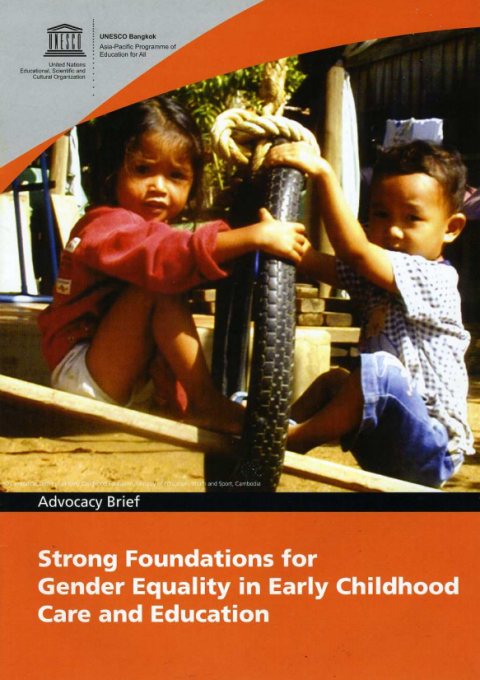 Strong foundations for gender equality in early childhood care and education: advocacy brief Год публикации: 2007 Организация-автор: UNESCO The term Early Childhood Care and Education (ECCE) refers to services for children from birth to eight years of age. These include educating parents in how to care for their children and help them learn, as well as providing community-run and formal preschool programmes for pre-primary school-aged boys and girls. Given the varying needs of children from birth to eight years, educators have found it best to have different policies and strategies for children below and above three years of age. This brief focuses on the gender issues in the services provided for children who are three years of age or older in the Asia-Pacific region. Its scope is informed by UNESCO's commitment to holistic pre-primary services for this age group. The goal is to provide early childhood education that helps girls and boys succeed in primary school and in learning throughout their lives. The brief starts by looking into the growth of ECCE in the Asia-Pacific region and what is driving this growth. It explores why gender responsiveness is important in early childhood education, gives practical examples of what this looks like, and discusses the challenges of providing ECCE that equally values and benefits each girl and each boy. Flowing from this, the brief concludes with recommendations on how to make ECCE more gender responsive De solides fondations pour l'égalité des sexes dans les soins de la petite enfance et de l'éducation: le plaidoyer bref Год публикации: 2007 Организация-автор: Organisation des Nations Unies pour l'éducation, la science et la culture (UNESCO) Le terme de l’éducation et la protection de la petite enfance (EPPE) fait référence aux services pour les enfants de la naissance à huit ans. Ceux-ci incluent l'éducation des parents dans la façon de prendre soin de leurs enfants et de les aider à apprendre, ainsi que de fournir des programmes formels préscolaires gérés par la communauté et pour les garçons et les filles d'âge scolaire pré-primaire. Compte tenu des divers besoins des enfants de la naissance à huit ans, les éducateurs ont trouvé préférable d'avoir des politiques et des stratégies pour les enfants de moins et de plus de trois ans. Ce bref se concentre sur les questions de genre dans les services fournis aux enfants qui sont de trois ans ou plus dans la région Asie-Pacifique. Son champ d'application est informé par l'engagement de l'UNESCO aux services pré-primaires holistiques pour ce groupe d'âge. L'objectif est de fournir une éducation de la petite enfance qui aide les filles et les garçons à réussir à l'école primaire et dans l'apprentissage tout au long de leur vie. Les brèves commence par la recherche dans la croissance de l'EPPE dans la région Asie-Pacifique et ce qui est le moteur de cette croissance. Il explore pourquoi le genre de réaction est important dans l'éducation de la petite enfance, donne des exemples concrets de ce que cela ressemble, et examine les défis de fournir EPPE que de façon égale les valeurs et les avantages de chaque fille et chaque garçon. Découlant de cela, le mémoire se termine par des recommandations sur la façon de rendre sensible EPPE plus le sexe.
  Thinkpiece on education and conflict Год публикации: 2009 Автор: Lynn Davies Организация-автор: UNESCO This paper looks first at the learning sites generally (violent schools, schools as a weapon of war, curriculum and textbooks). It then focuses on specific groups in conflict – gender, language, refugees, child soldiers. Thirdly it discusses education policy and donor intervention; and finally talks of the role of research. All these overlap hugely. This is not a prescription for how the Global Monitoring Report should be structured, but identification of themes and lessons learned that seem the most significant. Pensez pièce sur l'éducation et les conflits Год публикации: 2009 Автор: Lynn Davies Организация-автор: Organisation des Nations Unies pour l'éducation, la science et la culture (UNESCO) Ce document examine d'abord les sites d'apprentissage en général (écoles violentes, les écoles comme une arme de guerre, programmes et manuels). Elle se concentre ensuite sur des groupes spécifiques dans les conflits - le sexe, la langue, les réfugiés, les enfants soldats. Troisièmement, il discute de la politique de l'éducation et de l'intervention des bailleurs de fonds; et, enfin, parle du rôle de la recherche. Tous ces chevauchent énormément. Ce n'est pas une prescription pour la façon dont le rapport Suivi mondial devrait être structuré, mais l'identification des thèmes et des leçons apprises qui semblent les plus importants.
  Contemporary issues in human rights education Год публикации: 2011 Организация-автор: UNESCO The format of this publication presents the main strands concerning the role of human rights education as well as the key elements for its implementation. Each strand addresses current issues and challenges faced when incorporating a culture for human rights, also illustrating the collective importance of human rights education as a fundamental base for a peaceful and just society. Under each strand, a list of examples inspired by country initiatives is proposed. Enjeux contemporains éducation aux droits humains Год публикации: 2011 Организация-автор: Organisation des Nations Unies pour l'éducation, la science et la culture (UNESCO) Le format de cette publication présente les principaux volets concernant le rôle de l'éducation des droits de l'homme ainsi que les éléments clés de sa mise en œuvre. Chaque adresses de brins enjeux et les défis actuels auxquels sont confrontés lors de l'incorporation d'une culture des droits de l'homme, illustrant également l'importance collective de l'éducation aux droits de l'homme comme base fondamentale pour une société juste et pacifique. Sous chaque brin, une liste d'exemples inspirés par des initiatives de pays est proposé.