
Ресурсы
Изучайте широкий спектр ценных ресурсов ВГГ, чтобы углубить своё понимание и повысить эффективность исследований, просветительской деятельности, преподавания и обучения.
Найдено: 3,451
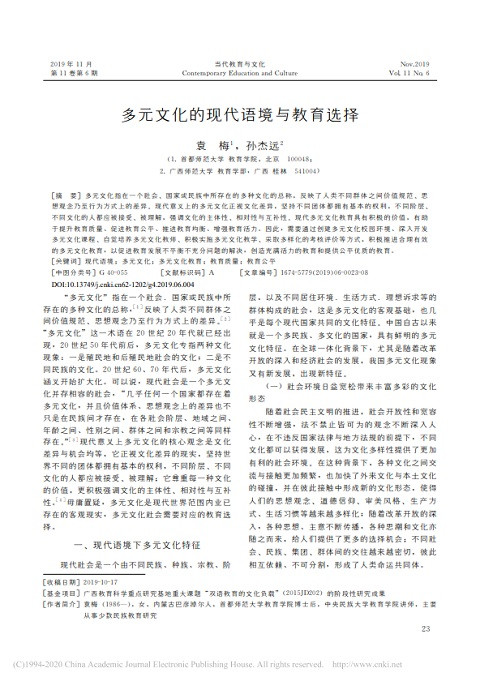 多元文化的现代语境与教育选择 Год публикации: 2019 Автор: Yuanmei | Sun Jieyuan Организация-автор: Contemporary Education and Culture 多元文化指在一个社会、国家或民族中所存在的多种文化的总称,反映了人类不同群体之间价值规范、思 想观念乃至行为方式上的差异。现代意义上的多元文化正视文化差异,坚持不同团体都拥有基本的权利,不 同 阶 层、 不同文化的人都应被接受、被理解,强调文化的主体性、相对性与互补性。现代多元文化教育具有积极的价值,有助 于提升教育质量、促进教育公平、推进教育均衡、增强教育活力。因此,需要通过创建多元文化校园环境、深入开发 多元文化课程、自觉培养多元文化教师、积极实施多元文化教学、采取多样化的考核评价等方式,积极推进合理有效 的多元文化教育,以促进教育发展不平衡不充分问题的解决,创造充满活力的教育和提供公平优质的教育。
 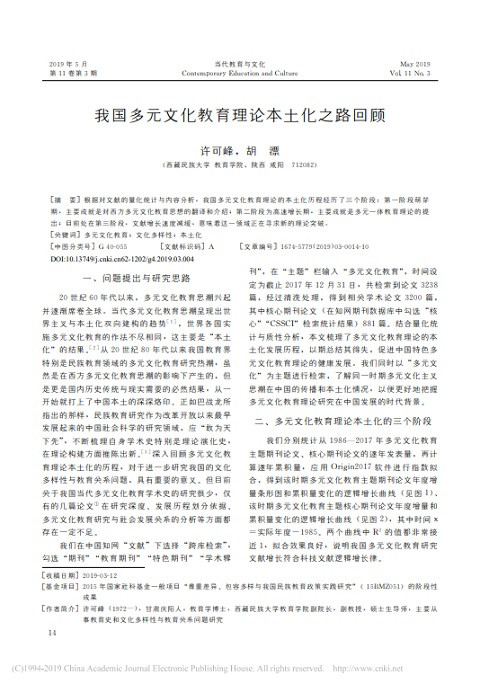 Review on the Localization of Multicultural Education Theory in China Год публикации: 2019 Автор: Xu Kefeng | Hupaio Организация-автор: Contemporary Education and Culture According to the quantitative statistics and content analysis of the literature, the localization of the multicultural education theory in China has gone through three stages: the main achievement is the translation and introduction of the western multicultural education thought; the second stage is the high-speed growth period, the main achievement is the multicultural education theory. At present, it is in the third stage and the growth rate of literature slows down, which means that new theoretical breakthroughs are being sought in this field. 我国多元文化教育理论本土化之路回顾 Год публикации: 2019 Автор: Xu Kefeng | Hupaio Организация-автор: Contemporary Education and Culture 根据对文献的量化统计与内容分析,我国多元文化教育理论的本土化历程经历了三个阶段:第 一 阶 段 萌 芽 期,主要成就是对西方多元文化教育思想的翻译和介绍;第二阶段为高速增长期,主要成就是多元一体教育理论的提 出;目前处在第三阶段,文献增长速度减缓,意味着这一领域正在寻求新的理论突破。
  Fostering national and global citizenship: an example from South Africa (Social Studies and the Young Learner, vol 21, no. 1, september/october 2008) Год публикации: 2008 Автор: Omiunota Nelly Ukpokodu Организация-автор: National Council for the Social Studies Multicultural and global scholars urge that we prepare the young for national and global democratic citizenship given the increasing interdependence and challenging realities for today. Young people desire to be a part of the solution to global problems, but they must be educated about what those problems are and how solutions can be arrived at. As has been seen in the U.S. presidential campaign, young people care about their communities, country, and planet, and they are volunteering and voting at record rates. We must take responsibility to plant the seeds of critical citizenship if we are to foster a more sustainable, peaceful, just, and prosperous world. Educator Sheldon Berman sums it up by writing: It is important for teachers to tell young people about the success stories of others, students who have reclaimed forests, cleaned up rivers, improved their school environment, helped the homeless. They need to hear about the Mother Teresas and the Martin Luther Kings, of course, but also about the people who live down the street who are doing what they can to improve the neighbourhood and about the many organizations that make a difference in our communities. We must put students in touch with these people and organizations so that they can see how deeply people care about their world and how worthwhile it is to participate in creating change.
 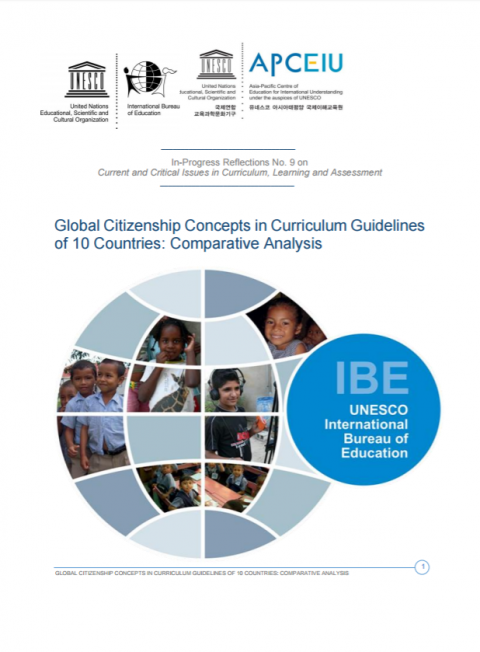 Global Citizenship Concepts in Curriculum Guidelines of 10 Countries: Comparative Analysis Год публикации: 2017 Автор: Cristián Cox Организация-автор: UNESCO International Bureau of Education (IBE) This paper reports on a study of concepts associated with the new construct of global citizenship education (GCED) in school curricula. We compared the national school curricula of ten countries with markedly different cultures and levels of development across different regions of the world (Africa, Asia, Europe, Latin America, and Southeast Asia) on the presence of concepts associated with GCED. The curricula of both primary and secondary education, in the areas of history and social sciences, and civics and moral education, were compared using a set of categories constructed for this study and derived from UNESCO’s definitions of GCED as well as from the International Association for the Evaluation of Educational Achievement’s (IEA) international assessment studies of civic and citizenship education. Patterns of presence/absence of GCED and related content were identified. The main finding is that only two of the ten countries’ curricula consistently included global citizenship concepts. At the same time, all ten countries, to the extent that the analysis distinguished, included content related to knowledge, values and attitudes that have the world or humanity as referent.
 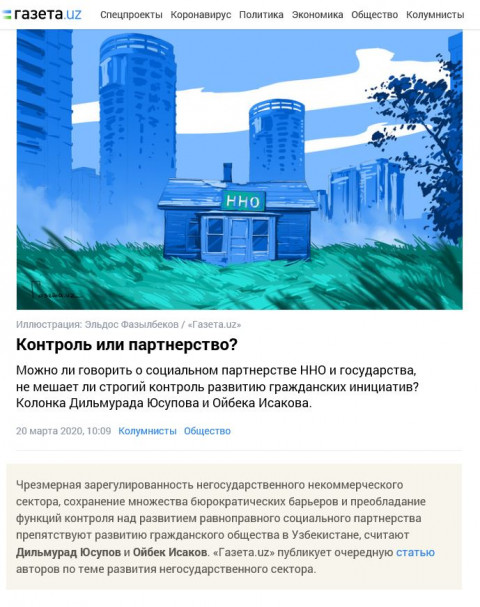 Контроль или партнерство? Год публикации: 2020 Автор: Dilmurod Yusupov | Oybek Isakov Чрезмерная зарегулированность негосударственного некоммерческого сектора, сохранение множества бюрократических барьеров и преобладание функций контроля над развитием равноправного социального партнерства препятствуют развитию гражданского общества в Узбекистане, считают авторы статьи. Control or Partnership? Год публикации: 2020 Автор: Dilmurod Yusupov | Oybek Isakov Excessive regulation of the non-governmental non-profit sector, the preservation of many bureaucratic barriers and the predominance of the functions of control over the development of equal social partnership hinder the development of civil society in Uzbekistan, the authors of the article say.
  Audacious Education Purposes: How Governments Transform the Goals of Education Systems Год публикации: 2020 Автор: Fernando Reimers This open access book offers a comparative study of eight ambitious national reforms that sought to create opportunities for students to gain the necessary breath of skills to thrive in a rapidly changing world. It examines how national governments transform education systems to provide students opportunities to develop such skills. It analyses comprehensive education reforms in Brazil, Finland, Japan, Mexico, Peru, Poland, Portugal and Russia and yields original and important insights on the process of educational change. The analysis of these 21st century skills reforms shows that reformers followed approaches which are based on the five perspectives: cultural, psychological, professional, institutional and political. Most reforms relied on institutional and political perspectives. They highlight the systemic nature of the process of educational change, and the need for alignment and coherence among the various elements of the system in order. They underscore the importance of addressing the interests of various stakeholders of the education system in obtaining the necessary impetus to initiate and sustain change. In contrast, as the book shows, the use of a cultural and psychological frame proved rarer, missing important opportunities to draw on systematic analysis of emerging demands for schools and on cognitive science to inform the changes in the organization of instruction. Drawing on a rich array of sources and evidence the book provides a careful account of how education reform works in practice.
  A Framework to Guide an Education Response to the COVID-19 Pandemic of 2020 Год публикации: 2020 Автор: Fernando Reimers | Andreas Schleicher Организация-автор: Organisation for Economic Co-operation and Development (OECD) This report aims at supporting education decision making to develop and implement effective education responses to the COVID-19 Pandemic. The report explains why the necessary social isolation measures will disrupt school-based education for several months in most countries around the world. Absent an intentional and effective strategy to protect opportunity to learn during this period, this disruption will cause severe learning losses for students.The report proposes that leaders of education systems and organizations develop plans for the continuation of education through alternate modalities, during the period of necessary social isolation. It offers a framework of areas to be covered by such plans. Un cadre pour guider une réponse éducative à la Covid-19 en cas de pandémie de 2020 Год публикации: 2020 Автор: Fernando Reimers | Andreas Schleicher Организация-автор: Organisation for Economic Co-operation and Development (OECD) Ce rapport vise à appuyer la décision de l'éducation faisant de développer et mettre en œuvre des réponses éducatives efficaces au Covid-19 en cas de pandémie. Le rapport explique pourquoi les mesures d'isolement social nécessaires perturberont l'éducation en milieu scolaire pendant plusieurs mois dans la plupart des pays à travers le monde. En l'absence d'une stratégie délibérée et efficace pour protéger l'occasion d'apprendre au cours de cette période, cette perturbation entraîne des pertes sévères d'apprentissage pour les étudiants.Le rapport propose que les dirigeants des systèmes d'éducation et les organisations à élaborer des plans pour la poursuite de l'éducation des modalités alternatives, au cours de la période d'isolement social nécessaire. Il offre un cadre de zones à couvrir par ces plans.