
Ресурсы
Изучайте широкий спектр ценных ресурсов ВГГ, чтобы углубить своё понимание и повысить эффективность исследований, просветительской деятельности, преподавания и обучения.
Найдено: 3,385
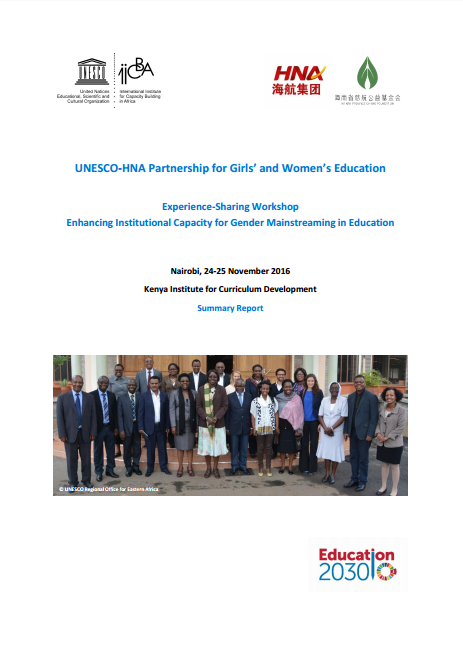 UNESCO-HNA partnership for girls' and women's education: experience-sharing workshop: enhancing institutional capacity for gender mainstreaming in education; summary report Год публикации: 2016 Организация-автор: UNESCO International Institute for Capacity-Building in Africa (IICBA) The first experience-sharing workshop was organised on 24-25 November 2016 in Nairobi, Kenya. The objectives of the workshop were to: v Increase awareness on girls' education activities through South-South interaction. v Exchange experiences and lessons on HFIT project implementation. v Enhance institutional networking and interaction on issues related to girls' education.
  2nd European congress on global education: education, interdependence and solidarity in a changing world; final report Год публикации: 2012 Организация-автор: North-South Centre of the Council of Europe | Global Education Network Europe (GENE) | CONCORD Europe | Portuguese Institute of Cooperation and Language | Portuguese NDGO Platform | University of Lisbon | European Commission The 2nd European Congress on Global Education: Education, Interdependence and Solidarity in a Changing World took place on 27 – 28 September 2012 in Lisbon. It was organised by the North-South Centre of the Council of Europe (NSC) in partnership with Global Education Network Europe (GENE) and CONCORD Europe, in cooperation with the Portuguese Institute of Cooperation and Language - Camões, the Portuguese NDGO Platform and the University of Lisbon and with the financial support of the European Commission. This Congress brought together approximately 200 stakeholders in global education, in particular international organisations, governments, parliamentarians, local and regional authorities, civil society organisations, as well as educators from Europe and beyond, using the principle of “quadrilogue” and a holistic approach to global education. This two-day event built on the efforts of the North-South Centre (NSC) and other stakeholders to promote global education since the Maastricht Congress Declaration (2002) which established a European strategy framework for improving and increasing global education in Europe to the year 2015. Thematic dialogue and exchange of ideas and practices together with a reflection on the political dimension of global education contributed to the formulation of a Lisbon Statement and the revision of the proposed Strategic Recommendations for Strengthening Global Education till 2015. The resume of the thematic dialogues, the Lisbon Statement on Global Education and the Strategic Recommendations represent an integral part of this report. This is also complemented with a short concluding section with follow-up proposals. 2nd European congress on global education: education, interdependence and solidarity in a changing world; final report Год публикации: 2012 Организация-автор: North-South Centre of the Council of Europe | Global Education Network Europe (GENE) | CONCORD Europe | Portuguese Institute of Cooperation and Language | Portuguese NDGO Platform | University of Lisbon | European Commission Ce rapport national sur l'éducation globale en Autriche fait partie du processus d'évaluation intra-européenne Éducation Mondiale, qui a été lancé en 2002 dans le but d'augmenter et d'améliorer l'éducation mondiale dans les États membres du Conseil de l'Europe. Ce rapport est l'aboutissement d'un processus d'examen par les pairs mené par une équipe d'examen international par des pairs. Grâce à la recherche et des entrevues avec des intervenants clés, des informations ont été recueillies et des perspectives critiques développé sur l'état actuel et les perspectives d'avenir pour l'éducation mondiale en Autriche. Ce processus long de l'année, facilitée par le Centre Nord-Sud du Conseil de l'Europe, a été développé en partenariat avec le Groupe Stratégie autrichienne pour l'éducation mondiale comme la contrepartie nationale dans le processus. Il a impliqué le Ministère des Affaires étrangères, le Ministère de l'Education, l'Agence Autrichienne de Développement (AAD), KommEnt, et les ONG et les milieux universitaires. Ce rapport d'évaluation intra reconnaît la relativement forte tradition d'éducation mondiale en Autriche. le soutien autrichien de EM se reflète dans l'éventail des organisations engagées impliquées dans EM, et les nombreuses initiatives et projets dans les secteurs formels et non formels d'éducation, et dans la société civile. Le chapitre 1 ci-dessous fournit une introduction au rapport et le processus général. Le chapitre 2 décrit le contexte de l'éducation mondiale en Autriche. Le chapitre 3 examine l'éducation mondiale dans le secteur de l'éducation formelle. Le chapitre 4 met l'accent sur le travail important et varié qui se déroule dans l'éducation non formelle, les organisations de la société civile et d'autres secteurs dans ce domaine. Le chapitre 5 fournit, de façon sommaire, un aperçu des observations et recommandations de l'examen par les pairs clés. 세계 교육에 관한 제 2차 유럽 의회: 변화하는 세계에서의 교육, 상호 의존 및 연대; 최종 보고서 Год публикации: 2012 Организация-автор: North-South Centre of the Council of Europe | Global Education Network Europe (GENE) | CONCORD Europe | Portuguese Institute of Cooperation and Language | Portuguese NDGO Platform | University of Lisbon | European Commission 오스트리아 글로벌 교육에 관한 이 국가 보고서는 유럽 의회 회원국들의 글로벌 교육을 증진 및 향상시키기 위한 목적으로 2002년에 시작된, 유럽 글로벌 교육의 공동 심의 과정(the European Global Education Peer Review Process)의 일부이다. 이 보고서는 국제 공동 심의 과정 팀에 의해 주도되는 공동 심의 과정의 정점이다. 리서치 및 주요 이해 관계자들과의 인터뷰를 통해서 정보를 수집하고, 오스트리아 글로벌 교육 현황 및 미래 전망에 대한 비판적 시각도 발전시켰다. 유럽 의회 남북 센터가(the North-South Centre of the Council of Europe)가 추진한 이 1년 과정은 현재 진행중인 국가적 대응 사업으로서, 글로벌 교육을 위한 오스트리아 전략 그룹(Austrian Strategy Group for Global Education)과 협력하여 개발되었다. 여기에는 외무부, 교육부, 오스트리아 개발기구(ADA), KommEnt, NGO 및 학계가 포함된다. 이 피어 리뷰 보고서(Peer Review report)에서는 오스트리아 글로벌 교육의 상대적으로 강한 전통을 인지하고 있다. 글로벌 교육(이하 GE)을 위한 오스트리아 국가 서포트와 GE와 관련된 열성적인 조직과 공식 및 비공식적 교육 분야, 시민 사회 내의 다수 이니셔티브 및 프로젝트에 반영이 되어 있다. 다음의 제 1장에서는 보고서와 프로세스 전반에 대한 소개를 제공한다. 제 2장에서는 오스트리아 글로벌 교육의 맥락을 개략적으로 보여준다. 제 3장에서는 정규 교육 부분에서의 글로벌 교육에 대해 살펴본다. 제 4장에서는 비정규 교육, 시민사회 조직 및 다른 부문에서 일어나는 중요하고 다양한 교육 작업에 중점을 둔다. 제 5장에서는 요약 방식으로, 피어 리뷰의 권고안들 및 주요 관찰에 대한 아웃라인을 제공한다.
  Controversial Issues - Teachers' attitudes and practices in the context of citizenship education Год публикации: 2004 Автор: Christopher Oultona | Vanessa Dayb | Justin Dillon | Marcus Graced A survey of the literature suggests that the principles and methods relating to the teaching of controversial issues are themselves controversial. This irony is more relevant to teachers now than ever before. This paper explores the issue of teachers' readiness to use controversial issues in the classroom, and reports on research involving focus groups and questionnaires. We suggest that many teachers are under‐prepared and feel constrained in their ability to handle this aspect of their work. Controversial Issues - Teachers' attitudes and practices in the context of citizenship education Год публикации: 2004 Автор: Christopher Oultona | Vanessa Dayb | Justin Dillon | Marcus Graced Une analyse de la littérature portant sur cette question montre que les principes et les méthodes relatifs à l'enseignement des questions controversées sont eux-mêmes controversés. Cette situation absurde concerne plus que jamais les enseignants. Cet article porte sur la formation des enseignants à l’utilisation des questions controversées dans la salle de classe, et publie les résultats de la recherche effectuée auprès des groupes cibles et par le biais de questionnaire. Il s’avère que de nombreux enseignants sont loin d’être formés et qu’ils ne sont pas prêts à gérer cet aspect de leur travail.
 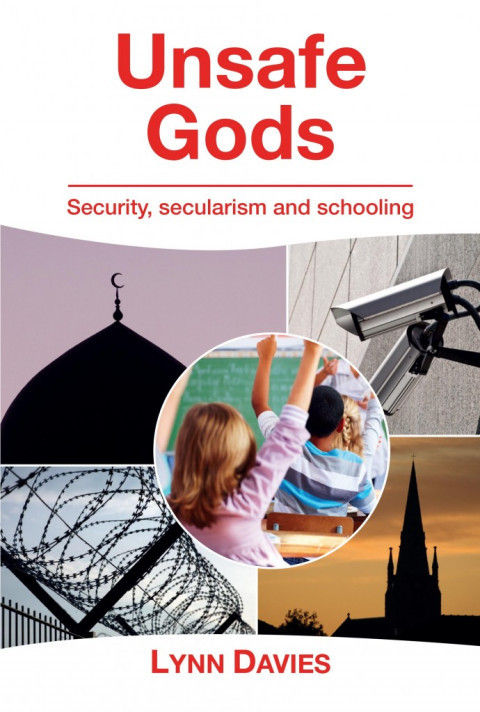 Unsafe Gods: Security, secularism and schooling Год публикации: 2014 Автор: Lynn Davies This book makes the compelling argument that religion can be complicit in conflict and that a new secularism is vital to foster security. Using insights from complexity science, it shows how dynamic secularism can be used to accommodate diverse faiths and beliefs within worldly politics. Exploration of the interplay of religion and education in the context of security and notions of safe schools offers new understandings of how religions learn – or instead remain frozen accidents that hinder societies from adapting to change. The book shows how turbulence and amplification underscore the necessity for an education that is critical even of patriarchal religious texts and that recognizes the power of satire and humour. Unsafe Gods: Security, secularism and schooling Год публикации: 2014 Автор: Lynn Davies Ce livre avance l'idée forte que la religion étant un facteur de conflictualité, une sécularisation plus poussée est vitale pour renforcer la sécurité. En mobilisant une approche inspirée des sciences de la complexité, il montre comment une sécularisation dynamique peut être appliquée à des systèmes politiques du monde entier afin de permettre la cohabitation de plusieurs religions et croyances. L'analyse des effets de l'interaction entre la religion et l'éducation en matière de sécurité et des dispositifs "safe schools" permet de comprendre la façon dont les religions s'adaptent, ou au contraire restent figées, empêchant les sociétés de s’adapter aux changements. Le livre montre que la conflictualité croissante souligne la nécessité de mettre en place une éducation centrée autour d'un regard critique, même à l'égard des textes religieux fondateurs, et qui reconnaisse l'intérêt de la satire et de l'humour. Globalising the school curriculum: gender, EFA and global citizenship education (RECOUP working paper 17) Год публикации: 2008 Автор: Harriet Marshall | Madeleine Arnot Организация-автор: Research Consortium on Educational Outcomes and Poverty (RECOUP) This paper aims to bring the school curriculum into the analysis of gender, education and development. There is a marked absence of discussion both in the academic field of development studies and in the political domain of educational policy making around Education for All about what is required of the school curriculum so that it could help promote gender equality. All too often national school curricula reproduce gender inequalities in the public and private sphere and sustain hegemonic male regimes on a national and global scale (Arnot, 2002). Curriculum research, however, can challenge these social messages embedded in curricular formations as well as raise deeper questions about whose forms of knowledge should be transmitted through official forms of schooling. Critical sociological research, for example, recognises the importance of the rules governing the access and redistribution of knowledge, and also the politics behind the selection, organisation and evaluation of legitimate knowledge through formal national educational institutions within developing economies and the impact these have on indigenous social stratifications. It can also critically assess new global interventions into the school curriculum whether in the name of economic progress, human rights or social justice. These global developments are controversial not least because of the challenge they represent to what has been considered the prerogative of national governments – to transmit its own selection of educational knowledge to its citizens, using its own contextualised pedagogic style. The study of national curricula therefore offers the possibility of exploring the equity dimensions of global–national and local educational interfaces and policy agendas. The paper has limited but hopefully valuable ambitions. It aims to initiate discussion of the curriculum in relation to gender, education and development by exploring the global significance of recent interventions on gender, and in particular girls’ education. The first section briefly considers the implications of globalisation as a transformative process on the development of educational knowledge and queries whether the school curricula could address persistent worldwide gender disparities, inequalities and female subjugation. In the second section, we focus specifically on whether new global declarations around gender equality such as those analysed in the UNESCO Education for All Global Monitoring Reports imply certain roles for the school curriculum. The final section addresses the possibilities for gender equality implied by recent interest global citizenship education – a new curriculum subject and approach that promises much. We consider in a preliminary way whether these new developments represent a move towards forms of educational knowledge that are critical rather than legitimating and ‘normalising’ in relation to gender inequalities. Mondialiser le programme scolaire: le sexe, l'EPT et L'éducation à la Citoyenneté Mondiale (ECM) (papier de travail 17) Год публикации: 2008 Автор: Harriet Marshall | Madeleine Arnot Организация-автор: Research Consortium on Educational Outcomes and Poverty (RECOUP) Ce document vise à amener le programme scolaire dans l'analyse de genre, l'éducation et le développement. Il y a une absence marquée de la discussion à la fois dans le domaine académique des études de développement et dans le domaine politique de la politique en matière d'éducation autour de l'éducation pour tous à propos de ce qui est requis du programme scolaire afin qu'il puisse aider à promouvoir l'égalité des sexes. Tous les programmes scolaires nationaux trop souvent reproduisent les inégalités entre les sexes dans le domaine public et privé et de soutenir les régimes de sexe masculin hégémonique à l'échelle nationale et mondiale (Arnot, 2002). la recherche des programmes, cependant, ne peut contester ces messages sociaux intégrés dans les formations scolaires ainsi que soulever des questions plus profondes sur dont les formes de connaissances doivent être transmises par le biais des formulaires officiels de scolarité. recherche sociologique critique, par exemple, reconnaît l'importance des règles régissant l'accès et la redistribution des connaissances, ainsi que la politique derrière la sélection, l'organisation et l'évaluation des connaissances légitimes par les institutions éducatives nationales officielles dans les économies en développement et de l'impact qu'elles ont sur autochtones stratifications sociales. Il peut également évaluer de façon critique les nouvelles interventions mondiales dans le programme scolaire que ce soit au nom du progrès économique, les droits de l'homme ou de la justice sociale. Ces développements mondiaux sont controversés pas moins à cause du défi qu'ils représentent pour ce qui a été considéré comme la prérogative des gouvernements nationaux - de transmettre sa propre sélection de connaissances sur l'éducation de ses citoyens, en utilisant son propre style pédagogique contextualisée. L'étude des programmes nationaux offre donc la possibilité d'explorer les dimensions d'équité des interfaces éducatives globales nationales et locales et les agendas politiques. Le papier a des ambitions limitées mais nous espérons précieux. Il vise à engager un débat sur le programme d'études en fonction du sexe, de l'éducation et le développement en explorant l'importance mondiale des récentes interventions sur le sexe, et en particulier l'éducation des filles. La première section examine brièvement les implications de la mondialisation comme un processus de transformation sur le développement des connaissances et des requêtes si les programmes scolaires pourraient remédier aux disparités persistantes entre les sexes dans le monde, les inégalités et la subordination des femmes de l'éducation. Dans la deuxième section, nous nous concentrons particulièrement sur le fait de nouvelles déclarations globales autour de l'égalité des sexes, tels que ceux analysés dans UNESCO sur l'Education pour tous rapports globaux Suivi impliquent certains rôles pour le programme scolaire. La dernière section porte sur les possibilités d'égalité entre les sexes impliqués par l'intérêt récent L'éducation à la citoyenneté Mondiale (ECM) - un nouveau sujet de curriculum et de l'approche qui promet beaucoup. Nous considérons de façon préliminaire si ces nouveaux développements représentent une évolution vers des formes de connaissances pédagogiques qui sont essentielles plutôt que légitimant et «normalisation» par rapport aux inégalités entre les sexes.