
Ресурсы
Изучайте широкий спектр ценных ресурсов ВГГ, чтобы углубить своё понимание и повысить эффективность исследований, просветительской деятельности, преподавания и обучения.
Найдено: 2,661
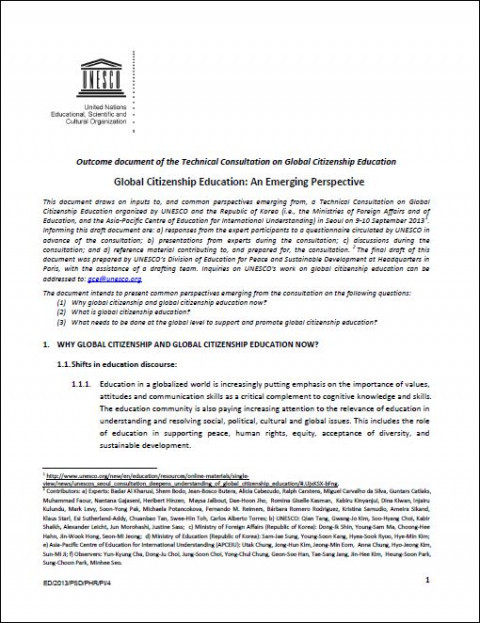 Document final de la Consultation technique sur l’éducation à la citoyenneté mondiale: Éducation à la citoyenneté mondiale : Une nouvelle vision Год публикации: 2013 Организация-автор: UNESCO Le présent document s’inspire des contributions et des perspectives communes issues d’une Consultation technique sur l’éducation à la citoyenneté mondiale organisée par l’UNESCO et la République de Corée (à savoir, par les ministères des Affaires étrangères et de l’Éducation et le Centre Asie-Pacifique d'éducation pour la compréhension internationale) à Séoul, les 9 et 10 septembre 20131. Ce projet de document s’appuie sur : (a) les réponses des experts participants à un questionnaire envoyé par l’UNESCO avant la consultation ; (b) les présentations des experts durant la consultation; (c) les débats qui ont eu lieu pendant la consultation ; et sur (d) les documents de référence préparés pour la consultation. Le projet final du présent document a été préparé par la Division de l'éducation pour la paix et le développement durable, au Siège de l’UNESCO, à Paris, avec le soutien d’une équipe de rédaction. Documento Final de la Consulta técnica Sobre Educación para la Ciudadanía Mundial - Educación para la Ciudadanía Mundial: una Perspectiva Emergente Год публикации: 2013 Организация-автор: Organización de las Naciones Unidas para la Educación, la Ciencia y la Cultura (UNESCO) En el presente documento se toman como base los aportes y las perspectivas comunes que surgen de la consulta técnica sobre la educación para la ciudadanía mundial, organizada por la UNESCO y la República de Corea (los Ministerios de Relaciones Exteriores y de Educación y el Centro de Asia y el Pacífico de Educación para el Entendimiento Internacional) en Seúl los días 9 y 10 de septiembre de 2013.A lo largo de la elaboración del borrador de este documento se utilizaron: a) las respuestas de expertos a un cuestionario circulado por la UNESCO previo a la consulta; b) las ponencias realizadas por los expertos durante la consulta; c) las discusiones que se efectuaron durante la consulta; y d) el material de referencia que respaldó y fue preparado para la consulta. El borrador final del presente documento fue preparado por la División de la Educación para la Paz y el Desarrollo Sostenible en la sede de la UNESCO en París, con la asistencia de un equipo de redacción. En este documento se presentan las perspectivas comunes que emanaron de la consulta.
  Study on measures taken by municipalities and recommendations for further action to achieve greater vigilance against racism: Commitment 1 of the Ten-Point Plan of Action Год публикации: 2006 Автор: Klaus Starl Организация-автор: UNESCO | European Training and Research Centre for Human Rights and Democracy (Austria) Commitment 1 of the Ten-Point Plan of Action of the European Coalition of Cities against Racism requires ‘Greater Vigilance against Racism’. This point aims at setting up a monitoring, vigilance and solidarity network against racism at the municipal level. To reach this goal, the members of the coalition are called to undertake activities, elaborate strategies and establish relevant institutions to monitor the local situation concerning structures in society, attitudes within the population and racist incidents. They are called to find out causes for racist tendencies among their population and establish solidarity networks involving all stakeholders, particularly civil society organisations. As an external expert, the European Training and Research Centre for Human Rights and Democracy in Graz, Austria, (ETC Graz) was commissioned by UNESCO to carry out a study on the measures already taken against racism at the local level that serve as good illustration of ‘Commitment 1’. Major information resource was the written material provided by the selected cities. Through direct exchange and/or interviews with responsible officers of the municipalities and some NGOs, additional or missing information could be obtained. The material is not to be considered as complete. On the basis of the contribution sent in by the participating cities, the ETC made an assessment whether these actions/activities meet the objective of the Commitment 1. The authors used the following criteria to make this assessment: does the action undertaken contribute to a) creating and promoting vigilance directly; b) creating and promoting vigilance indirectly through awareness raising; c) creating and promoting vigilance through a monitoring measure or d) the establishment and maintenance of a solidarity network. The authors presumed that c) and d) will lead directly to greater vigilance. The following recommendations are derived from the eight selected measures documented in Chapter II, and the analysis on their replicability in Chapter III. The 10 recommendations expicitly or implicitly refer to the replicable documented measures. Where the replicability requires specific conditions, these are stated or it is recommended to fulfil these conditions firstly, i.e. structural and institutional conditions. The 10 recommendations are addressed to municipalities in Europe irrespective of their current membership in the European Coalition of Cities against Racism. As already mentioned the recommendations focus on meeting the requirement of Commitment 1, creating greater vigilance against racism.
  Recommendation concerning Education for International Understanding, Cooperation and Peace and Education Relating to Human Rights and Fundamental Freedoms, adopted by the General Conferences at its 18th session, Paris, 19 November 1974 Год публикации: 1974 Организация-автор: UNESCO Following is the authentic text of the Recommendation duly adopted by the General Conference of the United Nations Educational, Scientific and Cultural Organization during its eighteenth session, which was held in Paris and declared closed the twenty-third day of November 1974. The General Conference recommends that Member States should submit to provisions as follows: to apply the following provisions by taking whatever legislative or other steps may be required in conformity with the Constitutional practice of each State to give effect within their respective territories to the principles set forth in this recommendation; to bring this recommendation to the attention of the authorities, departments or bodies responsible for school education, higher education and out-of-school education, of the various organizations carrying out educational work among young people and adults such as student and youth movements, associations of pupils’ parents, teachers’ unions and other interested parties; to submit to it, by dates and in the form to be decided upon by the Conference, reports concerning the action taken by them in pursuance of this recommendation. Recommendation concerning Education for International Understanding, Cooperation and Peace and Education Relating to Human Rights and Fundamental Freedoms, adopted by the General Conferences at its 18th session, Paris, 19 November 1974 Год публикации: 1974 Организация-автор: UNESCO Voici le texte authentique de la recommandation dûment adoptée par la Conférence générale de l'Organisation des Nations Unies pour l'éducation, la science et la culture lors de sa dix-huitième session, qui a eu lieu à Paris et déclarée close le vingt-troisième jour de Novembre 1974. La Conférence générale recommande que les États membres devraient se soumettre à des dispositions comme suit: pour appliquer les dispositions suivantes en prenant toutes les dispositions législatives ou autres en conformité avec la pratique constitutionnelle de chaque Etat pour donner effet dans leurs territoires respectifs aux principes énoncés dans la présente recommandation; de porter cette recommandation à l'attention des autorités, des services ou organismes responsables de l'enseignement scolaire, l'enseignement supérieur et de l'éducation hors de l'école, des diverses organisations exerçant une action éducative auprès des jeunes et des adultes tels que les étudiants et les mouvements de jeunesse, les associations des des parents, des enseignants des élèves les syndicats et les autres parties intéressées; de lui présenter, aux dates et sous la forme d'être décidée par la Conférence, des rapports concernant les mesures prises par eux en application de cette recommandation.Recommandation sur l'Education Pour la compréhension, la coopération et la paix et l'éducation relatives aux Droits de l'homme et des libertés Fondamentales, ADOPTÉE par les Conférences générales Le LORs de sa 18e session, Paris, le 19 Novembre 1974 1974년 11월 19일, 파리 제 18차 총회에서 채택된 인권과 기본적 자유, 국제 이해와 협력 및 평화에 관한 교육을 위한 권고안 Год публикации: 1974 Организация-автор: 유네스코 다음은 1974년 11월 파리에서 열리고 같은 달 23일에 폐회된, 제 18차 유엔 교육, 과학과 문화, 교육 기구 총회에서 정식 채택된 권고안의 실제 텍스트이다. 총회는 회원국이 다음과 같은 규정을 준수할 것을 권고한다. 즉, 해당 결의안에 명시된 원칙에 해당하는 지역들 내에서 효과를 얻기 위해 각 국가의 실제 헌법에 부합하며, 입법 혹은 다른 어떤 단계에 따라 본 권고안을 준수할 것을 권고한다. 또한, 이 권고안은 ‘학부모, 교사’ 협회와 기타 이해 관계자들 연합, 그리고 학생과 청소년 운동 단체와 같은 성인 및 젊은이들 사이에서 교육 사업을 수행하는 다양한 조직, 학교 교육과 고등 교육, 학교 밖 교육을 위한 책임 기관 또는 관련 부서들의 주의를 필요로 한다. 아울러 유엔 총회에서 본 권고안이 결정된 형식과 그 날짜로부터 실질적으로 이를 수행한 내용 및 그 조치에 관한 보고서를 제출한다. Declaração e Plano de Ação Integrado sobre a Educação para a Paz, os Direitos Humanos e a Democracia Год публикации: 1995 Организация-автор: UNESCO This document is Declaration of the 44th session of the International Conference on Education (Geneva, October 1994) endorsed by the General Conference Declaration of the 44th session of the International Conference on Education (Geneva, October 1994) endorsed by the General Conference of UNESCO at its twenty-eight session Paris, November 1995 of UNESCO at its twenty-eight session Paris, November 1995. إعلان وإطار العمل المتكامل بشأن التربية من أجل السلام وحقوق الإنسان والديمقراطية Год публикации: 1995 Организация-автор: UNESCO This document is Declaration of the 44th session of the International Conference on Education (Geneva, October 1994) endorsed by the General Conference Declaration of the 44th session of the International Conference on Education (Geneva, October 1994) endorsed by the General Conference of UNESCO at its twenty-eight session Paris, November 1995 of UNESCO at its twenty-eight session Paris, November 1995.
  UNESCO and Education Год публикации: 2017 Организация-автор: UNESCO Education is a fundamental human right and
a public good and, as such, has been at the core of UNESCO’s work since its inception.Education is also the path to sustainability – to poverty alleviation, better health, environmental protection and gender equality.As the only United Nations agency with a mandate to cover all aspects of education, UNESCO was entrusted in 2015 to lead the coordination and monitoring of Sustainable Development Goal 4, as part of the new Global Education 2030 Agenda.Goal 4 aims to “ensure inclusive and equitable quality education and promote lifelong learning opportunities for all,” and renewed UNESCO’s and Member States’ commitment to a vision of education that is holistic, inspirational and which leaves no one behind.This commitment is reflected in the size and scope of the Education Sector, the largest in UNESCO, with staff working at its Paris Headquarters and spread across a global network of field offices and specialized institutes and centres. With its close links with education ministries and other partners, UNESCO is strongly placed to press for action and change.UNESCO’s Education Sector supports Member States in developing education systems that foster high-quality and inclusive lifelong learning for all, empowering learners to be creative and responsible global citizens while leading the debate to help shape the future international education agenda.There is no stronger, no more lasting, investment a country can make than educating its citizens. The Education Sector exists to further this collective vision worldwide by transforming lives one by one. L'UNESCO et l'éducation Год публикации: 2017 Организация-автор: UNESCO Education is a fundamental human right and
a public good and, as such, has been at the core of UNESCO’s work since its inception.Education is also the path to sustainability – to poverty alleviation, better health, environmental protection and gender equality.As the only United Nations agency with a mandate to cover all aspects of education, UNESCO was entrusted in 2015 to lead the coordination and monitoring of Sustainable Development Goal 4, as part of the new Global Education 2030 Agenda.Goal 4 aims to “ensure inclusive and equitable quality education and promote lifelong learning opportunities for all,” and renewed UNESCO’s and Member States’ commitment to a vision of education that is holistic, inspirational and which leaves no one behind.This commitment is reflected in the size and scope of the Education Sector, the largest in UNESCO, with staff working at its Paris Headquarters and spread across a global network of field offices and specialized institutes and centres. With its close links with education ministries and other partners, UNESCO is strongly placed to press for action and change.UNESCO’s Education Sector supports Member States in developing education systems that foster high-quality and inclusive lifelong learning for all, empowering learners to be creative and responsible global citizens while leading the debate to help shape the future international education agenda.There is no stronger, no more lasting, investment a country can make than educating its citizens. The Education Sector exists to further this collective vision worldwide by transforming lives one by one.
UNESCO and Education Год публикации: 2017 Организация-автор: UNESCO Education is a fundamental human right and
a public good and, as such, has been at the core of UNESCO’s work since its inception.Education is also the path to sustainability – to poverty alleviation, better health, environmental protection and gender equality.As the only United Nations agency with a mandate to cover all aspects of education, UNESCO was entrusted in 2015 to lead the coordination and monitoring of Sustainable Development Goal 4, as part of the new Global Education 2030 Agenda.Goal 4 aims to “ensure inclusive and equitable quality education and promote lifelong learning opportunities for all,” and renewed UNESCO’s and Member States’ commitment to a vision of education that is holistic, inspirational and which leaves no one behind.This commitment is reflected in the size and scope of the Education Sector, the largest in UNESCO, with staff working at its Paris Headquarters and spread across a global network of field offices and specialized institutes and centres. With its close links with education ministries and other partners, UNESCO is strongly placed to press for action and change.UNESCO’s Education Sector supports Member States in developing education systems that foster high-quality and inclusive lifelong learning for all, empowering learners to be creative and responsible global citizens while leading the debate to help shape the future international education agenda.There is no stronger, no more lasting, investment a country can make than educating its citizens. The Education Sector exists to further this collective vision worldwide by transforming lives one by one. L'UNESCO et l'éducation Год публикации: 2017 Организация-автор: UNESCO Education is a fundamental human right and
a public good and, as such, has been at the core of UNESCO’s work since its inception.Education is also the path to sustainability – to poverty alleviation, better health, environmental protection and gender equality.As the only United Nations agency with a mandate to cover all aspects of education, UNESCO was entrusted in 2015 to lead the coordination and monitoring of Sustainable Development Goal 4, as part of the new Global Education 2030 Agenda.Goal 4 aims to “ensure inclusive and equitable quality education and promote lifelong learning opportunities for all,” and renewed UNESCO’s and Member States’ commitment to a vision of education that is holistic, inspirational and which leaves no one behind.This commitment is reflected in the size and scope of the Education Sector, the largest in UNESCO, with staff working at its Paris Headquarters and spread across a global network of field offices and specialized institutes and centres. With its close links with education ministries and other partners, UNESCO is strongly placed to press for action and change.UNESCO’s Education Sector supports Member States in developing education systems that foster high-quality and inclusive lifelong learning for all, empowering learners to be creative and responsible global citizens while leading the debate to help shape the future international education agenda.There is no stronger, no more lasting, investment a country can make than educating its citizens. The Education Sector exists to further this collective vision worldwide by transforming lives one by one.