
Ресурсы
Изучайте широкий спектр ценных ресурсов ВГГ, чтобы углубить своё понимание и повысить эффективность исследований, просветительской деятельности, преподавания и обучения.
Найдено: 3,451
 Strengthening the Rule of Law Through Education: A Guide for Policymakers Год публикации: 2019 Организация-автор: UN. Office on Drugs and Crime (UNODC) | UNESCO The new joint publication by UNESCO and UNODC Strengthening the Rule of Law through Education: A Guide for Policymakers explores the role that education institutions can play in promoting the rule of law and building new forms of engagement based on global citizenship, human rights and inclusion -- all of which are vital to take forward the Sustainable Development Goal 4 on education, at the heart of the 2030 Agenda for Sustainable Development. Strengthening the Rule of Law through Education: A Guide for Policymakers is intended for education policymakers and other professionals working in the formal education sector, within and outside Ministries of Education, and who are seeking to promote the rule of law and a culture of lawfulness.The guide may also be of interest to professionals working in non-formal education settings or other sectors – namely the justice, social and health sectors - in the area of crime and violence prevention, who are seeking to work more closely with the education sector. In particular, the guide offers:An explanation of key concepts, such as the rule of law and a culture of lawfulness, as well as outlining the role of education in upholding and promoting the rule of law; Guidance on how the education sector is able to strengthen and promote the rule of law, for instance, by speaking to the real learning needs of children and youth, and by ensuring that places of learning “practice what they preach”; A map of the necessary support systems needed to strengthen the rule of law at the school and classroom levels and outside formal education settings, including curricular support, classroom pedagogies, teacher training and development and school-family-community partnerships. Fortalecimiento del estado de derecho mediante la educación: guía para los encargados de la formulación de políticas Год публикации: 2019 Организация-автор: UN. Office on Drugs and Crime (UNODC) | Organización de las Naciones Unidas para la Educación, la Ciencia y la Cultura (UNESCO) La nueva publicación conjunta de la UNESCO y la Oficina de las Naciones Unidas contra la Droga y el Delito (UNODC): Fortalecimiento del estado de derecho mediante la educación: guía para los encargados de la formulación de políticas, explora el rol que pueden jugar las instituciones educativas en la promoción del estado de derecho y en la creación de nuevas formas de participación basadas en ciudadanía global, derechos humanos e inclusión – cuestiones que son vitales para promocionar el 4to Objetivo sobre educación para el Desarrollo Sostenible, en el corazón de la Agenda 2030 para el Desarrollo Sostenible. Fortalecimiento del estado de derecho mediante la educación: guía para los encargados de la formulación de políticas, está dirigido a los creadores de políticas educativas y a otros profesionales que trabajan en el sector formal de educación, dentro o fuera de los Ministerios de Educación, y que estén procurando promocionar el estado de derecho y la cultura de la legalidad.La guía también puede ser de interés para profesionales trabajando en contextos educativos no formales y otros sectores – como ser en los sectores sociales, de justicia o de salud – en las áreas de prevención de violencia y crimen, que estén buscando trabajar más cerca al área educativa. En particular, la guía ofrece: Una explicación de conceptos claves, como ser la cultura de derecho o la cultura de la legalidad, a la vez que detalla el rol de la educación en sostener y promover el estado de derecho;Orientaciones sobre cómo el sector educativo es capaz de fortalecer y promocionar el estado de derecho, por ejemplo, abordando las necesidades reales de niños y jóvenes, y asegurándose que los lugares de enseñanza “practican lo que predicen”;Un mapa de los sistemas de soporte necesarios para fortalecer el estado de derecho en la escuela, a nivel del aula y fuera de los contextos de educación formal, incluyendo soporte curricular, pedagogía de aula, desarrollo y capacitación docente y asociaciones entre la escuela, la familia y la comunidad. تعزيز سيادة القانون عن طريق التعليم: دليل لواضعي السياسات Год публикации: 2019 Организация-автор: UN. Office on Drugs and Crime (UNODC) | منظمة الأمم المتحدة للتربية والعلم والثقافة (UNESCO) لمنشور المشترك الجديد لليونسكو ومكتب الأمم المتحدة المعني بالمخدرات والجريمة بعنوان "تعزيز سيادة القانون من خلال التعليم: دليل لواضعي السياسات" يستكشف الدور الذي يمكن أن تلعبه المؤسسات التعليمية في تعزيز سيادة القانون وبناء أشكال جديدة من المشاركة على أساس المواطنة العالمية وحقوق الإنسان والإدماج - - جميعها حيوية للمضي قدمًا في تحقيق الهدف 4 من أهداف التنمية المستدامة بشأن التعليم ، في صميم خطة التنمية المستدامة لعام 2030.تعزيز سيادة القانون من خلال التعليم: دليل صانعي السياسات موجه لواضعي السياسات التعليمية وغيرهم من المهنيين العاملين في قطاع التعليم الرسمي ، داخل وزارات التعليم وخارجها ، والذين يسعون إلى تعزيز سيادة القانون وثقافة احترام القانون.قد يكون الدليل مفيدًا أيضًا للمهنيين العاملين في أماكن التعليم غير النظامي أو القطاعات الأخرى - وبالتحديد قطاعات العدالة والاجتماعية والصحية - في مجال منع الجريمة والعنف ، الذين يسعون إلى العمل بشكل أوثق مع قطاع التعليم.
 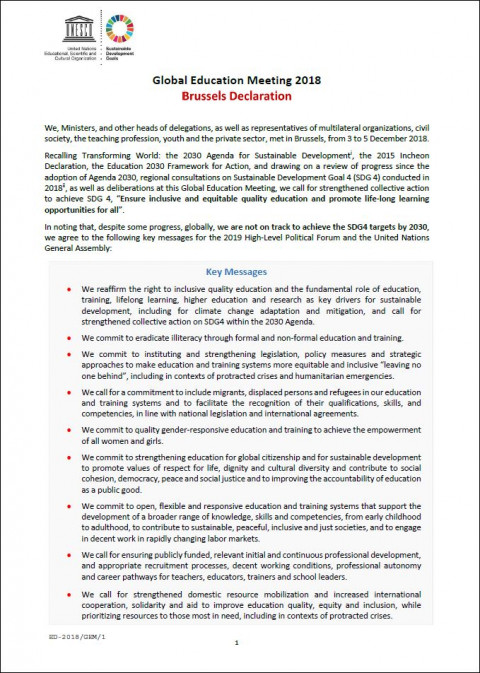 Global Education Meeting 2018: Brussels Declaration Год публикации: 2018 Организация-автор: UNESCO Ministers, and other heads of delegations, as well as representatives of multilateral organizations, civil society, the teaching profession, youth and the private sector, met in Brussels, from 3 to 5 December 2018. This document describes key messsages and commitments for the 2019 High-Level Political Forum and the United Nations General Assembly.
  The Intersections Between Education, Migration and Displacement are not gender-neutral (Global Education The Intersections between Education, Migration and Displacement Monitoring Report, 2019) Год публикации: 2019 Организация-автор: UNESCO The 2019 Global Education Monitoring Report emphasized the need to include migrants and refugees in national education systems, and also called for more planning to respond to the needs of these populations. As this short review has outlined, many of these needs have gender dimensions. These range from the vulnerability of rural‑to‑urban migrant girls who end up as domestic workers deprived of education opportunities to the vulnerability of refugee boys, often unaccompanied, who have limited opportunities to develop their skills. They encompass the deskilling of international migrant women in the ‘global care chain’ as well as the increasing chore burden that left‑behind girls face when a parent migrates.Still, research on the experiences of girls and women or boys and men in migration and displacement contexts – and how these can be affected by education – remains limited. More analysis on the intersection of gender, education, migration and displacement is needed on a wide variety of issues, including the gender-specific dimensions of remittance use, gender-responsive teaching practices and the empowerment impact of non-formal education opportunities. To fulfil their potential for instilling resilience, education systems need to recognize these needs and respond to them. Las intersecciones entre educación, migración y desplazamiento no son género-neutrales (Informe de Seguimiento de la Educación en el Mundo, 2019) Год публикации: 2019 Организация-автор: Organización de las Naciones Unidas para la Educación, la Ciencia y la Cultura (UNESCO) El Informe de Seguimiento de la Educación en el Mundo de 2019 enfatizaba la necesidad de incluir a migrantes y refugiados en los sistemas educativos mundiales, y también marcaba la necesidad de aumentar las planificaciones que busquen dar respuestas a las necesidades de estas poblaciones. Como desarrolla este corto informe, muchas de estas necesidades tienen dimensiones vinculadas al género. Estas van desde las vulnerabilidades de niñas migrantes de contextos tanto rurales como urbanos que terminan como trabajadoras domésticas siendo privadas de oportunidades educativas, hasta las vulnerabilidades de niños varones refugiados, muchas veces sin acompañantes, que tienen limitadas oportunidades de desarrollar sus habilidades. Ellas abarcan tanto la falta de cualificación de las mujeres migrantes en la ‘cadena global de cuidado’ como el incremento de la carga de trabajos que recae sobre niñas que han sido dejadas de lado cuando el padre o la madre migra. Más allá de esto, investigaciones sobre las experiencias de mujeres y niñas o de hombres y niños en contextos de migración y desplazamiento – y cómo estos pueden ser afectados por la educación – continúan siendo limitadas. Es preciso ahondar en el análisis de la intersección entre género, educación, migración y desplazamiento en una gran variedad de asuntos, incluyendo las dimensiones género-específicas de uso de remesas, repuestas a prácticas educativas en base a género y el impacto que tienen sobre el empoderamiento las oportunidades de educación no formal. Para cumplir con el potencial de instalar resiliencia, los sistemas educativos precisan reconocer todas estas necesidades y responder a ellas.
  Preventing Violent Extremism through Education: Effective Activities and Impact; Policy Brief Год публикации: 2018 Организация-автор: UNESCO Since 2015, UNESCO has driven forward the importance of education in preventing violent extremism (PVE-E) in the framework of its efforts to advance Global Citizenship Education (GCED). Despite the growing number of PVE-E activities globally, there is a lack of evidence on their effectiveness and impact.This Policy Brief seeks to provide answers to two questions: (i) What types of PVE-E activities tend to be more effective in having impact? and (ii) What is the proven impact of PVE-E activities?The aim is to help education stakeholders undertake programmes with stronger positive impact and take evidenced-informed decisions on spending priorities.The Policy Brief shows that PVE-E does work, highlighting various kinds of activities proven to be particularly effective, and recommending ways forward to develop stronger evidence on what works and does not. La Prévention de l’extrémisme violent par l’éducation: activités efficaces et impact; note d’orientation Год публикации: 2018 Организация-автор: Organisation des Nations Unies pour l'éducation, la science et la culture (UNESCO) Depuis 2015, l’UNESCO a mis en avant l’importance de l’éducation dans la prévention de l’extrémisme violent (PEV-E), dans le cadre de ses efforts pour faire progresser l’éducation à la citoyenneté mondiale (ECM). Malgré le nombre croissant d’activités de PEV-E à travers le monde, il manque des preuves de leur efficacité et leur impact.Ce document d’orientation a pour objectif de répondre à deux questions : (i) Quels types d’activités de PEV-E paraissent plus efficaces ? et (ii) Quel est l’impact prouvé des activités de PEV-E ?L’objectif est d’aider les acteurs de l’éducation à entreprendre des programmes ayant un plus grand impact et à prendre des décisions éclairées sur les priorités en matière de dépenses.Le document d’orientation montre que la PEV-E fonctionne, mettant en évidence divers types d’activités qui se sont avérées particulièrement efficaces. Il recommande enfin des actions à entreprendre pour obtenir davantage de preuves sur ce qui fonctionne ou pas.
 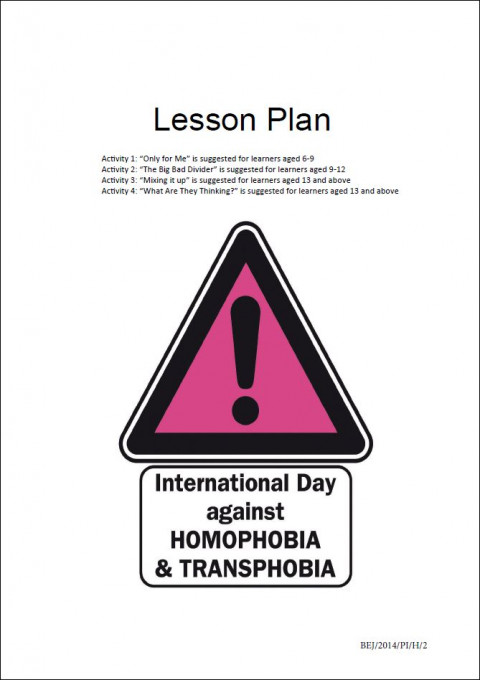 International Day against Homophobia & Transphobia: Lesson Plan Год публикации: 2014 Организация-автор: UNESCO Each year, the world celebrates the International Day Against Homophobia and Transphobia (IDAHO) on May 17th. During the days surrounding IDAHO, private and public actors, ranging from the United Nations agencies, to city councils, police stations, human rights organiza-tions, individual citizens, schools and others, implement activities to mark the day. The theme of this year’s IDAHO is “Fighting homophobia and transphobia IN and THROUGH education”. This theme was selected in response to a growing awareness that homophobic and transphobic bullying in schools which are manifestations of homophobia and transphobia, are serious issues that students and educational staff face every day across the world.Over the years, teachers around the world have been developing activities in their classrooms, with the help of various organizations working on efforts to address and homophobia and transphobia in educational institutions. Building on the success of these experiences, UNESCO and the IDAHO Committee propose teachers take advantage of the International Day Against Homophobia and Transphobia to conduct an ‘IDAHO Lesson’. The four activities proposed below are aimed at both primary and secondary level classes. A list of resources from other organizations for teachers, for all subjects and all grades is included below to enable greater choice of possible activities. By conducting an “IDAHO Lesson”, you can create safer learning environments, address discrimination and encourage respect and tolerance between and amongst learners.(Title: International Day against Homophobia and Transphobia: Lesson Plan) Combattre l’homophobie et la transphobie : Propositions pédagogiques Год публикации: 2014 Организация-автор: Organisation des Nations Unies pour l'éducation, la science et la culture (UNESCO) Le présent programme pédagogique a été élaboré à l’occasion de l’IDAHO 2012, autour du thème « Combattre l’homophobie et la transphobie DANS et PAR l’éducation », en réponse à la prise de conscience que le harcèlement homophobe ou transphobe dans les écoles sont des manifestations de l’homophobie et de la transphobie auxquelles étudiants et membres du corps enseignant du monde entier doivent faire face au quotidien. Un problème sérieux qui ne peut être ignoré.Diverses études démontrent que le harcèlement homophobe ou transphobe peut avoir de graves répercussions sur la santé physique et mentale des jeunes gens et jeunes filles qui le subissent à un moment crucial de leur vie. Le harcèlement homophobe peut entraîner une baisse des performances d’apprentissage, voire, parfois, le décrochage scolaire. Les jeunes personnes lesbiennes, gays, bisexuelles, transgenres ou intersexes (LGBTI) victimes de harcèlement homophobe sont plus enclines à l’automutilation, et on dénombre parmi cette population beaucoup plus de cas de suicide que chez les autres jeunes. Les recherches révèlent aussi que les jeunes LGBTI ont tendance à adopter des comportements à haut risque tels que les rapports sexuels non protégés et la consommation de stupéfiants.