
Ресурсы
Изучайте широкий спектр ценных ресурсов ВГГ, чтобы углубить своё понимание и повысить эффективность исследований, просветительской деятельности, преподавания и обучения.
Найдено: 3,385
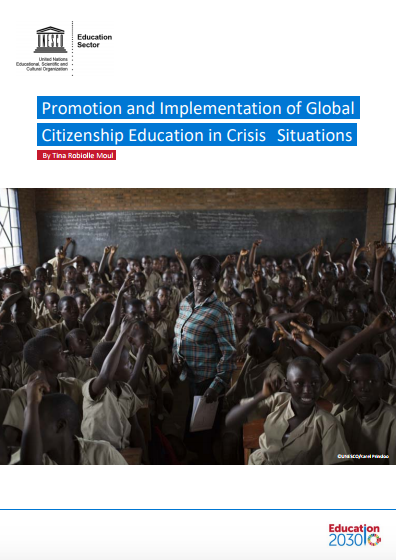 Promotion and implementation of global citizenship education in crisis situations Год публикации: 2017 Автор: Robiolle Moul, Tina Организация-автор: Organisation des Nations Unies pour l'éducation, la science et la culture (UNESCO) Crisis situations affect the realization of human rights of many people and communities across all regions of the world. Within UNESCO’s relevant areas of work, GCED is a powerful approach to education that can empower people to recover from crises and transform their communities into peaceful and sustainable societies. UNESCO commissioned a desk study that aimed at reviewing existing research on the promotion and implementation of GCED and related programs in countries affected by crisis situations, with particular attention to initiatives benefiting the refugee population. This study unveils the key challenges these programs encounter in such contexts, as well as promising practices that can guide the design and implementation of future GCED in crisis situations. This report is a synthesis of this desk study and supports the evidence that, after analyzing the context and the available means, GCED and related programs can and should be systematically adapted and implemented in crisis situations, including in response to refugee crises.
  Lifelong learning from a social justice perspective Год публикации: 2017 Автор: Carlos Vargas Организация-автор: UNESCO Over the past two decades, a set of globally converging discourses on lifelong learning (LLL) has emerged around the world. Driven mostly by inter-governmental organizations, these discourses have been largely embraced by national and local education systems seeking to reflect local traditions and priorities. This paper argues that these discourses tend to look remarkably alike, converging into a homogeneous rationale in which the economic dimension of education predominates over other dimensions of learning, and in which adaptation takes pre-eminence over social transformation as a goal of LLL. It also shows how these converging discourses are embedded in the logic of the knowledge economy, driven by concern for human capital formation as dictated by the changing demands of the global labour market, and can neglect the learning needs and interests of local communities. The paper concludes that the globally converging discourse of LLL tends to serve the interests of the market ahead of those of the community, and argues that an alternative characterization of LLL, anchored in social justice, is necessary in the light of the 2030 Agenda for Sustainable Development, and especially Sustainable Development Goal 4, which aims to ensure inclusive and equitable quality education and to promote lifelong learning opportunities for all.
  Repensar l'educacio: vers un bé comú mundial? Год публикации: 2015 Организация-автор: UNESCO The changes in the world today are characterized by new levels of complexity and contradiction. These changes generate tensions for which education is expected to prepare individuals and communities by giving them the capability to adapt and to respond. This publication contributes to rethinking education and learning in this context. It builds on one of UNESCO’s main tasks as a global observatory of social transformation with the objective of stimulating public policy debate. It is a call for dialogue among all stakeholders. It is inspired by a humanistic vision of education and development, based on respect for life and human dignity, equal rights, social justice, cultural diversity, international solidarity, and shared responsibility for a sustainable future. These are the fundamentals of our common humanity. This book enhances the vision provided by the two landmark UNESCO publications: Learning to Be: The world of education today and tomorrow (1972), the ‘Faure Report’, and Learning: The treasure within (1996), the ‘Delors Report’.
 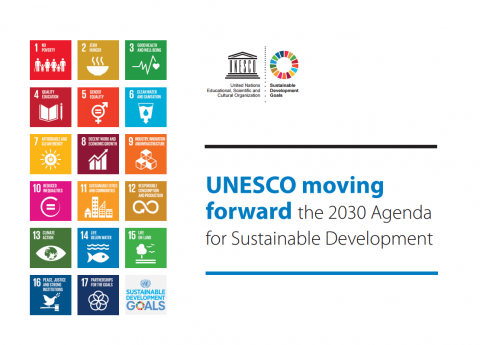 La UNESCO avanza la Agenda 2030 para el Desarrollo Sostenible Год публикации: 2017 Организация-автор: Organización de las Naciones Unidas para la Educación, la Ciencia y la Cultura (UNESCO) The United Nations 2030 Agenda for Sustainable Development, with its 17 Sustainable Development Goals, sets forth a bold new framework for development cooperation over the next 15 years. This agenda aspires to ensure prosperity and well-being for all women and men, while protecting our planet and strengthening the foundations for peace. ЮНЕСКО: работа по осуществлению Повестки дня в области устойчивого развития на период до 2030 г. Год публикации: 2017 Организация-автор: Организация Объединенных Наций по вопросам образования, науки и культуры (UNESCO) The United Nations 2030 Agenda for Sustainable Development, with its 17 Sustainable Development Goals, sets forth a bold new framework for development cooperation over the next 15 years. This agenda aspires to ensure prosperity and well-being for all women and men, while protecting our planet and strengthening the foundations for peace. 教科文组织助力 《2030年可持续发展议程》 Год публикации: 2017 Организация-автор: 联合国教科文组织 (UNESCO) The United Nations 2030 Agenda for Sustainable Development, with its 17 Sustainable Development Goals, sets forth a bold new framework for development cooperation over the next 15 years. This agenda aspires to ensure prosperity and well-being for all women and men, while protecting our planet and strengthening the foundations for peace.
  المياه والسلام من أجل الناس: حلول ممكنة للنزاعات المائية في الشرق الأوسط Год публикации: 2008 Организация-автор: منظمة الأمم المتحدة للتربية والعلم والثقافة (UNESCO) This book proposes practical and objective solutions to the entrenched water conflicts in the Middle East. The author reveals and clarifies the complexity of the water conflicts, drawing on years of experience facilitating and chairing water negotiations in the region. The bottom line is: Unless the countries involved co-operate, the consequences will be devastating. The lack of plentiful and clean water for the people will not only result in severe human suffering, but could also have grave geopolitical consequences.
  Intégrer l'ODD 4-Education 2030 dans les politiques et la planification sectorielles: directives techniques à l'intention des bureaux hors Siège de l'UNESCO Год публикации: 2016 Организация-автор: Organisation des Nations Unies pour l'éducation, la science et la culture (UNESCO) Mainstreaming SDG4-Education 2030 in sector-wide policy and planning offers technical guidelines for UNESCO field offices to ensure adequate technical support to national authorities. The guidelines take into account the different profiles of countries’ need and capacities, thus avoiding a one-size-fits-all approach. The document contains resources and pointers that can be combined and tailored to fit the particular context of each country. In all cases, UNESCO is expected to ensure that all the relevant information about SDG4-Education 2030 is properly disseminated in these guidelines. Field staff will adapt the guidelines provided here to the country they are serving to ensure that UNESCO plays its role as the leading United Nations agency in the field. Integración del ODS 4-Educación 2030 en la formulación de políticas y planeamiento para todo el sector: directrices técnicas para las oficinas de la UNESCO fuera de la Sede Год публикации: 2016 Организация-автор: Organización de las Naciones Unidas para la Educación, la Ciencia y la Cultura (UNESCO) Mainstreaming SDG4-Education 2030 in sector-wide policy and planning offers technical guidelines for UNESCO field offices to ensure adequate technical support to national authorities. The guidelines take into account the different profiles of countries’ need and capacities, thus avoiding a one-size-fits-all approach. The document contains resources and pointers that can be combined and tailored to fit the particular context of each country. In all cases, UNESCO is expected to ensure that all the relevant information about SDG4-Education 2030 is properly disseminated in these guidelines. Field staff will adapt the guidelines provided here to the country they are serving to ensure that UNESCO plays its role as the leading United Nations agency in the field.
 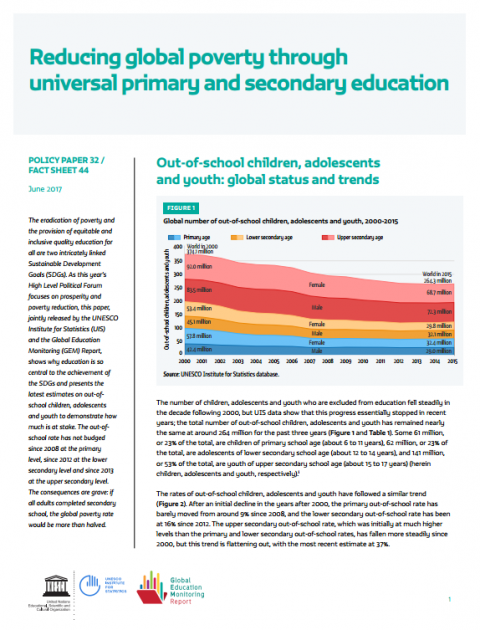 Reducing global poverty through universal primary and secondary education Год публикации: 2017 Организация-автор: UNESCO The eradication of poverty and the provision of equitable and inclusive quality education for all are two intricately linked Sustainable Development Goals (SDGs). As this year’s High Level Political Forum focuses on prosperity and poverty reduction, this paper, jointly released by the UNESCO Institute for Statistics (UIS) and the Global Education Monitoring (GEM) Report, shows why education is so central to the achievement of the SDGs and presents the latest estimates on out-ofschool children, adolescents and youth to demonstrate how much is at stake. The out-ofschool rate has not budged since 2008 at the primary level, since 2012 at the lower secondary level and since 2013 at the upper secondary level. The consequences are grave: if all adults completed secondary school, the global poverty rate would be more than halved.