
Ресурсы
Изучайте широкий спектр ценных ресурсов ВГГ, чтобы углубить своё понимание и повысить эффективность исследований, просветительской деятельности, преподавания и обучения.
Найдено: 3,385
 L’éducation transforme la vie Год публикации: 2017 Организация-автор: Organisation des Nations Unies pour l'éducation, la science et la culture (UNESCO) Grâce au nouveau Programme audacieux de développement durable entériné par la communauté internationale en septembre 2015, le monde s’est fixé pour objectif d’éradiquer la pauvreté à l’horizon 2030 à travers 17 Objectifs de développement durable (ODD). Ces objectifs ambitieux ont été adoptés à l’unanimité par les 193 États membres de l’Organisation des Nations Unies. C’est à ces derniers qu’incombe en premier lieu la responsabilité de les réaliser. L’éducation, cruciale pour atteindre l’ensemble des ODD, bénéficie d’un objectif dédié, l’ODD 4, visant à « assurer l’accès de tous à une éducation de qualité, sur un pied d’égalité, et promouvoir les possibilités d’apprentissage tout au long de la vie ».L’UNESCO est la seule agence des Nations Unies chargée de tous les aspects de l’éducation et possède également un réseau mondial d’instituts et de bureaux spécialisés. C’est pourquoi elle s’est vue confier la direction et la coordination de cet objectif, aux côtés de ses partenaires, par le biais de l’agenda Éducation 2030.
  SDG-Education 2030 Steering Committee: Terms of Reference Год публикации: 2016 Организация-автор: 联合国教科文组织 (UNESCO) This paper is the terms of reference of the SDG-Education 2030 Steering Committee.
 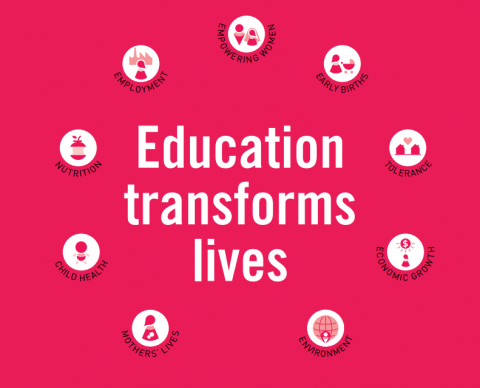 Education Transforms Lives Год публикации: 2013 Организация-автор: UNESCO Education lights every stage of the journey to a better life, especially for the poor and the most vulnerable. Education’s unique power to act as a catalyst for wider development goals can only be fully realized, however, if it is equitable. That means making special efforts to ensure that all children and young people – regardless of their family income, where they live, their gender, their ethnicity, whether they are disabled – can benefit equally from its transformative power. Education empowers girls and young women, in particular, by increasing their chances of getting jobs, staying healthy and participating fully in society – and it boosts their children’s chances of leading healthy lives. To unlock the wider benefits of education, all children need the chance to complete not only primary school but also lower secondary school. And access to schooling is not enough on its own: education needs to be of good quality so that children actually learn. Given education’s transformative power, it needs to be a central part of any post-2015 global development framework. L'Education transforme nos existences Год публикации: 2013 Организация-автор: Organisation des Nations Unies pour l'éducation, la science et la culture (UNESCO) Education lights every stage of the journey to a better life, especially for the poor and the most vulnerable. Education’s unique power to act as a catalyst for wider development goals can only be fully realized, however, if it is equitable. That means making special efforts to ensure that all children and young people – regardless of their family income, where they live, their gender, their ethnicity, whether they are disabled – can benefit equally from its transformative power. Education empowers girls and young women, in particular, by increasing their chances of getting jobs, staying healthy and participating fully in society – and it boosts their children’s chances of leading healthy lives. To unlock the wider benefits of education, all children need the chance to complete not only primary school but also lower secondary school. And access to schooling is not enough on its own: education needs to be of good quality so that children actually learn. Given education’s transformative power, it needs to be a central part of any post-2015 global development framework. La Educación transforma la vida Год публикации: 2013 Организация-автор: Organización de las Naciones Unidas para la Educación, la Ciencia y la Cultura (UNESCO) Education lights every stage of the journey to a better life, especially for the poor and the most vulnerable. Education’s unique power to act as a catalyst for wider development goals can only be fully realized, however, if it is equitable. That means making special efforts to ensure that all children and young people – regardless of their family income, where they live, their gender, their ethnicity, whether they are disabled – can benefit equally from its transformative power. Education empowers girls and young women, in particular, by increasing their chances of getting jobs, staying healthy and participating fully in society – and it boosts their children’s chances of leading healthy lives. To unlock the wider benefits of education, all children need the chance to complete not only primary school but also lower secondary school. And access to schooling is not enough on its own: education needs to be of good quality so that children actually learn. Given education’s transformative power, it needs to be a central part of any post-2015 global development framework.
  反思教育:向 “全球共同利益” 的理念转变? Год публикации: 2015 Организация-автор: 联合国教科文组织 (UNESCO) 当今世界的错综复杂和矛盾冲突,达到了前所未有的程度。这些变化引发了紧张不安,人们寄希望于教育能够培养个人和社会掌握适应变化并做出反应的能力。本出版物有助于在这一背景下反思教育与学习。本书立足于教科文组织作为全球社会变革观测站的主要任务,目的是促进公共政策辩论。本书呼吁所有利益攸关方开展对话。这是一部在人文主义教育观和发展观的启迪下完成的作品,以尊重生命和人类尊严、权利平等、社会正义、文化多样性、国际团结和为创造可持续的未来承担共同责任为基础,而这些正是人性的基本共同点。本书彰显了教科文组织具有里程碑意义的两部出版物提出的愿景——《学会生存:教育世界的今天和明天》(《富尔报告》,1972年)和《学习:内在的财富》(《德洛尔报告》,1996年)。
  다시 생각하는 교육: 교육은 전지구적 공동재를 향해 가고 있는가? Год публикации: 2018 Организация-автор: 유네스코 유네스코 아시아태평양 국제이해교육원은 유네스코와 공동으로 『다시 생각하는 교육: 교육은 전지구적 공동재를 향해 가고 있는가? (Rethinking Education: Towards a global common good?)』의 한국어판을 발간하였다. 본 한국어판은 영어 포함 13번째로 출간된 번역본이다.이 책은 새로운 전 지구적 학습 환경이 부상하는 가운데 교육의 목적이 무엇인지, 그리고 학습을 어떻게 조직할 것인지에 대해 다시 생각해야 한다고 강조하고 있다. 교육과 발전에 대한 인본주의적 비전에 영감을 받아 발간된 이 책은 복잡한 세계에서 집단적 사회 공동행동의 일환으로 학습목표와 학습조직 간의 조화를 이룩해내기 위해서는 교육과 지식을 전 지구적 공동재로 보아야 한다고 제안한다.
  Repenser l'éducation: vers un bien commun mondial? Год публикации: 2015 Организация-автор: Organisation des Nations Unies pour l'éducation, la science et la culture (UNESCO) The changes in the world today are characterized by new levels of complexity and contradiction. These changes generate tensions for which education is expected to prepare individuals and communities by giving them the capability to adapt and to respond. This publication contributes to rethinking education and learning in this context. It builds on one of UNESCO’s main tasks as a global observatory of social transformation with the objective of stimulating public policy debate. It is a call for dialogue among all stakeholders. It is inspired by a humanistic vision of education and development, based on respect for life and human dignity, equal rights, social justice, cultural diversity, international solidarity, and shared responsibility for a sustainable future. These are the fundamentals of our common humanity. This book enhances the vision provided by the two landmark UNESCO publications: Learning to Be: The world of education today and tomorrow (1972), the ‘Faure Report’, and Learning: The treasure within (1996), the ‘Delors Report’.
  Education à la citoyenneté mondiale: thèmes et objectifs d'apprentissage Год публикации: 2015 Организация-автор: Organisation des Nations Unies pour l'éducation, la science et la culture (UNESCO) This publication, titled Global Citizenship Education: Topics and learning objectives, is the first pedagogical guidance from UNESCO on global citizenship education. It is the result of an extensive research and consultation process with experts from different parts of the world. This guidance draws on the UNESCO publication Global Citizenship Education: Preparing learners for the challenges of the 21st century and the outcomes of three key UNESCO events on global citizenship education: the Technical Consultation on Global Citizenship Education (September 2013), as well as the First and Second UNESCO Fora on Global Citizenship Education, organized in December 2013 and January 2015 respectively. Before it was finalized, the guidance was field-tested by education stakeholders in selected countries in all regions to ensure its relevance in different geographical and socio-cultural contexts. Following the foundational work of UNESCO to clarify the conceptual underpinnings of global citizenship education and provide policy and programmatic directions, this document has been developed in response to the needs of Member States for overall guidance on integrating global citizenship education in their education systems. It presents suggestions for translating global citizenship education concepts into practical and age-specific topics and learning objectives in a way that allows for adaptation to local contexts. It is intended as a resource for educators, curriculum developers, trainers as well as policy-makers, but it will also be useful for other education stakeholders working in non-formal and informal settings.
  [Summary] Accountability in Education: Meeting Our Commitments: Global Education Monitoring Report Summary, 2017/8 Год публикации: 2017 Организация-автор: UNESCO This summary of the 2017/8 GEM Report shows the entire array of approaches to accountability in education. It ranges from countries unused to the concept, where violations of the right to education go unchallenged, to countries where accountability has become an end in itself instead of a means to inclusive, equitable and high-quality education and lifelong learning for all.The report emphasizes that education is a shared responsibility. While governments have primary responsibility, all actors – schools, teachers, parents, students, international organizations, private sector providers, civil society and the media – have a role in improving education systems. The report emphasizes the importance of transparency and availability of information but urges caution in how data are used. It makes the case for avoiding accountability systems with a disproportionate focus on narrowly defined results and punitive sanctions. In an era of multiple accountability tools, the report provides clear evidence on those that are working and those that are not.